Published 9 October 2026 | News | The Kopi Notes
The results are in. Singapore’s latest 6-month Treasury Bill auction closed on 8 October 2026 with a cut-off yield of 1.90% per annum — and on the same day, MAS officially confirmed the November 2026 Singapore Savings Bond (SSB) rates. This editorial gives you the complete picture: what the T-bill result means, what the SSB is offering, and how every major cash instrument stacks up right now.
T-Bill Auction Result: October 8, 2026
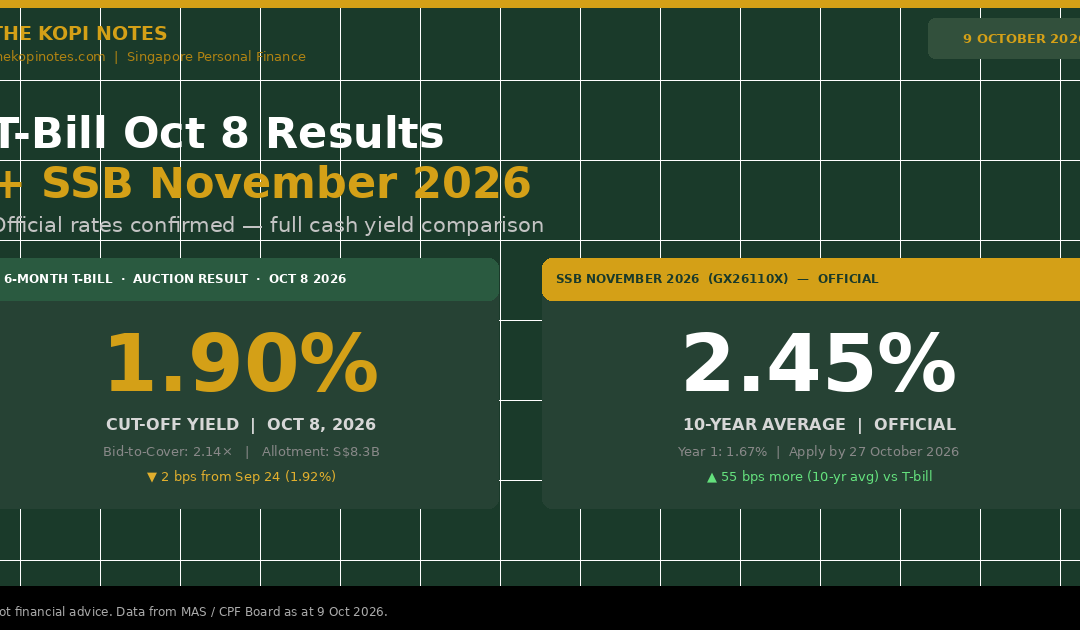
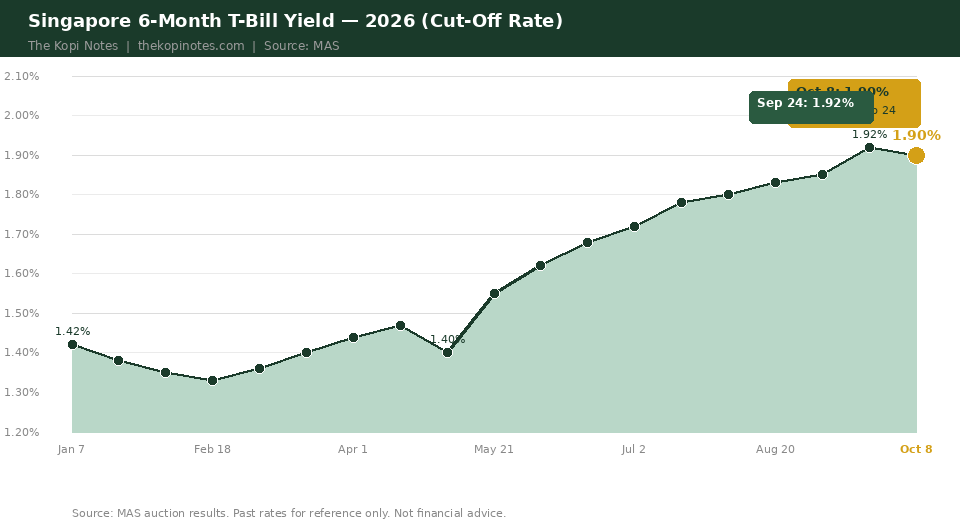
The 6-month T-bill auction on 8 October 2026 printed a cut-off yield of 1.90% per annum. Here are the key numbers:
- Cut-off yield: 1.90% p.a.
- Change from previous auction (Sep 24): ▼ 2 basis points (from 1.92%)
- Total bids received: S$17.76 billion
- Amount allotted: S$8.3 billion
- Bid-to-cover ratio: 2.14×
A bid-to-cover of 2.14× means demand for T-bills continues to be healthy — investors are still submitting more than double the amount available. The 2 bps dip from September’s 1.92% is modest, continuing a gentle downward drift we’ve seen over recent auctions after the yield peaked in the 1.90–1.92% range through the third quarter of 2026.
The 2026 Yield Trend in Context
Cast your mind back to January 2026: the 6-month T-bill was yielding just 1.38–1.42%. Yields rose steadily through the first half of 2026 — reaching the mid-1.60s by June, then climbing further to the 1.80s–1.90s in the second half. The October 8 result of 1.90% sits near the peak of this cycle, though the slight pullback from 1.92% suggests the market may be approaching a plateau.
For context, the 6-month T-bill has yielded more than the SSB’s Year 1 rate for most of the second half of 2026. But the November SSB’s 10-year average is now comfortably above the T-bill — which changes the calculus for longer-horizon savers.
SSB November 2026 (GX26110X): Official Rates Confirmed
MAS has officially confirmed the rates for the November 2026 Singapore Savings Bond, bond code GX26110X. These are not projections — they are the locked-in rates:
- Year 1 interest rate: 1.67% p.a.
- 10-year average yield: 2.45% p.a.
- Application deadline: 27 October 2026, 9pm
- Minimum investment: S$500 (multiples of S$500)
- Maximum per person: S$200,000 (subject to lifetime cap)
- Redemption: Any month with no penalty, interest paid to date
The step-up structure is the SSB’s core feature. You earn 1.67% in Year 1, with the rate gradually stepping up each year such that if you hold all 10 years, your average annual return is 2.45%. In practical terms: the longer you hold, the more you earn — and because you can redeem at any time with zero penalty (interest paid up to the last full month), you’re never locked in.
The November 2026 SSB is one of the better offers this year. The 2.45% 10-year average compares very favourably to the current T-bill, and the no-lock-in flexibility puts it in a different category from fixed deposits. The S$2 transaction fee per application is the only “cost” — a small administrative charge.
The Full Singapore Cash Yield Comparison
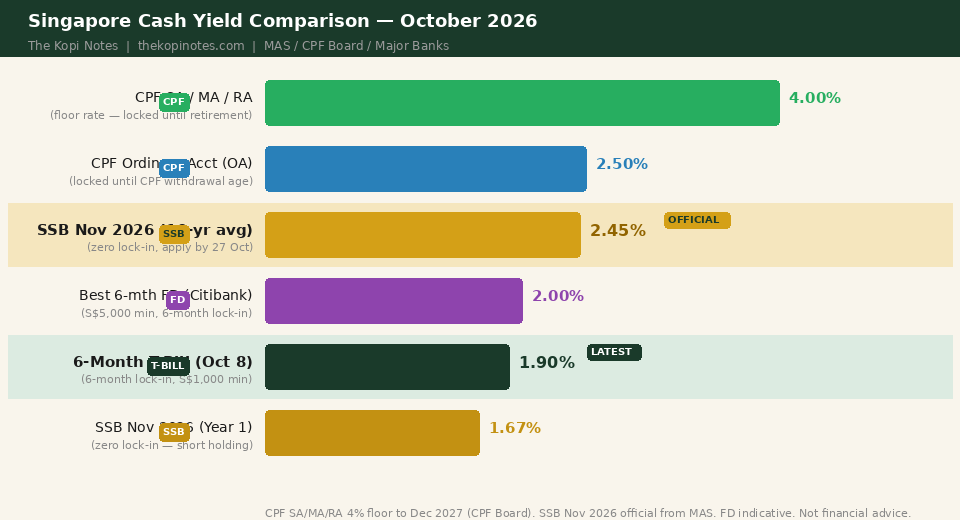
Here is how all the major cash instruments compare as of October 2026, from highest to lowest accessible yield:
CPF Rates: Still the Highest, But Not Accessible Cash
CPF SA / MA / RA: 4.00% p.a. (floor guaranteed to at least December 2027 per CPF Board). These earn the highest rates but are retirement accounts — you cannot freely withdraw them as accessible cash before the applicable ages. They serve a fundamentally different purpose from T-bills and SSBs.
CPF OA: 2.50% p.a. (plus an additional 1% on the first S$20,000 of combined balances). OA monies can be used for housing, education, and eventually retirement — but again, not liquid in the way a T-bill or savings bond is.
CPF’s rates are exceptional, but they are for retirement and specific permitted uses, not for your accessible emergency fund or medium-term cash holdings.
SSB November 2026: The Standout for Flexible Longer-Term Savers
At 2.45% 10-year average with zero lock-in, the November SSB is the most compelling option for money you might not need for one to three years. Here is how it plays out across different holding periods:
- Hold only 1 year: You earn 1.67% — below the T-bill’s 1.90%, but with full flexibility to exit without penalty.
- Hold 2–3 years: The step-up rates kick in, bringing your average well above the T-bill and competitive with FDs.
- Hold all 10 years: 2.45% average — beating every accessible option outside of CPF.
The no-penalty redemption is the standout feature. You can redeem next month if rates rise sharply. You can leave it for a decade if they stay low. No bank, no T-bill, and no FD offers this combination of yield and optionality.
Fixed Deposits: Competitive in the Short Run
The best 6-month FD rates as at early October 2026 are around 2.00% p.a. (Citibank, subject to conditions including a minimum S$5,000 deposit and new funds requirement). Some banks offer slightly more for longer tenors or larger amounts. FDs are fully locked — breaking early typically forfeits all or most of the interest earned.
For a 6-month horizon and if you can meet the minimum deposit and new-funds conditions, FDs are currently competitive with T-bills. The trade-off is the loss of flexibility compared to SSBs.
T-Bills: Efficient for 6-Month Short-Term Cash
At 1.90%, the October 8 T-bill is solid for a 6-month horizon, though it now sits just below the best FD rates. Key advantages include its government backing, a rate locked in at auction, and eligibility for SRS and CPF-OA investment. The limitation is a fixed 6-month tenor with no early redemption.
One important note: T-bill yields are determined competitively at auction. If you submit a non-competitive bid, you receive the cut-off yield (1.90% in this case). If you submit a competitive bid above the cut-off, your application is not allotted.
A Simple Decision Framework
This is not financial advice. Please consult a licensed financial adviser before making investment decisions based on your personal circumstances.
Here is a straightforward time-horizon framework:
- Money needed within 6 months: T-bill (1.90%) or a high-yield savings account. The SSB Year 1 rate of 1.67% is lower, though you can still exit with accrued interest at no penalty.
- Money you can lock away for 6 months: Best 6-month FD at around 2.00% edges out the T-bill for those who meet the conditions.
- Money you might not need for 1–3+ years: SSB November 2026 is the clear standout — 2.45% average with no lock-in gives you optionality that FDs and T-bills simply cannot match.
- Retirement savings: Maximise CPF contributions and voluntary top-ups — nothing in the accessible market beats the CPF SA rate of 4%.
Key Dates to Note
- SSB November 2026 application closes: 27 October 2026, 9pm (via DBS/POSB, OCBC, UOB internet banking or ATM)
- Next 6-month T-bill auction: Approximately late October / early November 2026 (check MAS website for exact schedule)
- SSB December 2026 rates: To be announced by MAS in early November 2026
Bottom Line
The October 8 T-bill result of 1.90% confirms that short-term yields remain healthy in Singapore, though the slight dip from 1.92% suggests we may be near the near-term ceiling for this cycle. For those with a longer time horizon, the November 2026 SSB at 2.45% (10-year average) with zero lock-in is genuinely compelling — particularly if you are sitting on accessible cash that you are not certain when you will need.
The Singapore savings landscape in October 2026 rewards careful thinking about time horizons. Do not simply auto-roll T-bills or leave cash sitting in a standard savings account earning 0.05% — compare your options, consider your liquidity needs, and allocate accordingly.
Data sources: MAS T-bill auction results (8 October 2026), MAS Singapore Savings Bond official announcement (GX26110X), CPF Board interest rate announcement. All rates as at 9 October 2026. This article is for general informational purposes only and does not constitute financial advice.
This article was researched with the help of AI. While we strive to keep all information accurate and up to date, there may be errors. If you notice any discrepancies, please contact us.