DBS posted a record SGD 3.08 billion second-quarter net profit on 6 August 2026, up 9% year-on-year, as quarterly total income crossed SGD 6 billion for the first time and Wealth AUM passed SGD 500 billion. Here’s what the results mean for Singapore’s dividend and bank-stock investors.
This is an editorial analysis. Not financial advice. Data verified as at 6 August 2026 against DBS Group’s official newsroom release and CPF Board’s official interest rate announcement.
What Happened: DBS Posts Record Q2, Total Income Tops S$6 Billion
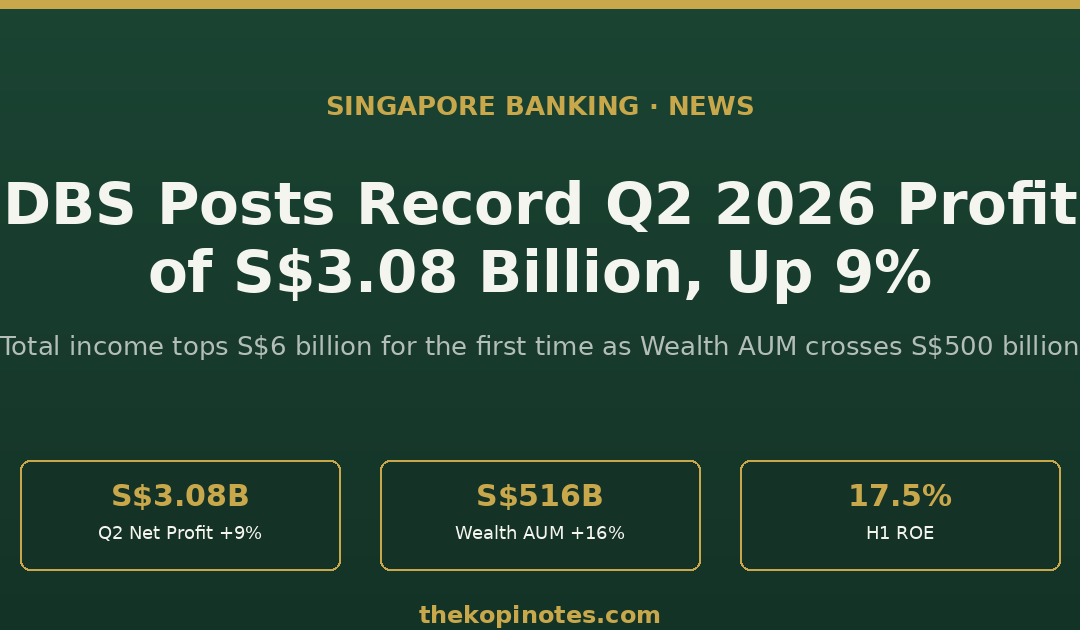
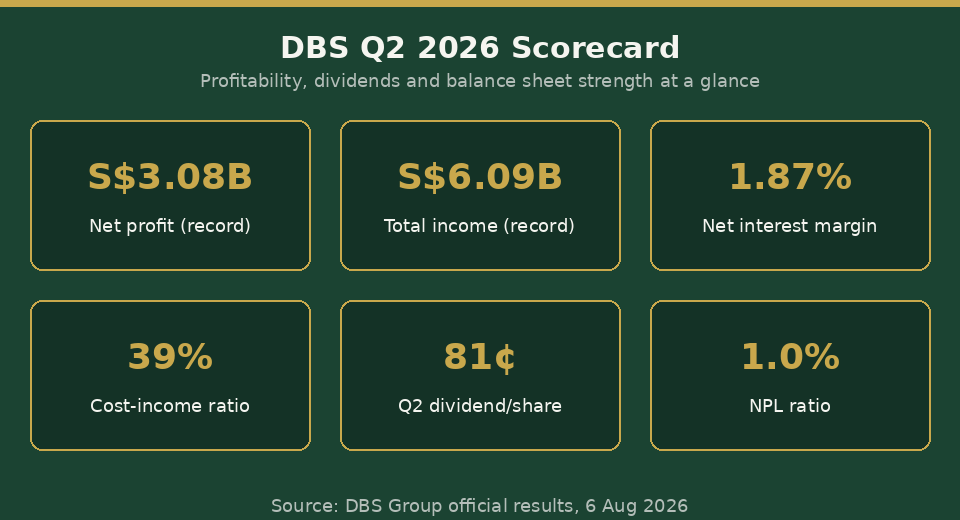
DBS Group announced its second-quarter and first-half 2026 results after market close on 6 August 2026, and the headline numbers were the strongest in the bank’s history. Second-quarter net profit hit a record SGD 3.08 billion, up 9% from a year earlier, while total income rose 6% to SGD 6.09 billion — the first time DBS has crossed the S$6 billion mark in a single quarter. Compared to the previous quarter, total income rose 2% and net profit rose 5%.
For the first half of 2026, total income climbed 3% to a new high of SGD 12.0 billion, and net profit rose 5% to SGD 6.01 billion. Return on equity for the half came in at 17.5%, with return on tangible equity at 19.2%. The cost-income ratio held steady at 39% for both the quarter and the half.
What this means for SG retail investors: DBS is Singapore’s largest bank by market cap and a core holding in most local dividend and STI ETF portfolios. A record profit quarter, delivered despite a falling-rate environment, suggests the bank’s fee-generating businesses are doing the heavy lifting that net interest income used to do. If you’re comparing bank stocks after last week’s pullback from record highs, our deep dive on DBS, OCBC and UOB’s 1H 2026 rally and pullback is a useful companion read.
Where the Growth Came From: Wealth Management Crosses Half a Trillion
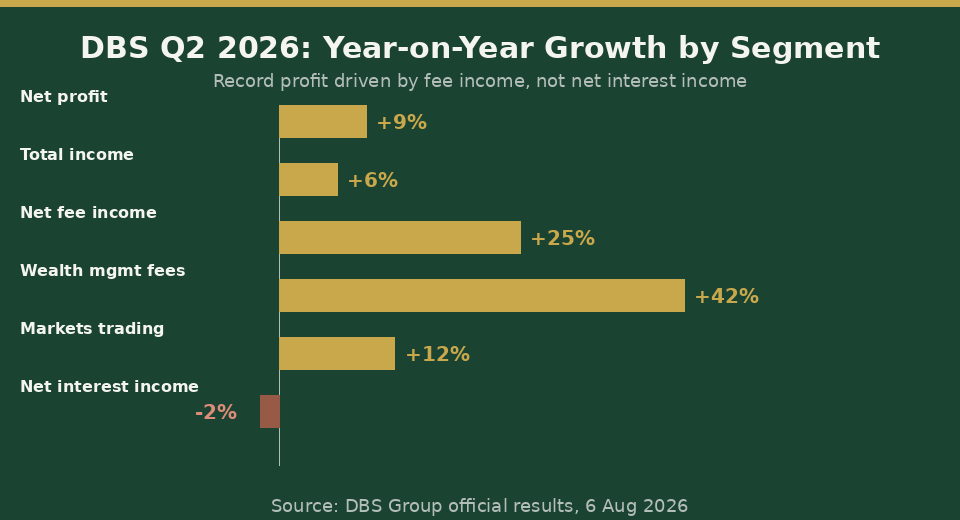
The standout figure in this release isn’t net interest income — it’s wealth management. DBS’s Wealth segment assets under management surpassed SGD 500 billion for the first time, reaching SGD 516 billion, up 16% year-on-year in constant-currency terms. Net fee income for the quarter rose 25% to SGD 1.46 billion, the second-highest quarterly level on record, with wealth management fees alone jumping 42% to a record SGD 919 million on higher customer investment activity.
Markets trading income also strengthened, rising 12% year-on-year to SGD 469 million in the quarter, and for the first half delivered its strongest performance in five years at SGD 858 million. Commercial book other non-interest income — largely treasury customer sales — rose 30% to a record SGD 681 million in the quarter.
What this means for SG retail investors: DBS’s earnings mix is shifting away from pure interest-rate sensitivity toward fee income tied to customer investment and trading activity. That’s arguably a more resilient model in a falling-rate world, but it also means DBS’s near-term earnings are now more exposed to how much Singaporeans and regional clients are actively investing — a trend that ties back to the broader retail investing boom our dividend investing guide covers in more detail.
Margins Are Still Under Pressure — Here’s the Trade-off
Not everything in the release was a record. Group net interest income fell 2% year-on-year to SGD 3.58 billion in the quarter, as group net interest margin narrowed 18 basis points to 1.87%, reflecting lower interest rates. For the first half, net interest margin was down 20 basis points year-on-year to 1.88%. DBS said strong loan and deposit growth, plus proactive hedging, offset most of the impact: loans grew 8% (SGD 35 billion) in constant-currency terms to SGD 469 billion, while deposits rose 11% (SGD 61 billion) to SGD 638 billion, with CASA balances driving about three-quarters of that deposit growth.
Asset quality stayed resilient. The non-performing loan ratio held at 1.0%, specific allowances were 16 basis points of loans for the quarter (15 basis points for the half), and allowance coverage stood at 130% (196% after collateral). Capital remained comfortable, with a Common Equity Tier-1 ratio of 16.6% on a transitional basis (14.6% fully phased-in) and a leverage ratio of 5.8%, well above the 3% regulatory minimum.
What this means for SG retail investors: the margin compression is the trade-off for the record fee income — it’s the direct effect of Singapore’s falling interest rate environment on a bank’s core lending business. If you’re weighing how much of your portfolio should sit in bank dividend stocks versus safer instruments as rates fall, our dividend yield calculator can help you model what a lower entry yield actually means for your income stream.
The Dividend: What DBS Shareholders Are Actually Getting
The Board declared an ordinary dividend of SGD 66 cents per share plus a Capital Return dividend of SGD 15 cents per share for the second quarter — a combined 81 cents in cash per share for the quarter. That brings the first-half totals to SGD 132 cents in ordinary dividends and SGD 30 cents in Capital Return dividends per share, for a combined SGD 162 cents (S$1.62) paid out across the first two quarters of 2026.
DBS moved to quarterly dividends in 2024, which has made its payout schedule more predictable for income investors tracking distributions across the year. If you hold DBS or are timing a purchase around its dividend dates, our dividend payout calendar for Singapore stocks tracks when local blue chips actually pay out.
DBS Q2 2026 By the Numbers
| Metric | Q2 2026 | YoY Change |
|---|---|---|
| Net profit | S$3.08 billion | +9% (record) |
| Total income | S$6.09 billion | +6% (first time above S$6b in a quarter) |
| Net interest margin | 1.87% | -18 basis points |
| Net fee income | S$1.46 billion | +25% |
| Wealth management fees | S$919 million | +42% (record) |
| Wealth segment AUM | S$516 billion | +16% (first time above S$500b) |
| Cost-income ratio | 39% | Stable |
| Non-performing loan ratio | 1.0% | Stable |
| Ordinary + Capital Return dividend | 81 cents/share | H1 total: S$1.62/share |
| H1 return on equity | 17.5% | ROTE at 19.2% |
Source: DBS Group official newsroom release, 6 August 2026.
What This Means for Different Types of SG Investors
If you’re a dividend/income investor: DBS’s quarterly cash payout of 81 cents (ordinary plus Capital Return) is a concrete, verifiable number to plug into your income projections — but remember the Capital Return component isn’t guaranteed to continue at this rate indefinitely. It’s worth checking whether your existing bank stock allocation still matches your target yield now that share prices have moved. Our high dividend stocks Singapore ranking is a useful cross-check against S-REITs and other blue chips.
If you’re an ETF/index investor: DBS is one of the three largest weights in the Straits Times Index, so a record quarter for DBS has an outsized effect on any STI ETF you hold. Strong bank earnings support the index, but concentration risk cuts both ways — a slowdown at any one of the three local banks moves the STI more than it would move a broader regional fund.
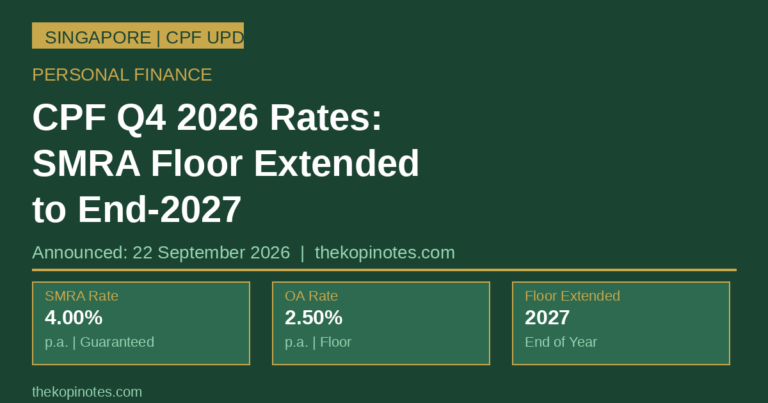
If you’re a CPF-first saver: CPF Board has kept its rates unchanged for the third quarter of 2026 — the Ordinary Account (OA) rate stays at its floor of 2.5% per annum, and the combined Special, MediSave and Retirement Account (SMRA) rate stays at its floor of 4% per annum, both for 1 July to 30 September 2026. Up to S$35,000 of CPF OA savings can be invested in CPFIS-approved instruments, including bank stocks like DBS, if you’re comfortable taking on market risk in exchange for a shot at a higher return than the 2.5% floor. Our CPF Investment Scheme returns glossary entry explains how that trade-off works in practice.
Bottom Line for SG Investors
DBS’s Q2 2026 results confirm that Singapore’s largest bank can still grow profit at a record pace even as interest rates fall, by leaning on wealth management, fee income and markets trading rather than net interest income alone. That’s a genuinely different earnings mix from what carried the bank through the high-rate years of 2023–2024, and it’s arguably a more durable one as rates normalise further. For shareholders, the practical takeaway is to look past the single “record profit” headline and check whether the underlying drivers — wealth AUM growth, fee momentum, asset quality — are still intact each quarter, rather than assuming the current dividend rate is fixed in stone.
Frequently Asked Questions
What was DBS’s net profit for Q2 2026?
DBS reported a record second-quarter 2026 net profit of SGD 3.08 billion, up 9% year-on-year, according to DBS Group’s official results announcement dated 6 August 2026.
How much dividend did DBS declare for Q2 2026?
DBS’s Board declared an ordinary dividend of SGD 66 cents per share plus a Capital Return dividend of SGD 15 cents per share for the second quarter, bringing the combined quarterly cash payout to 81 cents per share. First-half 2026 totals were SGD 132 cents in ordinary dividends and SGD 30 cents in Capital Return dividends per share.
Why did DBS’s net interest margin fall even as profit hit a record?
DBS’s group net interest margin fell 18 basis points year-on-year to 1.87% in Q2 2026 due to lower interest rates. The bank offset most of this impact through loan and deposit growth, proactive hedging, and record growth in fee income, particularly from wealth management.
How large is DBS’s Wealth Management business now?
DBS’s Wealth segment assets under management surpassed SGD 500 billion for the first time in Q2 2026, reaching SGD 516 billion, up 16% year-on-year in constant-currency terms, per DBS’s official release.
What is the CPF Ordinary Account interest rate for Q3 2026?
The CPF Ordinary Account (OA) interest rate remains at its floor of 2.5% per annum for the period from 1 July to 30 September 2026, unchanged from the previous quarter, per CPF Board’s official announcement. The combined Special, MediSave and Retirement Account (SMRA) rate remains at its floor of 4% per annum for the same period.
Is DBS’s asset quality still healthy?
Yes. DBS’s non-performing loan ratio was stable at 1.0% in Q2 2026, with allowance coverage at 130% (196% after considering collateral), and capital ratios remained well above regulatory minimums, per the bank’s official release.
Should I buy DBS shares after this results announcement?
This is an editorial analysis, not financial advice. A record earnings quarter doesn’t automatically mean a stock is undervalued at current prices — valuations, your own time horizon and existing portfolio concentration in Singapore bank stocks are all relevant factors. Readers should consider speaking with a licensed financial adviser for personalised guidance.
Sources
- DBS Group: Second-quarter net profit up 9% to record SGD 3.08 billion (6 August 2026)
- CPF Board: CPF interest rates from 1 July to 30 September 2026
This article was researched with the help of AI. While we strive to keep all information accurate and up to date, there may be errors. If you notice any discrepancies, please contact us.