How to Invest in Singapore: Your First ETF Portfolio Step-by-Step (2026 Guide)
Build a low-cost, globally diversified portfolio using Ireland-domiciled UCITS ETFs — the tax-smart choice for Singapore investors in 2026.
The smartest way to start investing in Singapore is with Ireland-domiciled UCITS ETFs listed on the London Stock Exchange. These funds — including CSPX (TER 0.07%), SPYL (TER 0.03%), and VWRA (TER 0.14%) — benefit from a 15% US dividend withholding tax rate instead of 30%, carry zero US estate tax risk, and can be bought through brokers like Interactive Brokers or via FSMOne’s Regular Savings Plan starting from as little as S$50 per month.
Not financial advice. All figures are for educational reference only. Data verified as at October 2026 unless noted.
Table of Contents
Contents — Click to expand
- What Is an ETF? (And Why It Suits Singapore Investors)
- Why Ireland-Domiciled UCITS ETFs Beat US-Listed for Singapore Investors
- The 3 Best ETFs for Your First Singapore Portfolio
- 3 Simple Portfolio Strategies: 1-Fund, 2-Fund & 3-Fund
- How to Buy Your First ETF in Singapore: Step-by-Step
- Dollar-Cost Averaging: Automate Your Investment
- Common Mistakes to Avoid
- Frequently Asked Questions
What Is an ETF? (And Why It Suits Singapore Investors)
An Exchange-Traded Fund (ETF) is a basket of securities — stocks, bonds, or other assets — that trades on a stock exchange like a single share. When you buy one unit of CSPX, for instance, you instantly own a proportional slice of all 504 companies in the S&P 500, from Apple and Microsoft down to smaller constituents.
For investors learning how to start investing in Singapore, ETFs offer three compelling advantages over picking individual stocks:
Instant diversification. A single unit of VWRA holds over 3,700 companies across 49 countries. No individual stock blow-up can meaningfully damage your portfolio.
Rock-bottom costs. Actively managed unit trusts in Singapore typically charge 1.0–1.75% per year in management fees. Index ETFs like SPYL charge just 0.03% — meaning more than 97% of returns flow through to you, not fund managers.
Tax efficiency. Singapore has no capital gains tax and no dividend tax on accumulating ETFs, meaning gains compound untouched until you decide to sell. Pair that with the right ETF structure (more on this below) and you have one of the most tax-efficient investment frameworks available globally.
The key question for Singapore investors is not whether to use ETFs, but which ETFs and from which exchange to buy them. The answer matters far more than most beginners realise.
Why Ireland-Domiciled UCITS ETFs Beat US-Listed for Singapore Investors
Most financial content online focuses on US-listed ETFs like VOO (Vanguard S&P 500) or VT (Vanguard Total World). These are excellent funds — but structurally disadvantaged for Singapore residents due to two US tax rules that are almost never discussed in mainstream Singapore personal finance content.
US Dividend Withholding Tax (WHT). When a US-domiciled ETF distributes dividends, the IRS withholds 30% before the money reaches a non-US investor. An Ireland-domiciled UCITS ETF holding the same US stocks benefits from the Ireland-US tax treaty, which reduces that rate to 15%. On a S$100,000 portfolio yielding 1.5% annually, that difference is roughly S$225 every year — permanently lost to tax drag if you chose the wrong ETF.
US Estate Tax. Non-US persons (including Singapore residents) are subject to US estate tax on US-sited assets above USD 60,000 at death — at rates up to 40%. A S$200,000 position in VOO or VTI exposes your estate to a potential USD 54,000+ tax bill. Ireland-domiciled UCITS ETFs are not US-sited assets and carry no such exposure.
| Factor | Ireland UCITS (LSE) | US-Listed ETF (NYSE) |
|---|---|---|
| US Dividend WHT | 15% | 30% |
| US Estate Tax Risk | None | Yes (above USD 60k) |
| SG Capital Gains Tax | None | None |
| SG Dividend Tax (accumulating) | None | None |
Source: IRS Publication 515 (US estate tax threshold USD 60k for non-residents); Ireland-US Double Tax Treaty, October 2026
The conclusion is clear: Singapore investors should buy Ireland-domiciled UCITS ETFs on the London Stock Exchange, not US-listed equivalents on the NYSE or Nasdaq.
The 3 Best ETFs for Your First Singapore Portfolio
For most Singapore investors building their first ETF portfolio, three Ireland-domiciled UCITS ETFs cover the full spectrum of needs: a low-cost S&P 500 tracker, a global all-world fund, and an ultra-cheap S&P 500 alternative. All three are accumulating, meaning dividends are automatically reinvested — ideal for long-term compounders who do not want to manage cash flow.
| ETF | Ticker | Index | TER | AUM | Holdings |
|---|---|---|---|---|---|
| iShares Core S&P 500 UCITS ETF | CSPX | S&P 500 | 0.07% | USD 161B | 504 |
| SPDR S&P 500 UCITS ETF Acc | SPYL | S&P 500 | 0.03% | USD 45B | 505 |
| Vanguard FTSE All-World UCITS ETF Acc | VWRA | FTSE All-World | 0.14% | USD 18.7B | 3,700+ |
Source: iShares factsheet Oct 2026; State Street Global Advisors (SSGA) factsheet Oct 2026; Vanguard factsheet (TER updated Aug 2026)
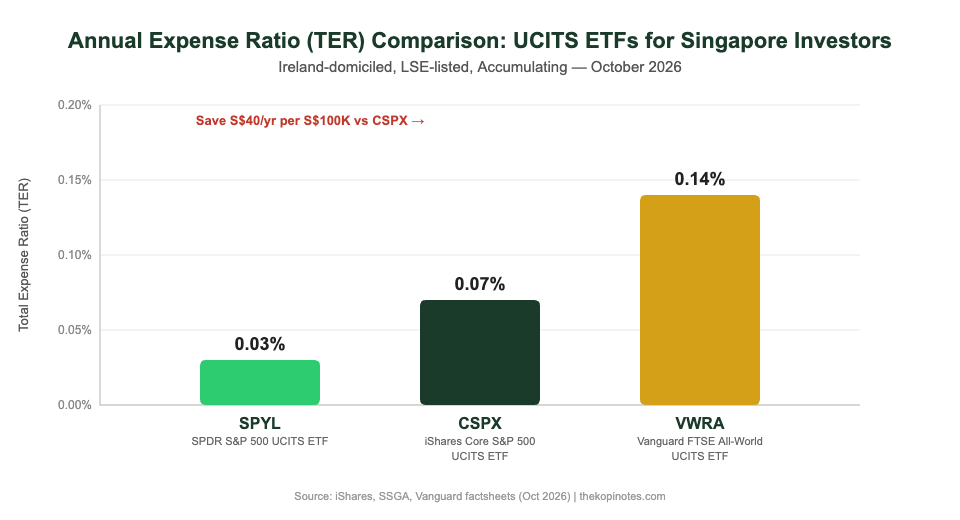
SPYL vs CSPX: Both track the S&P 500. SPYL’s 0.03% TER is the lowest available for a UCITS S&P 500 ETF — four basis points cheaper than CSPX. On a S$100,000 portfolio, that saves roughly S$40 per year. CSPX has the larger AUM (USD 161B vs USD 45B) and longer track record, making it the default choice for risk-averse beginners; SPYL suits cost-optimisers.
VWRA: The one-stop global ETF. Instead of just 500 US companies, VWRA holds over 3,700 companies across developed and emerging markets — the US, Europe, Japan, India, China, and more. The slightly higher TER of 0.14% buys you true global diversification, removing single-country concentration risk.
Which should you pick? If you want simplicity and maximum diversification in a single fund, VWRA is the answer. If you want the lowest-cost US equity exposure, SPYL wins on TER. CSPX sits in the middle — lower cost than VWRA with a 16-year track record. Many Singapore investors hold a combination: VWRA as a core global holding with CSPX or SPYL adding S&P 500 concentration for those who want more US tech exposure.
3 Simple Portfolio Strategies: 1-Fund, 2-Fund & 3-Fund
You do not need a complex portfolio to invest well. The most effective long-term strategies for Singapore investors are elegantly simple. Here are three levels of simplicity, from the absolute beginner to the slightly more hands-on investor.
Strategy 1: The 1-Fund Portfolio (Beginner)
Buy one ETF. Done. VWRA gives you exposure to 3,700+ global companies across 49 countries in a single ticker. You make one investment decision — how much to put in each month — and the fund handles diversification automatically. This strategy is appropriate for investors with less than S$50,000 invested or those who want zero ongoing portfolio decisions.
- ETF: VWRA
- Blended TER: 0.14% p.a.
- Rebalancing needed: None
- Best for: True beginners, long-term set-and-forget investors
Strategy 2: The 2-Fund Portfolio (Intermediate)
Pair a global equity ETF with a bond ETF for smoother returns as you approach retirement or have a shorter time horizon. A common allocation is 80% VWRA + 20% AGGG (iShares Core Global Aggregate Bond UCITS ETF), adjusting the bond allocation upward with age. This strategy is appropriate once your portfolio exceeds S$50,000 and you want some cushioning against equity volatility.
- ETFs: VWRA (80%) + AGGG (20%)
- Blended TER: ~0.13% p.a.
- Rebalancing needed: Annually
- Best for: Investors with 10–20 year horizons who want modest downside protection
Strategy 3: The 3-Fund Portfolio (DIY Optimiser)
For investors who want more control over geographic allocation, the 3-fund approach uses separate S&P 500 and international ETFs alongside a bond allocation. A sample allocation: 60% CSPX + 25% VWRA (acting as an international tilt) + 15% AGGG. The blended TER is approximately 0.10% p.a. — marginally cheaper than a pure VWRA portfolio, though the difference shrinks once transaction costs and rebalancing friction are factored in.
- ETFs: CSPX (60%) + VWRA (25%) + AGGG (15%)
- Blended TER: ~0.10% p.a.
- Rebalancing needed: Quarterly or bi-annually
- Best for: Experienced DIY investors who want maximum cost optimisation
Whichever strategy you choose, the most important variables are consistency and time in market. A S$500/month investment in VWRA at a 7% annualised return grows to approximately S$610,000 over 30 years — rising to S$1.31 million over 40 years. Starting a decade earlier matters far more than optimising by a few basis points. Use our Singapore retirement calculator to model your own scenario with different contribution levels and time horizons.
How to Buy Your First ETF in Singapore: Step-by-Step
Once you have decided on your ETF and portfolio strategy, you need a brokerage account that provides access to the London Stock Exchange. Three platforms dominate for Singapore investors buying UCITS ETFs in 2026.
Option 1: Interactive Brokers (IBKR) — Best for Larger Portfolios
- Open an IBKR account at ibkr.com.sg (takes 2–3 business days to verify)
- Fund via PayNow/bank transfer in SGD — IBKR converts to USD or GBP at competitive FX rates (typically ~0.002% spread)
- In the Trader Workstation or mobile app, search for “CSPX” and select the LSE (London Stock Exchange) listing
- Place a limit order in GBP during LSE trading hours (9am–5:30pm UK time, 4pm–12:30am SGT)
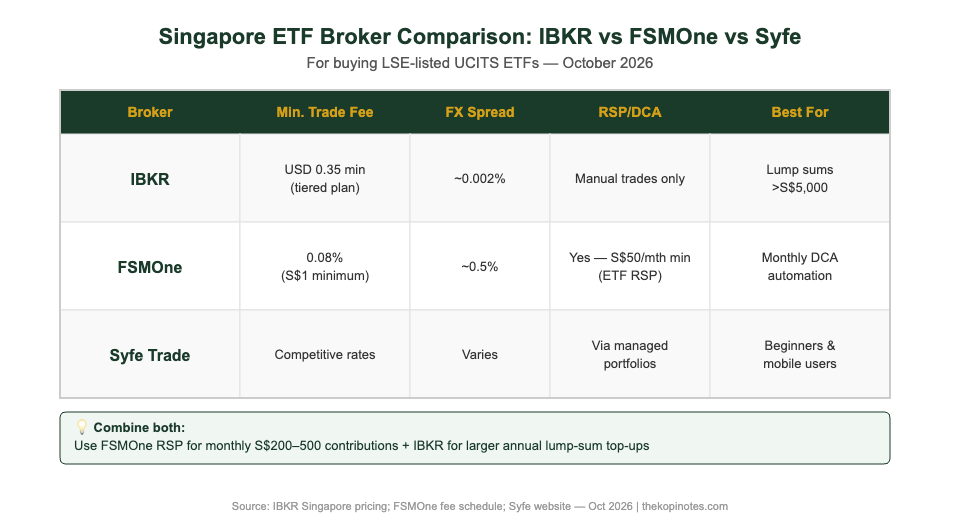
Fees: USD 0.35 minimum per trade (tiered plan) — the cheapest option for lump-sum investments above S$5,000. No platform fee for accounts over USD 100,000. Use our moomoo Singapore review to compare if IBKR’s interface feels too complex initially.
Option 2: FSMOne RSP — Best for Monthly Automation
- Open an FSMOne account at fsmone.com.sg (use the FSMOne referral code P0544985 for a sign-up bonus)
- Set up an ETF Regular Savings Plan (RSP) — minimum S$50/month
- Select CSPX, SPYL, or VWRA from the ETF RSP list
- Set a monthly deduction date and contribution amount
Fees: 0.08% brokerage with S$1 minimum per RSP transaction — no additional platform fee. FSMOne RSP is the easiest way to automate dollar-cost averaging into LSE ETFs without manual intervention.
Option 3: Syfe Trade — Best for Beginners
Syfe Trade offers a clean mobile interface with competitive rates on global ETFs. Use the Syfe referral code SRPRFFFCD to get a bonus when you first fund your account. Syfe also offers managed ETF portfolios (Core Equity100, REIT+) for investors who want professional rebalancing alongside their self-directed holdings.
| Broker | Min. Trade Fee | FX Spread | RSP Available | Best For |
|---|---|---|---|---|
| IBKR | USD 0.35 min | ~0.002% | No | Lump sums >S$5,000 |
| FSMOne | 0.08% (S$1 min) | ~0.5% | Yes (S$50 min) | Monthly DCA automation |
| Syfe Trade | Competitive | Varies | Via managed portfolios | Beginners, mobile users |
Source: IBKR Singapore pricing page; FSMOne fee schedule; Syfe website, October 2026
Dollar-Cost Averaging: Automate Your Investment
Dollar-cost averaging (DCA) means investing a fixed sum at regular intervals — say, S$500 on the first of every month — regardless of market conditions. When prices are high, your fixed amount buys fewer units. When prices fall, it buys more. Over time, this averaging effect reduces the risk of investing a large lump sum at a market peak.
For a Singapore investor contributing S$500 per month into VWRA at an assumed 7% annualised return:
- After 10 years: ~S$86,400 contributed → ~S$104,200 value
- After 20 years: ~S$172,800 contributed → ~S$260,900 value
- After 30 years: ~S$259,200 contributed → ~S$610,000 value
The practical implementation: FSMOne RSP is the most frictionless option — set it up once and contributions happen automatically on your chosen date, investing directly into CSPX, SPYL, or VWRA at 0.08% per transaction. IBKR requires manual trades but offers the lowest per-trade cost for larger lump sums (USD 0.35 minimum). Many Singapore investors combine both: FSMOne RSP for monthly S$200–500 contributions and IBKR for annual lump-sum top-ups.
You may also want to explore whether your CPF investment strategy complements your ETF portfolio. CPF OA funds earn 2.5% guaranteed interest — a low-risk floor that many investors retain rather than invest through CPFIS, preferring to maximise cash ETF contributions instead. Pair this with passive income strategies in Singapore to build multiple income streams alongside your growth portfolio.
Common Mistakes to Avoid When Building Your First ETF Portfolio
1. Buying US-listed ETFs (VOO, VTI, QQQ) from Singapore. The 30% WHT and USD 60k estate tax exposure make US-listed ETFs structurally inferior for Singapore residents versus their Ireland-domiciled UCITS equivalents. CSPX and SPYL track the same S&P 500 index at comparable or lower TERs — use those instead.
2. Waiting for the “right” entry point. Studies consistently show that lump-sum investing outperforms DCA in roughly two-thirds of market environments over long horizons. But the biggest mistake is not the timing — it is the waiting. Time in market beats timing the market. Every month you delay a S$500 contribution at 7% growth costs you approximately S$35 in future value.
3. Ignoring total cost drag. A 1.5% active fund fee vs 0.03% SPYL sounds small. On S$200,000 over 20 years at 7% gross return, the active fund compounds to approximately S$584,000 versus S$764,000 for the ETF — a S$180,000 difference consumed by fees. Cost is the only factor in investing fully within your control; optimise it rigorously.
4. Over-trading in response to volatility. Keep your ETF core portfolio untouched unless your personal circumstances change. For additional yield exposure, our guide to the best S-REITs in Singapore 2026 and the Singapore REIT ETF guide cover dividend-focused alternatives that complement an ETF core.
5. Neglecting SRS contributions. The Supplementary Retirement Scheme (SRS) offers a dollar-for-dollar tax deduction on contributions up to S$15,300 per year. At the 11.5% tax bracket, that saves S$1,760 annually — money that can be reinvested into your ETF portfolio. SRS funds can be invested in CSPX and VWRA through FSMOne or Syfe, making it a tax-efficient layer on top of your regular cash portfolio.
Frequently Asked Questions
Which is the best ETF for Singapore investors in 2026?
For most Singapore investors, VWRA (Vanguard FTSE All-World UCITS ETF, accumulating) is the single-best ETF to hold — it gives you 3,900+ stocks across developed and emerging markets in one fund, with a TER of just 0.14% and no US estate tax exposure. If you prefer pure S&P 500 exposure, SPYL (TER 0.03%) is the lowest-cost option. Both are Ireland-domiciled UCITS ETFs listed on the London Stock Exchange, which means only 15% WHT on US dividends versus 30% for US-listed equivalents like VOO or VTI.
Can I buy ETFs using my CPF in Singapore?
Yes — CSPX and VWRA are both available under the CPF Investment Scheme (CPFIS) through FSMOne, though only your Ordinary Account (OA) funds (above the S$20,000 floor) and Special Account (SA) funds (above S$40,000) are eligible for investment. That said, many Singapore investors choose not to invest their CPF, since OA earns 2.5% guaranteed and SA earns 4% — both risk-free and very competitive with a conservative ETF allocation. If you do invest via CPFIS, FSMOne charges 0.08% per RSP transaction (minimum S$1), making it cost-efficient for monthly contributions.
What is the minimum amount to start investing in ETFs in Singapore?
You can start with as little as S$100 per month via FSMOne’s Regular Savings Plan (RSP), which purchases fractional units of CSPX, SPYL, or VWRA. For lump-sum investing on IBKR, the practical minimum is around USD 200–300 (enough to buy one unit of CSPX at ~USD 230) plus a USD 0.35 commission. Syfe’s managed ETF portfolios have a S$1 minimum but charge a platform fee of 0.35–0.65% per year on top of the ETF’s TER. For pure cost efficiency, FSMOne RSP is unbeatable for amounts under S$2,000/month; IBKR makes more sense above that threshold.
Why do Singapore investors prefer Ireland-domiciled ETFs over US-listed ones?
Three structural advantages: (1) Withholding tax — Irish UCITS ETFs pay only 15% WHT on US dividends versus 30% for US-listed ETFs, saving Singapore investors up to 15% of their dividend income each year. (2) US estate tax — Americans have a USD 13.6 million exemption; Singapore investors have only USD 60,000, meaning a US-listed ETF holding above that threshold faces 26–40% estate tax. Irish-domiciled ETFs are not subject to US estate tax. (3) Accumulating share classes — CSPX and SPYL automatically reinvest dividends, eliminating the WHT drag entirely by avoiding dividend distributions.
Is IBKR or FSMOne better for buying ETFs in Singapore?
It depends on your investment size and style. FSMOne wins for small, regular contributions: its RSP charges 0.08% per transaction (S$1 minimum), and no minimum account balance is required. IBKR wins for larger lump sums: it charges USD 0.35 minimum per trade, which represents only 0.15% on a USD 230 CSPX purchase — far cheaper than FSMOne’s manual trade fee of 0.08% minimum S$10. IBKR also offers access to more ETFs and LSE listings. Most Singapore investors use both: FSMOne RSP for S$200–500/month contributions, IBKR for annual top-ups above S$5,000.
What is DCA and should I invest a lump sum or use dollar-cost averaging?
Dollar-cost averaging (DCA) means investing a fixed amount at regular intervals regardless of market price. Academic research shows lump-sum investing outperforms DCA in about two-thirds of 12-month windows because markets trend upward more often than they fall. However, DCA is psychologically easier and removes the risk of investing all your capital at a market peak. For most Singapore investors starting out, DCA via FSMOne RSP is the practical recommendation — it builds the habit, is automated, and reduces the behavioural risk of panic-selling after a bad entry point. As your portfolio grows, use DCA for regular contributions and a lump sum for windfalls (bonus, inheritance).
How do I buy CSPX or VWRA in Singapore step by step?
For FSMOne RSP: (1) Register at FSMOne using referral code P0544985 → (2) Complete SingPass/MyInfo verification → (3) Fund your account (minimum S$100) → (4) Go to RSP → Add New Plan → search CSPX or VWRA → (5) Set contribution amount and date → (6) Done. For IBKR: (1) Sign up at IBKR using referral code jianxiong368 → (2) Complete identity verification (1–2 days) → (3) Fund via SGD bank transfer (no FX needed for SGD account) → (4) On IBKR desktop/app, search “CSPX” → select LSE, GBP listing → (5) Place a market or limit order during LSE trading hours (3pm–11:30pm SGT). Both brokers allow SRS account investing for additional tax savings.
This article was researched with the help of AI. While we strive to keep all information accurate and up to date, there may be errors. If you notice any discrepancies, please contact us.