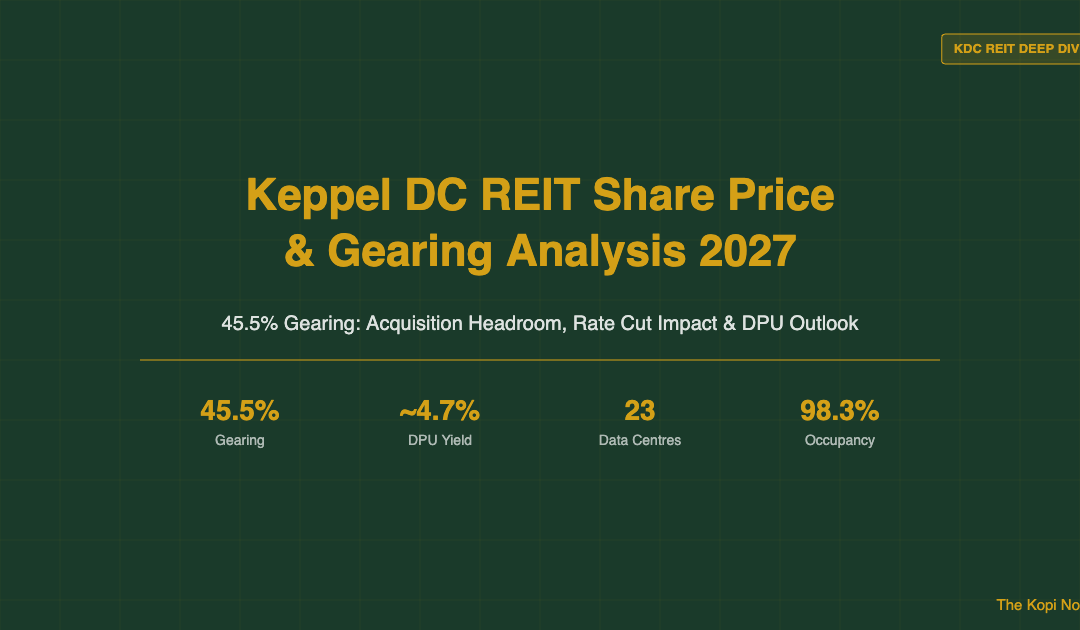
Keppel DC REIT Share Price & Gearing Analysis: Acquisition Capacity and DPU Outlook 2027
At 45.5% aggregate leverage, KDC REIT is one of Singapore’s highest-geared data centre REITs — here’s what that means for acquisitions, DPU, and your investment case in 2027.
Keppel DC REIT (SGX: AJBU) is Singapore’s largest listed data centre REIT, trading at approximately S$2.10–2.20 as at Q3 2026, with a DPU yield of around 4.7%. Its 45.5% aggregate leverage is one of the highest among Singapore REITs — just 4.5 percentage points below the 50% regulatory ceiling. This analysis examines what that gearing level means for acquisition headroom, DPU sensitivity to interest rate cuts, and the outlook for 2027.
Not financial advice. All figures are for educational reference only. Data as at H1 2026 unless otherwise noted.
Table of Contents
Contents — Click to expand
KDC REIT at a Glance (2026)
Keppel DC REIT (SGX: AJBU) is Singapore’s first and largest listed data centre REIT. Established in 2014, it owns 23 data centres across nine countries — Singapore, Germany, Netherlands, Italy, Ireland, United Kingdom, Australia, Malaysia, and the Netherlands — with a total asset value of approximately S$3.8 billion as at Q2 2026.
The REIT benefits from long-term, triple-net leases (tenants pay operating costs) and high occupancy rates, making it a stable income vehicle. However, its elevated aggregate leverage of 45.5% has increasingly drawn attention as a key risk and opportunity factor heading into 2027.
| Metric | Value (H1 2026) |
|---|---|
| SGX Ticker | AJBU |
| Share Price (Q3 2026 est.) | S$2.10–2.20 |
| Annualised DPU | ~10.01 cents |
| DPU Yield (at S$2.15) | ~4.65% |
| Aggregate Leverage | 45.5% |
| Total Assets (est.) | ~S$3.8 billion |
| Number of Data Centres | 23 |
| Countries | 9 |
| Portfolio Occupancy | ~98.3% |
| WALE (by income) | ~6.2 years |
| Average Cost of Debt | ~3.7% p.a. |
Source: KDC REIT H1 FY2026 results announcement; TKN estimates for Q3 2026 share price range.
Understanding KDC REIT’s 45.5% Aggregate Leverage
Aggregate leverage (commonly called “gearing”) measures a REIT’s total borrowings as a percentage of total assets. In Singapore, the Monetary Authority of Singapore (MAS) sets regulatory limits under the Code on Collective Investment Schemes:
- 45% limit — for REITs without a credit rating from a recognised agency
- 50% limit — for REITs with at least one credit rating (KDC REIT qualifies under this threshold)
KDC REIT carries a credit rating (Baa2 from Moody’s, investment grade), so its effective ceiling is 50%. At 45.5%, it sits just 4.5 percentage points below this hard limit — a meaningfully tight buffer compared to most S-REIT peers.
Why does this matter? Three reasons. First, it limits debt-funded acquisitions without a corresponding equity raise. Second, it magnifies DPU sensitivity to interest rate movements — higher debt means higher interest costs, which eat directly into distributable income. Third, it can weigh on investor confidence if rate cuts fail to materialise, since refinancing risks loom larger at elevated gearing.
That said, high gearing is not inherently negative for an income investor analysing best S-REITs in Singapore 2026. The key question is whether the returns on assets deployed exceed the cost of debt — and for KDC REIT, data centre assets have consistently delivered high occupancy and positive rental reversions that support this argument.
Gearing vs S-REIT Peers
To understand whether KDC REIT’s 45.5% gearing is a structural concern or market noise, it helps to compare it against peers in the S-REIT universe. The chart below shows aggregate leverage for six major S-REITs as at Q2 2026 results.
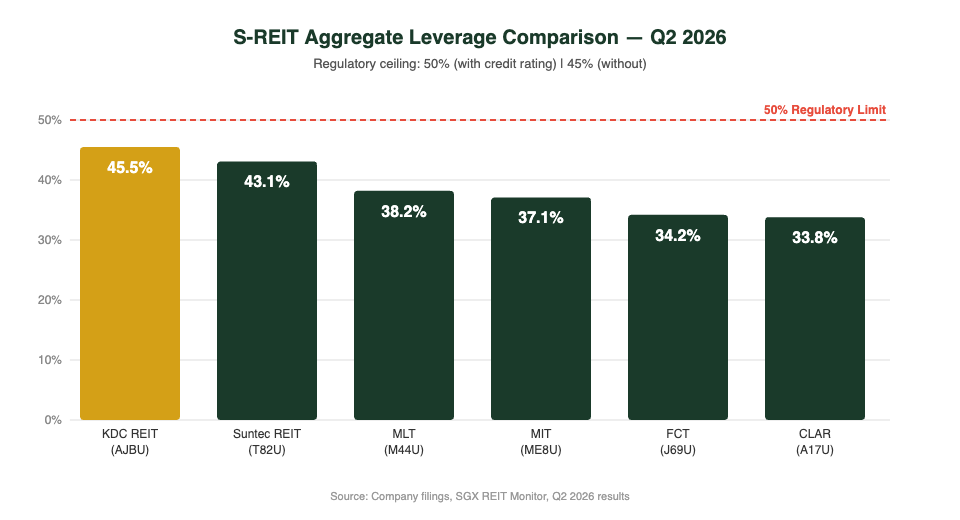
KDC REIT at 45.5% sits meaningfully above Mapletree Logistics Trust (MLT) at 38.2%, Mapletree Industrial Trust (MIT) at 37.1%, Frasers Centrepoint Trust (FCT) at 34.2%, and CapitaLand Ascendas REIT (CLAR) at 33.8%. Suntec REIT at 43.1% is the closest peer in gearing terms.
The higher gearing reflects KDC REIT’s aggressive growth trajectory over 2020–2024, when it acquired data centres across Europe at compressed yields. Those acquisitions have since revalued upward, but the debt load from the buying spree remains on the balance sheet.
Acquisition Capacity: How Much Can KDC REIT Still Grow?
With 45.5% gearing and a 50% regulatory ceiling, KDC REIT has limited room for pure debt-funded acquisitions. Here is a simplified calculation:
- Total assets (est.): S$3.8 billion
- Current total borrowings: ~45.5% × S$3.8B = S$1.729 billion
- Maximum borrowings at 50% gearing: 50% × S$3.8B = S$1.9 billion
- Additional debt headroom: ~S$171 million
In practice, this means KDC REIT could fund a small single-asset data centre acquisition (typically S$200–400 million) using a combination of the remaining debt headroom plus an equity placement. However, a large portfolio deal would almost certainly require a rights issue or private placement to avoid breaching the 50% cap.
Historically, KDC REIT has demonstrated willingness to raise equity — it executed multiple preferential offerings between 2020 and 2023 to fund European acquisitions. Any 2027 acquisition announcement should therefore be evaluated alongside the terms of any accompanying equity raise, as dilution can partially offset DPU growth from the new asset.
For Singapore investors building a passive income Singapore portfolio around data centre REITs, this acquisition constraint is a key watch item. New acquisitions are the primary growth lever for REITs; without them, DPU growth must come from organic rental reversions alone.
Interest Rate Sensitivity and DPU Impact
At 45.5% gearing, KDC REIT carries approximately S$1.73 billion in total borrowings. A portion of this debt is at floating rates (linked to SORA, EURIBOR, or SOFR), while the remainder is fixed through hedging. Based on KDC REIT’s typical hedging strategy (~70–75% fixed), roughly S$430–520 million of debt is exposed to rate movements.
As at H1 2026, KDC REIT’s average cost of debt was approximately 3.7% per annum. Every 50 basis points (bps) of rate reduction on its floating-rate portion translates to roughly S$2.2–2.6 million in annual interest savings, or approximately 0.04 cents of incremental DPU.
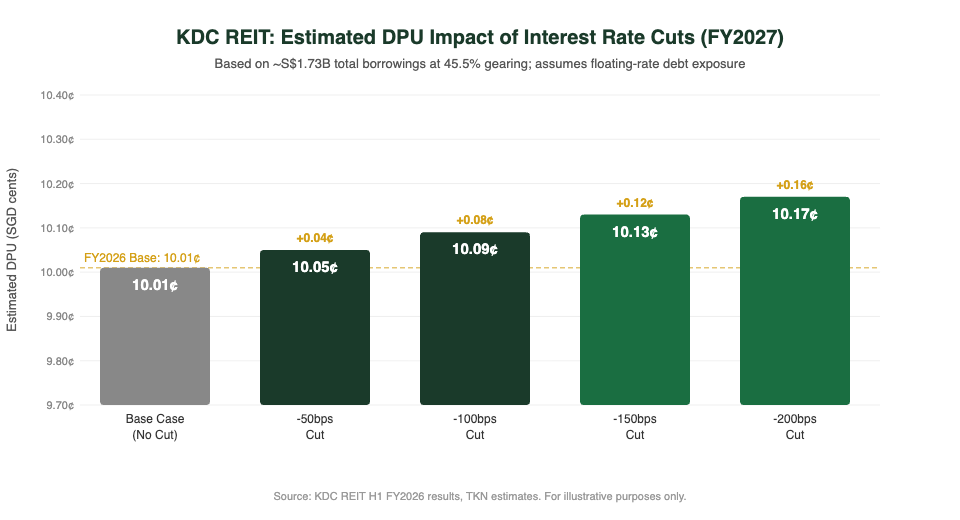
The chart above illustrates estimated DPU at various rate-cut scenarios relative to the FY2026 base of approximately 10.01 cents. A 100bps rate reduction — a realistic scenario if the US Federal Reserve continues its 2026 cutting cycle into 2027 — could add approximately 0.08 cents to annualised DPU, bringing it to around 10.09 cents. A more aggressive 200bps scenario (unlikely in a single year but possible cumulatively) could push DPU above 10.17 cents.
These estimates assume: (a) floating-rate exposure of approximately S$460 million; (b) no change in the fixed-rate hedging ratio; and (c) full-year benefit from rate cuts (actual impact would be phased depending on timing). Use our Singapore retirement calculator to model how different DPU scenarios affect your passive income target.
There is also the debt refinancing cycle to consider. KDC REIT refinances tranches of its debt periodically; if existing fixed-rate bonds mature in 2026–2027 and are refinanced at lower rates, this provides an additional DPU uplift beyond the floating-rate benefit modelled above.
DPU Outlook for FY2027
Putting the gearing, acquisition, and rate sensitivity picture together, the FY2027 DPU outlook for KDC REIT hinges on three variables:
| Driver | FY2027 Direction | Estimated Impact on DPU |
|---|---|---|
| Organic rental reversions (AI demand) | Positive (+5–10% on renewals) | +0.05–0.10¢ |
| Interest rate cuts (floating-rate debt) | Positive (assuming -100bps) | +0.06–0.10¢ |
| EUR/SGD currency headwind | Uncertain (European exposure ~30%) | 0 to -0.06¢ |
| Acquisition DPU uplift (if any) | Small (limited by high gearing) | 0 to +0.05¢ |
| Equity dilution risk (if rights issue) | Negative short-term | -0.02 to -0.05¢ |
Source: TKN estimates based on KDC REIT H1 FY2026 results and analyst consensus. For illustrative purposes only.
Net of these factors, the base case FY2027 DPU estimate is in the range of 10.05–10.25 cents, representing modest but positive DPU growth of 0.4–2.4% year-on-year from the FY2026 base. The bull case (aggressive rate cuts + strong EUR/SGD) could push DPU to 10.30–10.40 cents.
Investors should also review KDC REIT’s WALE and lease expiry profile alongside gearing, as lease renewal timing affects near-term revenue visibility. And for broader portfolio context, the KDC overseas portfolio breakdown is essential reading — European assets now contribute ~30% of income but introduce currency risk.
Share Price Valuation: P/NAV and Yield Spread
As at Q3 2026, KDC REIT’s share price of ~S$2.10–2.20 implies a price-to-NAV (P/NAV) multiple of approximately 1.05–1.10x, a modest premium to book value. This compares to the sector median of ~0.95–1.00x, reflecting the market’s recognition of KDC’s growth quality and tenant mix.
On a yield-spread basis, KDC REIT’s ~4.65% yield sits approximately 240 basis points above the 10-year Singapore Government Securities (SGS) yield of ~2.25% (as at Q3 2026). Historically, a yield spread of 200–250bps for a growth REIT like KDC is considered fair-to-slightly-tight pricing. Spread compression (rising share price) becomes more likely if the SGS yield falls further as global rates ease.
For investors comparing data centre REITs, KDC REIT at 4.65% yield vs the SGX-listed best S-REITs in Singapore 2026 leaderboard is competitive. However, the 45.5% gearing is a meaningful valuation risk factor that deserves a discount — investors who prefer lower gearing peers (MLT, MIT, CLAR) are not wrong to do so.
Buy, Hold, or Wait?
KDC REIT’s investment case in late 2026 breaks into three scenarios:
Buy case: If the Federal Reserve delivers 100+ bps of rate cuts by end-2027 and the EUR/SGD holds above 1.45, KDC REIT’s DPU could expand to 10.10–10.25 cents while financing costs ease. The share price should re-rate closer to 1.10–1.15x P/NAV as the gearing risk discount fades. Target entry zone: S$2.05–2.15.
Hold case: Existing unitholders with a cost basis below S$2.00 are in a comfortable position. The ~4.7–4.9% yield provides solid income while waiting for rate cuts to materialise. Review the portfolio after FY2026 full-year results (February 2027) before making further additions.
Wait case: Investors who prefer high conviction entry points may wish to wait for (a) confirmation of a 2027 acquisition and its financing terms, or (b) a share price pullback to S$1.90–2.00, which would offer 5.0–5.3% yield and a more comfortable margin of safety on high gearing. High gearing amplifies downside as much as upside — if the rate-cut cycle is slower than expected, DPU recovery will also be slower.
To put this in income planning context, consider using our Singapore retirement calculator to determine how much KDC REIT you need at different DPU levels to hit your monthly passive income target. For brokerage access to S-REITs at low commissions, the FSMOne referral code (P0544985) offers a competitive fee structure, while Syfe referral code (SRPRFFFCD) is ideal for fractional S-REIT investing through Syfe’s REIT+ portfolio.
Frequently Asked Questions
What is Keppel DC REIT's current share price?
As at Q3 2026, Keppel DC REIT (SGX: AJBU) was trading in the range of approximately S$2.10–2.20, implying a DPU yield of around 4.65–4.75% based on an annualised DPU of ~10.01 cents. Share price fluctuates daily — always check SGX or your broker for the live quote before making any investment decision.
Is KDC REIT's 45.5% gearing a major risk?
It is a meaningful risk factor but not an immediate crisis. KDC REIT has an investment-grade credit rating (Baa2, Moody’s), which means the regulatory gearing ceiling is 50% rather than 45%. At 45.5%, it has ~4.5 percentage points of headroom. The key risks are: (1) limited debt-funded acquisition capacity without equity dilution; and (2) higher DPU sensitivity to interest rate movements in either direction. If rates rise further, financing costs increase; if rates fall, DPU benefits more significantly than lower-geared peers.
What is KDC REIT's dividend yield in 2026?
At a share price of S$2.15 and an annualised DPU of approximately 10.01 cents, KDC REIT’s distribution yield is around 4.65% as at H1 2026. KDC REIT distributes quarterly. The actual FY2026 full-year DPU will be confirmed with the H2 2026 results, typically released in January or February 2027. Note that DPU is reported in Singapore cents per unit.
Will KDC REIT do an acquisition in 2027?
No acquisition has been publicly announced as at October 2026. Given its high gearing of 45.5%, any 2027 acquisition is likely to require an accompanying equity raise (rights issue or private placement) to stay within the 50% regulatory limit. KDC REIT’s management has historically targeted European data centre markets for growth; watch for announcements of pipeline assets in Germany, Netherlands, or new markets like Nordics. Any acquisition announcement should be evaluated on yield-on-cost vs the REIT’s average cost of debt (~3.7%).
How does interest rate reduction affect KDC REIT's DPU?
Based on estimated floating-rate debt exposure of ~S$430–520 million, every 50 basis points of rate reduction translates to approximately S$2.2–2.6 million in annual interest savings — equivalent to roughly 0.04 cents of incremental DPU per annum. A 100bps rate cut cycle (base case for 2026–2027) could add approximately 0.06–0.10 cents to annualised DPU. The exact benefit depends on the fixed/floating ratio, which KDC REIT discloses in its quarterly results.
How do I buy Keppel DC REIT shares in Singapore?
KDC REIT (SGX: AJBU) is listed on the Singapore Exchange and trades in board lots of 100 units. You can buy it through any CDP-linked brokerage such as DBS Vickers, OCBC Securities, FSMOne (use FSMOne referral code P0544985 for a fee discount), or through robo-advisors like Syfe’s REIT+ portfolio (use Syfe referral code SRPRFFFCD). IBKR Singapore is popular for low commissions on larger trades. Settlement is T+2 in Singapore dollars.
This article was researched with the help of AI. While we strive to keep all information accurate and up to date, there may be errors. If you notice any discrepancies, please contact us.