S-REITs vs Unit Trusts: Which Wins for Income in Singapore (2026)?
Fees, yield, tax and a real 10-year cost simulation — compared side by side for Singapore investors.
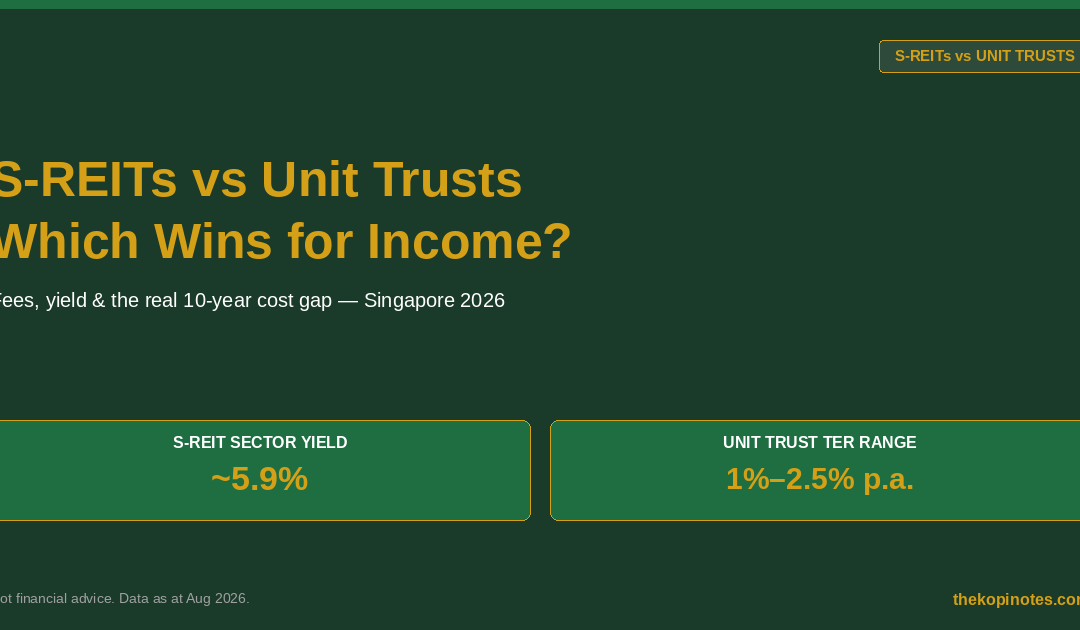
For most Singapore investors chasing passive income, buying S-REITs directly on SGX beats an actively managed unit trust or income fund on cost — the sector’s ~5.9% average yield already has REIT-level fees baked in, while a unit trust adds a 0%–5% sales charge plus a 1%–2.5% annual expense ratio on top. Unit trusts win on diversification-without-effort and CPF eligibility.
Not financial advice. All figures are for educational reference only. Data as at August 2026 unless noted.
- Direct S-REITs cost roughly 0.08% one-time (brokerage) with no extra fee to you — unit trusts typically cost 0%–5% upfront plus 1%–2.5% a year, every year.
- On a S$50,000 portfolio held 10 years at the same gross return, that fee gap alone is worth about S$15,800 in our worked example below.
- Unit trusts win if you want CPF OA access (most individual S-REITs aren’t CPFIS-approved) or don’t want to pick individual counters yourself.
Quick Answer
If your only goal is maximum income after fees, buying S-REITs directly usually wins. The S-REIT sector’s average distribution yield of around 5.9% is already net of the REIT manager’s fee — that cost is deducted before Distribution Per Unit (DPU) is declared, so it doesn’t come out of your pocket a second time. You just pay a one-time brokerage fee, often under 0.1%.
An actively managed unit trust or income fund adds a sales charge (0%–5%) when you buy in, and a Total Expense Ratio (TER) of 1%–2.5% a year on top of whatever the fund earns. That’s a real, recurring drag on your returns. Where unit trusts win: you don’t have to research or pick individual counters, your money is spread across many assets automatically, and far more unit trusts are CPF Investment Scheme (CPFIS) approved than individual S-REITs.
Key Differences at a Glance
| Feature | Direct S-REITs | Unit Trust / Income Fund |
|---|---|---|
| How you buy it | SGX brokerage account, real-time trading | Bank, fund platform (FSMOne, Endowus) or advisor |
| Management | You pick each REIT yourself | Fund manager picks and rebalances for you |
| Typical yield | ~5.5%–6.5% sector average | Varies by fund; often 3%–5% for SGD/Asian income funds |
| Upfront cost | ~0.08%–0.28% brokerage commission | 0%–5% sales charge |
| Ongoing cost to you | None directly (REIT-level fee already in DPU) | 1%–2.5% p.a. TER, sometimes + platform fee |
| Liquidity | Real-time on SGX, T+2 settlement | Once-daily forward pricing; redemption can take days |
| CPF OA eligible | Mostly no (rare exceptions, e.g. Elite UK REIT since Jun 2026) | Many CPFIS-approved options exist |
| Diversification | You build it yourself, one counter at a time | Instant, professionally managed |
Source: DBS Bank unit trust fee guide (2026), POEMS/Syfe brokerage rate cards (2026), CPF Board CPFIS product list (2026).
Yield & Income Comparison
The CSOP iEdge S-REIT Leaders Index ETF — a reasonable proxy for the broad S-REIT market — carries an indicative dividend yield in the 5.5%–6.5% range as at mid-2026, with the market-cap-weighted average nearer 6.3% earlier this year. That’s the yield you’d broadly expect from a diversified basket of blue-chip S-REITs like CapitaLand Ascendas REIT, Mapletree Logistics Trust or Frasers Centrepoint Trust.
Actively managed SGD or Asian income funds — the kind sold through banks and platforms like FSMOne or Endowus — typically target a lower headline distribution, often in the 3%–5% range. That’s not necessarily a worse investment. These funds usually blend bonds, equities and sometimes REITs, which lowers volatility but also caps the income yield versus a pure S-REIT basket.
Here’s the catch: S-REITs must distribute at least 90% of taxable income to unitholders by law to keep their tax-transparent status. That’s a regulatory floor, not a marketing promise. Unit trusts have no such requirement — a fund manager can cut the payout rate at any time, and some funds even pay out of capital during weak periods, which quietly erodes your principal.
Fee Comparison: What Each Path Really Costs
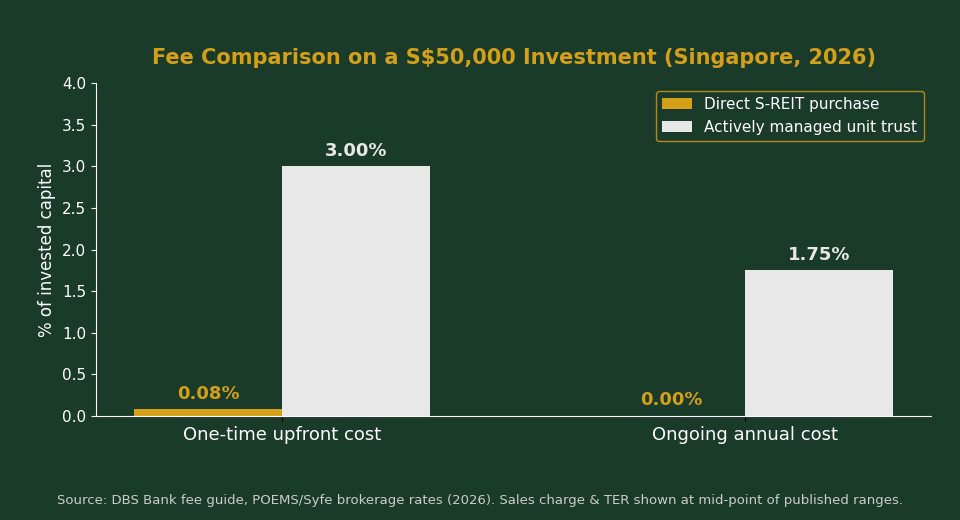
This is where the two paths diverge the most. When you buy an S-REIT directly, the REIT manager’s base fee (typically 0.25%–0.5% of the property portfolio’s value, per industry fee-structure research) is already deducted before the DPU figure is announced. You never see a separate bill for it — the quoted yield is the yield you actually receive. Your only direct cost is a one-time brokerage commission, which runs as low as 0.08% at platforms like POEMS Cash Plus or Syfe.
A unit trust stacks costs on top of whatever the fund earns. According to DBS Bank’s investment fee guide, expect a one-time sales charge of 0%–5% when you invest, a Total Expense Ratio (TER) of 1%–2.5% a year deducted from the fund’s NAV, and sometimes a platform fee of up to 3% on top. Redemption fees of 1%–5% can also apply when you sell.
Worked Example: The 10-Year Cost-Drag Gap
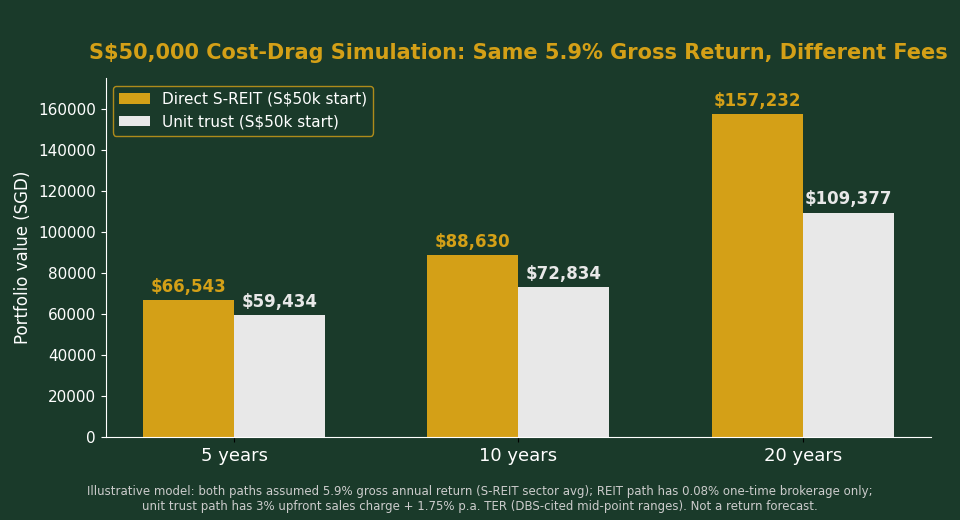
Numbers make this concrete. Say you invest S$50,000 and, purely to isolate the effect of fees, we assume both paths deliver the same 5.9% gross annual return (the S-REIT sector average). This isn’t a return forecast — it’s a controlled comparison to show what fees alone cost you.
Path A — Direct S-REIT purchase: You pay a 0.08% brokerage fee upfront (S$40), leaving S$49,960 invested. There’s no further fee taken from your side each year.
Path B — Actively managed unit trust: You pay a 3% sales charge upfront (S$1,500, the mid-point of the 0%–5% DBS-cited range), leaving S$48,500 invested. A 1.75% TER (mid-point of the 1%–2.5% range) is then deducted from returns every single year.
| Time Horizon | Direct S-REIT | Unit Trust | Gap |
|---|---|---|---|
| 5 years | S$66,543 | S$59,434 | S$7,109 |
| 10 years | S$88,630 | S$72,834 | S$15,796 |
| 20 years | S$157,232 | S$109,377 | S$47,855 |
Illustrative model, not a return forecast: both paths assumed identical 5.9% gross annual return to isolate the fee effect. REIT path: 0.08% one-time brokerage only. Unit trust path: 3% upfront sales charge + 1.75% p.a. TER (DBS-cited mid-point ranges), compounded annually. Author’s own calculation, August 2026.
By year 10, the fee gap alone is worth about S$15,800 — nearly a third of the original S$50,000 you started with. Stretch that to 20 years and it’s almost S$48,000. That’s the real cost of “letting someone else manage it for you” when the underlying return happens to be similar.
Liquidity & Control
S-REITs trade on SGX in real time during market hours. You see the price, place an order, and settlement happens on T+2 — two business days later. If you need cash urgently, you can sell within minutes.
Unit trusts use forward pricing. You don’t know the exact price you’ll get when you place a buy or sell order — it’s calculated once a day, after the market closes, based on the fund’s Net Asset Value (NAV). Redemption proceeds can then take several business days to reach your account.
Control is the other side of this coin. With direct S-REITs, you choose exactly which sectors and counters you own — industrial, retail, data centre, or a mix. With a unit trust, the fund manager makes those calls, and you often only find out the current holdings from a quarterly or semi-annual factsheet, not in real time.
Tax, CPF & SRS Treatment
For individual investors, S-REIT distributions are generally not taxed as personal income in Singapore. This exemption is set out under Section 13(1)(zh) of the Income Tax Act, per the IRAS e-Tax Guide on REITs — the exemption doesn’t apply if you receive the distribution through a partnership, or as part of carrying on a trade or business. Unit trust distributions to individual retail investors are typically structured to avoid this kind of double taxation too, but the exact treatment depends on the specific fund’s structure. Always check the fund prospectus, and speak to a tax advisor if you’re unsure how a specific product applies to you.
Where unit trusts have a real edge: CPF and SRS access. Most individual S-REITs are not CPFIS-approved — you generally can’t use your CPF Ordinary Account to buy a specific REIT counter directly (Elite UK REIT is a rare 2026 exception, added to the CPFIS-OA list in June 2026). Unit trusts, by contrast, have a wide range of CPFIS-approved options across banks and platforms, and CPFIS-approved funds are subject to a TER cap set by CPF Board. If your CPF investment strategy depends on using OA funds, a unit trust (or a REIT ETF — see below) may be your only practical route into the sector.
SRS is more flexible: you can generally use SRS funds to buy both individual SGX-listed S-REITs and eligible unit trusts through participating brokers and platforms.
Who Should Choose Which?
Direct S-REITs make sense if you:
- Want the lowest ongoing cost and are comfortable researching individual REITs yourself
- Are investing outside CPF (cash brokerage or SRS) and want maximum income yield
- Already have a diversified portfolio and want to add REIT exposure precisely, sector by sector
- Like the idea of a well-known “best S-REITs in Singapore” style basket you control
A unit trust or income fund makes sense if you:
- Want to invest via CPF Ordinary Account and need CPFIS-approved options
- Prefer someone else to handle diversification, rebalancing and counter selection
- Want smoother, blended income (bonds + equities + REITs) rather than pure REIT-sector volatility
- Are already using a platform like FSMOne or Endowus for other holdings and want one consolidated view
There’s also a middle path many Singapore investors overlook: a Singapore REIT ETF like the Lion-Phillip S-REIT ETF or CSOP iEdge S-REIT Leaders Index ETF. These trade like a stock (real-time, low brokerage fee) but still give you instant diversification across the whole sector — without picking individual counters or paying a unit trust’s sales charge and TER. For most income-focused Singapore investors, this is worth comparing before committing to either extreme.
If you’re weighing S-REITs against other income options entirely, we’ve also compared them against Singapore Savings Bonds and against money market funds — useful reading if you’re building a full passive income strategy rather than choosing just one instrument.
Not financial advice. Every investor’s tax situation, risk tolerance and CPF/SRS position is different — use this article as a starting point for your own research, not a recommendation.
Frequently Asked Questions
Are S-REITs or unit trusts better for passive income in Singapore?
For pure income and lowest cost, direct S-REITs generally win because the sector’s ~5.9% average yield is already net of the REIT manager’s fee, and your only cost is a small one-time brokerage commission. Unit trusts add a sales charge and an annual expense ratio on top, which reduces net income over time — but they offer instant diversification and CPF eligibility that most individual S-REITs don’t have.
What fees do I pay for unit trusts vs buying S-REITs directly?
Buying an S-REIT directly typically costs 0.08%–0.28% in one-time brokerage commission, with no separate ongoing fee — the REIT manager’s fee is already deducted before the dividend (DPU) is declared. A unit trust usually charges a 0%–5% sales charge upfront plus a 1%–2.5% Total Expense Ratio (TER) every year, and sometimes a platform fee or redemption fee too.
Are unit trust distributions taxable in Singapore?
S-REIT distributions to individual investors are generally tax-exempt under Section 13(1)(zh) of the Income Tax Act, unless received through a partnership or business activity. Unit trust distributions to retail individual investors are typically structured to avoid double taxation as well, but the exact treatment varies by fund. Check the fund’s prospectus or speak to a tax advisor for your specific situation.
Can I buy S-REITs or unit trusts using my CPF or SRS?
Most individual S-REITs are not CPFIS-approved, so you generally cannot buy them with your CPF Ordinary Account — Elite UK REIT (added June 2026) is a rare exception. Unit trusts have a much wider range of CPFIS-approved options. SRS funds, on the other hand, can typically be used for both individual S-REITs and eligible unit trusts through participating platforms.
What's the difference between a unit trust and a REIT ETF?
Both give you diversified REIT exposure, but a REIT ETF (like the Lion-Phillip S-REIT ETF or CSOP iEdge S-REIT Leaders Index ETF) trades on SGX in real time like a stock, with low brokerage fees and no sales charge. A unit trust is priced once a day and usually carries a sales charge plus a higher ongoing expense ratio. For Singapore investors who want diversification without picking individual REITs, a REIT ETF often sits in a cost sweet spot between the two options in this article.
Is FSMOne or Endowus better for buying an income fund in Singapore?
Both are established Singapore fund platforms. FSMOne offers a wide self-directed unit trust marketplace with competitive, sometimes zero, platform fees on many funds, which suits investors who want to pick their own funds. Endowus focuses on curated portfolios and CPF/SRS-friendly access, which suits investors who want more guidance. Compare the specific fund’s sales charge and TER on each platform before committing, since these can differ even for the same underlying fund.
Ready to Start Building Passive Income?
Whether you go direct S-REITs or a managed fund, open the right account for the job. Use our referral links below for sign-up offers.
This article was researched with the help of AI. While we strive to keep all information accurate and up to date, there may be errors. If you notice any discrepancies, please contact us.