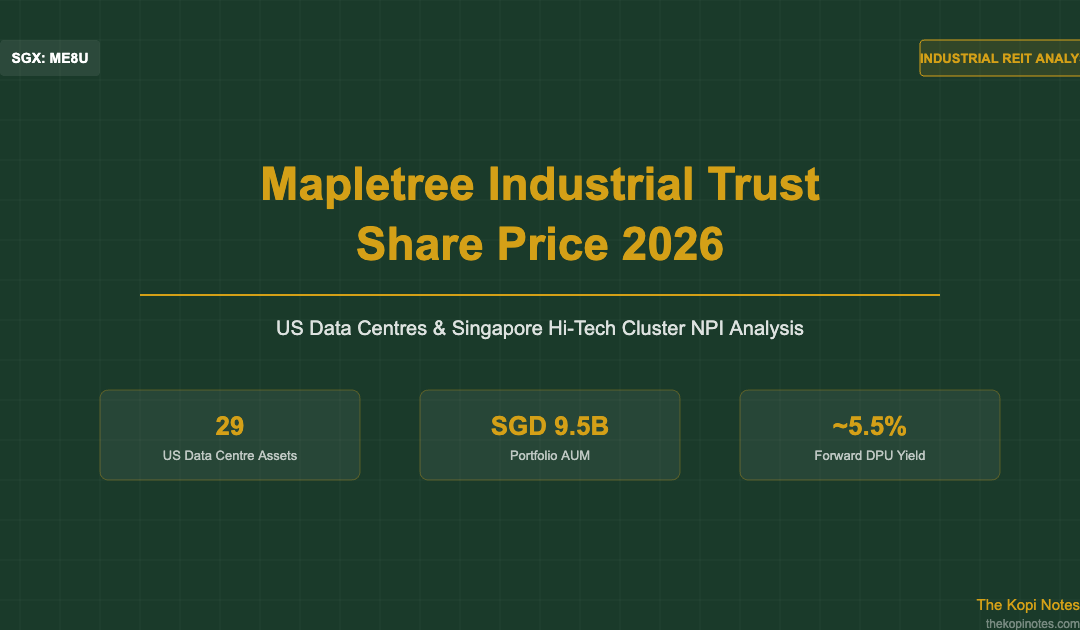
Mapletree Industrial Trust Share Price 2026: US Data Centres & Singapore Hi-Tech Cluster NPI Analysis
SGX: ME8U · Deep-dive into the 29-asset US data centre JV, Singapore hi-tech cluster demand, and Q4 2026 DPU outlook for Singapore investors.
Mapletree Industrial Trust (SGX: ME8U) is Singapore’s largest industrial REIT by market capitalisation, managing a SGD 9.5 billion portfolio that spans 29 US data centres (held via a 50% JV stake), 13 Singapore hi-tech buildings, 85 flatted factories, and 13 business parks. As at Q3 2026, the US data centre JV continues to post near-full occupancy at approximately 98.5%, while Singapore hi-tech cluster demand from semiconductor and biomedical tenants has tightened available space to historic lows. At the current share price of around SGD 2.35, MIT’s forward DPU yield of approximately 5.5% positions it as a high-quality income REIT for Singapore investors seeking exposure to data centre growth without a pure-play premium valuation.
Not financial advice. All figures are for educational reference only. Data as at Q3 2026 unless noted.
Table of Contents
Contents — Click to expand
- What Is Mapletree Industrial Trust (ME8U)?
- MIT Share Price Performance in 2026
- US Data Centre JV: Occupancy, WALE & Growth Drivers
- Singapore Hi-Tech Cluster: Demand Analysis Q3 2026
- NPI Breakdown by Segment
- DPU Outlook: FY2026/27 Forecast
- Valuation & Investment Case
- Risks to Consider
- Frequently Asked Questions
What Is Mapletree Industrial Trust (ME8U)?
Mapletree Industrial Trust (MIT) is an industrial REIT listed on the Singapore Exchange (SGX) in October 2010, managed by Mapletree Industrial Trust Management Ltd — a subsidiary of Mapletree Investments Pte Ltd, itself wholly owned by Temasek Holdings. MIT was Singapore’s first REIT to provide exposure to US data centres, having completed its first JV acquisition in 2017.
As at Q3 2026, MIT’s portfolio comprises approximately 161 properties across two countries — Singapore and the United States — with a total assets under management (AUM) of approximately SGD 9.5 billion. The REIT holds a 50% stake in the Mapletree Rosewood Data Centre Trust, which owns 29 data centre properties across major US tech hubs including Northern Virginia, Silicon Valley, Dallas, and Chicago. This JV structure allows MIT to count 50% of the data centres’ NPI in its consolidated financials while sharing capital expenditure requirements with its partner.
The four main property segments are: US Data Centres (via JV), Singapore Hi-Tech Buildings, Singapore Flatted Factories & Stack-up/Ramp-up Buildings, and Singapore Business Parks. Of these, the US data centres and Singapore hi-tech buildings command the highest per-square-foot rents and longest WALEs, making them the NPI quality drivers even as flatted factories contribute the largest property count.
MIT Share Price Performance in 2026
Mapletree Industrial Trust share price has traced a gradual recovery arc through 2026, rising from a multi-year low of SGD 2.05 in January to a Q3 2026 range of SGD 2.25–2.45. This recovery has been driven by two converging tailwinds: the global rate-cut cycle reducing refinancing pressure on MIT’s approximately 37% gearing ratio, and renewed hyperscaler and enterprise demand for US colocation data centre capacity.
| Metric | Value (Q3 2026 Est.) |
|---|---|
| SGX Ticker | ME8U (SGD-denominated units) |
| Share Price (Q3 2026) | ~SGD 2.30–2.45 |
| Market Capitalisation | ~SGD 5.8–6.0 billion |
| Total AUM | ~SGD 9.5 billion |
| Gearing Ratio | ~36.8% |
| P/NAV Ratio | ~1.08x (NAV/unit: ~SGD 2.17) |
| Annualised Forward DPU | ~SGD 0.1296 per unit |
| Forward Distribution Yield | ~5.5% (at SGD 2.35) |
Source: SGX filings, MIT quarterly investor presentations, Q3 2026. Figures are estimates by The Kopi Notes and may differ from official reporting. Not financial advice.
For context on the broader S-REIT recovery story in 2026, see our guide to the best S-REITs in Singapore 2026, which covers peer comparison across yield, gearing, and portfolio quality metrics.
US Data Centre JV: Occupancy, WALE & Growth Drivers
The 29-asset US data centre portfolio is MIT’s highest-NPI-per-sqft segment and the primary reason institutional investors have re-rated the stock upward in 2026. Held through the Mapletree Rosewood Data Centre Trust JV at 50%, the portfolio is predominantly located in Northern Virginia (the world’s largest data centre hub), Silicon Valley, Texas, and Illinois.
Key US data centre metrics as at Q3 2026:
- Portfolio occupancy: approximately 98.5% — near-full, with limited vacancy risk
- Weighted Average Lease Expiry (WALE) by NLA: approximately 6.4 years — one of the longest WALEs in MIT’s portfolio, providing income visibility
- Tenant mix: hyperscalers (cloud providers) represent approximately 65% of US DC NPI; remaining 35% is enterprise co-location tenants
- Rental reversion trend: positive in 2026, with new leases and renewals 8–12% above expiring rents as AI workload demand drives pricing power
- Capex runway: select data centres have been approved for power and cooling capacity upgrades to accommodate GPU-dense AI server deployments
The AI infrastructure buildout cycle — driven by hyperscaler spending on GPU clusters and inference compute — has directly benefited MIT’s US data centres. Northern Virginia saw record data centre absorption in H1 2026, with available power (the binding constraint for new builds) down to near-zero in the Ashburn/Loudoun County corridor. This supply tightness has supported above-market rental reversions for MIT’s existing leases.
For Singapore investors seeking passive income in Singapore, MIT’s data centre exposure provides a structural growth angle that distinguishes it from traditional office and retail REITs.
Singapore Hi-Tech Cluster: Demand Analysis Q3 2026
MIT’s 13 Singapore hi-tech buildings are clustered in established industrial estates — Toa Payoh, Kallang, Woodlands, and Ayer Rajah — and cater to tenants in semiconductors, biomedical devices, precision engineering, and electronics manufacturing. These buildings command rents of SGD 3.50–5.80 per sqft per month (versus SGD 1.20–2.20 for flatted factories), reflecting the superior specifications (higher floor loading, clean rooms, temperature control).
Demand indicators as at Q3 2026 are encouraging:
- Hi-tech building occupancy: approximately 96.2% — above the Singapore industrial average
- Rental reversion: +5.8% on average for leases renewed in Q3 2026, reflecting scarce good-quality hi-tech industrial supply
- Government tailwind: Singapore’s RIE 2025 framework continues to fund semiconductor and biomedical R&D, supporting tenant clusters in MIT’s buildings
- AEI pipeline: two hi-tech buildings earmarked for asset enhancement, with completion expected in FY2026/27 — potential uplift of SGD 4–6M NPI upon stabilisation
By contrast, MIT’s flatted factories — which account for approximately 53% of property count but only ~18% of NPI — continue to face slower demand as Singapore’s industrial policy discourages low-value-add manufacturing. Occupancy for flatted factories stands at approximately 91.5%, and while it is above JTC’s national average, this segment faces rental reversion pressure of flat to minus 2% at renewal.
NPI Breakdown by Segment
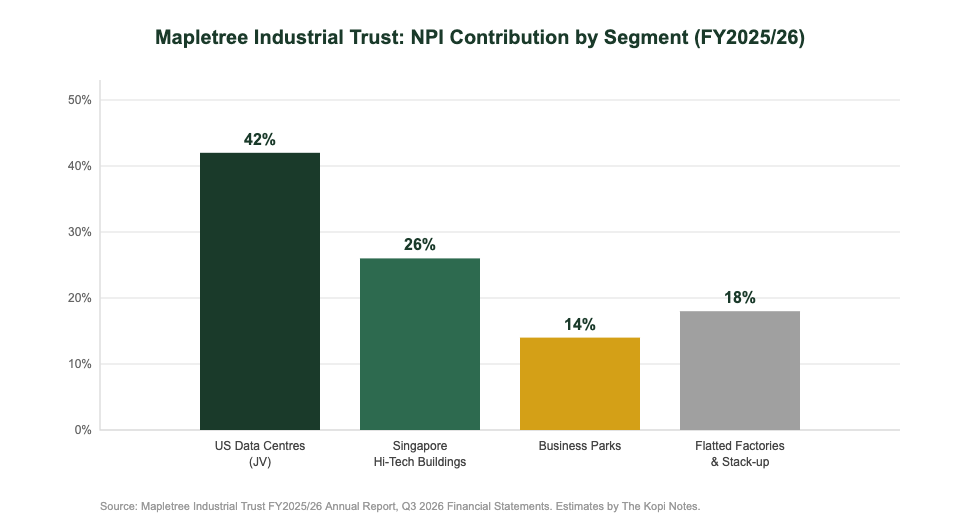
The chart below illustrates the estimated NPI contribution by segment for FY2025/26. While US data centres represent only 29 of MIT’s ~161 properties, they account for an estimated 42% of total NPI — underscoring why the JV performance is the dominant share price catalyst.
DPU Outlook: FY2026/27 Forecast
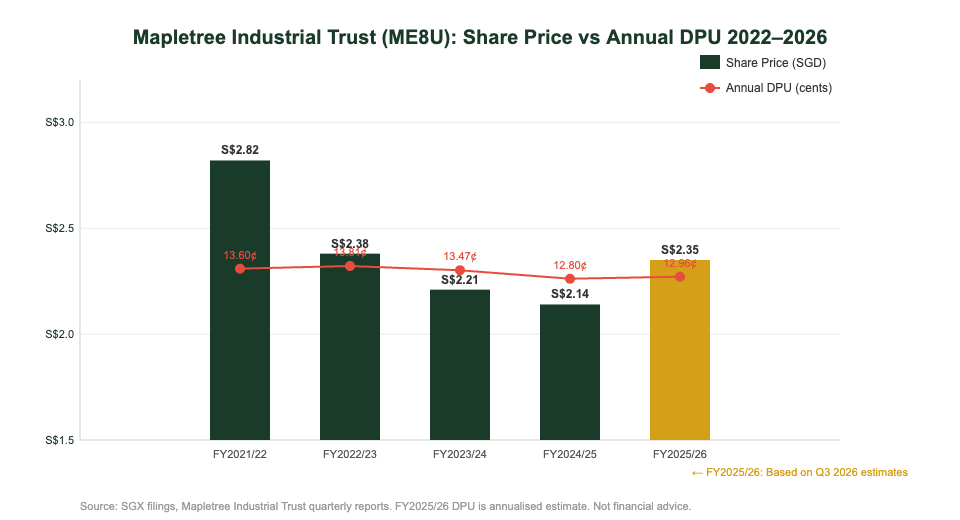
MIT’s distribution per unit (DPU) has trended lower since FY2022/23 as rising interest costs compressed distributable income despite stable NPI. However, the rate-cut cycle that began in late 2024 and accelerated through 2025–2026 has meaningfully reduced this headwind. MIT hedges approximately 80% of its interest rate exposure through fixed-rate instruments and interest rate swaps, meaning the benefit of rate cuts flows through gradually as hedges roll off.
The DPU recovery case for FY2026/27 rests on three pillars:
- Falling interest cost: As 2022–2023 vintage fixed-rate borrowings are refinanced at 2026 rates (approximately 3.5–4.0% vs 5.0–5.5% peak), interest savings of SGD 15–20M annually are expected to flow through to DPU
- US data centre rental reversions: Positive renewal spreads of +8–12% on expiring US leases add approximately SGD 5–8M to NPI in FY2026/27
- Singapore hi-tech AEI completions: SGD 4–6M incremental NPI from completed asset enhancements
Factoring in these tailwinds against ongoing management fees, forex hedging costs (USD-SGD), and conservative occupancy assumptions, The Kopi Notes estimates MIT’s FY2026/27 DPU at approximately SGD 0.133–0.138 per unit — a recovery of 2.6–6.5% versus the FY2025/26 run rate. At SGD 2.35 per unit, this implies a forward yield of approximately 5.7–5.9%.
The chart below illustrates the MIT share price and annual DPU trajectory from FY2021/22 through FY2025/26.
Valuation & Investment Case
At approximately SGD 2.35 per unit, MIT trades at a price-to-NAV (P/NAV) of roughly 1.08x — a slight premium to book value. For a REIT with data centre exposure, near-full occupancy across key segments, and a recovery DPU trajectory, a slight premium to NAV is not unusual. Comparable pure-play data centre REITs globally trade at 1.3–1.8x P/NAV.
The investment case for MIT in Q4 2026 can be framed for two types of Singapore investors:
For the income-focused investor: MIT’s forward yield of ~5.5–5.9% compares favourably with the current Singapore T-bills 2026 yield of approximately 2.8–3.2% (6-month) and Singapore Savings Bonds at approximately 2.5–3.0%. Against risk-free alternatives, MIT’s yield spread of ~250–300bps compensates for REIT-specific risks (gearing, FX, tenant concentration).
For the growth-oriented investor: The AI data centre demand cycle provides a structural earnings growth lever that most traditional S-REITs lack. If hyperscaler demand continues to drive above-market US data centre rental reversions, the NPI upside could exceed the current consensus, potentially supporting a higher share price target of SGD 2.50–2.60 by mid-2027.
For those building a diversified REIT portfolio with MIT as a core holding, our Singapore retirement calculator can help model how MIT’s projected 5.5–5.9% yield compounds over a 20–30 year accumulation horizon. You can access MIT units through Syfe (simplest for beginners, use code SRPRFFFCD) or FSMOne (low commission for frequent investors, use code P0544985).
Risks to Consider
No REIT investment is without risk. For MIT specifically, Singapore investors should be aware of the following:
- USD/SGD currency risk: Approximately 42% of MIT’s NPI originates from US dollar-denominated data centre income. A significant SGD appreciation against the USD would reduce distributable income in SGD terms. MIT partially mitigates this through currency hedging.
- US data centre concentration: While the 29 US data centres are geographically diversified, Northern Virginia accounts for the largest portion. Any regulatory change affecting data centre energy consumption or zoning in Virginia could impact occupancy or expansion plans.
- Gearing headroom: At ~37% gearing, MIT has approximately 8–10% headroom before the MAS 50% regulatory limit. While this is adequate, a significant acquisition would require either equity fundraising (dilutive to unitholders) or asset disposals.
- Singapore flatted factory demand: The ongoing restructuring of Singapore’s economy away from low-value manufacturing puts long-term pressure on flatted factory occupancy and rents. This segment may see gradual reduction in MIT’s overall portfolio contribution over time.
- Hyperscaler lease concentration: Approximately 65% of US data centre NPI comes from hyperscale tenants. While these are investment-grade counterparties, non-renewal of a major hyperscaler lease could materially impact NPI given the large individual unit sizes.
For a broader overview of S-REIT risks and sector comparison, see our guide to the moomoo Singapore review 2026 for broker platform options, or explore the passive income Singapore guide for portfolio construction principles.
Frequently Asked Questions
What is Mapletree Industrial Trust (ME8U) and why do Singapore investors buy it?
Mapletree Industrial Trust (SGX: ME8U) is a Singapore-listed industrial REIT managed by a subsidiary of Temasek Holdings’ Mapletree Investments. Singapore investors buy MIT primarily for its diversified industrial portfolio that includes data centres, hi-tech buildings, and flatted factories — offering both income stability from Singapore leases and growth exposure from the 29-asset US data centre joint venture. As at Q3 2026, it offers a forward distribution yield of approximately 5.5%, paid quarterly.
How does MIT's US data centre JV affect the DPU?
MIT holds a 50% interest in the Mapletree Rosewood Data Centre Trust, which owns 29 US data centres. The JV’s NPI (net property income) is proportionally consolidated, meaning 50% of the US data centre NPI flows into MIT’s distributable income. In FY2025/26, this is estimated to contribute approximately 42% of total NPI. Positive rental reversions in the US — driven by AI data centre demand — are therefore a meaningful positive catalyst for MIT’s DPU growth in FY2026/27.
What is Mapletree Industrial Trust's current dividend yield in 2026?
Based on a Q3 2026 share price of approximately SGD 2.35 and an annualised DPU estimate of SGD 0.1296 per unit, MIT’s forward distribution yield is approximately 5.5%. If the FY2026/27 DPU recovers to the estimated SGD 0.133–0.138 range (driven by interest cost savings and rental reversion upside), the yield at the same price rises to approximately 5.7–5.9%. Distributions are paid quarterly, typically in June, September, December, and March.
Can I buy Mapletree Industrial Trust (ME8U) using CPF or SRS?
Yes. ME8U is listed on the Singapore Exchange (SGX) and is eligible for investment using both CPF Ordinary Account (OA) funds under the CPF Investment Scheme (CPFIS-OA) and Supplementary Retirement Scheme (SRS) funds. However, CPF investment involves certain eligibility and withdrawal-on-sale conditions — investors should verify their CPFIS eligibility on the CPF Board website before investing. SRS investment is generally more straightforward and can be done through most Singapore brokerages.
What is MIT's gearing ratio and is it safe?
As at Q3 2026, Mapletree Industrial Trust’s aggregate leverage (gearing) ratio is estimated at approximately 36.8% — comfortably below the MAS regulatory limit of 50% for Singapore REITs. This gives MIT headroom of approximately 13 percentage points before hitting the cap, equivalent to roughly SGD 1.2 billion in additional debt capacity. The REIT has a well-distributed debt maturity profile and approximately 80% of its interest rate exposure is hedged, providing earnings stability as rates decline.
How does Mapletree Industrial Trust compare to Keppel DC REIT for data centre exposure?
Both MIT and Keppel DC REIT (AJBU.SI) offer Singapore investors data centre exposure, but with different risk profiles. Keppel DC REIT is a pure-play data centre REIT with higher valuation multiples (P/NAV typically 1.3–1.6x) and a broader geographic footprint including Asia and Europe. MIT trades at approximately 1.08x P/NAV with a higher headline yield (~5.5% vs KDCR’s ~3.5–4.5%), offering data centre growth exposure at a more value-oriented entry point. The trade-off is that MIT’s data centre income is diluted by flatted factories and business parks, whereas KDCR is 100% focused on data centres.
Start Investing in Singapore REITs Today
Buy ME8U through these platforms with exclusive sign-up bonuses available for new accounts.
This article was researched with the help of AI. While we strive to keep all information accurate and up to date, there may be errors. If you notice any discrepancies, please contact us.