ILP vs ETF Singapore: Which Grows Your Wealth More in 2026?
An investment-linked policy (ILP) is a Singapore life insurance product that bundles death coverage with unit-linked fund investments — sold by insurers like AIA, Prudential, and Manulife. An ETF (exchange-traded fund) like CSPX tracks the S&P 500 at just 0.07% per year in fees. Because ILPs carry total annual costs of 2.5%–4.5% in early years versus under 0.3% for ETFs, the long-term wealth gap between the two can exceed S$200,000 on a S$100,000 initial investment over 20 years.
Not financial advice. All figures are for educational reference only. Data verified as at October 2026 unless noted. Speak to a licensed financial adviser before making any investment or insurance decision.
What Is an Investment-Linked Policy (ILP)?
An investment-linked policy is a life insurance product regulated by the Monetary Authority of Singapore (MAS) under the Insurance Act. Unlike a traditional whole-life or endowment plan, an ILP does not guarantee returns — instead, your premium (after charges) is used to purchase units in one or more sub-funds managed by the insurer.
These sub-funds invest in equities, bonds, or balanced portfolios. The insurance component pays a death benefit if you pass away during the policy term. The investment component’s performance is entirely market-linked — meaning it can go up or down.
Key ILP Components
ILPs carry several overlapping cost layers that most buyers don’t fully appreciate at purchase:
- Premium Allocation Charge: Some ILPs allocate only 60–100% of your premium to investment units in years 1–2. The rest goes to distribution and setup costs.
- Fund Management Charge (FMC): Typically 0.75%–2.50% p.a., deducted daily from fund assets. This is similar to an ETF’s TER but significantly higher.
- Mortality & Expense (M&E) Charge: Covers the cost of the death benefit. Varies by age and sum assured. For a 35-year-old male with S$200,000 death benefit, this might be S$25–S$60/month.
- Policy Administration Fee: S$6–S$10/month, deducted by cancelling units.
- Surrender Charge: 5%–15% if you exit in years 1–5. This creates liquidity risk if your circumstances change.
MAS now requires all ILP products to disclose a Reduction in Yield (RIY) figure, which represents the total annual drag from all charges expressed as a percentage. For most regular-premium ILPs in Singapore, the RIY runs between 2.5% and 4.5% p.a. in the first 10 years.
For deeper context on how ILPs compare within the insurance space, see our ILP vs Endowment Plan Singapore 2026 comparison, or our ILP vs Buy Term Invest the Rest analysis.
What Is an ETF?
An ETF (exchange-traded fund) is a basket of securities — stocks, bonds, or REITs — that trades on a stock exchange like a single share. Singapore investors most commonly use LSE-listed UCITS ETFs to avoid US estate tax exposure:
- CSPX (iShares Core S&P 500 UCITS ETF): Tracks the S&P 500 index. TER: 0.07% p.a. (iShares factsheet, August 2026). Listed on the London Stock Exchange in USD.
- VWRA (Vanguard FTSE All-World UCITS ETF Acc): Tracks ~4,000 global stocks. TER: 0.22% p.a. Accumulating (dividends reinvested). LSE-listed.
Unlike an ILP, an ETF has:
- No surrender charges — you can sell any day the market is open
- No mortality charges — it is a pure investment vehicle with no life cover bundled in
- No premium allocation charges — 100% of your investment goes to work immediately
- Full transparency — holdings are disclosed daily
The trade-off: ETFs provide no life insurance coverage. If you need death cover, you would need to buy a separate term policy (typically the “Buy Term, Invest the Rest” strategy).
The Fee Gap: ILP vs ETF Costs Compared
The fundamental problem with ILPs as a wealth-building tool is not that they’re “bad products” — it’s that their cost structure makes long-term wealth compounding significantly harder. Here’s a side-by-side breakdown:
| Cost Component | ILP (Typical) | CSPX ETF | VWRA ETF |
|---|---|---|---|
| Fund Management Charge | 0.75–2.50% p.a. | 0.07% p.a. | 0.22% p.a. |
| Insurance / Mortality Charge | 0.5–3.0% p.a. (age-dependent) | None | None |
| Policy / Admin Fee | S$6–S$10/month | None | None |
| Premium Allocation Charge | 0–40% (years 1–2) | None | None |
| Surrender Charge | 5–15% (years 1–5) | None | None |
| Total RIY (Early Years) | 2.5–4.5% p.a. | 0.07% p.a. | 0.22% p.a. |
Source: MAS ILP disclosure requirements (RIY basis), iShares CSPX factsheet (August 2026), Vanguard VWRA factsheet. ILP costs are indicative ranges across common SG market products.
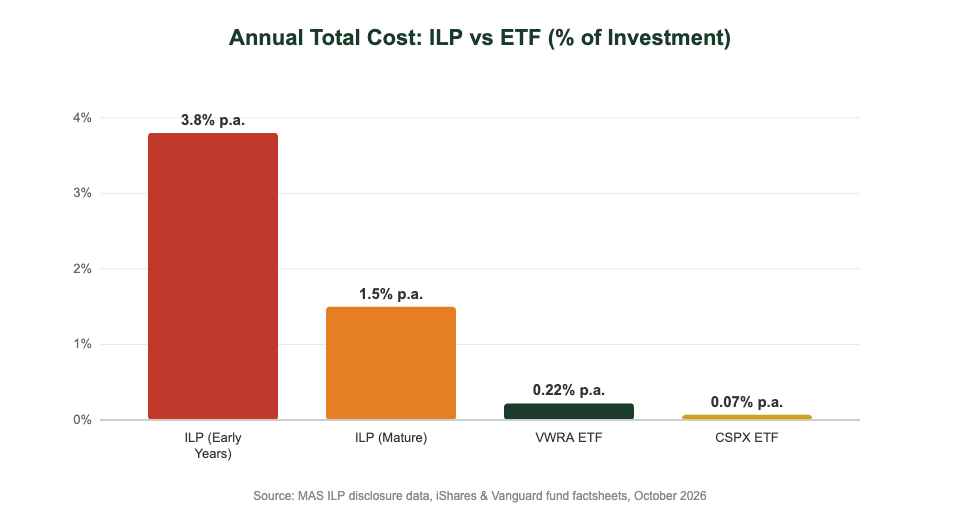
To put annual fees in dollar terms, here’s what different portfolio sizes pay each year:
| Portfolio Size | ILP Fee (3.8% p.a.) | CSPX ETF (0.07% p.a.) | Annual Difference |
|---|---|---|---|
| SGD 10,000 | S$380 | S$7 | S$373 |
| SGD 50,000 | S$1,900 | S$35 | S$1,865 |
| SGD 100,000 | S$3,800 | S$70 | S$3,730 |
| SGD 500,000 | S$19,000 | S$350 | S$18,650 |
Illustrative. Based on 3.8% p.a. RIY for typical regular-premium ILP in early years (MAS disclosure data), vs CSPX TER of 0.07% p.a. (iShares, October 2026). Actual ILP fees vary by product and age.
20-Year Wealth Simulation (SGD 100,000 Initial Investment)
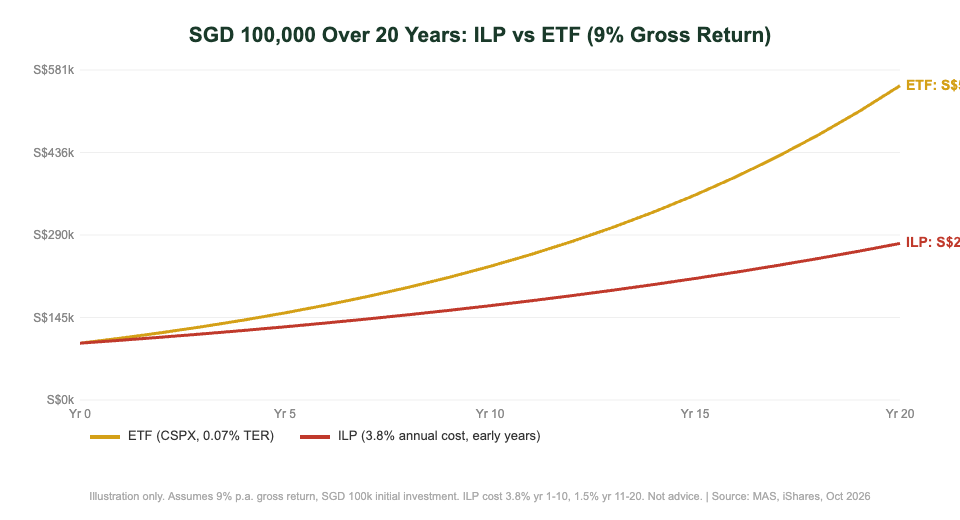
To illustrate the compounding impact of cost differences, consider a Singapore investor placing SGD 100,000 at age 35. We assume a 9% p.a. gross return (approximate historical S&P 500 long-run average), with the ILP carrying 3.8% p.a. total cost in years 1–10 and 1.5% p.a. in years 11–20 (as costs reduce after the surrender period).
| Year | ETF (CSPX, 0.07% cost) | ILP (3.8% yr 1–10, 1.5% yr 11–20) | Wealth Gap |
|---|---|---|---|
| Year 5 | ~S$153,000 | ~S$129,000 | S$24,000 |
| Year 10 | ~S$234,000 | ~S$166,000 | S$68,000 |
| Year 15 | ~S$357,000 | ~S$238,000 | S$119,000 |
| Year 20 | ~S$546,000 | ~S$342,000 | S$204,000 |
Illustration only. Assumes S$100,000 lump-sum, 9% p.a. gross return, ILP total cost 3.8% p.a. years 1–10 and 1.5% p.a. years 11–20. No withdrawals. Not a guarantee or projection. Does not account for actual fund performance, which varies. Source: Illustrative calculation, October 2026.
That S$204,000 gap — equivalent to more than two years of a median Singapore household income — is the compounding cost of higher fees over 20 years. Even if the ILP’s sub-funds slightly outperformed the S&P 500, it would need to consistently beat the ETF by ~2% p.a. net of all charges to break even. Very few actively managed funds sustain such outperformance over two decades.
When an ILP Makes Sense
Despite the cost disadvantage for pure wealth accumulation, ILPs are not universally bad. There are specific circumstances where they remain relevant:
- You need both insurance and investment in one wrapper: If you have limited income and cannot afford separate term cover plus a brokerage account, an ILP offers a bundled solution. However, the bundling premium is high — quantify the cost before signing.
- You have severe financial self-discipline issues: ILPs are illiquid (surrender charges for 5–10 years). For investors who might otherwise spend any accessible savings, the forced lock-in can be a practical behavioural constraint.
- CPF Investment Scheme (CPFIS) ILPs: Certain ILPs are CPFIS-approved, allowing you to invest OA funds that would otherwise earn only 2.5% in CPF. If you have excess OA funds above the Basic Retirement Sum and want market exposure via CPF, a CPFIS ILP might be relevant. Always compare against CPFIS-approved ETFs first.
- Premium holiday features: Some ILPs allow you to pause premiums during unemployment or financial difficulty, with the policy sustained from sub-fund units. This flexibility is not available with a standalone ETF account.
Our ILP sub-fund switching guide covers how to optimise your ILP’s investment allocation if you already own one.
When an ETF Wins
For the majority of Singapore investors focused on building long-term wealth, ETFs win on cost, transparency, and flexibility. Specifically:
- Pure wealth accumulation: If your goal is to grow a lump sum over 10–30 years and you can handle volatility, an ETF like CSPX or VWRA is demonstrably more cost-efficient. The S$204,000 simulation gap above is not a theoretical edge case — it’s what average fees do to compounding.
- You already have term life insurance: If you’ve separated your insurance and investment needs (term policy for death cover; ETF for growth), you have no reason to pay the bundling premium of an ILP.
- You want full liquidity: ETFs can be sold on any trading day. No surrender charges, no lock-in period. This is critical if your life circumstances change.
- Tax efficiency: Ireland-domiciled UCITS ETFs like CSPX and VWRA are not subject to US estate tax on the underlying holdings (unlike buying US-domiciled SPY or VOO directly). Singapore imposes no capital gains tax. This combination makes LSE-listed UCITS ETFs highly tax-efficient for Singapore investors.
- Building toward passive income in Singapore: Larger ETF portfolios generate dividends or capital growth that can eventually supplement salary income — a goal best served by minimising fee drag from day one.
If you’re planning for retirement, try our Singapore retirement calculator to model how different fee scenarios affect your final nest egg.
How to Get Started with Each
Starting with ETFs in Singapore
To buy CSPX or VWRA in Singapore, you need a brokerage account that provides access to the London Stock Exchange. The most common options:
- Interactive Brokers (IBKR): Lowest cost for active ETF investors. Commissions from ~US$1.70 per trade. No custody fee for ETF holdings. Requires a minimum initial deposit but no ongoing minimum balance.
- Syfe Trade: User-friendly Singapore broker. Syfe also offers managed portfolios for investors who prefer a hands-off approach. Use the Syfe referral code SRPRFFFCD for a sign-up bonus.
- Endowus: Best for CPF and SRS investing. Endowus’s Fund Smart platform lets you access low-cost ETF-equivalent funds using CPF-OA or SRS funds. Use the Endowus referral code 2V343 for S$20 off advisory fees.
- FSMOne: Singapore-based broker with RSP (Regular Savings Plan) function for automated monthly ETF purchases. No custody fee on SGX-listed ETFs; small custody fee for LSE-listed ETFs. See the FSMOne referral code page for the latest promotions.
Starting with an ILP
ILPs are sold through licensed financial advisers (FAs) in Singapore. You cannot buy them directly online without FA involvement, by MAS regulation. When speaking to an FA about an ILP:
- Ask for the Product Summary and Benefit Illustration — both are legally required disclosures
- Look for the RIY figure on the Benefit Illustration — this is your total annual cost drag in one number
- Compare the ILP’s projected returns in the Benefit Illustration at 4.75% and 9% gross (MAS-mandated illustration rates) against what you would achieve investing the same amount directly in CSPX or VWRA
- Check the surrender schedule — understand exactly what you would receive if you terminated the policy in years 1, 3, 5, and 10
Frequently Asked Questions
Is an ILP better than an ETF for Singapore investors?
What is the average RIY for ILPs in Singapore?
Can I invest in ETFs using my CPF funds?
What happens to an ILP's investment component when I die?
Can I switch my ILP sub-funds to reduce fees?
Is it safe to buy ETFs like CSPX in Singapore?
Get Free Insurance Advice
Speak with a licensed insurance advisor. No obligation, no cost.
By submitting this form, you agree to our Privacy Policy.
This article was researched with the help of AI. While we strive to keep all information accurate and up to date, there may be errors. If you notice any discrepancies, please contact us.