Best ETFs for Your SRS Account in Singapore (2026 Guide)
Maximise tax savings and long-term growth with Ireland-domiciled UCITS ETFs — the smart way to invest your SRS contributions in 2026.
The best ETFs for your SRS account in Singapore are Ireland-domiciled UCITS ETFs listed on the London Stock Exchange (LSE) — specifically CSPX, VWRA, and SPYL. These funds avoid US estate tax exposure, attract only 15% withholding tax on US dividends (versus 30% for US-listed ETFs), and deliver broad global diversification. Buying them through an SRS-eligible broker lets your contributions grow tax-deferred until retirement.
Not financial advice. All figures are for educational reference only. Data as at September 2026 unless noted.
Table of Contents
Contents — Click to expand
- What Is the SRS Account?
- SRS Contribution Limits and Tax Benefits 2026
- Why LSE-Listed ETFs Are Best for SRS Investing
- Best ETFs for SRS Account (2026 Comparison)
- How to Buy ETFs Through Your SRS Account
- SRS-Eligible Brokers for ETF Investing
- Who Should Use SRS + ETF Investing?
- Frequently Asked Questions
What Is the SRS Account?
The Supplementary Retirement Scheme (SRS) is a voluntary savings programme administered by the Ministry of Finance and managed through three banks — DBS, OCBC, and UOB. Unlike CPF, SRS contributions are fully voluntary and can be invested in a wide range of instruments including stocks, unit trusts, bonds, and — critically — exchange-traded funds (ETFs) listed on approved exchanges.
The defining benefit of the SRS is its tax structure. Every dollar you contribute to your SRS account reduces your taxable income for that year. When you withdraw at or after the statutory retirement age (63 years as at 2026), only 50% of the amount withdrawn is taxable — and spread over up to 10 years, most retirees pay little to no tax on withdrawals.
For Singapore investors who are already maximising their CPF contributions and looking for additional tax-advantaged growth, the SRS is the next logical step — especially when the funds are invested rather than left sitting in cash earning negligible interest.
SRS Contribution Limits and Tax Benefits 2026
Annual SRS contribution limits differ by residency status. Singaporeans and Permanent Residents may contribute up to SGD 15,300 per year, while foreigners may contribute up to SGD 35,700 per year. These limits have remained unchanged since 2016, though the government reviews them periodically.
| Item | Singaporeans / PRs | Foreigners |
|---|---|---|
| Annual SRS Cap | SGD 15,300 | SGD 35,700 |
| Tax Deduction | Full contribution deducted from chargeable income | Full contribution deducted from chargeable income |
| Tax Savings at 15% Bracket | ~SGD 2,295/year | ~SGD 5,355/year |
| Withdrawal Tax | 50% of withdrawal is taxable (10-year window from age 63) | 50% of withdrawal is taxable (10-year window) |
| Penalty for Early Withdrawal | 5% penalty + 100% of withdrawn amount taxable | 5% penalty + 100% of withdrawn amount taxable |
Source: Ministry of Finance Singapore, IRAS, SRS guidelines effective 2026.
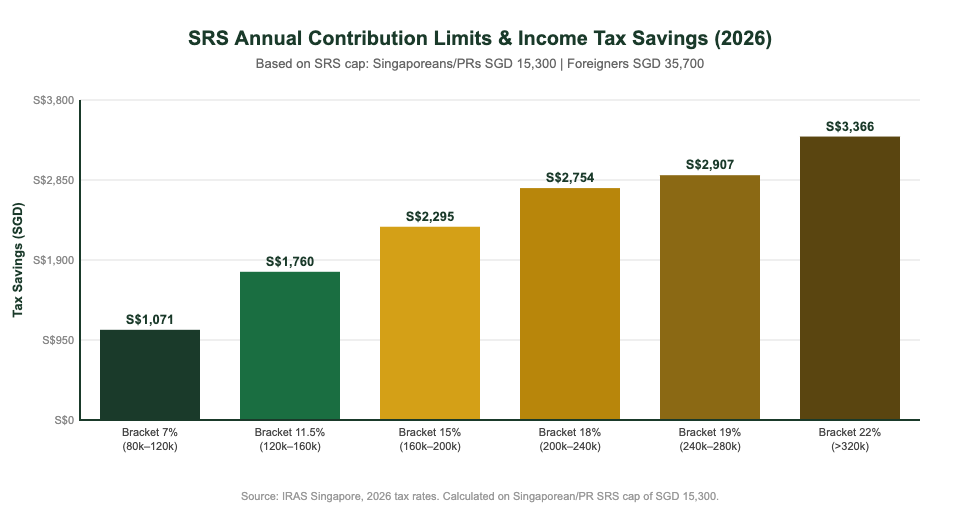
The key insight: if you are in the 15% tax bracket (chargeable income SGD 160,000–200,000), contributing the full SGD 15,300 saves you approximately SGD 2,295 in tax this year. That is an immediate 15% guaranteed return before your investments earn a single cent.
Why LSE-Listed ETFs Are Best for SRS Investing
Once your SRS cash is in the account, it needs to be invested — leaving it in the SRS cash account earns only 0.05% per annum. Most Singapore investors default to unit trusts or Singapore-listed ETFs, but Ireland-domiciled UCITS ETFs on the London Stock Exchange offer superior tax efficiency for SRS investors.
There are two critical tax reasons to choose LSE-listed over US-listed ETFs for your SRS account:
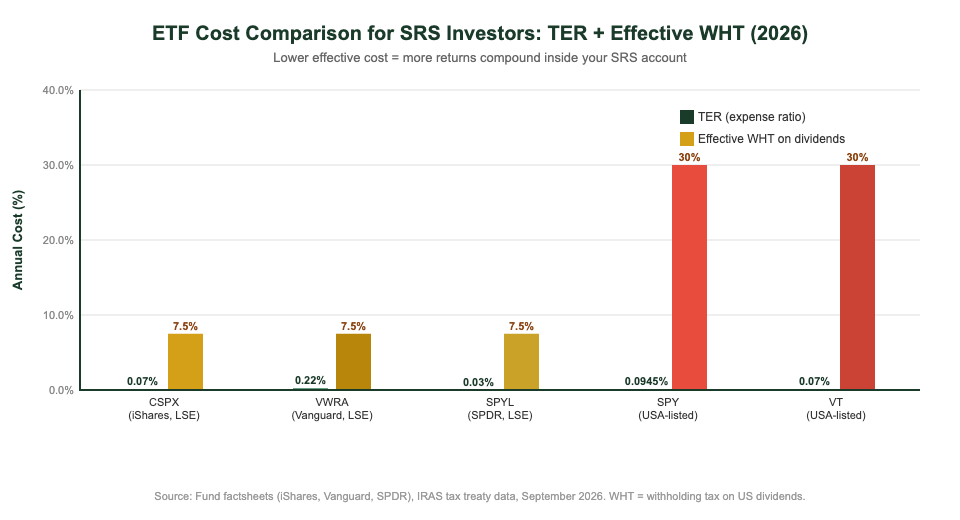
1. Lower Withholding Tax (15% vs 30%): US companies pay dividends subject to withholding tax. When a US-domiciled ETF (like SPY or VT) receives these dividends, the full 30% US withholding tax is deducted before distributions reach you. Ireland-domiciled ETFs benefit from the Ireland-US tax treaty, which reduces this withholding to 15%. Over a 20-year SRS investment horizon, that 15% difference compounds significantly.
2. No US Estate Tax Exposure: Non-resident aliens (which includes all Singapore investors) face a USD 60,000 estate tax threshold on US-domiciled assets. A Singapore investor with SGD 500,000 in SPY would be exposed to US estate tax on amounts above USD 60,000. Ireland-domiciled ETFs are not US situs assets — they carry zero US estate tax risk regardless of portfolio size. For your CPF investment strategy Singapore, this distinction is important to understand.
| Factor | LSE UCITS ETF (Ireland) | US-Listed ETF (USA) |
|---|---|---|
| US Dividend WHT | 15% | 30% |
| US Estate Tax Risk | None | Yes (above USD 60k) |
| Singapore Capital Gains Tax | None | None |
| Accumulating Structure Available | Yes (CSPX, VWRA, SPYL) | Rare |
| SRS Compatibility | Yes (via eligible brokers) | Yes (via eligible brokers) |
Source: IRAS, IRS Publication 515, iShares fund prospectus, September 2026.
For SRS investors specifically, the accumulating structure of most LSE UCITS ETFs is an additional advantage. Distributions are reinvested within the fund automatically, meaning there is no taxable event triggered inside your SRS account — your full investment compounds uninterrupted until withdrawal.
Best ETFs for SRS Account (2026 Comparison)
These are the top ETFs Singapore investors use for SRS investing in 2026. All are listed on the London Stock Exchange, domiciled in Ireland, and available through SRS-eligible brokers including Interactive Brokers and Saxo. The goal is broad diversification at low cost — your SRS contributions should be working as hard as possible over a 20–30 year horizon.
| ETF | Ticker (LSE) | Index Tracked | TER | Structure | AUM | Best For |
|---|---|---|---|---|---|---|
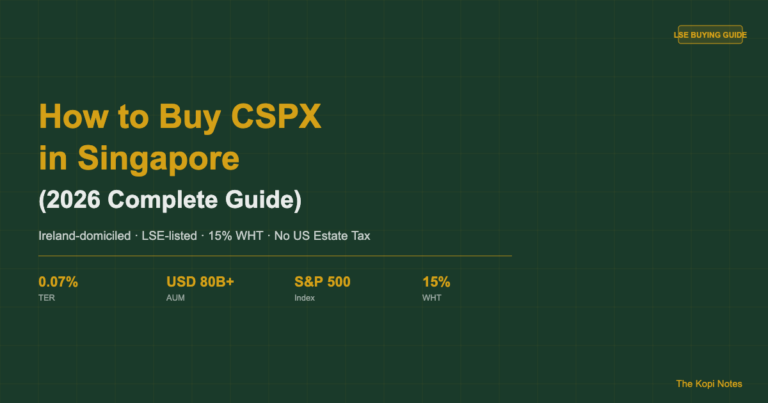
| iShares Core S&P 500 | CSPX | S&P 500 | 0.07% | Accumulating | USD 80bn+ | US large-cap focus |
| Vanguard FTSE All-World | VWRA | FTSE All-World | 0.22% | Accumulating | USD 20bn+ | Global diversification |
| SPDR S&P 500 UCITS | SPYL | S&P 500 | 0.03% | Accumulating | USD 12bn+ | Lowest cost S&P 500 |
| iShares MSCI World | IWDA | MSCI World | 0.20% | Accumulating | USD 70bn+ | Developed markets only |
| iShares Core MSCI Emerging Markets | EIMI | MSCI EM IMI | 0.18% | Accumulating | USD 20bn+ | EM satellite holding |
Source: iShares, Vanguard, SPDR fund factsheets, September 2026. AUM figures approximate.
For most SRS investors, the simplest and most effective choice is one of the following two strategies:
- One-ETF portfolio: VWRA — instant global diversification across 3,700+ companies in 50+ countries. Higher TER (0.22%) but one less decision to make.
- Two-ETF portfolio: 80% CSPX or SPYL + 20% EIMI — lower blended TER (~0.09%), manually rebalanced annually, slightly more hands-on.
Avoid Singapore-listed ETFs (like the Nikko AM STI ETF or Lion-OCBC Securities HSBC STI ETF) for your SRS account if growth is the primary objective — the Singapore market’s concentration in banks and REITs limits diversification, and the long-term returns have historically lagged global indices. For broader passive income Singapore strategies, a hybrid approach may work better.
How to Buy ETFs Through Your SRS Account
Buying ETFs with your SRS account is a three-step process: open an SRS account at a qualifying bank, link your SRS account to an eligible broker, and then invest your SRS balance in LSE-listed ETFs through that broker. Here is a step-by-step walkthrough.
Step 1: Open an SRS Account (if you haven’t)
Open an SRS account at DBS, OCBC, or UOB — any branch or online. You will receive an SRS account number. There is no annual fee and no minimum deposit required to maintain the account.
Step 2: Fund Your SRS Account
Transfer funds from your personal bank account to your SRS account. Contributions are capped at SGD 15,300 per year (Singaporeans/PRs). Transfers must be made before 31 December to qualify for that year’s tax deduction. The deduction appears in your IRAS income tax notice for the following year.
Step 3: Link Your SRS Account to a Brokerage
Not all brokers accept SRS funds for ETF purchases. You must use an SRS-approved operator with connectivity to the SRS system. The main options are:
- Interactive Brokers (IBKR): Most cost-effective for LSE ETFs. IBKR supports SRS funding via a linked bank transfer. Commission from USD 1.70 per trade. Best for portfolios above SGD 30,000. Use referral code jianxiong368 when signing up.
- Saxo Markets: SRS-compatible, SGX-listed ETFs plus LSE access. Higher fees than IBKR but a cleaner interface for beginners.
- FSMOne: SRS-friendly, known for its fund supermart. Good for regular savings plans (RSP) into ETFs. Use the FSMOne referral code P0544985 for cash credits.
- Syfe Brokerage: Simple interface, SRS-eligible. Good entry point for first-time investors. Use the Syfe referral code SRPRFFFCD for sign-up bonus.
Step 4: Place Your ETF Order on the LSE
Once your SRS balance is in your brokerage account, search for the ETF by ticker (e.g. CSPX, VWRA). Select the London Stock Exchange as the exchange. Orders are filled in GBP or USD depending on the ETF. Use limit orders to avoid wide bid-ask spreads, especially for less liquid ETFs. CSPX and VWRA have excellent liquidity on the LSE and spreads are typically under 0.05%.
Worked example for a 15% taxpayer: A Singapore investor earning SGD 170,000 contributes the full SGD 15,300 to their SRS account in December 2026. They save SGD 2,295 in income tax immediately. They then invest SGD 15,000 into CSPX at IBKR (paying ~SGD 3 commission). Assuming 8% p.a. growth over 25 years, that SGD 15,000 grows to approximately SGD 102,000 — all tax-deferred until withdrawal, when only 50% of each withdrawal is taxable. To model your personal numbers, use the Singapore retirement calculator.
SRS-Eligible Brokers for ETF Investing
| Broker | SRS-Eligible | LSE ETF Access | Commission (LSE) | Min. Funding | Best For |
|---|---|---|---|---|---|
| Interactive Brokers | Yes | Yes | USD 1.70/trade | None | Active, cost-conscious |
| Saxo Markets | Yes | Yes | GBP 3–8/trade | SGD 3,000 | Beginners, clean UI |
| FSMOne | Yes | Yes (SGX + overseas) | 0.08% min SGD 10 | None | RSP investors |
| Syfe Brokerage | Yes | Yes | SGD 1.99/trade | None | Simplicity-first |
Source: Broker fee schedules, September 2026. Commissions may vary; verify before trading.
Who Should Use SRS + ETF Investing?
SRS + LSE ETF investing is ideal if you:
- Are in the 11.5% income tax bracket or higher (chargeable income above SGD 80,000)
- Have a 10+ year investment horizon before SRS withdrawal age
- Want a simple, low-cost, globally diversified retirement portfolio
- Already maximise your CPF SA/RA top-ups and are looking for the next tax-advantaged vehicle
- Prefer accumulating ETFs that compound without triggering taxable distributions
Consider alternatives if you:
- Are in the 0% or 2% tax bracket — the SRS tax deduction is less valuable
- Plan to withdraw SRS funds before retirement age (5% penalty + full tax on withdrawal)
- Need Singapore-dollar income streams — LSE ETFs are GBP/USD denominated and carry FX risk
- Prefer dividend-paying instruments — accumulating ETFs do not pay cash dividends
For income-focused investors, Singapore REITs (S-REITs) can complement an SRS ETF strategy. The Singapore REIT ETF guide covers the best S-REIT ETF options for local income exposure. For a broader look at wealth-building, the best S-REITs in Singapore 2026 article compares individual REIT picks. You can also compare Syfe vs Endowus 2026 if you prefer managed portfolio services over DIY ETF investing.
All investment decisions should be made after careful consideration of your personal financial situation, risk tolerance, and goals. Data in this article is as at September 2026 and may change. This is not financial advice.
Frequently Asked Questions
Can I invest my SRS account in ETFs listed on the London Stock Exchange?
Yes. Singapore investors can use their SRS funds to purchase ETFs listed on the London Stock Exchange (LSE) through SRS-eligible brokers such as Interactive Brokers, Saxo Markets, FSMOne, and Syfe Brokerage. The ETFs are purchased in GBP or USD, and the SRS funds are used to settle the trades. Ireland-domiciled UCITS ETFs like CSPX, VWRA, and SPYL are the most popular choices for SRS investors due to their low TER, accumulating structure, and favourable 15% withholding tax rate on US dividends.
What is the best ETF for SRS account in Singapore 2026?
For most Singapore investors, CSPX (iShares Core S&P 500 UCITS ETF) or VWRA (Vanguard FTSE All-World UCITS ETF) are the top choices. CSPX offers exposure to 500 of the largest US companies at an ultra-low TER of 0.07%, while VWRA provides global diversification across 3,700+ companies at 0.22% TER. Both are accumulating ETFs domiciled in Ireland, listed on the LSE, and fully compatible with SRS investing through eligible brokers. SPYL is an alternative to CSPX with an even lower TER of 0.03% but smaller AUM.
How much tax do I save by contributing to SRS?
Your SRS tax savings depend on your marginal income tax rate. For Singaporeans and PRs, the annual SRS cap is SGD 15,300. At a 15% marginal rate (chargeable income SGD 160,000–200,000), you save approximately SGD 2,295 per year. At 18% (SGD 200,000–240,000), you save approximately SGD 2,754. At 22% (above SGD 320,000), savings reach approximately SGD 3,366. Even at lower brackets — 7% or 11.5% — the compounding tax benefit over 20–30 years makes SRS contributions highly attractive.
Are ETF gains inside my SRS account taxed?
No. Investment gains — including capital gains and reinvested dividends within accumulating ETFs — are not taxed while they remain inside your SRS account. Singapore has no capital gains tax, and accumulating ETFs like CSPX and VWRA do not distribute dividends to your account (they reinvest internally), so there is no taxable income event until you withdraw from SRS. Upon withdrawal (from age 63), only 50% of each withdrawal is added to your taxable income for that year.
What happens to my SRS-invested ETFs if I withdraw early?
Early withdrawal from SRS before retirement age (currently 63 for those who reached 55 before 2022, 65 for those who reach 55 from 2030 onwards) incurs a 5% penalty on the full withdrawal amount, and 100% of the withdrawn amount (not just 50%) becomes taxable income. This makes early withdrawal expensive in most cases. If you foresee needing liquidity, it is advisable to maintain a separate emergency fund outside SRS rather than withdrawing from it prematurely.
Is IBKR or FSMOne better for SRS ETF investing?
Interactive Brokers (IBKR) is the more cost-effective choice for larger SRS portfolios (SGD 30,000+) due to its very low commission of approximately USD 1.70 per LSE trade and narrow spreads. FSMOne is more suitable for investors who prefer a Regular Savings Plan (RSP) approach — contributing monthly into ETFs automatically — as it supports RSP and has no minimum trade size. FSMOne also has a user-friendly fund supermart interface. Both are SRS-eligible and support LSE ETF access.
Can I use CPF funds to invest in LSE-listed ETFs like CSPX?
No. The CPF Investment Scheme (CPFIS) does not allow investment in LSE-listed ETFs. CPFIS is restricted to SGX-listed instruments and selected unit trusts approved by CPF Board. To invest in CSPX, VWRA, or other LSE UCITS ETFs, you must use cash or SRS funds. This is one reason SRS investing in LSE ETFs is particularly valuable — it provides access to globally diversified, low-cost ETFs that CPF cannot access.
Ready to Start Investing Your SRS in ETFs?
Open a brokerage account with SRS support and start your ETF portfolio today. Use our referral links for exclusive sign-up bonuses.
This article was researched with the help of AI. While we strive to keep all information accurate and up to date, there may be errors. If you notice any discrepancies, please contact us.