Vietnam ETF Singapore: How to Invest Before the 2026 FTSE Emerging Market Upgrade
FTSE Russell’s reclassification takes effect on 21 September 2026 — here’s what it means and which ETFs give Singapore investors access.
FTSE Russell will officially reclassify Vietnam from Frontier to Secondary Emerging Market status on 21 September 2026, a move expected to draw up to US$6 billion in fresh foreign inflows. You can already get exposure through the Xtrackers FTSE Vietnam ETF, which trades directly on SGX under ticker HD9, or the larger US-listed VanEck Vietnam ETF (VNM) — each with very different costs and estate tax implications for Singapore investors.
Not financial advice. All figures are for educational reference only. Data verified as at 20 August 2026 unless noted.
- FTSE Russell upgrades Vietnam to Secondary Emerging Market status on 21 September 2026 — the first reclassification since Vietnam joined the watchlist in 2018.
- The Xtrackers FTSE Vietnam ETF trades directly on SGX (ticker HD9) in SGD — no LSE or US brokerage account needed.
- VanEck’s VNM is cheaper (0.66% TER) and bigger, but it’s US-domiciled — meaning your holdings above US$60,000 face US estate tax.
Table of Contents
What Is a Vietnam ETF?
A Vietnam ETF is a fund that tracks a basket of Vietnamese-listed companies. It gives you diversified exposure to Southeast Asia’s fastest-growing economy without picking individual stocks. Most Vietnam ETFs track either the FTSE Vietnam Index or the MVIS Vietnam Index. Both are dominated by banks, real estate developers, and consumer companies such as Vingroup, Vietcombank, and Hoa Phat Group.
Vietnam has been on investors’ radar since 2018, when it first appeared on FTSE Russell’s watchlist for a potential upgrade from Frontier to Emerging Market status. The VN-Index, Vietnam’s main benchmark, hit an all-time high of 1,918.46 points in January 2026, before correcting sharply to around 1,735 in July 2026.
You have three practical ways to get exposure as a Singapore investor: an SGX-listed UCITS ETF, a US-listed ETF, or a Taiwan-listed ETF. Each has a different fee structure, domicile, and tax profile. We break these down below.
Why Vietnam Is Trending in 2026
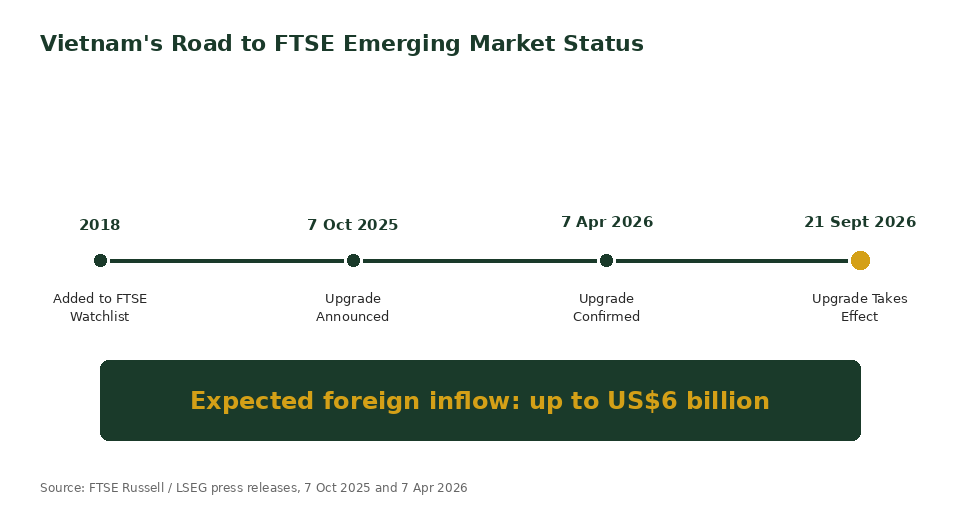
Vietnam has spent almost seven years working toward this moment. FTSE Russell first placed the country on its watchlist for a Frontier-to-Emerging upgrade back in 2018. On 7 October 2025, FTSE Russell formally announced the upgrade, subject to a final review. That review happened in March 2026, and FTSE Russell confirmed on 7 April 2026 that Vietnam’s status upgrade to Secondary Emerging Market would take effect on 21 September 2026.
The upgrade recognises real reforms. Vietnamese regulators removed the pre-funding requirement for foreign institutional investors and set up a formal process for handling failed trades — two of the biggest complaints international fund managers had. Once the change takes effect, Vietnamese equities join the FTSE Global Equity Index Series alongside China, India, Indonesia, the Philippines, and Qatar, through a phased process extending into 2027.
| Milestone | Date |
|---|---|
| Added to FTSE watchlist | 2018 |
| Upgrade announced | 7 October 2025 |
| Final review | March 2026 |
| Upgrade confirmed | 7 April 2026 |
| Upgrade takes effect | 21 September 2026 |
Source: FTSE Russell / LSEG, 7 Oct 2025 and 7 Apr 2026
Why does this matter to you? Index reclassifications force passive money to move. Global emerging-market index funds that don’t currently hold Vietnamese stocks will need to buy them once Vietnam enters the FTSE Emerging Markets index. FTSE Russell itself estimates this could bring in up to US$6 billion in foreign inflows — a meaningful sum for a market of Vietnam’s size.
That said, the rally isn’t a straight line. The VN-Index has already run hard, hitting an all-time high in January 2026 before correcting 6.7% in a single month in July. Much of the 2026 gain has come from just a handful of large caps — Vingroup, Vinhomes, Vincom Retail, and Vinpearl — while the broader market has been flatter. That’s a sign the “buy ahead of the upgrade” trade is already partly priced in. It’s not a reason to avoid Vietnam ETFs, but it is a reason to size your position sensibly, the same way you would for our emerging markets ETF or China ETF picks.
Best Vietnam ETFs for Singapore Investors
You have three realistic options for Vietnam ETF exposure. Here’s how they stack up as at August 2026.
| Feature | Xtrackers FTSE Vietnam | VanEck Vietnam (VNM) | Fubon FTSE Vietnam |
|---|---|---|---|
| Ticker | HD9 (SGX) / XFVT (LSE) | VNM (NYSE Arca) | 00885 (Taiwan) |
| Index | FTSE Vietnam Index | MVIS Vietnam Index | FTSE Vietnam 30 Index |
| TER | 0.85% p.a. | 0.66% p.a. | 1.22% p.a. |
| Domicile | Luxembourg | USA | Taiwan |
| AUM (Aug 2026) | ~US$344M | ~US$493M | ~US$450M equiv. |
| Structure | Accumulating, synthetic (swap) | Distributing, physical | Physical replication |
| US Estate Tax Risk | None | Yes, above US$60,000 | None |
| Direct SGX Access | Yes | No — needs US market access | No — needs Taiwan market access |
Source: justETF / DWS Xtrackers factsheet, VanEck.com, Fubon SITE — data as at 19 Aug 2026
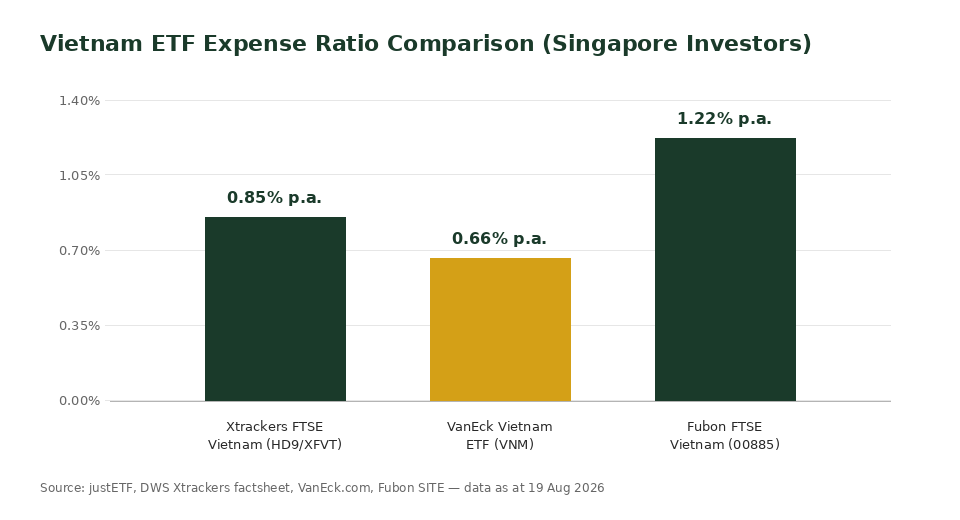
The Xtrackers FTSE Vietnam Swap UCITS ETF (SGX: HD9, also listed on the London Stock Exchange as XFVT) is the only Vietnam ETF that trades directly on SGX. That’s a meaningful advantage: you can buy it in SGD through any Singapore brokerage — moomoo, Tiger Brokers, Syfe Brokerage, IBKR, Saxo, or your bank’s trading platform — the same way you’d buy any SGX-listed stock, without needing the London Stock Exchange access most other UCITS ETFs require.
One quirk worth knowing: HD9/XFVT uses synthetic replication through a total return swap rather than holding Vietnamese shares directly, and it’s an accumulating share class. That means it doesn’t pay out dividends. Any income from the underlying index is reinvested into the fund’s net asset value automatically, so there’s no dividend distribution for you to worry about at all.
The VanEck Vietnam ETF (VNM) is bigger, at about US$493 million in assets as at 19 August 2026, and cheaper on paper at 0.66% TER. But it’s a US-domiciled fund listed on NYSE Arca, and that has two consequences. First, you need a broker with US market access — IBKR, Saxo, Tiger, or moomoo all work. Second, VNM carries the same US estate tax exposure as any other US-domiciled ETF: holdings above US$60,000 face US estate tax of up to 40% if you pass away while holding US-situs assets, and dividend distributions are subject to a 30% non-resident withholding rate.
There’s also the Fubon FTSE Vietnam ETF (00885), listed on the Taiwan Stock Exchange with roughly NT$13.9 billion (about US$450 million) in assets. It’s the least cost-efficient of the three at 1.22% TER, and Taiwan-listed securities aren’t accessible through every Singapore broker. For most readers, it isn’t worth the extra friction versus HD9 or VNM.
How to Buy a Vietnam ETF in Singapore
Buying HD9 on SGX is the simplest route for most Singapore investors. Fund your Syfe Brokerage account or your broker of choice, search “HD9” or “Xtrackers FTSE Vietnam,” and place your order the same way you would for any SGX stock. No currency conversion is needed since it trades in SGD, and you don’t need to open a UK or US trading account. moomoo, Tiger Brokers, DBS Vickers, and OCBC Securities all support SGX trading by default.
If you want VNM instead, you’ll need a broker with US market access. IBKR is generally the most cost-effective for larger portfolios because of its low per-share commissions and tight FX spreads. Saxo and Tiger Brokers are reasonable alternatives if you already hold an account with them. Fund your account, convert to USD if needed, search “VNM,” and place your order on NYSE Arca during US trading hours (9:30pm–4am SGT).
Whichever ETF you choose, this isn’t a CPF-investable product — Vietnam ETFs aren’t on the CPFIS list. If you’re investing for retirement, treat this as part of your SRS or cash portfolio rather than your CPF allocation, and check how it fits your broader plan using our Singapore retirement calculator.
Risks to Consider
Vietnam ETFs are higher-risk than a broad developed-market fund. Size your position accordingly.
Concentration risk is the biggest one. Both the FTSE Vietnam Index and the MVIS Vietnam Index are heavily weighted toward banks and real estate — sectors that tend to move together in a downturn. As at mid-2026, a handful of Vingroup-related stocks accounted for a disproportionate share of the VN-Index’s gains for the year, which means the index’s near-term direction depends heavily on a few large caps.
Currency risk matters too. The Vietnamese dong isn’t freely convertible. While HD9 and VNM are denominated in SGD and USD respectively, the underlying Vietnamese equities remain exposed to dong depreciation, which can drag on returns even when local stock prices rise.
Valuation risk: the VN-Index already hit an all-time high in January 2026 and has since been volatile, correcting 6.7% in a single month in July 2026 before partially recovering. Some of the “FTSE upgrade” trade may already be priced in. Buying now doesn’t guarantee you catch further upside once the reclassification takes effect on 21 September 2026.
If you choose HD9/XFVT, there’s also swap counterparty risk: because the fund uses synthetic replication, part of your return depends on the swap counterparty honouring its side of the agreement — a standard but real risk for synthetic UCITS ETFs.
Finally, liquidity: at roughly US$344–493 million in AUM, none of these three ETFs are as liquid as a mainstream fund like VWRA or CSPX. Expect wider bid-ask spreads, especially on HD9’s SGX order book, which trades much less volume than a typical blue-chip SGX stock.
Frequently Asked Questions
What is a Vietnam ETF and why are Singapore investors buying it in 2026?
A Vietnam ETF is a fund tracking a basket of Vietnamese-listed companies. Interest has picked up in 2026 because FTSE Russell is upgrading Vietnam from Frontier to Secondary Emerging Market status on 21 September 2026, a change expected to draw up to US$6 billion in new foreign investment.
When exactly does Vietnam's FTSE Emerging Market upgrade take effect?
FTSE Russell confirmed on 7 April 2026 that the upgrade takes effect on 21 September 2026, with Vietnamese equities entering the FTSE Global Equity Index Series through a phased process extending into 2027.
Can I buy a Vietnam ETF directly on SGX without opening a UK or US brokerage account?
Yes. The Xtrackers FTSE Vietnam Swap UCITS ETF trades on SGX under the ticker HD9, in SGD. You can buy it through any Singapore broker that supports SGX trading, including moomoo, Tiger Brokers, and Syfe Brokerage.
Is the Xtrackers Vietnam ETF (HD9) the same fund as the VanEck Vietnam ETF (VNM)?
No. They track different indices — HD9 follows the FTSE Vietnam Index and VNM follows the MVIS Vietnam Index — and have different domiciles, fees, and structures. HD9 is Luxembourg-domiciled, synthetic, and accumulating; VNM is US-domiciled, physically replicated, and distributes dividends.
Does buying VNM expose Singapore investors to US estate tax?
Yes. Because VNM is a US-domiciled ETF, non-resident alien investors face US estate tax of up to 40% on holdings above US$60,000 if they pass away while holding the fund. HD9/XFVT, domiciled in Luxembourg, does not carry this risk.
What are the biggest risks of investing in a Vietnam ETF right now?
The main risks are sector concentration (heavy weighting toward banks and real estate), currency risk from the Vietnamese dong, and valuation risk, since the VN-Index already hit an all-time high in January 2026 before a sharp correction in July.
Ready to Get Ahead of the Vietnam Upgrade?
Open a brokerage account and start building exposure before 21 September 2026. Use our referral links for exclusive sign-up bonuses.
This article was researched with the help of AI. While we strive to keep all information accurate and up to date, there may be errors. If you notice any discrepancies, please contact us.