CSPX Price Today: Live Data and Post-FOMC Outlook (2026)
Live NAV, valuation and 52-week range for the iShares Core S&P 500 UCITS ETF, plus what the Fed’s September 2026 rate hike means for your portfolio.
CSPX (iShares Core S&P 500 UCITS ETF) traded at a NAV of USD 814.44 on 16 September 2026, down 0.44% after the Fed raised rates for the first time in three years. Listed on the London Stock Exchange and domiciled in Ireland, CSPX gives Singapore investors 15% US dividend withholding tax and no US estate tax exposure — versus 30% and full exposure for US-listed alternatives like VOO.
Not financial advice. All figures are for educational reference only. Data as at 16–17 September 2026 unless otherwise noted.
- CSPX’s NAV sits near the top of its 52-week range (USD 681.22–840.08), even after the Fed’s hike knocked the S&P 500 down 0.45% on decision day.
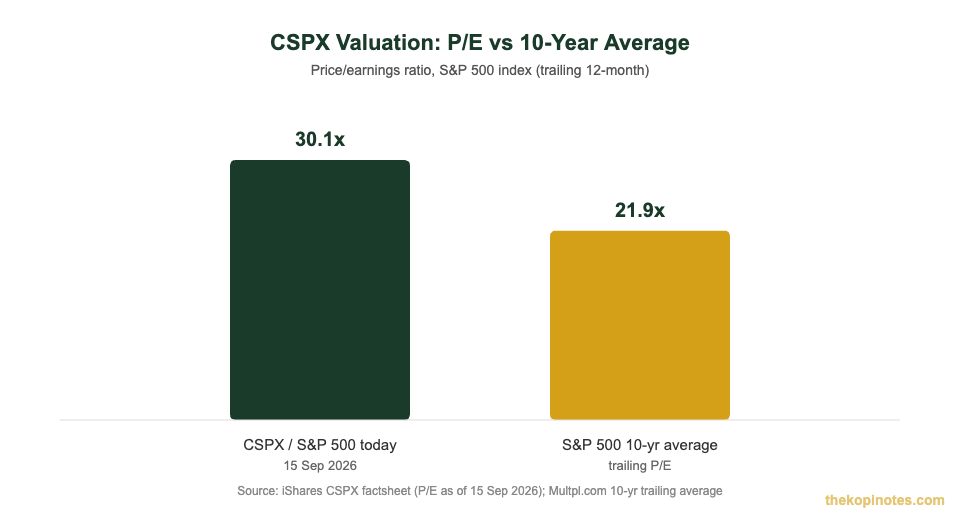
- At a P/E of 30.07, CSPX is priced well above the S&P 500’s 10-year average of 21.9 — valuation, not the rate hike itself, is the bigger risk right now.
- CSPX still beats US-listed VOO on tax (15% withholding tax vs 30%, no US estate tax), even though its 0.07% TER is higher than VOO’s 0.03%.
Table of Contents
CSPX Price Today: Live NAV and Trading Data
Here is where CSPX stood as at the close of 16 September 2026, sourced directly from the iShares factsheet. Prices move daily — use this as a snapshot, not a live quote.
| Metric | Value |
|---|---|
| NAV per Unit | USD 814.44 (16 Sep 2026) |
| 1-Day Change | –USD 3.63 (–0.44%) |
| 52-Week Range | USD 681.22 – 840.08 |
| YTD Total Return | 11.56% (as at 15 Sep 2026) |
| Net Assets | USD 153.9 billion |
| TER (Expense Ratio) | 0.07% p.a. |
| LSE Ticker / Currency | CSPX / USD |
Source: iShares Core S&P 500 UCITS ETF factsheet, 16 Sep 2026.
What Is CSPX?
CSPX is the iShares Core S&P 500 UCITS ETF (USD Accumulating share class), managed by BlackRock Asset Management Ireland. It tracks the S&P 500 Index using full physical replication, meaning the fund actually holds all 504 underlying stocks rather than using derivatives.
The fund launched on 19 May 2010 and is domiciled in Ireland (full details on the iShares CSPX product page) — a Undertakings for Collective Investment in Transferable Securities (UCITS) structure that gives non-US investors a lower dividend withholding tax rate under the US-Ireland tax treaty. It is an accumulating share class, so dividends are reinvested automatically rather than paid out as cash.
CSPX trades on the London Stock Exchange in USD. A separate GBP-hedged distributing share class (CSP1) also exists for UK investors, but most Singapore investors use the USD-denominated CSPX.
Why CSPX Dipped After the Fed’s Rate Hike
On 16 September 2026, the Federal Reserve raised the federal funds rate by 25 basis points to a target range of 3.75%–4.00%. The vote was unanimous at 12-0. It was the Fed’s first rate hike in more than three years, and the committee cited elevated inflation as the reason (see the Federal Reserve press release).
US stocks fell on the news. The S&P 500 closed down 0.45% at 7,551.81 points on decision day. CSPX moved in step, with its NAV slipping 0.44% to USD 814.44.
Here’s why the move was muted rather than severe. The hike itself was widely expected. What rattled investors more was the Fed’s forward guidance — officials pencilled in one more 25 basis point hike before the end of 2026, which pushed bond yields higher and weighed on richly valued growth stocks.
That matters for CSPX specifically because of its sector mix. Information Technology makes up 37.72% of the fund, the single largest sector weight. Higher interest rates raise the discount rate used to value future earnings, and growth-heavy tech stocks are typically hit hardest by that repricing.
For a Singapore investor holding CSPX through IBKR or Saxo, this kind of single-day move is normal volatility, not a reason to panic-sell. The bigger question — covered next — is whether the index was overvalued before the hike even happened.
CSPX Performance and Valuation
CSPX is up strongly for the year, but that gain has come with a richer price tag. Here is the fund’s key valuation data as at mid-September 2026.
| Metric | Value |
|---|---|
| YTD Total Return | 11.56% |
| Price/Earnings (P/E) | 30.07x |
| Price/Book (P/B) | 5.61x |
| 3-Year Beta | 1.00 |
| 3-Year Std. Deviation | 12.93% |
Source: iShares CSPX factsheet, 15–16 Sep 2026.
The number that matters most here is the P/E ratio. At 30.07 times earnings, CSPX (and the S&P 500 it tracks) is priced well above the index’s 10-year average trailing P/E of 21.9. Here is the original calculation: (30.07 – 21.9) ÷ 30.07 ≈ 27%. That means earnings would need to grow into the current price by roughly 27% — or the price would need to fall by a similar magnitude — for the index to revert to its 10-year average valuation, all else equal.
That is not a prediction that CSPX will fall 27%. It is a reminder that 2026’s rally has pushed valuations well above historical norms, so the Fed’s rate path from here matters more than usual for future returns.
CSPX vs VOO: Which Costs Less for Singapore Investors?
CSPX and VOO both track the S&P 500. The difference that matters for you as a Singapore investor is not the headline expense ratio — it is tax.
| Feature | CSPX | VOO |
|---|---|---|
| Domicile | Ireland | USA |
| Exchange | London Stock Exchange | NYSE Arca |
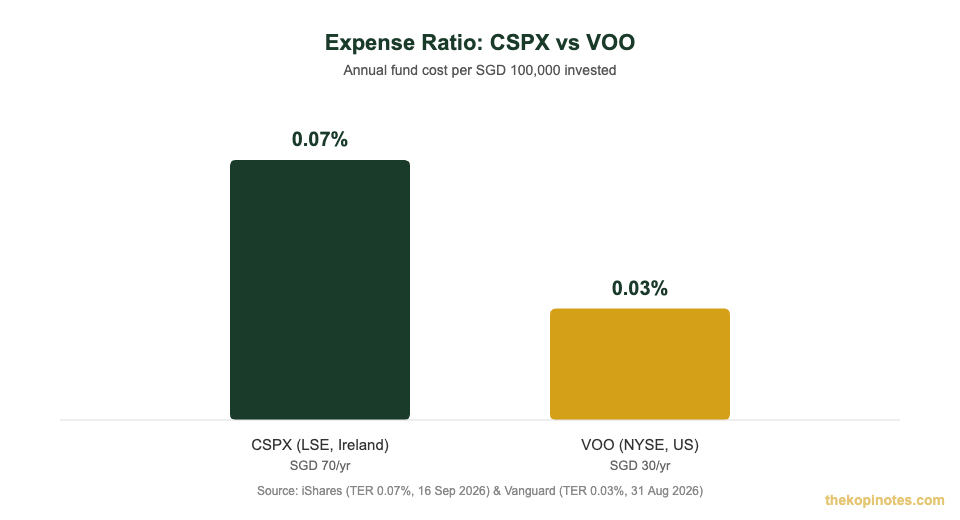
| TER | 0.07% | 0.03% |
| US Dividend WHT | 15% | 30% |
| US Estate Tax Risk | None | Yes (above USD 60k) |
Source: iShares CSPX factsheet (16 Sep 2026); Vanguard VOO fund page (31 Aug 2026).
Here is a worked example. Say you hold SGD 100,000 in either fund, and the S&P 500’s dividend yield is roughly 1.3%. Your annual dividend income is about SGD 1,300.
On CSPX, the 15% treaty rate means you lose about SGD 195 a year to withholding tax. On VOO, the 30% non-treaty rate takes about SGD 390 — nearly double. Meanwhile, CSPX’s 0.07% TER costs about SGD 30 more per year than VOO’s 0.03%. Net the two effects, and CSPX still saves you roughly SGD 165 a year on a SGD 100,000 position, purely from the tax treatment.
That gap grows for larger portfolios, and it is separate from the US estate tax issue: non-resident aliens holding more than USD 60,000 in US-situs assets like VOO can trigger US estate tax of up to 40% on the excess. CSPX, as an Ireland-domiciled fund, carries no such exposure. For the full breakdown, see our CSPX vs VOO comparison.
How to Buy CSPX in Singapore
CSPX trades on the London Stock Exchange in USD, so you will need a broker with LSE access. Here is how the main options compare.
Interactive Brokers (IBKR)
Fund your IBKR account, search for “CSPX” and select the London Stock Exchange listing (not the Amsterdam or Milan lines). IBKR charges some of the lowest commissions for LSE trades, which makes it cost-effective for larger, less frequent purchases.
Saxo Markets
Saxo also offers LSE access with a clean, beginner-friendly interface, though commissions are typically higher than IBKR for smaller trade sizes.
MooMoo Singapore
MooMoo Singapore has expanded its LSE coverage in recent years, letting you buy CSPX directly from the app. Check current commission tiers before committing to regular monthly purchases.
Syfe Brokerage
Syfe Brokerage is often the simplest starting point for beginners, with a straightforward fee structure and no separate custody account to manage. If you are just getting started, our Syfe referral code and sign-up bonus page has the current offer.
For cost-conscious investors comparing platforms side by side, our FSMOne referral code page covers another low-cost option with access to LSE-listed ETFs.
Whichever broker you choose, place your order in USD and double-check you are buying the LSE-listed CSPX line (ticker CSPX, ISIN IE00B5BMR087) rather than a similarly-named line on another exchange.
Who Should Buy CSPX Now?
CSPX suits you if you want low-cost, diversified exposure to large US companies, you are investing for the long term (10 years or more), and you want to minimise US withholding and estate tax drag as a non-US resident.
Consider alternatives or dollar-cost averaging in gradually if you are uncomfortable with a P/E of 30x, you want more valuation cushion before committing a lump sum, or you already hold significant US tech exposure elsewhere in your portfolio.
Note that CSPX is not CPF-investable, since it is not on the CPF Investment Scheme approved list, but it is generally accessible through SRS-linked brokerage accounts. If retirement planning is part of your goal, run the numbers through our Singapore retirement calculator before deciding how much to allocate.
If you are building a broader income portfolio alongside your growth holdings, our guide to the best S-REITs in Singapore 2026 covers the dividend side of that equation.
Frequently Asked Questions
What is CSPX’s price today?
As at 16 September 2026, CSPX’s NAV was USD 814.44, down 0.44% for the day. Its 52-week range is USD 681.22 to USD 840.08. Because CSPX trades on the London Stock Exchange, its market price can differ slightly from NAV during the trading day, though the gap is usually small for a fund this large.
Why did CSPX fall after the Fed’s September 2026 rate hike?
The Fed raised rates 25 basis points to 3.75%–4.00% on 16 September 2026, its first hike in three years. The move itself was expected, but the Fed’s guidance that one more hike could follow before year-end pushed bond yields up and weighed on richly valued growth stocks, which make up a large share of the S&P 500 that CSPX tracks.
Is CSPX overvalued right now?
By one common measure, yes. CSPX’s P/E of 30.07 is well above the S&P 500’s 10-year average trailing P/E of 21.9. That does not mean a fall is imminent, but it does mean the index is priced for continued strong earnings growth, and has less valuation cushion if growth disappoints.
Can I buy CSPX using my CPF or SRS funds?
CSPX is not on the CPF Investment Scheme approved list, so you cannot buy it directly with CPF Ordinary Account funds. It is generally accessible through SRS-linked brokerage accounts at platforms that support LSE-listed ETFs, though you should confirm this with your specific broker before transferring funds.
Which broker is cheapest for buying CSPX in Singapore?
Interactive Brokers (IBKR) typically offers the lowest commission rates for LSE-listed ETFs like CSPX, especially for larger trade sizes. Syfe Brokerage and MooMoo Singapore are simpler for beginners making smaller, regular purchases, though their fee structures differ — compare current rates before committing to a platform.
Is CSPX better than VOO for Singapore investors?
For most Singapore-based investors, yes. CSPX’s 15% dividend withholding tax and lack of US estate tax exposure typically outweigh VOO’s lower 0.03% expense ratio, especially for larger portfolios. See our full CSPX vs VOO comparison for the complete breakdown.
Ready to Start Investing in CSPX?
Open a brokerage account with LSE access and buy CSPX today. Use our referral links for exclusive sign-up bonuses.
This article was researched with the help of AI. While we strive to keep all information accurate and up to date, there may be errors. If you notice any discrepancies, please contact us.