ES3 vs G3B: Which STI ETF Should You Buy? (2026 Guide)
Reddit’s top STI ETF questions answered — TER, dividends, liquidity, CPF eligibility, and whether you should even buy STI ETFs at all.
ES3 (SPDR STI ETF) and G3B (Nikko AM STI ETF, now rebranded as Amova) both track the Straits Times Index — Singapore’s 30 largest listed companies. They hold identical stocks and deliver nearly identical returns. ES3 charges a slightly lower 0.28% TER compared to G3B’s 0.30%. The practical differences come down to fees, liquidity, dividend frequency, and AUM. For most Singapore investors doing dollar cost averaging, either works. But if you want a simple answer: ES3 is the safer default thanks to its far larger fund size and tighter bid-ask spreads.
Not financial advice. All figures are for educational reference only. Data as at June 2026 unless noted.
- ES3 charges 0.28% TER and G3B charges 0.30% — both track the same index with nearly identical returns
- ES3 has 3.6x the AUM (SGD 3.2 billion vs SGD 890 million), so it’s more liquid with tighter spreads
- G3B has a marginally higher trailing dividend yield (3.5% vs 3.4%) — but the difference is negligible
- Both are CPF-IS and SRS eligible. Pick whichever your broker or Regular Savings Plan (RSP) supports
Table of Contents
Contents — Click to expand
What r/singaporefi Is Actually Debating
If you spend any time on r/singaporefi, you’ll notice STI ETF threads pop up almost weekly. We read through dozens of them so you don’t have to. Here are the six questions that keep coming up — and what the community actually thinks.
1. “ES3 or G3B — which one should I pick?”
This is the most common question by far. The honest answer from most experienced investors in the community: it doesn’t matter much. Both track the exact same index, hold the same 30 stocks in the same proportions, and charge very similar TERs (ES3 at 0.28%, G3B at 0.30%). The difference in your returns over 10 years will be negligible. That said, ES3 tends to be the default recommendation because of its larger fund size and tighter bid-ask spreads.
2. “What about GAB — the accumulating version?”
G3B actually has a sibling: GAB (Amova Singapore STI ETF SGD Accumulating Class). Instead of paying out dividends, GAB automatically reinvests them into the fund. Some investors prefer this for convenience — no need to manually reinvest small dividend amounts. However, GAB has very low trading volume and wide spreads. Most community members stick with ES3 or G3B for liquidity reasons.
3. “Should I just buy DBS stock instead of an STI ETF?”
This comes up a lot because DBS makes up about 25% of the STI anyway. The argument goes: why pay a ~0.30% management fee when you can just buy the dominant stock directly? The counter-argument — and the one most community members agree with — is that the STI ETF gives you diversification across 30 companies. If DBS has a bad year, you’re buffered by 29 other stocks. Concentration risk is real, even for blue chips.
4. “STI ETF vs VWRA — which is better for long-term wealth building?”
This is the bigger philosophical debate. Many r/singaporefi regulars argue that VWRA (Vanguard FTSE All-World UCITS ETF) is the better long-term choice because it gives you global diversification across 3,700+ stocks, not just 30 Singapore names. The STI is heavily concentrated in banks (about 50% of the index), which means your returns are closely tied to Singapore’s banking sector.
That said, STI ETFs have advantages too: they pay dividends directly in SGD with no currency conversion, they’re CPF-investable, and you can buy them on the SGX during Singapore trading hours. For many investors, the answer is to hold both — STI ETFs for local income and CPF allocation, and VWRA or CSPX for global growth.
5. “Is STI ETF better than Singapore T-bills or bonds?”
With Singapore T-bills yielding around 2.5–3.0% and STI ETFs yielding about 3.4–3.5% with capital growth potential, this debate comes down to risk tolerance. T-bills are essentially risk-free — you get your principal back at maturity. STI ETFs can drop 20–30% in a downturn. The community consensus: T-bills for your emergency fund and short-term savings, STI ETFs for money you won’t need for 10+ years.
6. “Is now a good time to buy? The STI is at all-time highs.”
Every time the STI hits a new record, this question surfaces. The pragmatic answer most experienced investors give: if you’re dollar cost averaging (DCA) over many years, the entry point matters less than you think. Trying to time the market usually costs you more in missed gains than it saves in avoided dips. Start with a consistent monthly amount and stick with it.
ES3 vs G3B: Head-to-Head Comparison
Let’s cut through the noise with a direct feature comparison. Both ETFs track the FTSE Straits Times Index, but there are small structural differences worth knowing about.
| Feature | ES3 (SPDR STI ETF) | G3B (Nikko AM / Amova STI ETF) |
|---|---|---|
| Full Name | State Street SPDR Straits Times Index ETF | Amova Singapore STI ETF SGD (Dist) Class |
| Fund Manager | State Street Global Advisors | Amova Asset Management (formerly Nikko AM) |
| Index Tracked | FTSE Straits Times Index | FTSE Straits Times Index |
| TER (Expense Ratio) | 0.28% p.a. | 0.30% p.a. |
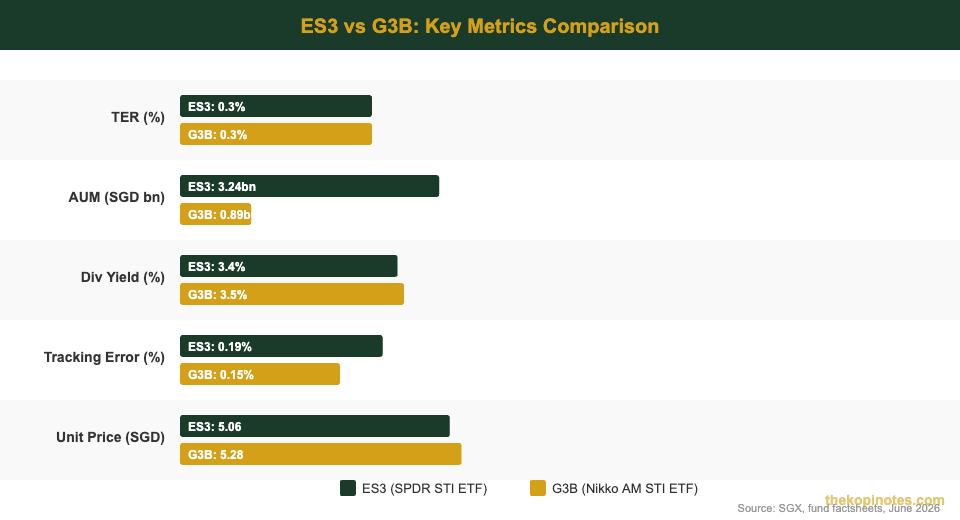
| AUM | SGD 3.24 billion | SGD 890 million |
| Launch Date | 11 April 2002 | 24 January 2009 |
| Dividend Frequency | Semi-annually (Feb & Aug) | Semi-annually (Jan & Jul) |
| Trailing 12M Dividend Yield | ~3.4% | ~3.5% |
| Unit Price | SGD 5.06 | SGD 5.28 |
| Trustee | DBS Trustee Limited | HSBC Institutional Trust Services |
| Tracking Error | 0.19% (1-year rolling) | 0.15% (3-year annualised) |
| CPF-IS Eligible | Yes | Yes |
Source: SSGA, Amova factsheets, SGX, as at June 2026
TER Deep Dive — Does the Fee Even Matter?
Here’s the thing most people get wrong: ES3 actually has a slightly lower Total Expense Ratio than G3B. As at the latest annual reports (June 2025 financial year for ES3), ES3 charges 0.28% per year while G3B charges 0.30%. G3B used to be slightly cheaper at around 0.25%, but the positions have since reversed.
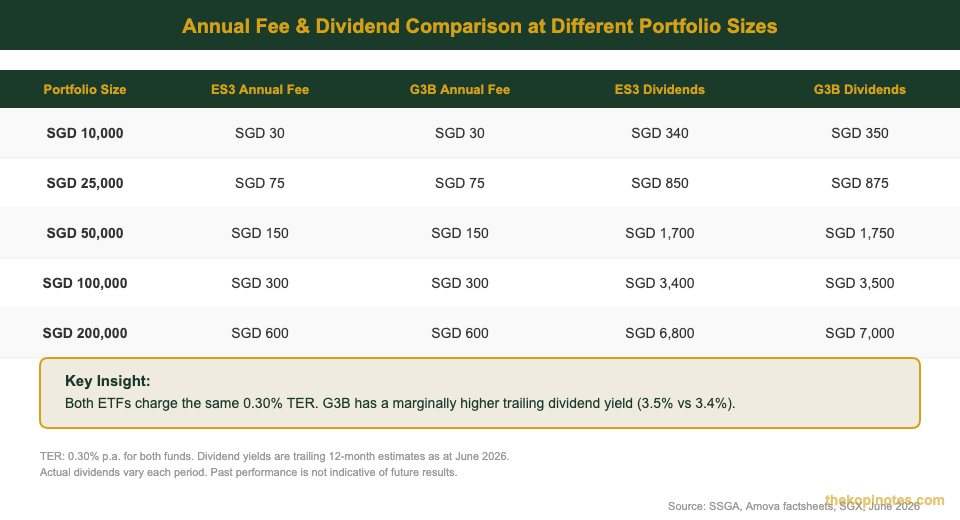
So what does ~0.30% actually cost you? For every SGD 10,000 invested in ES3, you pay about SGD 28 per year in management fees (SGD 30 for G3B). On a SGD 50,000 portfolio, that’s SGD 140 for ES3 or SGD 150 for G3B. The fee is deducted automatically from the fund’s Net Asset Value (NAV) — that’s the price you see quoted on the SGX. You don’t pay it separately.
Are these fees expensive? Compared to actively managed unit trusts in Singapore, which typically charge 1.0–1.5% per year, both are very reasonable. However, compared to global ETFs like CSPX (0.07%) or SPYL (0.03%), it’s noticeably higher. The reason is simple: with only SGD 4 billion combined AUM between both funds, the Singapore market doesn’t generate enough scale to push fees lower.
The bottom line: the 0.02% fee difference (0.28% vs 0.30%) is negligible — on a SGD 50,000 portfolio it’s SGD 10 per year. TER alone shouldn’t be the deciding factor between ES3 and G3B.
Dividend Comparison
Both ES3 and G3B pay dividends semi-annually — twice a year. The key difference is timing. ES3 pays in February and August. G3B pays in January and July. If you hold both, you’d get dividend payments four times a year, which some income-focused investors find appealing.
As at June 2026, the trailing 12-month dividend yields are close: ES3 at approximately 3.4% and G3B at approximately 3.5%. The small difference comes from slight variations in how each fund manager handles dividend reinvestment timing and rounding. Over any multi-year period, these differences wash out.
| Year | ES3 DPU (SGD) | G3B DPU (SGD) | ES3 Yield | G3B Yield |
|---|---|---|---|---|
| 2025 | 0.163 | 0.170 | 3.5% | 3.6% |
| 2024 | 0.138 | 0.145 | 3.8% | 3.9% |
| 2023 | 0.119 | 0.124 | 3.8% | 3.9% |
| 2022 | 0.118 | 0.119 | 3.7% | 3.7% |
| 2021 | 0.090 | 0.092 | 2.8% | 2.8% |
Source: SGX, dividends.sg, as at June 2026. DPU = Distribution Per Unit (total annual). Yield based on year-end unit price.
One thing to note: Singapore does not tax dividends for individual investors. Whether you receive dividends from ES3 or G3B, they land in your brokerage account tax-free. This applies to both cash and CPF/SRS accounts.
For those who prefer not to deal with dividends at all, remember that GAB — the accumulating share class of the Amova STI ETF — automatically reinvests dividends back into the fund. However, as mentioned earlier, its trading volume is very low.
Liquidity and Trading Volume
This is where ES3 has a clear advantage. With an AUM of SGD 3.24 billion compared to G3B’s SGD 890 million, ES3 is by far the more liquid fund. In practical terms, this means tighter bid-ask spreads when you buy or sell on the SGX.
Why does this matter? Every time you buy an ETF, you pay a small premium over the NAV (the bid-ask spread). And every time you sell, you receive slightly less than NAV. For ES3, this spread is typically 1–2 cents. For G3B, it can be 2–4 cents during less active trading periods. On a SGD 5 unit price, a 2-cent spread difference costs you about 0.4% — more than an entire year’s management fee.
If you’re buying once and holding for 20 years, this is a one-time cost and doesn’t matter much. But if you’re doing monthly DCA — buying every single month — those spread costs add up over time. For frequent buyers, ES3’s superior liquidity is a genuine practical advantage.
That said, if your Regular Savings Plan (RSP) platform only offers G3B, don’t stress about it. The spread difference is small in absolute terms, and the convenience of automated monthly investing outweighs a few cents per trade.
CPF and SRS Eligibility
Good news: both ES3 and G3B are eligible for the CPF Investment Scheme (CPFIS). You can use your CPF Ordinary Account (OA) funds to buy either ETF through an approved investment agent. Both are also eligible for the Supplementary Retirement Scheme (SRS). If you’re using your SRS account to invest for retirement, both STI ETFs qualify.
There’s no difference between the two in terms of CPF or SRS eligibility — both are on the approved list because they track a Singapore-based index and are listed on the SGX.
One important caveat: while STI ETFs are CPF-investable, global ETFs like VWRA, CSPX, and SPYL are not. They’re listed on overseas exchanges (London Stock Exchange), which makes them ineligible for CPFIS. This is one of the main reasons some Singapore investors hold STI ETFs in their CPF portfolios alongside global ETFs in their cash or SRS accounts.
To invest via CPFIS, you’ll need to open a CPF Investment Account with one of the approved agent banks: DBS, OCBC, or UOB. The process takes about a week, and you can then buy ES3 or G3B through your agent bank’s brokerage platform.
Should You Even Buy STI ETFs?
This is the question that sparks the most debate on r/singaporefi — and it deserves an honest answer.
The Straits Times Index is heavily concentrated. As at June 2026, the top three holdings — DBS, OCBC, and UOB — make up about 51% of the index. The financial sector as a whole accounts for nearly 50%. If Singapore’s banking sector hits a rough patch, your STI ETF will feel it disproportionately.
Compare that with VWRA, which holds 3,700+ stocks across 49 countries. No single stock makes up more than 4% of the fund. No single sector dominates to the extent that banks dominate the STI.
For long-term wealth building, many experienced investors in the Singapore community argue that global diversification through VWRA or a combination of CSPX (S&P 500) and IWDA (MSCI World) is a stronger approach. The US market and global equities have historically delivered higher annualised returns than the STI over 10- and 20-year periods.
However, STI ETFs serve specific purposes that global ETFs can’t:
CPF investment. If you want your CPF OA money working harder than the 2.5% base interest rate, STI ETFs are one of the few equity options available under CPFIS. You can use the Singapore retirement calculator to model how investing your CPF in STI ETFs could affect your retirement pot.
SGD income. STI ETFs pay dividends directly in Singapore dollars. No currency conversion, no foreign withholding tax. For retirees or those building passive income in Singapore, this is a significant convenience factor.
Home bias comfort. Investing in companies you know and see every day — DBS, Singtel, CapitaLand — gives some investors the confidence to stay the course during downturns. Behavioral comfort matters more than most people admit.
Our view: STI ETFs have a place in a diversified Singapore investor’s portfolio, but they probably shouldn’t be your only equity holding. A sensible split might be 20–30% in STI ETFs (especially in CPF) and 70–80% in global ETFs like VWRA or CSPX for long-term growth.
DCA Strategy for STI ETFs
Dollar cost averaging is the most popular approach for buying STI ETFs — and for good reason. You invest a fixed SGD amount every month regardless of the market price. When prices are high, you buy fewer units. When prices dip, you buy more. Over time, this smooths out your average purchase price and removes the stress of trying to time the market.
Here’s how to set it up practically:
Option 1: Regular Savings Plan (RSP). Several brokers offer automated monthly investing into STI ETFs. FSMOne offers RSP for both ES3 and G3B with no minimum investment. moomoo Singapore also offers automated recurring buys. The advantage: it’s fully automated. Set it once and forget it.
Option 2: Manual monthly buys. If your broker doesn’t offer an RSP, or if you prefer more control, simply log in on the same date each month and place a market order. The minimum lot size on the SGX is 100 units for board lots, but many brokers now support odd lots (as few as 1 unit) for a slightly higher commission.
How much per month? There’s no magic number, but a common starting point is SGD 200–500 per month. At SGD 5 per unit, SGD 500 buys you about 100 units — one board lot. The most important thing isn’t the amount — it’s consistency. Investing SGD 200 every month for 10 years beats investing SGD 2,400 once a year in a lump sum, because you capture more of the averaging benefit.
If you’re also investing in global ETFs, consider using Syfe for your VWRA or CSPX allocation alongside an RSP for STI ETFs. This way your entire portfolio runs on autopilot.
Frequently Asked Questions
What is the main difference between ES3 and G3B?
Both ES3 and G3B track the same Straits Times Index with very similar TERs (ES3 at 0.28%, G3B at 0.30%). The main practical difference is fund size: ES3 has an AUM of SGD 3.24 billion compared to G3B’s SGD 890 million. This means ES3 typically has tighter bid-ask spreads and higher daily trading volume on the SGX. Dividend payment months also differ — ES3 pays in February and August, while G3B pays in January and July.
Which STI ETF has lower fees — ES3 or G3B?
As at June 2026, ES3 charges a Total Expense Ratio (TER) of 0.28% per annum while G3B charges 0.30%. G3B previously had a slightly lower TER of around 0.25%, but the positions have since reversed. On a SGD 50,000 portfolio, ES3 costs approximately SGD 140 and G3B costs SGD 150 per year in management fees, deducted automatically from the fund’s NAV.
Can I buy ES3 or G3B using my CPF or SRS funds?
Yes. Both ES3 and G3B are approved under the CPF Investment Scheme (CPFIS) and are also eligible for investment through your Supplementary Retirement Scheme (SRS) account. To invest via CPFIS, you need to open a CPF Investment Account with an approved agent bank — DBS, OCBC, or UOB. For SRS, you can invest through any SRS operator that offers brokerage services.
Is the STI ETF better than buying DBS stock directly?
While DBS makes up about 25% of the STI, buying the ETF gives you diversification across all 30 constituent companies — including banks, REITs, telcos, and industrials. If DBS underperforms in a given year, the other 29 stocks provide a buffer. Buying DBS alone exposes you to single-stock concentration risk. For most investors, the ETF is the safer approach unless you have strong conviction and deep knowledge of individual banking stocks.
Should I invest in STI ETFs or VWRA for long-term growth?
For pure long-term wealth building, VWRA offers broader global diversification across 3,700+ stocks in 49 countries, compared to the STI’s 30 Singapore-listed companies. Historically, global equities have delivered higher annualised returns than the STI. However, STI ETFs have unique advantages — they’re CPF-investable, pay dividends in SGD with no withholding tax, and give you exposure to Singapore’s economy. Many investors hold both: STI ETFs in their CPF account and VWRA or CSPX in their cash or SRS account.
What is the minimum amount to invest in an STI ETF?
The minimum board lot on the SGX is 100 units. At a unit price of about SGD 5 (as at June 2026), that’s roughly SGD 500. However, many brokers like FSMOne and moomoo now support odd-lot trading, allowing you to buy as few as 1 unit — so you could start with as little as SGD 5–10 plus brokerage commission. Regular Savings Plans (RSPs) typically have no minimum investment amount beyond the cost of one unit.
Is it better to DCA into ES3 monthly or buy in lump sum?
Research generally shows that lump-sum investing beats DCA about two-thirds of the time, because markets tend to rise over time. However, DCA is psychologically easier for most investors — it removes the anxiety of investing a large sum at the “wrong” time. If you have a lump sum available and a long time horizon (10+ years), investing it immediately is statistically optimal. If you’re investing from monthly salary, DCA is the natural and practical approach. Either way, consistency and time in the market matter more than the method.
What happens to my STI ETF dividends if I hold them in CPF?
If you buy ES3 or G3B through your CPF Investment Account, dividends are paid back into your CPF Ordinary Account (OA) — not into your bank account. The dividends then earn the standard CPF OA interest rate of 2.5% per annum. You can reinvest these dividends by purchasing more STI ETF units, or leave them in your OA to earn the guaranteed interest rate. There is no tax on these dividends for Singapore residents.
Not financial advice. All figures are for educational reference only. Data as at June 2026 unless noted. Past performance is not indicative of future results. Always do your own research before making investment decisions.
Ready to Start Investing in STI ETFs?
Open a brokerage account and set up your first DCA today. Use our referral links for exclusive sign-up bonuses.
This article was researched with the help of AI. While we strive to keep all information accurate and up to date, there may be errors. If you notice any discrepancies, please contact us.