Tokio Marine Endowment Plan Singapore 2026: TM Nest Egg (II) FlexiSaver & CashBack 8/10 Reviewed
Guaranteed monthly or yearly payouts, plus the real 2023-2025 Par Fund return data Tokio Marine doesn’t put on its own product page.
Tokio Marine Life Insurance Singapore runs two endowment-style savings plans under its TM Nest Egg (II) name: FlexiSaver, which pays a flexible guaranteed monthly cash payout plus a non-guaranteed dividend, and CashBack 8/10, which pays guaranteed yearly cash from your 2nd policy anniversary. Both come from a 140-year-old Japanese insurance group, and neither publishes a single guaranteed percentage return.
Not financial advice. All figures are for educational reference only. Data verified as at 25 July 2026 against tokiomarine.com and official product disclosure documents unless otherwise stated.
- TM Nest Egg (II) comes in two flavours: FlexiSaver (customisable monthly cash payout + non-guaranteed dividend) and CashBack 8/10 (guaranteed yearly payouts for 8 or 10 years, 2-year premium term).
- Tokio Marine’s own product pages haven’t been updated since July 2021 — but its official Product Summary document (dated June 2026) reveals the actual Participating Fund returned 8.09%, 7.94% and 13.63% in 2023, 2024 and 2025 respectively. That’s real, dated performance data most competitor reviews won’t show you.
- Neither plan publishes a single “guaranteed % p.a.” rate the way FWD or China Life’s plans do — the guaranteed portion is a fixed dollar payout tied to your unpublished premium quote, which makes direct rate comparison against CPF or SSB harder than it looks.
Table of Contents
Contents — Click to expand
- Who Is Tokio Marine Life Insurance Singapore?
- TM Nest Egg (II) FlexiSaver: How It Works
- Worked Example: What FlexiSaver Actually Pays
- The Real Numbers: Par Fund Performance 2023-2025
- TM Nest Egg (II) CashBack 8/10: How It Works
- How It Compares to CPF, SSB & T-Bills
- Who Should (and Shouldn’t) Consider It
- Pros and Cons
Who Is Tokio Marine Life Insurance Singapore?
Tokio Marine Life Insurance Singapore Pte. Ltd. (Company Reg. No. 194800055D) is a MAS-licensed Direct Insurer (Life), headquartered at 20 McCallum Street, Tokio Marine Centre. It’s part of Tokio Marine Holdings, a Japanese insurance group that traces its roots back to 1879 — making it one of the oldest insurers still operating today, with more than 140 years of history.
In Singapore’s endowment plan market, Tokio Marine sits in the same “smaller footprint” tier as insurers like China Life or Etiqa — it doesn’t have AIA, Prudential or Great Eastern’s brand recognition locally, but it distributes through IFA firms and its own agency force, and every policy carries the same Policy Owners’ Protection Scheme (administered by the Singapore Deposit Insurance Corporation, SDIC) coverage as the bigger names.
Tokio Marine’s savings product line-up covers three areas: general Savings (where both products in this review sit), Education (TM Kidstart (II)), and Retirement (TM Retirement GIO Plus (II)). If you’re new to how these plans work mechanically, our what is an endowment plan guide covers the basics first.
TM Nest Egg (II) FlexiSaver: How It Works
FlexiSaver is a limited-pay, participating endowment plan built around one idea: you choose the shape of your own payout schedule. Tokio Marine lets you mix and match four variables, subject to a 30-year overall cap:
| Feature | Detail |
|---|---|
| Premium payment term | 5, 10 or 15 years (level, guaranteed premiums) |
| Accumulation period | 0 to 10 years (delay before payouts begin) |
| Payout period | 10, 15 or 20 years |
| Combined maximum | Premium term + accumulation period + payout period ≤ 30 years |
| Issue age | 1 to 70 years old (age next birthday) |
| Medical underwriting | None required — guaranteed acceptance |
| Terminal illness benefit | Up to S$4,500,000, across all Tokio Marine policies on the same life |
| Surrender | Allowed after 3 full years of premiums paid; guaranteed surrender value may be less than premiums paid |
Source: Tokio Marine Life Insurance Singapore, TM Nest Egg (II) FlexiSaver product page (correct as at July 2021), cross-checked against the official Product Summary dated 3 June 2026.
Every month during your chosen payout period, Tokio Marine pays a Cash Benefit made up of two parts: the Guaranteed Monthly Cash Payout, which equals the policy’s notional sum assured (a fixed dollar figure set when you buy the policy, not a percentage rate), plus a non-guaranteed monthly dividend that depends on how the Participating Fund performs. Tokio Marine is upfront that this notional sum assured “does not represent the amount to be payable on the insured events” — it’s purely a reference figure used to calculate your payouts.
FlexiSaver also bundles in death and terminal illness coverage, plus optional riders (Cancer Waiver, Payer Benefit, Spouse Rider, Enhanced Payer/Spouse Rider, Waiver of Premium, and an Early Critical Illness Premium Waiver Rider) if you want future premiums waived on specific triggers.
Worked Example: What FlexiSaver Actually Pays
Because the Guaranteed Monthly Cash Payout is a fixed dollar figure tied to your specific premium quote (which Tokio Marine doesn’t publish without an adviser illustration), you can’t calculate an effective guaranteed percentage return the way you can with a simple single-premium plan. What Tokio Marine does publish is how the non-guaranteed dividend scales as a percentage of that guaranteed payout — and that’s genuinely useful.
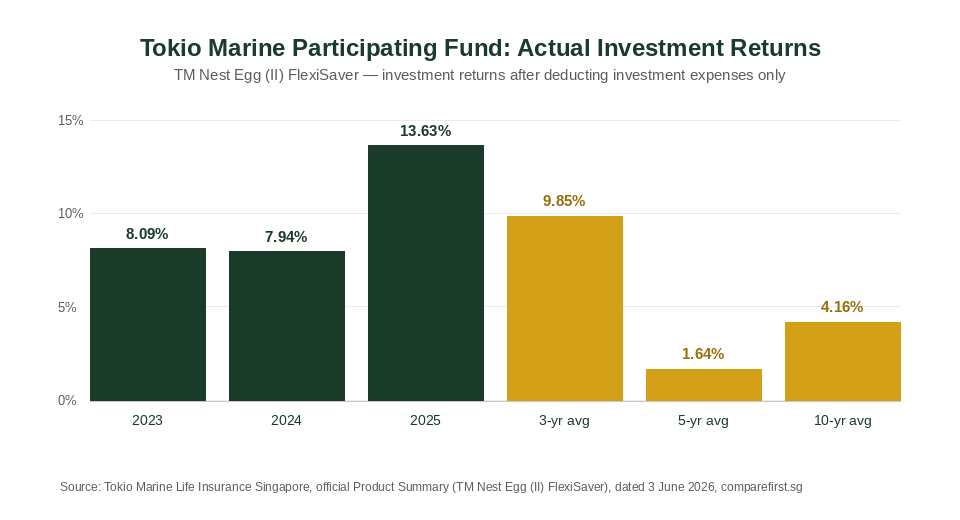
Take a policy with a 10-year premium term and a 10-year payout period, at Tokio Marine’s illustrated Investment Rate of Return of 4.25% p.a. If your accumulation period is 0 years (payouts start right after your last premium), the illustrated monthly dividend adds 29.5% on top of your Guaranteed Monthly Cash Payout. Delay your payout start by choosing a longer accumulation period, and that dividend percentage climbs sharply — to 40.5% at 2 years, 63.9% at 6 years, and 90.3% at a full 10-year accumulation period.
In plain dollar terms: if your Guaranteed Monthly Cash Payout is S$500, a policy with no accumulation delay would pay roughly S$500 + S$147.50 (29.5% illustrated dividend) = ~S$647.50 a month at the 4.25% illustrated rate, while the same policy with a 10-year accumulation period would pay roughly S$500 + S$451.50 (90.3%) = ~S$951.50 a month. The trade-off is obvious: you wait longer before the money starts flowing, but the illustrated total is meaningfully higher once it does.
Two honest caveats. First, Tokio Marine also publishes a lower illustrated rate of 3.00% p.a., at which “dividend rates are expected to be adjusted downwards” — the exact lower figures aren’t listed publicly, so you’d need a personalised Policy Illustration to see both scenarios side by side. Second, and more importantly: the dividend portion is not guaranteed. Only the base Guaranteed Monthly Cash Payout is contractually locked in; everything above it depends on how the Participating Fund actually performs, which is exactly what the next section digs into.
The Real Numbers: Par Fund Performance 2023-2025
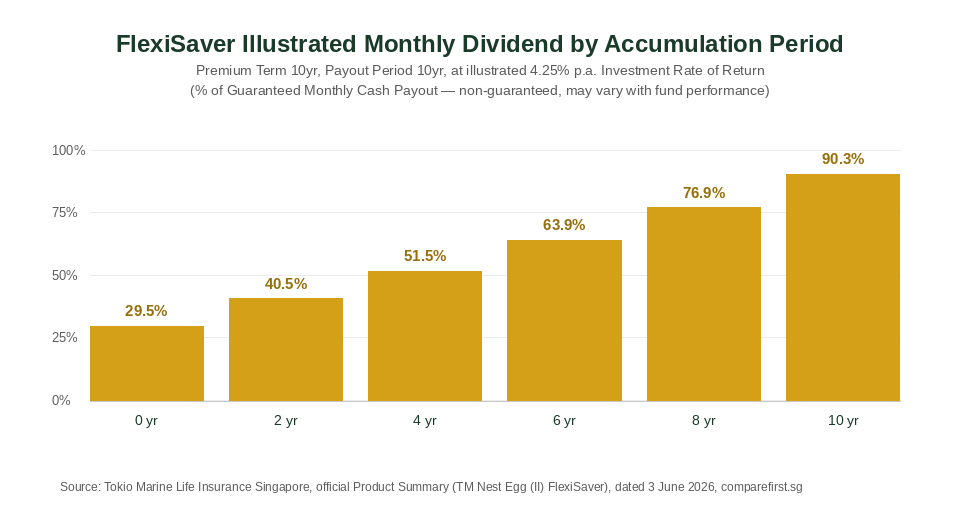
Here’s the most useful thing buried in Tokio Marine’s paperwork that you won’t find on its marketing pages. FlexiSaver’s own product page says the information is “correct as at July 2021” — nearly five years stale. But the official Product Summary document, hosted on the comparison portal comparefirst.sg and dated 3 June 2026, discloses actual, audited Participating Fund performance:
| Period | Investment Return* | Total Expense Ratio |
|---|---|---|
| 2023 | 8.09% | 0.57% |
| 2024 | 7.94% | 0.60% |
| 2025 | 13.63% | 0.52% |
| 3-year average | 9.85% | 0.56% |
| 5-year average | 1.64% | 0.58% |
| 10-year average | 4.16% | 0.91% |
*After deducting investment expenses only; not the actual dividend rate paid to policyholders, which also reflects insurance costs, commissions and smoothing. Source: Tokio Marine Life Insurance Singapore, official Product Summary (TM Nest Egg (II) FlexiSaver), dated 3 June 2026, via comparefirst.sg.
Notice the gap between the 3-year average (9.85%) and the 5-year average (just 1.64%). That’s not a typo — it’s what happens when a couple of very weak years (most likely 2021-2022, when global bond and equity markets both sold off together) are still inside the 5-year window but have already rolled out of the 3-year one. It’s a reminder that “average returns” depend heavily on which years you’re averaging, and a single headline number can hide a lot of volatility underneath.
The Fund’s own asset mix explains some of that pattern: as at 31 December 2025, it held roughly 68% fixed income, 26% equities, and 6% cash and other assets — a bond-heavy, conservatively positioned Participating Fund, managed together with an appointed external manager (Schroder Investment Management). That mix is why returns moved in the high single-to-low-double digits recently rather than swinging as wildly as a pure equity fund would.
TM Nest Egg (II) CashBack 8/10: How It Works
CashBack 8/10 takes a completely different shape from FlexiSaver. Instead of a flexible, customisable schedule, it’s a simple structure: pay premiums for 2 years, then receive guaranteed yearly payouts starting from your 2nd policy anniversary, for either 8 or 10 years depending on which plan term you pick.
| Feature | Detail |
|---|---|
| Premium payment term | 2 years |
| Plan term (choice of) | 10 or 12 years |
| Guaranteed payouts | Yearly, from the 2nd policy anniversary, for either 8 or 10 years |
| Issue age | 1 to 70 years old |
| Medical underwriting | None required |
| Death benefit | Lump sum payable on death |
Source: Tokio Marine Life Insurance Singapore, TM Nest Egg (II) CashBack 8/10 product page, information correct as at July 2021.
Unlike FlexiSaver, Tokio Marine’s public page for CashBack 8/10 doesn’t disclose a specific payout amount, an illustrated dividend table, or Participating Fund data specific to this variant — the page is noticeably thinner on detail. We couldn’t locate a public Product Summary for CashBack 8/10 the way we found one for FlexiSaver, so we can’t show you an equivalent worked example here. If you’re seriously considering this plan, ask your adviser for the full Product Summary and Policy Illustration before committing — don’t rely on the product page’s marketing copy alone, which is honestly true of any endowment plan review, including this one.
Tokio Marine’s own suitability notes are blunt about who this plan is for. It’s designed for cash liquidity and a short premium commitment with no medical check-up — not for high protection coverage, a longer premium term, or payouts that continue for life. If you want a plan that pays out indefinitely rather than for a fixed 8 or 10-year window, that’s closer to what a retirement income plan like Tokio Marine’s own TM Retirement GIO Plus (II) is built for, not CashBack 8/10.
How It Compares to CPF, SSB & T-Bills
This is where Tokio Marine’s TM Nest Egg (II) plans are genuinely harder to compare than most of the insurer plans we’ve reviewed. FWD and China Life both publish a single guaranteed percentage rate you can put straight into a comparison table. Tokio Marine doesn’t — its guaranteed portion is a fixed dollar payout tied to a premium quote you can only get from an adviser, not a published rate.
Here’s an honest comparison using what’s actually publicly verifiable as at 25 July 2026:
| Option | Rate (p.a.) | Guaranteed? |
|---|---|---|
| TM Nest Egg (II) FlexiSaver | No published % rate — fixed dollar payout + 29.5%-90.3% illustrated dividend* | Partially — base payout guaranteed, dividend is not |
| TM Nest Egg (II) CashBack 8/10 | Not publicly disclosed | Yes, on the payout amount itself — but the amount isn’t published |
| CPF Ordinary Account | 2.50% | Yes, statutory floor (reviewed quarterly) |
| CPF Special / MediSave / Retirement Account | 4.00% | Yes, floor extended to 31 Dec 2026 |
| Singapore Savings Bond (SBAUG26, 2-yr avg) | 1.60% | Yes, backed by the Singapore Government |
| 6-month T-bill (16 Jul 2026 auction) | 1.55% | No — each new auction resets the rate |
*Illustrated dividend range for a 10-year premium term, 10-year payout period policy at Tokio Marine’s 4.25% p.a. illustrated Investment Rate of Return, across accumulation periods of 0 to 10 years — not guaranteed. Sources: Tokio Marine Product Summary, CPF Board, ilovessb.com, as at 25 July 2026.
The honest takeaway: if a single guaranteed rate is what you’re shopping for, CPF’s Special/MediSave/Retirement Account floor of 4.00% and even the Ordinary Account’s 2.50% floor are both simpler, higher and fully transparent compared with Tokio Marine’s undisclosed guaranteed payout structure. What Tokio Marine’s plans offer instead is a mix of built-in life and TI protection, a real (if bond-heavy) Participating Fund track record, and flexibility over payout timing — not a rate advantage. For a broader look at how endowment plans stack up against government-backed guaranteed options generally, see our endowment plan vs SSB comparison, or our CPF investment strategy guide if you’d rather put idle CPF savings to work directly.
Who Should (and Shouldn’t) Consider It
Consider it if: you want a savings plan bundled with genuine life and terminal illness protection rather than a pure savings vehicle, you like the idea of customising exactly when and how long your payouts run (FlexiSaver), or you want a short 2-year premium commitment with guaranteed yearly cash afterwards (CashBack 8/10). The Participating Fund’s recent 3-year track record (9.85% average, before insurance costs) is also a genuine positive, even if its 5-year average is far more modest. Before committing, it’s worth working out how a plan like this actually fits your broader retirement timeline — our retirement planning calculator can help you see whether the amount you’d otherwise put into premiums is better placed here or elsewhere.
Skip it if: you want to compare a clean guaranteed percentage rate against CPF, SSB or T-bills upfront — Tokio Marine simply doesn’t publish one for these plans, so you’ll need to sit down with an adviser and get a Policy Illustration before you can judge the real numbers. Also skip it if you need liquidity before 3 full years of premiums are paid, or if you’d rather have a transparently disclosed guaranteed floor like CPF’s 2.50%-4.00% rates.
If you’re comparing across the smaller-insurer tier specifically, our FWD Endowment Plan review is a useful contrast — FWD publishes one clean guaranteed rate on a simple single-premium plan, which is the opposite trade-off from Tokio Marine’s flexible-but-opaque structure.
Pros and Cons
| Pros | Cons |
|---|---|
| Backed by a 140-year-old insurance group, MAS-licensed and SDIC-protected | No published guaranteed % rate for either plan — can’t compare directly to CPF/SSB without an adviser quote |
| Built-in death and terminal illness benefits (up to S$4.5M TI, FlexiSaver) | Product pages haven’t been updated since July 2021 |
| Highly flexible payout timing on FlexiSaver (premium/accumulation/payout mix) | Dividend portion (up to 90%+ of total payout) is not guaranteed |
| Real, verifiable 3-year Par Fund return of 9.85% p.a. (2023-2025) | 5-year average return (1.64%) is far lower — single-year figures can mislead |
| Short 2-year premium commitment option (CashBack 8/10) | CashBack 8/10 discloses no payout figures or Product Summary publicly |
Frequently Asked Questions
What is Tokio Marine's endowment plan called in Singapore?
Tokio Marine Life Insurance Singapore’s endowment-style savings products are called TM Nest Egg (II), available in two versions: FlexiSaver (customisable monthly cash payout) and CashBack 8/10 (guaranteed yearly payouts over 8 or 10 years).
What's the difference between TM Nest Egg (II) FlexiSaver and CashBack 8/10?
FlexiSaver lets you customise your premium term (5/10/15 years), accumulation period (0-10 years) and payout period (10/15/20 years), paying a guaranteed monthly cash payout plus a non-guaranteed monthly dividend. CashBack 8/10 is simpler and fixed: pay premiums for 2 years, then receive guaranteed yearly payouts from your 2nd policy anniversary for either 8 or 10 years.
What is the guaranteed return on TM Nest Egg (II)?
Neither plan publishes a single guaranteed percentage return. FlexiSaver’s guaranteed portion is a fixed dollar Guaranteed Monthly Cash Payout tied to your specific premium (available only via an adviser quote), on top of which a non-guaranteed dividend is illustrated at 29.5% to 90.3% of that payout, depending on your chosen accumulation period. CashBack 8/10 doesn’t disclose payout figures publicly at all.
Does TM Nest Egg (II) require a medical check-up?
No. Both FlexiSaver and CashBack 8/10 offer guaranteed acceptance with no medical underwriting required, for issue ages 1 to 70 (age next birthday).
How has Tokio Marine's Participating Fund performed recently?
According to Tokio Marine’s official Product Summary (dated 3 June 2026), the Participating Fund’s investment returns, after deducting investment expenses only, were 8.09% in 2023, 7.94% in 2024, and 13.63% in 2025 — a 3-year average of 9.85% p.a. The 5-year average is much lower at 1.64% p.a., reflecting weaker performance in earlier years now inside that longer window. As at 31 December 2025, the fund held roughly 68% fixed income, 26% equities and 6% cash.
Can I withdraw or surrender my TM Nest Egg (II) policy early?
You can surrender FlexiSaver after at least 3 full years of premiums have been paid, receiving a guaranteed surrender value plus any accumulated Cash Benefit and interest. As with any endowment plan, early surrender usually means receiving less than what you paid in.
What death and terminal illness benefits are included?
FlexiSaver pays a lump sum death benefit (the higher of 101% of total annual premiums paid less any Guaranteed Monthly Cash Payouts already received, or 12 months’ worth of Guaranteed Monthly Cash Payout), plus a non-guaranteed terminal dividend. Its terminal illness benefit is capped at S$4,500,000 across all Tokio Marine policies on the same life. CashBack 8/10 pays a lump sum death benefit; specific terms require a Policy Illustration.
Is Tokio Marine Life Insurance Singapore a safe, reputable insurer?
Tokio Marine Life Insurance Singapore Pte. Ltd. (Reg. No. 194800055D) is licensed by MAS as a Direct Insurer (Life) and is part of Tokio Marine Holdings, a Japanese insurance group founded in 1879. Its policies are covered under the Policy Owners’ Protection Scheme administered by the Singapore Deposit Insurance Corporation (SDIC), the same protection scheme covering every other MAS-licensed life insurer in Singapore.
How does TM Nest Egg (II) compare to CPF, SSB, or T-bills?
Unlike CPF’s Ordinary Account (2.50% p.a. floor), Special/MediSave/Retirement Account (4.00% p.a. floor), the Singapore Savings Bond (1.60% 2-year average, SBAUG26) or T-bills (1.55% at the 16 July 2026 auction), TM Nest Egg (II) doesn’t publish a single guaranteed percentage rate for either plan. Its guaranteed component is a fixed dollar payout tied to your premium, making a direct rate comparison against these government-backed options difficult without a personalised Policy Illustration.
Want a Clear, Published Guaranteed Rate Instead?
If comparing exact numbers matters to you, government-backed options and robo-advisers publish their rates and fees upfront — no adviser quote needed.
Get Free Insurance Advice
Speak with a licensed insurance advisor. No obligation, no cost.
By submitting this form, you agree to our Privacy Policy.
This article was researched with the help of AI. While we strive to keep all information accurate and up to date, there may be errors. If you notice any discrepancies, please contact us.