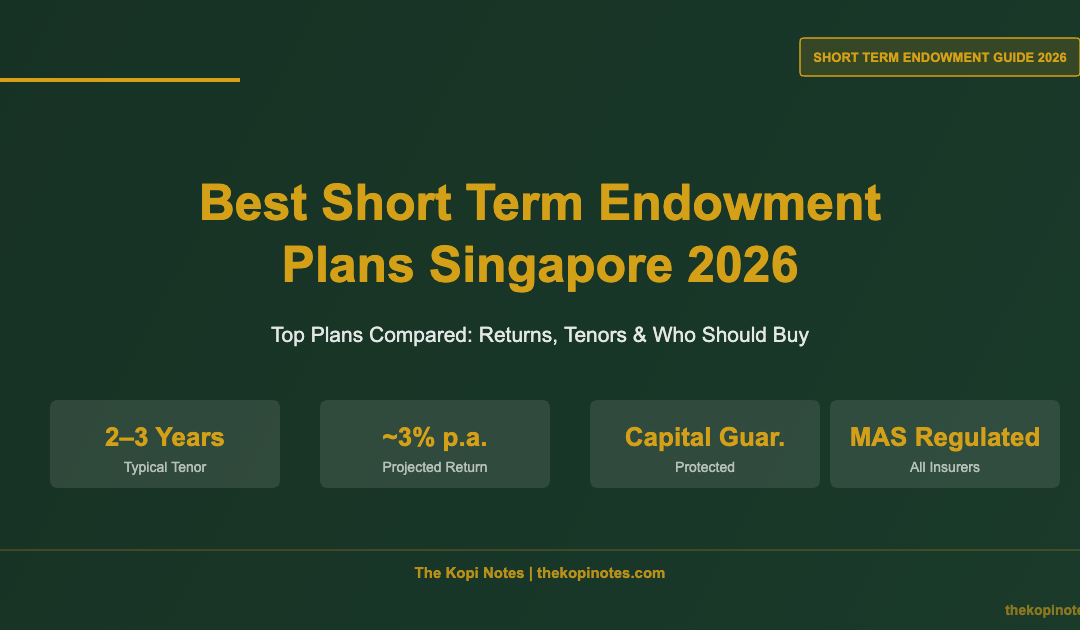
Best Short Term Endowment Plans Singapore 2026: Top Plans, Returns & Complete Buyer’s Guide
Compare 2-year and 3-year endowment plans from Singapore’s top insurers — projected returns, capital guarantees, and who should buy.
Short term endowment plans in Singapore are capital-protected savings products with fixed tenors of 2–3 years, offered by MAS-regulated life insurers. The best plans in 2026 project returns of 2.50–3.20% p.a. — beating fixed deposits and T-bills — while locking in your capital with a partial or full guarantee. They suit conservative investors who want a higher, predictable return on idle cash without equity risk.
Not financial advice. All figures are for educational reference only. Data as at June 2026 unless noted.
Table of Contents
Expand Table of Contents
What Is a Short Term Endowment Plan in Singapore?
A short term endowment plan is a life insurance savings product with a fixed tenor — typically 2 or 3 years. You pay a lump-sum premium upfront (single premium), and the insurer guarantees to return at least your capital (sometimes 100%, sometimes 80–90%) plus a projected bonus at maturity.
Unlike regular savings plans that compound over 10–25 years, short term endowment plans target conservative savers who want a defined exit in 2–3 years with a return premium over fixed deposits or T-bills. All plans are issued by MAS-regulated life insurers and (where capital-guaranteed) are eligible for SDIC protection up to S$100,000 per insurer.
How Do Short Term Endowment Plans Work?
- Single premium: You invest a lump sum (typically S$5,000–S$250,000) at policy start.
- Par or non-par fund: Funds are invested in a mix of bonds and equities (par fund), with a guaranteed + non-guaranteed bonus structure.
- Maturity: At the end of the tenor (e.g. 2 or 3 years), you receive your principal plus the stated bonus.
- Surrender: Early termination before maturity typically results in a lower surrender value — sometimes below premium paid. Always hold to maturity.
| Feature | Short Term Endowment | Fixed Deposit | T-Bill (6-month) |
|---|---|---|---|
| Typical Tenor | 2–3 years | 1–24 months | 6 months |
| Capital Guarantee | ~80–100% | 100% | 100% |
| 2026 Projected Return | 2.50–3.20% p.a. | 2.20–2.50% p.a. | 1.44% p.a. |
| Early Exit | Penalty (surrender) | Interest forfeited | Can sell at discount |
| SDIC Protected | Yes (up to S$100k) | Yes (up to S$100k) | Government-backed |
| SRS-Eligible | Yes | Yes (selected banks) | No |
Source: MAS, SDIC, insurer product documents, DBS/OCBC FD promotions, June 2026
Best Short Term Endowment Plans Singapore 2026
With T-bill yields at 1.44% and FD rates softening in mid-2026, short term endowment plans have become one of the most competitive 2–3 year savings vehicles for conservative Singapore investors. Here are the top plans currently available:
| Insurer | Plan Name | Tenor | Min Premium | Projected Return | Capital Guarantee |
|---|---|---|---|---|---|
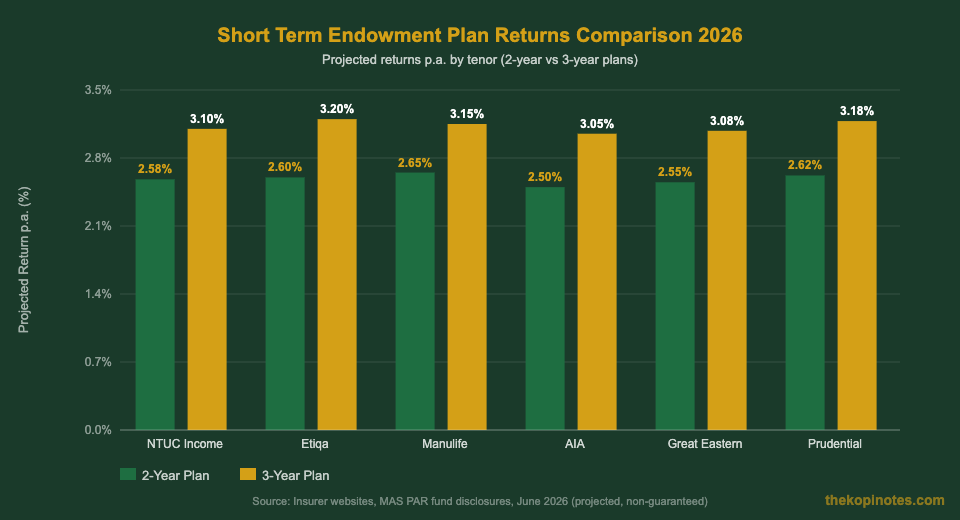
| NTUC Income | Gro Capital Ease | 2 / 3 yrs | S$10,000 | 2.58–3.10% p.a. | 100% |
| Etiqa | Tiq 3-Year Endowment | 2 / 3 yrs | S$5,000 | 2.60–3.20% p.a. | 100% |
| Manulife | ReadyBuilder | 2 / 3 yrs | S$20,000 | 2.65–3.15% p.a. | 100% |
| AIA | AIA Smart Growth | 2 / 3 yrs | S$10,000 | 2.50–3.05% p.a. | 100% |
| Great Eastern | GREAT SP Series | 2 / 3 yrs | S$10,000 | 2.55–3.08% p.a. | 100% |
| Prudential | PRUGrowth Series | 2 / 3 yrs | S$5,000 | 2.62–3.18% p.a. | 100% |
Source: Insurer product factsheets, MAS par fund disclosures, June 2026. Projected returns are non-guaranteed bonuses and may vary.
Our top pick for 2026: Etiqa’s Tiq 3-Year Endowment stands out for its low S$5,000 minimum, 100% capital guarantee, and competitive 3.20% p.a. projected return. NTUC Income’s Gro Capital Ease is the runner-up — 100% capital guarantee and strong par fund performance history. Always confirm the latest rates directly with the insurer before committing, as endowment offers are time-limited.
Returns Comparison: 2-Year vs 3-Year Endowment Plans
Choosing between a 2-year and 3-year plan comes down to your liquidity needs and return preference. Three-year plans consistently offer a 0.50–0.60% p.a. premium over two-year plans — on S$50,000, that difference compounds to roughly S$900 extra over 3 years.
| Plan Tenor | Typical Return (p.a.) | Maturity Value (S$50,000) | Best For |
|---|---|---|---|
| 2-Year | 2.50–2.65% p.a. | ~S$52,625 | Near-term savings goal (e.g. housing deposit in 2 years) |
| 3-Year | 3.05–3.20% p.a. | ~S$54,850 | Emergency fund ladder, SRS invested idle cash |
Source: Illustrative calculations based on mid-range projected returns, June 2026
Guaranteed vs Non-Guaranteed Returns
Most short term endowment plans have two return components:
- Guaranteed return: Typically 1.0–1.5% p.a. — this is the floor you will receive regardless of par fund performance.
- Non-guaranteed bonus: An additional 1.0–1.8% p.a. projected based on the insurer’s par fund investment returns. This is not guaranteed and can be lower if markets perform poorly.
For context, MAS mandates that par fund projections are illustrated at 4.75% (upper) and 3.25% (lower) scenarios, providing a conservative and optimistic view. The “projected” returns cited in this article use the lower 3.25% scenario basis — a conservative assumption.
To explore how different returns scenarios affect your maturity value, use the Endowment Plan Returns Calculator.
Short Term Endowment vs Alternatives in 2026
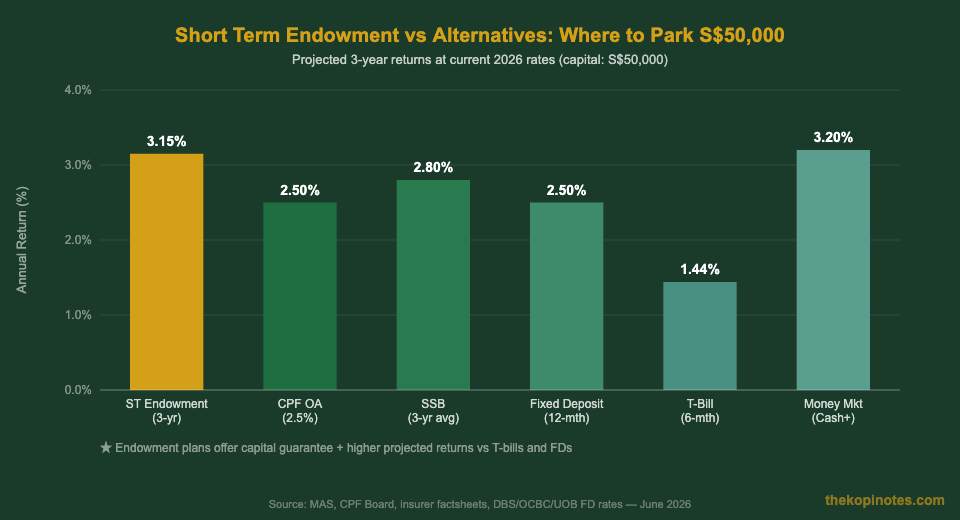
With T-bill yields collapsing to 1.44% in June 2026 and FD rates hovering around 2.2–2.5%, short term endowment plans have re-emerged as the highest-yielding capital-safe instrument for 2–3 year cash parking. Here’s how they compare:
| Instrument | 2026 Rate | Capital Safety | Liquidity | SRS-Eligible |
|---|---|---|---|---|
| ST Endowment (3-yr) | ~3.15% p.a. | ~80–100% | Low (surrender penalty) | ✅ Yes |
| CPF OA (2.5%) | 2.50% p.a. | 100% (govt) | Low | — |
| SSB (3-yr avg) | ~2.80% p.a. | 100% (govt) | High (monthly redemption) | ❌ No |
| Fixed Deposit (12-mth) | 2.20–2.50% p.a. | 100% (SDIC) | Low (interest forfeited) | ✅ Selected |
| T-Bill (6-mth) | 1.44% p.a. | 100% (govt) | Medium (secondary market) | ❌ No |
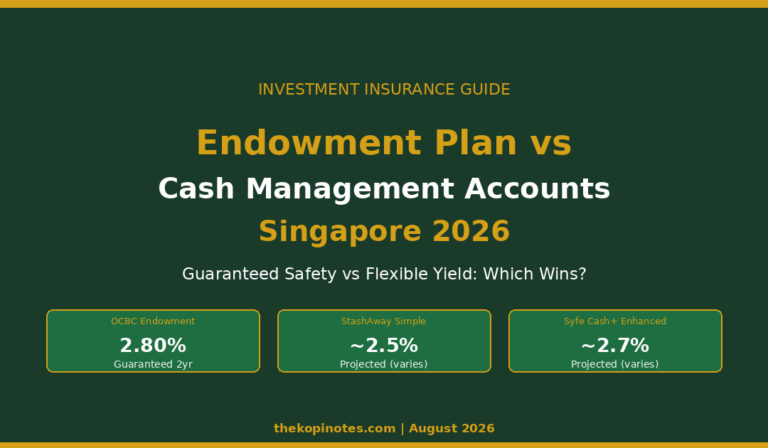
| Money Market (Cash+) | ~3.20% p.a. | ~95% (fund NAV) | High (T+1 redemption) | ✅ Yes (Endowus/Syfe) |
Source: MAS, CPF Board, MAS SSB portal, DBS/OCBC/UOB FD pages, June 2026
Key takeaway: For 3-year horizons where you won’t need the money back early, short term endowment plans offer the best yield among capital-protected options as of mid-2026. If you need flexibility, the Syfe referral code gets you access to Syfe Cash+ (3.2% p.a., T+1 withdrawal) — a better fit for your emergency fund. For tax-efficient long-term wealth, the Endowus referral code unlocks access to institutional funds via your SRS account.
Who Should (and Should Not) Buy a Short Term Endowment Plan?
✅ Good fit if you:
- Have idle cash (S$10k–S$250k) you won’t need for 2–3 years
- Want to beat FDs and T-bills without equity market risk
- Have an upcoming financial goal in 2–3 years (e.g. housing upgrade, children’s education fund)
- Have an SRS account with uninvested cash earning 0.05% in the default account
- Are a retiree or pre-retiree seeking predictable income with capital protection
❌ Not a good fit if you:
- May need the money before the tenor ends (surrender value could be below premium)
- Have high-interest debt (credit cards, personal loans) — pay these off first
- Are comfortable with equities and seeking higher long-term returns (consider the best S-REITs in Singapore 2026 for 5–7% dividend yields)
- Need returns linked to inflation (consider Singapore Savings Bonds instead, which pay 2.8% avg over 3 years with full liquidity)
- Are using CPF funds — CPFIS-OA allows only certain insurance products, and the 2.5% CPF OA floor means endowments need to clear 2.5%+ net just to break even on opportunity cost
| Investor Profile | ST Endowment Verdict | Better Alternative |
|---|---|---|
| Idle cash, 2–3 yr lock-up OK | ✅ Recommended | — |
| Emergency fund replacement | ❌ Not suitable | Syfe Cash+ / MariBank |
| SRS uninvested cash | ✅ Recommended | — |
| Long-term wealth building | ⚠️ Sub-optimal | S-REITs, ETFs |
| Retiree capital preservation | ✅ Recommended | — |
Source: The Kopi Notes analysis, June 2026
How to Buy a Short Term Endowment Plan in Singapore: Step-by-Step
Short term endowment plans can be bought directly from insurer websites, through financial advisory platforms, or via robo-advisor platforms like Endowus that list multiple issuers side-by-side.
Step 1: Define Your Goal and Timeline
Decide how much idle cash you want to deploy (minimum S$5,000–S$20,000 depending on insurer) and confirm you won’t need it for 2–3 years. Never use your emergency fund for an endowment plan.
Step 2: Compare Plans and Rates
Use the comparison table above to shortlist 2–3 plans. Pay attention to: the guaranteed vs non-guaranteed split (a higher guaranteed portion is safer), the minimum premium, and whether the plan is SRS-eligible if you want to invest your SRS funds.
Step 3: Choose Your Platform
- Direct from insurer: Apply on the insurer’s website. Useful for specific proprietary plans. Requires completing a financial needs analysis (FNA) for sums above S$50,000.
- Endowus: Lists multiple insurers’ endowment plans on one platform. Accepts CPF OA and SRS funds. Use the Endowus referral code (2V343) for S$20 in fee credits on your first investment.
- FSMOne: Lists selected endowment plans alongside ETFs and unit trusts. Use the FSMOne referral code (P0544985).
Step 4: Complete the Application
You’ll need your NRIC/passport, bank account details for premium deduction, and a beneficiary designation. If paying with SRS funds, link your SRS account number. Applications are typically processed within 1–3 business days.
Step 5: Pay the Single Premium
Transfer the lump sum from your bank or SRS account. Keep the policy document — your surrender value schedule is printed in the product disclosure sheet (PDS). Mark your maturity date in your calendar.
Step 6: Hold to Maturity
Do not surrender early. Short term endowments return the projected bonus only at maturity. Surrendering in year 1 typically returns only 85–95% of your premium. At maturity, the insurer automatically credits the full maturity value to your linked bank or SRS account.
For a fuller picture of how endowment plan returns compound, try the Singapore retirement calculator to see how a 3-year endowment laddering strategy slots into your overall retirement plan.
SRS Tax-Saving Strategy: Invest Your SRS in Short Term Endowments
One of the most underutilised strategies in Singapore is investing idle SRS cash in short term endowment plans. The default SRS account interest rate is just 0.05% p.a. — stashing S$50,000 in the default SRS account earns you only S$25 per year. A 3-year SRS endowment at 3.15% p.a. earns S$4,875 over the same period.
Worked Example: SRS Endowment Ladder
A Singapore investor aged 55 with S$100,000 in SRS could structure a 3-year endowment ladder:
- Year 1 entry (S$50,000 × 3-yr plan at 3.15%): Matures Year 4 → S$54,850
- Year 2 entry (S$50,000 × 2-yr plan at 2.60%): Matures Year 4 → S$52,630
- Total Year 4 maturity: ~S$107,480 vs S$100,100 in default SRS rate
- Extra return: ~S$7,380 — effectively free money from an SRS account change
The SRS tax deduction is separate — any SRS contribution in the year of endowment purchase is deductible from your chargeable income, reducing your income tax bill. Use the CPF investment strategy guide for the full SRS withdrawal optimisation playbook.
Frequently Asked Questions
What is the best short term endowment plan in Singapore 2026?
Are short term endowment plans capital guaranteed?
How do short term endowment plans compare to fixed deposits?
Can I use SRS money to buy a short term endowment plan?
What happens if I surrender a short term endowment plan early?
Are short term endowment returns taxable in Singapore?
What is the minimum investment for a short term endowment plan?
Is SDIC protection available for short term endowment plans?
How does a short term endowment plan differ from an endowment savings plan?
Which platform offers the best rates for short term endowment plans?
Start Earning More on Your Idle Cash
With T-bill yields at 1.44% in mid-2026, short term endowment plans are one of the best ways to earn 3%+ p.a. on capital you won’t need for 2–3 years — with full capital protection and MAS regulation.
Not financial advice. Always read the product disclosure sheet and speak to a licensed financial adviser before purchasing any insurance product.
Get Free Insurance Advice
Speak with a licensed insurance advisor. No obligation, no cost.
By submitting this form, you agree to our Privacy Policy.
This article was researched with the help of AI. While we strive to keep all information accurate and up to date, there may be errors. If you notice any discrepancies, please contact us.