Keppel DC REIT vs Mapletree Industrial Trust: Singapore Data Centre REIT Comparison 2026
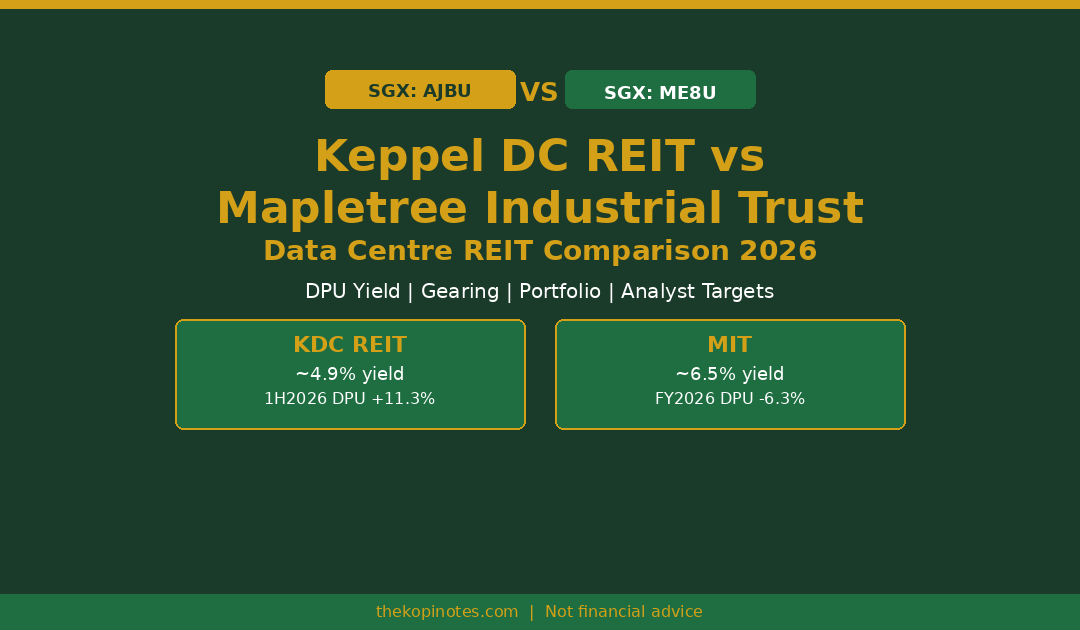
SGX: AJBU vs SGX: ME8U — yield, DPU, gearing, portfolio and analyst targets, side by side. Not financial advice.
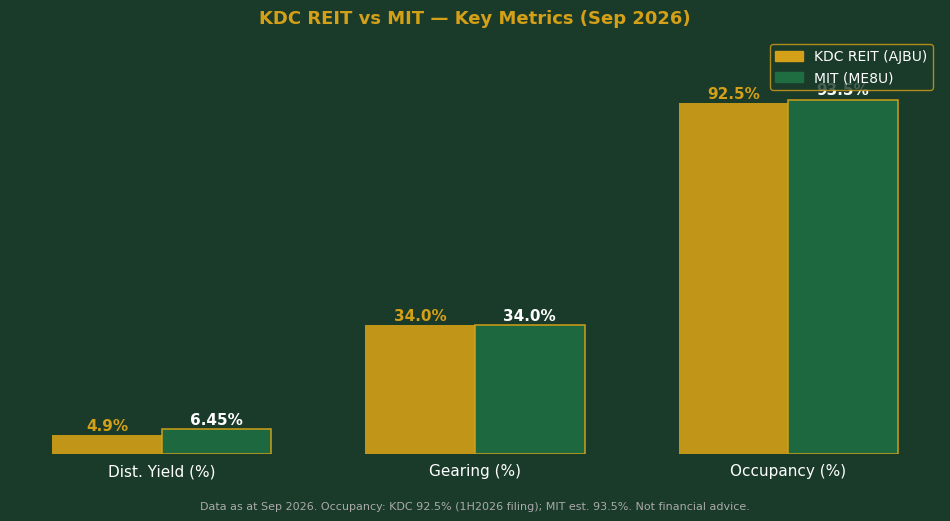
The keppel dc reit share price closed at S$2.31 in early September 2026. Mapletree Industrial Trust (ME8U) traded at S$1.97. Both carry exactly 34.0% gearing. Beyond that number, the two REITs diverge considerably.
KDC REIT holds 23 data centres across Singapore, Europe, Malaysia and China — a pure-play with 1H2026 DPU up 11.3% year-on-year. MIT owns 136 properties: 79 in Singapore and 55 in North America (including 13 data centres via a JV), plus assets in Japan. Data centres account for 57% of MIT’s AUM, but the rest is flatted factories and hi-tech industrial space.
The choice between them comes down to one trade-off: higher current yield (MIT at ~6.5%) versus stronger DPU growth (KDC REIT at +11.3% in 1H2026). This article sets out the data so you can decide which fits your portfolio. It is not financial advice.
For full deep-dives, see the KDC REIT 2026 investor guide and the MIT 2026 investor guide on this site.
Table of Contents
Contents — Click to expand
- Quick Comparison at a Glance
- Keppel DC REIT (AJBU) Overview
- Mapletree Industrial Trust (ME8U) Overview
- DPU History and Distribution Yield
- Portfolio: Size, Geography and Diversification
- Gearing and Financial Health
- Analyst Targets and Consensus
- Which Data Centre REIT Suits You?
- Frequently Asked Questions
Quick Comparison at a Glance
All figures are sourced from SGX company filings and announcements as at September 2026.
| Metric | KDC REIT (AJBU) | MIT (ME8U) |
|---|---|---|
| Share Price (Sep 2026) | S$2.31 | S$1.97 |
| Latest DPU | 5.714¢ (1H2026) | 12.71¢ (FY2025/26) |
| DPU Growth (YoY) | +11.3% | -6.3% |
| Distribution Yield | ~4.9% | ~6.5% |
| Aggregate Leverage | 34.0% | 34.0% |
| No. of Properties | 23 data centres | 136 (57% DC by AUM) |
| Focus | Pure-play data centre | Data centre + industrial |
| Consensus Analyst TP | S$2.62 | ~S$2.10 |
| Consensus Rating | Buy | Hold |
Keppel DC REIT (AJBU) 2026 Overview
KDC REIT listed on SGX in December 2014 as Singapore’s first listed data centre REIT. It holds 23 data centres across Singapore, Australia, Europe, Malaysia and China — a purely data-centre-focused portfolio.
1H2026 distributable income rose 18.5% year-on-year to S$150.67 million. Revenue increased 14.5% to S$242.05 million. DPU came in at 5.714¢ for the half — up 11.3% from the 5.132¢ paid in 1H2025. The annualised DPU run-rate sits at approximately 11.4¢.
Portfolio occupancy was 92.5% as at 30 June 2026, reflecting one contract expiry at Cardiff Data Centre. Around 95% of the portfolio’s power capacity was contracted. KDC REIT completed the acquisition of Tokyo Data Centre 3 and the remaining interests in Keppel DC Singapore 3 and 4 during the period — both fuelled the revenue uplift.
For the full analysis, see the KDC REIT price and valuation guide 2026.
Mapletree Industrial Trust (ME8U) 2026 Overview
MIT listed on SGX in October 2010. It is Singapore’s largest industrial-focused S-REIT by portfolio breadth, holding 136 properties across Singapore (79), North America (55, including 13 data centres via a JV) and Japan.
FY2025/26 DPU came in at 12.71¢ — down 6.3% year-on-year. Excluding the prior year’s one-off Tanglin Halt divestment gain, the underlying decline was 3.2%. Gross revenue for FY2025/26 was S$673.0 million; NPI was S$500.4 million. AUM stands at approximately S$8.3 billion, with data centres comprising 57% of that total.
MIT completed S$550.6 million of divestments in the year and issued S$300 million of perpetual securities at 3.25% in March 2026. Aggregate leverage fell 3.2 percentage points quarter-on-quarter to 34.0% as a result. The North American occupancy rate remains a key watch item heading into FY2026/27.
MIT’s yield at S$1.97 is approximately 6.45% — meaningfully higher than KDC REIT’s ~4.9% at S$2.31.
DPU History and Distribution Yield
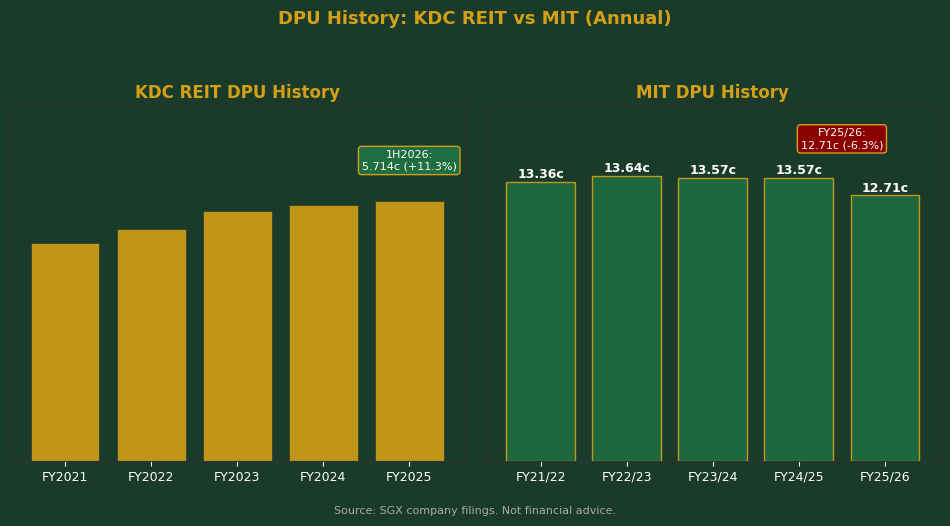
The two REITs tell opposite DPU stories over the past 12 months. KDC REIT grew its 1H2026 DPU by 11.3%. MIT’s full-year DPU fell 6.3% to 12.71¢ — driven largely by the absence of the prior year’s divestment gain and softer North American occupancy.
On a trailing yield basis, MIT wins at ~6.5% versus KDC REIT’s ~4.9%. On a DPU growth basis, KDC REIT is the clear leader.
KDC REIT has grown its annual DPU from roughly 8.60¢ in FY2021 to an annualised run-rate of ~11.4¢ heading into 2H2026 — a compound annual growth of roughly 7.3% over five years. MIT’s DPU hovered between 13.36¢ and 13.64¢ from FY2021/22 to FY2024/25 before declining in FY2025/26.
For investors prioritising income stability and yield today, MIT has the edge. For those willing to accept a lower starting yield in exchange for growth, KDC REIT’s trajectory is more compelling.
Portfolio: Size, Geography and Diversification
KDC REIT’s 23-asset portfolio spans Singapore (its home market), Germany, the Netherlands, Ireland, the UK, Australia, Malaysia and China. The concentration in data centres makes it highly sensitive to data centre demand trends — a strength when AI infrastructure spending is rising, but a risk if any large tenant does not renew.
MIT’s 136-asset portfolio is more diversified. Singapore assets (79 properties) include flatted factories, business parks, stack-up/ramp-up buildings and hi-tech industrial space alongside four hyperscale data centres. The 55 North American properties include 13 data centres held via a JV. Japan rounds out the portfolio with a smaller allocation.
The trade-off is straightforward. KDC REIT offers purer AI/data centre exposure — higher upside if the data centre capex cycle accelerates. MIT provides broader industrial diversification — a buffer if data centre valuations compress. Neither approach is wrong; it depends on your portfolio’s existing exposures.
See the best S-REITs in Singapore 2026 guide for how both compare across the full S-REIT universe.
Gearing and Financial Health
Both REITs carry identical aggregate leverage of 34.0% as at mid-2026 — comfortably below the MAS regulatory limit of 50%. This is the one metric where the comparison is genuinely a draw.
KDC REIT maintained 34.0% gearing despite completing two acquisitions in 1H2026. That signals strong cash flow generation and disciplined capital management. MIT’s gearing fell 3.2 percentage points quarter-on-quarter after deploying S$300 million of perpetual securities proceeds to repay borrowings — a meaningful deleveraging step.
The perpetual securities coupon of 3.25% is below MIT’s weighted average cost of debt, which is net positive for distributions. However, perpetual securities are excluded from gearing calculations under MAS rules — investors should account for them as quasi-debt when assessing balance sheet risk.
On interest rate sensitivity: KDC REIT has a higher proportion of fixed-rate debt, providing more protection in a volatile rate environment. MIT’s floating rate exposure is a mild negative if rates remain elevated post-FOMC (September 17-18, 2026).
Analyst Targets and Consensus
Analyst sentiment strongly favours KDC REIT. The consensus 12-month target price is S$2.62, with Goldman Sachs maintaining a Buy rating and a target of S$2.57. The broker range runs from S$2.48 to S$2.70. At S$2.31, the implied upside to consensus is approximately 13%.
MIT carries a consensus Hold rating. DBS holds a Buy with a target of S$2.22; Maybank rates it Hold at S$2.05. The consensus target sits around S$2.10. At S$1.97, that implies roughly 6.5% upside — below the trailing yield on offer, which at 6.45% provides a meaningful income floor even if capital appreciation is muted.
Investors using Syfe REIT+ (code: SRPRFFFCD) or FSMOne (P0544985) can access both REITs without paying brokerage on individual trades.
Which Data Centre REIT Suits You?
Neither REIT is a bad choice. The decision depends on what you are trying to achieve.
If your priority is income now, MIT’s 6.5% yield is 160 basis points above KDC REIT’s 4.9%. That gap compounds meaningfully over five years if you are reinvesting distributions. The diversified industrial portfolio also means MIT is less exposed to a single-sector correction.
If your priority is DPU growth and analyst-backed upside, KDC REIT’s +11.3% 1H2026 DPU growth — with a pure-play data centre portfolio riding AI infrastructure demand — makes it the stronger growth candidate. The consensus target of S$2.62 suggests 13% capital upside, above MIT’s implied 6.5%.
A third option is to hold both. KDC REIT provides growth; MIT provides yield. Together they cover the full data centre exposure in the Singapore S-REIT market without taking a binary bet. See the retirement planning calculator to model how different yield and growth combinations affect your projected passive income target.
This is not financial advice. Past DPU trends do not guarantee future distributions. Always read the latest SGX filings and consult a licensed financial adviser if in doubt.
Frequently Asked Questions
Is Keppel DC REIT or Mapletree Industrial Trust a better buy in 2026?
What is the current yield of Keppel DC REIT?
What is the current yield of Mapletree Industrial Trust?
What is the gearing of KDC REIT and MIT?
Does MIT own data centres?
Is Keppel DC REIT a pure-play data centre REIT?
This article was researched with the help of AI. While we strive to keep all information accurate and up to date, there may be errors. If you notice any discrepancies, please contact us.