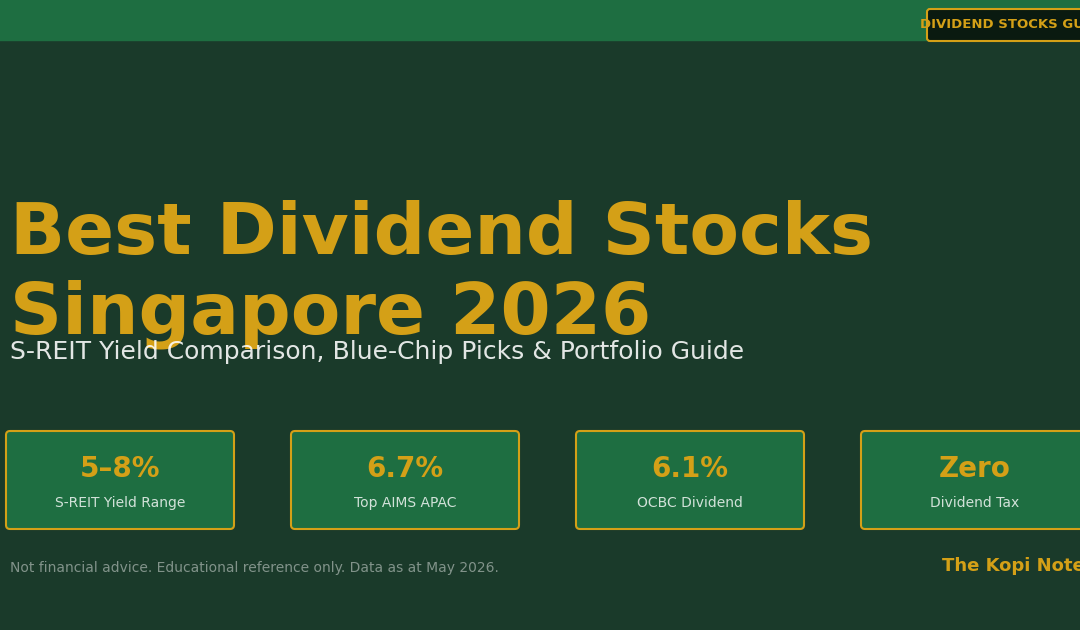
Best Dividend Stocks Singapore 2026: Yield Comparison, S-REITs & Top Picks
S-REITs, blue-chip counters & high-yield REITs — ranked by yield, DPU consistency & safety for Singapore passive income investors
Singapore’s best dividend stocks for 2026 are dominated by S-REITs yielding 5–8%, alongside blue-chip counters like DBS, OCBC and Singtel that offer 4–6% yields with stronger balance sheets. S-REITs remain the go-to choice for Singapore passive income investors thanks to their mandatory 90% income distribution, SGX listing, and compatibility with CPF and SRS accounts — delivering predictable quarterly or semi-annual DPU payouts.
Not financial advice. All figures are for educational reference only. Data as at May 2026 unless noted.
Table of Contents
Contents — Click to expand
Why Dividend Stocks Suit Singapore Investors
Singapore’s tax regime makes dividend investing exceptionally attractive. There is no withholding tax on dividends received from Singapore-listed equities by Singapore tax residents, and S-REITs are required by MAS regulations to distribute at least 90% of their taxable income to unitholders each year to maintain their tax-transparent status.
This combination of high mandatory payouts, zero dividend tax, and SGX listing makes Singapore one of the most dividend-friendly markets in Asia. For a Singapore investor building passive income, the most common strategy is a core S-REIT portfolio (for 5–8% yield) supplemented by dividend-paying blue chips (for yield stability and capital growth).
The other key advantage: S-REITs are eligible for CPF Investment Scheme (CPFIS) and SRS accounts, meaning you can invest CPF Ordinary Account funds or Supplementary Retirement Scheme contributions into selected S-REITs — effectively earning dividend yield on money that would otherwise sit in CPF at 2.5% OA rate. Learn more about CPF investment strategy and how to optimise your allocation.
Finally, S-REITs trade on SGX just like regular stocks — you buy and sell through any brokerage, including Syfe (for fractional and commission-free investing), FSMOne, or standard brokerages like Moomoo and IBKR.
Best S-REIT Dividend Stocks 2026
S-REITs are the backbone of Singapore dividend investing. Unlike ordinary stocks, REITs hold real assets — shopping malls, industrial parks, data centres, offices, hospitals — and must distribute 90%+ of income, giving unitholders a direct share of rental cash flows. Here are the top S-REIT dividend stocks by sector:
Industrial REITs (Highest Yields, Strong Fundamentals)
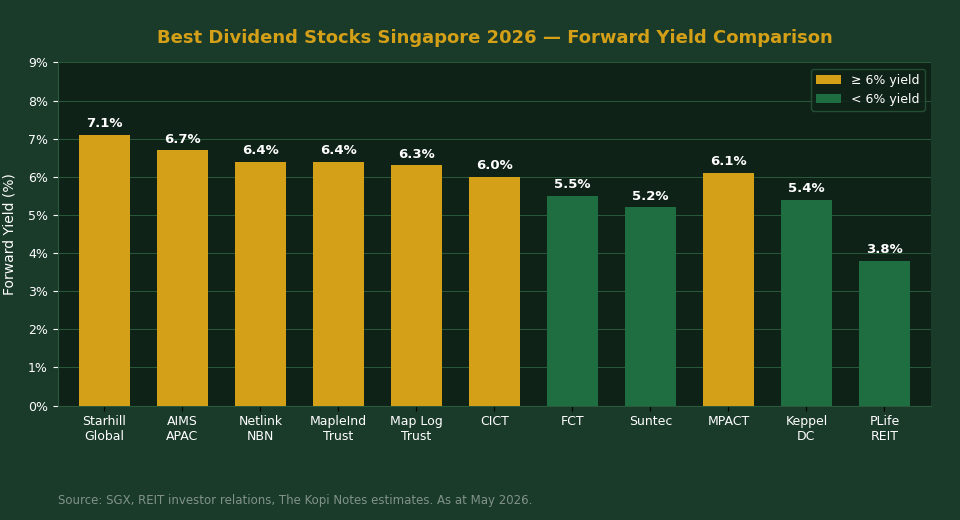
Mapletree Industrial Trust (SGX: ME8U) is one of Singapore’s largest industrial REITs, owning a diversified portfolio of flatted factories, hi-tech buildings, data centres and business parks. As at Q4 FY2026, MIT delivered a DPU of approximately 13.50 cents for the full year, implying a forward yield of around 6.4% at current prices near $2.10. MIT’s gearing sits comfortably at ~39%, well below the 50% MAS regulatory cap, and its data centre segment (which generates roughly 30% of gross revenue) provides a structural growth tailwind.
AIMS APAC REIT (SGX: O5RU) is a smaller industrial REIT focused on Singapore and Australia with a compelling yield profile. Its 9-month FY2026 DPU of 6.81 cents annualises to approximately 9.08 cents, implying a forward yield of ~6.7% at $1.36. AIMS APAC benefits from high occupancy (95.4%), short WALE of 3.6 years and a resilient light industrial tenant base. Read the full AIMS APAC REIT investor guide 2026 for detailed DPU history and portfolio analysis.
Keppel DC REIT (SGX: AJBU) is Singapore’s pure-play data centre REIT — the highest-quality growth REIT in the S-REIT universe. With the AI infrastructure buildout driving data centre demand globally, Keppel DC’s portfolio occupancy has remained near 98%+ and its DPU has grown steadily. At current prices around $2.15, the forward yield is approximately 5.4%, which is lower than other S-REITs but justified by its superior growth profile and defensive long-lease structure (WALE ~7 years).
Retail REITs (Resilient DPU, Mall-Based Income)
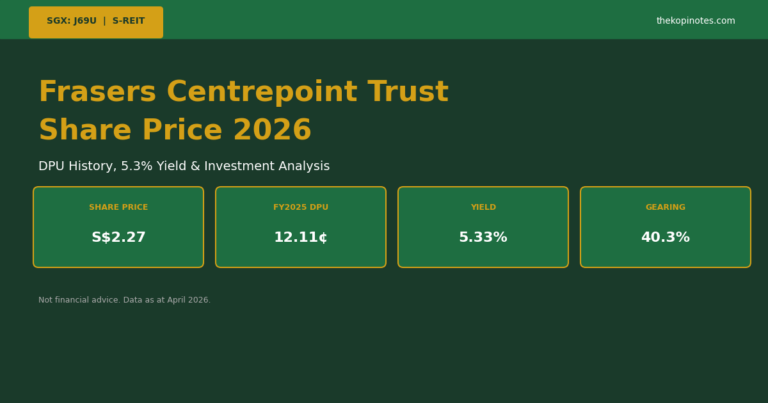
Frasers Centrepoint Trust (SGX: J69U) owns nine heartland suburban malls anchored by supermarkets and F&B — which means its income is highly defensive against e-commerce disruption. FCT delivered a 1H FY2026 DPU of 6.16 cents, annualising to ~12.3 cents, for a forward yield of approximately 5.5% at $2.24. Occupancy across its nine Singapore malls is 99.7%, and its AUM has grown to $6.9 billion following the acquisition of Nex mall.
Suntec REIT (SGX: T82U) is a mixed-use office/retail REIT that owns Suntec City Mall, a stake in One Raffles Quay, and assets in Australia and the UK. Its 1Q 2026 DPU jumped +23.9% YoY to 1.797 cents (driven by divestment gains), and its Singapore office occupancy is 98.8%. At ~$1.35, forward yield is approximately 5.2%. Read the full Suntec REIT investor guide.
Healthcare REITs (Defensive, Inflation-Linked)
Parkway Life REIT (SGX: C2PU) is the standout healthcare REIT — owning Singapore’s three largest private hospitals (Mount Elizabeth, Gleneagles, Parkway East) plus nursing homes in Japan and Malaysia. Its lease structure includes annual rent escalation clauses tied to the Consumer Price Index, making PLife REIT one of the most inflation-protected S-REITs. Its DPU has grown for 17 consecutive years. At current prices near $3.95, the yield is approximately 3.8% — lower than other S-REITs but compensated by exceptional DPU growth consistency. Read the ParkwayLife REIT investor guide 2026.
Full Yield Comparison Table — Best S-REIT Dividend Stocks 2026
The table below compares the top S-REIT dividend stocks by forward yield, gearing, and sector — giving you a fast overview for portfolio building. All yield figures are based on annualised DPU and prices as at May 2026.
| S-REIT | SGX Code | Sector | Fwd Yield | Gearing | DPU Trend |
|---|---|---|---|---|---|
| Keppel DC REIT | AJBU | Data Centre | ~5.4% | ~37% | ↑ Growing |
| Mapletree Industrial Trust | ME8U | Industrial | ~6.4% | ~39% | → Stable |
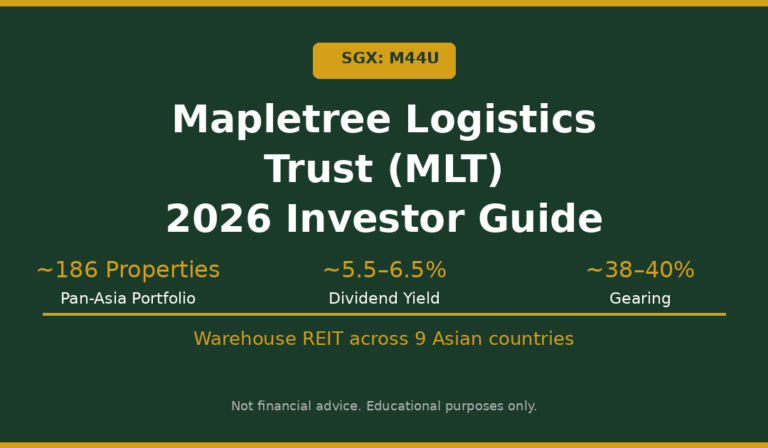
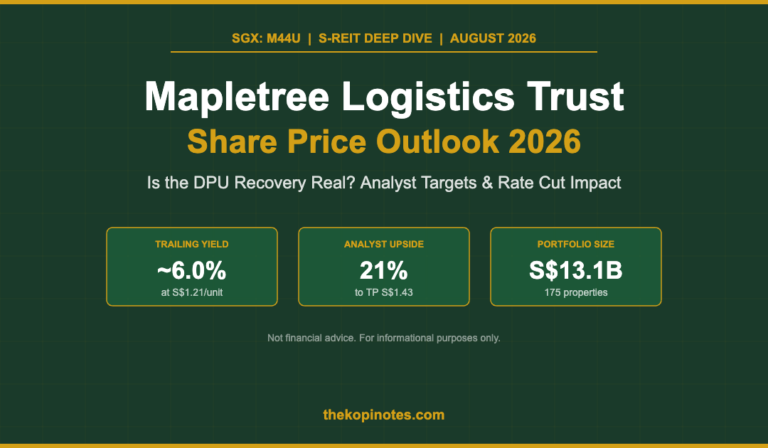
| Mapletree Logistics Trust | M44U | Logistics | ~6.3% | ~40% | ↓ Under pressure |
| AIMS APAC REIT | O5RU | Industrial | ~6.7% | ~35% | ↑ Growing |
| Frasers Centrepoint Trust | J69U | Retail | ~5.5% | ~39% | → Stable |
| Suntec REIT | T82U | Office/Retail | ~5.2% | ~43% | ↑ Recovery |
| Mapletree Pan Asia Commercial Trust | N2IU | Office/Retail | ~6.1% | ~41% | ↓ Under pressure |
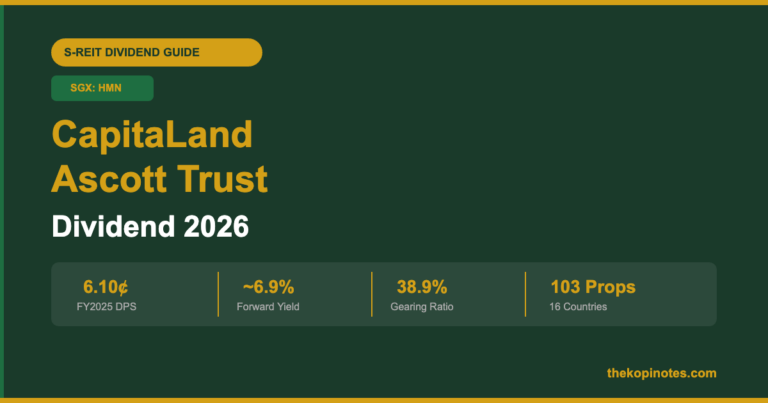
| CapitaLand Ascendas REIT | A17U | Industrial/Logistics | ~5.8% | ~38% | → Stable |
| ParkwayLife REIT | C2PU | Healthcare | ~3.8% | ~36% | ↑↑ 17yr growth |
| Starhill Global REIT | P40U | Retail/Office | ~7.1% | ~35% | → Stable |
Source: SGX, respective REIT investor relations, The Kopi Notes estimates. Yields based on annualised DPU and prices as at May 2026. Past DPU is not a guarantee of future payouts.
For a more interactive comparison, use the S-REIT dividend yield calculator to model your own portfolio returns based on current prices and DPU data.
Blue-Chip Dividend Stocks Singapore 2026
Beyond S-REITs, Singapore’s blue-chip equities offer attractive dividends with the added benefit of potential capital appreciation. These counters tend to have stronger balance sheets and lower leverage than REITs, making them a good complement in a dividend portfolio.
| Stock | SGX Code | Sector | Dividend Yield | Payout Freq. | Notes |
|---|---|---|---|---|---|
| DBS Group | D05 | Banking | ~5.9% | Quarterly | Raised dividend to S$2.22/share for FY2025 |
| OCBC Bank | O39 | Banking | ~6.1% | Semi-annual | FY2025 dividend S$0.92/share |
| UOB | U11 | Banking | ~5.5% | Semi-annual | Regional ASEAN banking exposure |
| Singtel | Z74 | Telco | ~4.8% | Semi-annual | Recovering; Optus drag reduced |
| Netlink NBN Trust | CJLU | Infrastructure | ~6.4% | Quarterly | Regulated broadband infrastructure, very stable |
Source: SGX, respective company annual reports / investor relations. Yields are forward estimates based on latest announced dividends and prices as at May 2026.
Key insight: Singapore banks in 2026 are offering some of the highest yields they have in a decade, with DBS and OCBC both offering quarterly/semi-annual dividends above 5.5%. Unlike S-REITs, banks are not required to distribute a fixed percentage of earnings — so their dividends depend on profit performance and management’s capital return policy. However, MAS’s strong banking oversight has historically made Singapore bank dividends very consistent.
How to Pick the Best Dividend Stock for You
Selecting the right dividend stocks depends on your income goals, risk tolerance, and investment horizon. Here is a practical framework Singapore investors can use:
1. Start with yield — but don’t chase it blindly. An 8% yield on a REIT with 48% gearing and declining occupancy is riskier than a 5% yield from a REIT with strong DPU growth. Always cross-check yield against gearing (below 40% is safer), interest coverage ratio (ICR above 3x is comfortable), and WALE (weighted average lease expiry — longer is more stable). Use the S-REIT yield vs SGS bond spread calculator to see whether current yields offer sufficient risk premium over the risk-free rate.
2. Check DPU consistency. A dividend stock that has grown or maintained its DPU over 5+ years is a far more reliable income generator than one that cuts and restores. Parkway Life REIT (17 consecutive years of DPU growth) and Mapletree Industrial Trust are examples of consistent performers. Look for year-on-year DPU history in the REIT’s quarterly results presentations.
3. Sector diversification matters. Do not concentrate your dividend portfolio in one sector. Pair a high-yield industrial REIT (e.g. AIMS APAC) with a more defensive healthcare REIT (ParkwayLife) and a blue-chip bank (DBS or OCBC) for balance. A Singapore investor’s dividend portfolio might look like: 40% industrial/logistics REITs, 20% retail REITs, 20% bank stocks, 10% healthcare REITs, 10% infrastructure trust.
4. Consider the interest rate environment. S-REITs are sensitive to interest rates because they carry debt. When rates rise, borrowing costs go up and compress DPU — which is why many S-REITs saw DPU pressure in 2023–2024. With the Fed starting to cut in 2025 and continuing in 2026, S-REITs with high fixed-rate debt hedging ratios (above 70%) are better positioned. Check the hedge ratio in each REIT’s quarterly results.
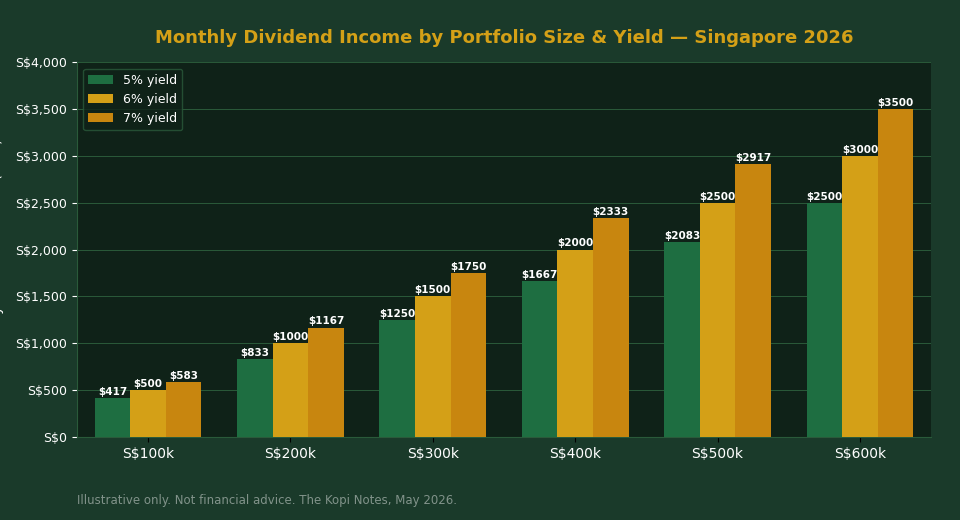
5. Use the retirement calculator to size your portfolio. A common rule of thumb for Singapore passive income: divide your target monthly passive income by the portfolio’s blended annual yield. For example, if your portfolio yields 6% and you want S$2,000/month (S$24,000/year), you need a portfolio of S$400,000. The retirement calculator models this with CPF integration.
Using CPF & SRS for Dividend Stocks
One of the most powerful strategies for Singapore dividend investors is using CPF Ordinary Account (OA) funds to buy selected S-REITs through the CPF Investment Scheme (CPFIS). Your OA currently earns 2.5% interest — but selected S-REITs and STI ETFs eligible for CPFIS can potentially deliver 5–7% annually, materially improving your retirement nest egg over a 20–30 year horizon.
CPFIS-eligible S-REITs include the large-cap counters: CapitaLand Ascendas REIT, Mapletree Industrial Trust, Mapletree Logistics Trust, Keppel DC REIT and others. Check the CPF Board’s updated CPFIS-included investments list before buying — the list changes periodically. You can learn more about CPF investment strategy including CPFIS allocation rules and risk grades.
SRS (Supplementary Retirement Scheme) is another tax-advantaged account. Contributions to SRS reduce your taxable income (up to S$15,300/year for Singapore citizens/PRs), and you can invest SRS funds in SGX-listed stocks including S-REITs and dividend ETFs. Dividends and capital gains within SRS are not taxed until withdrawal — making SRS an excellent vehicle for building a dividend portfolio with a long horizon.
For a detailed breakdown of how to optimise your CPF and SRS for dividend investing, see our guide on passive income Singapore 2026 — which models real SGD scenarios for building S$2,000–S$5,000/month in passive income. You can also explore the dividend portfolio yield calculator to model different S-REIT combinations.
Key Risks to Watch in 2026
Dividend investing looks attractive in 2026 but is not without risk. Singapore investors should watch the following:
Interest rate trajectory: While the US Fed has begun cutting rates, the pace of cuts matters enormously for S-REITs. If rates stay “higher for longer” into 2027, REITs with floating-rate debt exposure face continued DPU pressure. Check each REIT’s interest rate hedging percentage — REITs that have locked in fixed rates for 70–80% of their debt are more insulated.
China property overhang: Several S-REITs with China exposure (including Mapletree Pan Asia Commercial Trust and CapitaLand China Trust) continue to face weaker retail traffic and rental reversions in China. If you are building a dividend portfolio, consider limiting China-exposed REITs to a smaller allocation until the macro picture clarifies.
US tariff uncertainty: Singapore’s manufacturing and logistics REITs have indirect exposure to global trade volumes. Industrial tenants in sectors facing US tariff headwinds may renegotiate leases or delay expansion — which can suppress rental reversion growth. Our S-REIT tariff resilience analysis — see the best S-REITs Singapore 2026 guide — ranked S-REITs by their tariff resilience score.
Rights issues and equity dilution: Many S-REITs fund acquisitions via rights issues, which are dilutive to existing unitholders if the acquisition is not immediately DPU-accretive. Keep a watch on REIT gearing ratios — a REIT approaching the 45–50% gearing level is more likely to do an equity fundraise.
DPU cut risk: No S-REIT dividend is guaranteed. If occupancy falls or interest costs spike, the REIT manager may reduce distributions to preserve cash flow. Investors should diversify across at least 5–8 REITs to reduce single-stock DPU cut risk. Use our S-REIT total return calculator to model downside scenarios.
Start Building Your Dividend Portfolio
Ready to invest in Singapore’s best dividend stocks? Compare brokerages and get sign-up bonuses:
Frequently Asked Questions
What are the best dividend stocks in Singapore for 2026?
Are dividends from Singapore stocks taxable?
How much do I need to invest to earn S$2,000/month in dividends?
Can I buy Singapore dividend stocks using CPF?
What is the highest yielding S-REIT in Singapore right now?
What is the difference between S-REITs and dividend stocks?
Is it safe to invest in S-REITs during high interest rate periods?
The Kopi Notes provides educational content only and is not a licensed financial adviser. All yield figures and DPU data are sourced from public company filings and SGX announcements as at May 2026. Past distributions are not a guarantee of future payouts. Always do your own due diligence before investing. The Kopi Notes may earn referral fees from broker sign-up links on this page.
This article was researched with the help of AI. While we strive to keep all information accurate and up to date, there may be errors. If you notice any discrepancies, please contact us.