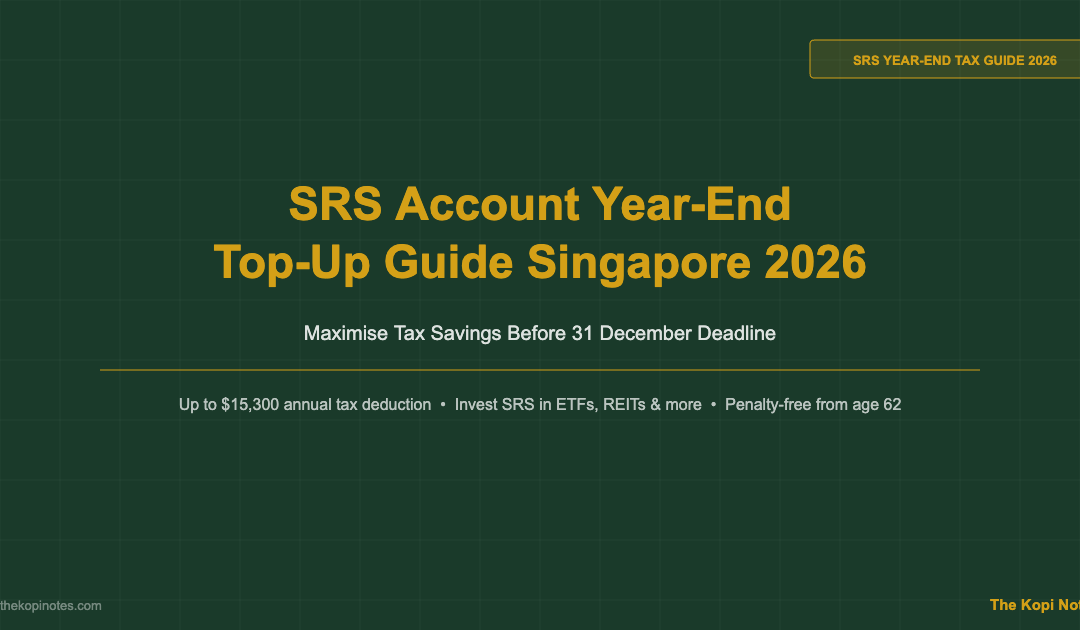
SRS Account Year-End Top-Up Guide Singapore 2026: Maximise Tax Savings Before 31 December
Maximise Tax Deductions Before 31 December — A Step-by-Step Guide
The Supplementary Retirement Scheme (SRS) lets Singapore residents — citizens, PRs, and foreigners — contribute up to $15,300 (or $35,700 for foreigners) each year before 31 December and deduct every dollar from their taxable income. Depending on your tax bracket, topping up your SRS account before year-end can save you anywhere from $918 to over $5,200 in income tax — and your funds can be invested in ETFs, REITs, bonds, and more through brokers like Syfe and FSMOne.
Not financial advice. All figures are for educational reference only. Data as at October 2026 unless noted.
What Is the SRS Account?
The Supplementary Retirement Scheme (SRS) is a voluntary savings programme introduced by the Singapore Government in 2001 to encourage working adults to save more for retirement. Unlike CPF, which is mandatory, SRS is entirely opt-in — and its tax benefits are its defining feature.
When you contribute to your SRS account, the amount is deducted from your assessable income in that same year of assessment. This means if you earn $100,000 and contribute the maximum $15,300, you are taxed only on $84,700. Over a working lifetime, the compounded tax savings — plus investment returns on those savings — can be substantial.
SRS accounts are administered by three banks in Singapore: DBS, OCBC, and UOB. You can only hold one SRS account, and you must open it with one of these three providers. Once opened, your SRS funds can be invested in a wide range of instruments — including ETFs listed on the SGX, unit trusts, Singapore Savings Bonds, fixed deposits, and eligible REITs. For a broader view of building passive income in Singapore, SRS forms one important pillar alongside dividend investing and REITs.
SRS Contribution Limits 2026
The annual SRS contribution cap depends on your residency status. As of 2026, the limits are:
| Residency Status | Annual SRS Cap | Employer Contribution Rate | Max Tax Deduction |
|---|---|---|---|
| Singapore Citizen | $15,300 | Not applicable | $15,300 |
| Singapore PR | $15,300 | Not applicable | $15,300 |
| Foreigner (Employment Pass etc.) | $35,700 | 15% of salary (employer) | $35,700 |
Source: IRAS Singapore (iras.gov.sg), CPF Board. Data as at October 2026.
Note that partial contributions are allowed — you do not need to hit the cap. Contributing even $5,000 or $10,000 before 31 December generates a meaningful tax deduction. The key rule: contributions must be credited to your SRS account by 31 December for the deduction to apply in that year of assessment.
If you are also considering CPF investment strategy options, note that SRS and CPF Special Account top-ups are separate deductions that can stack — subject to their respective caps.
How Much Tax Can You Save? A Practical Breakdown by Income
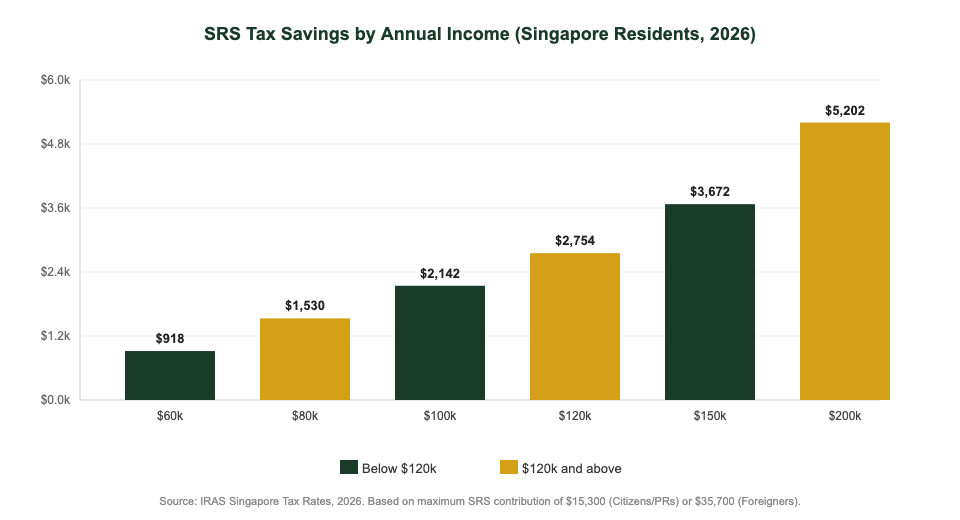
The actual tax savings from an SRS top-up depend on your marginal tax rate, which rises with income. Here is a worked example for Singapore residents earning between $60,000 and $200,000 annually, contributing the full $15,300 SRS cap:
| Annual Income | Marginal Tax Rate | Est. Tax Saved (Full $15,300 SRS) | Effective Return on Top-Up |
|---|---|---|---|
| $60,000 | 6% | ~$918 | 6.0% |
| $80,000 | 10% | ~$1,530 | 10.0% |
| $100,000 | 14% | ~$2,142 | 14.0% |
| $120,000 | 18% | ~$2,754 | 18.0% |
| $150,000 | 24% | ~$3,672 | 24.0% |
| $200,000 | 34% | ~$5,202 | 34.0% |
Source: IRAS Singapore tax rates 2026. Estimates based on marginal rate applied to SRS contribution amount; actual savings depend on full income profile and other deductions.
That “effective return” figure is the risk-free, guaranteed return you get the moment your SRS contribution hits — before any investment return. A 34% guaranteed return is effectively unbeatable by any fixed income product in the market today. If you plan to use the Singapore retirement calculator, factor in your projected SRS balance at age 62 to see the full retirement income picture.
How to Top Up Your SRS Account Before 31 December
The process differs slightly by bank, but the steps are broadly the same whether you bank with DBS, OCBC, or UOB:
Step 1: Open an SRS Account (If You Haven’t Already)
Apply through your preferred bank’s internet banking portal or app. You will need your NRIC (or passport and employment pass for foreigners), and approval is typically instant for online applications. You can only hold one SRS account across all three providers — you cannot switch banks without closing and reopening.
Step 2: Transfer Funds Before 31 December
Log in to your bank’s internet banking platform and navigate to the SRS top-up section. Key deadline: the transfer must be credited to your SRS account by 31 December 2026. Allow at least 2–3 business days buffer for interbank transfers if you are topping up from a non-SRS bank account.
Most banks allow same-day or next-day crediting for intrabank transfers (e.g. DBS savings account → DBS SRS). For FAST/PayNow from another bank, check the cut-off time (typically 10pm–11pm). Do not wait until 31 December itself — bank system load is highest then.
Step 3: Invest Your SRS Funds
SRS cash sitting uninvested earns a nominal 0.05% p.a. interest — barely any return. You should deploy your SRS funds into productive investments. You can invest SRS through:
- Your SRS bank’s brokerage (DBS Vickers, OCBC Securities, UOB Kay Hian)
- Third-party brokers that accept SRS: FSMOne (use referral code P0544985), Syfe (code SRPRFFFCD), Endowus (code 2V343)
Step 4: File Your Tax Return (Apr–May 2027)
IRAS will pre-fill your SRS contribution data in your income tax return for Year of Assessment 2027 (for contributions made in 2026). Verify the pre-filled amount matches your actual contribution and submit. The deduction is automatic.
SRS vs CPF Top-Up vs Cash Savings: Which Is the Better Year-End Move?
October through December is tax planning season in Singapore. Here is how the SRS top-up stacks up against the two other common year-end tax moves:
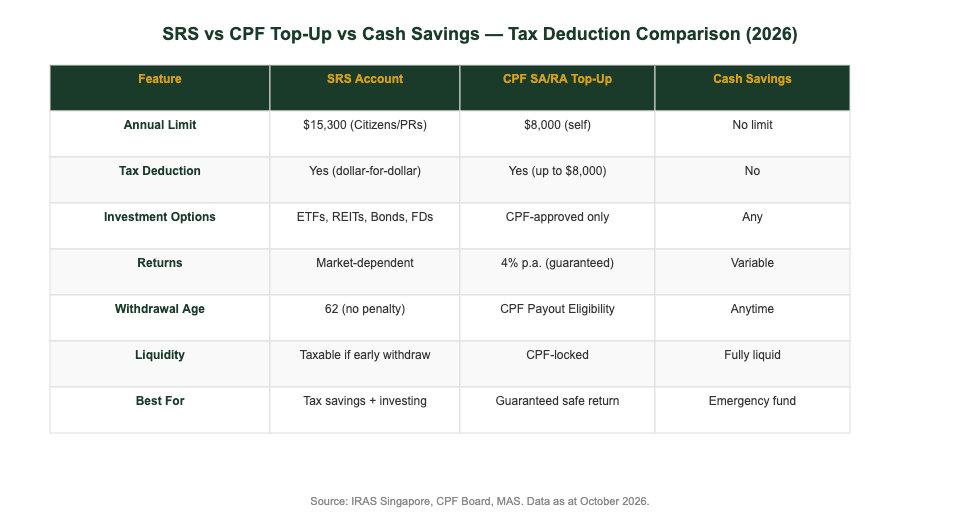
The key practical distinction: SRS is the only option that preserves full investment flexibility. CPF Special Account or Retirement Account top-ups give a guaranteed 4% p.a. return — excellent for conservative savers — but the funds are locked within the CPF system until eligibility age. SRS funds, by contrast, can be invested in SGX-listed ETFs, Singapore Savings Bonds, unit trusts, and REITs, while still flowing back to your own bank account at age 62. For a guide on Singapore Savings Bonds as an SRS-eligible fixed income option, see our dedicated article.
For most working adults earning above $80,000 annually, doing both SRS ($15,300) and CPF Retirement Sum Topping-Up ($8,000 for self + $8,000 for family) in the same year maximises total deductions — up to $31,300 in deductions before other reliefs. Consult an IFA or IRAS’s tax calculator to model your specific situation.
What to Invest Your SRS Funds In
Once your SRS funds are credited, the worst thing you can do is leave them as cash earning 0.05% p.a. The investment menu available through your SRS account includes:
SGX-Listed ETFs and REITs
ETFs tracking the STI (Straits Times Index), S-REITs, global indices, and bond markets are all SRS-eligible when listed on the SGX. This covers popular names like the Nikko AM STI ETF, SPDR STI ETF, Lion-OCBC Securities APAC Financials ETF, and various S-REIT ETFs. These can be purchased via SRS-linked brokerage accounts. Our guide on Singapore REIT ETF investing covers the key options in detail.
Singapore Savings Bonds (SSB)
SSBs are SRS-eligible and offer a step-up interest structure. As at Q4 2026, new SSB tranches are yielding in the 2.8%–3.2% range (10-year average). They are capital-guaranteed and fully redeemable — making them ideal for SRS investors who want guaranteed returns without CPF restrictions.
Unit Trusts via Endowus, Syfe, FSMOne
Platforms like Endowus (use code 2V343 for fee rebate) accept SRS funds and provide access to institutional-class global unit trusts at low cost. Syfe (code SRPRFFFCD) similarly allows SRS-funded investments via Syfe referral code into diversified portfolios. FSMOne (code P0544985) offers one of the largest SRS-eligible fund libraries in Singapore.
Fixed Deposits
DBS, OCBC, and UOB all offer SRS fixed deposits, typically at rates close to their standard FD rates. As at October 2026, SRS FD rates from the three banks range from 2.5% to 3.1% p.a. for 12-month tenors. These are the most conservative option — useful for SRS investors approaching retirement age who want capital preservation.
SRS Withdrawal Rules: What Happens When You Retire
SRS withdrawals are taxed — but at a 50% concessionary rate. This means only half your withdrawal is added to your taxable income in any given year. Practically, this creates a powerful tax arbitrage: you get a deduction at your peak working income rate, but pay tax at a much lower effective rate at retirement (when total income is lower).
| Withdrawal Timing | Tax Treatment | Penalty |
|---|---|---|
| At or after age 62 | 50% of withdrawal is taxable income | None |
| Before age 62 (premature withdrawal) | 100% of withdrawal is taxable income | 5% penalty on amount withdrawn |
| Withdrawal over 10-year window from age 62 | 50% of each annual tranche is taxable | None — optimal strategy |
| Lump sum at age 62 | 50% of lump sum taxable — higher rate if large | None — but consider tax impact |
Source: IRAS Singapore, MOF. Data as at October 2026.
Optimal withdrawal strategy: spread withdrawals over 10 years from age 62, withdrawing no more than $40,000 per year (so only $20,000 — 50% — is taxable, falling below Singapore’s personal income tax threshold). At zero effective tax on retirement withdrawals, the SRS gives you a full deduction on the way in and near-zero tax on the way out. Use the Singapore retirement planning calculator to model your optimal SRS drawdown.
📋 Year-End SRS Checklist: Do This Before 31 December
- ✅ Open SRS account if not already done (DBS/OCBC/UOB — takes 15 minutes online)
- ✅ Calculate your optimum contribution — aim for the full $15,300 if you earn above $80k; even $5k–$10k is meaningful
- ✅ Transfer funds by 31 December — allow 2–3 days buffer; do not wait until the last day
- ✅ Set up SRS brokerage linkage with FSMOne, Syfe, or Endowus before the contribution (so funds can be deployed immediately in January)
- ✅ Invest your SRS balance — do not leave it as cash at 0.05% p.a.
- ✅ Stack with CPF RS Top-Up if also making CPF contributions for additional deduction
- ✅ Verify on IRAS myTax Portal (April–May 2027) that the SRS deduction appears correctly
Frequently Asked Questions: SRS Account Year-End Top-Up
What is the SRS contribution deadline for 2026?
How much can I contribute to SRS in 2026?
Is an SRS top-up worth it if I earn $60,000 a year?
What happens if I withdraw from SRS early (before age 62)?
What happens if I withdraw from SRS early (before age 62)?
Can I have more than one SRS account?
Does SRS count separately from CPF tax deductions?
This article was researched with the help of AI. While we strive to keep all information accurate and up to date, there may be errors. If you notice any discrepancies, please contact us.