Retirement Planning in Singapore: Complete 2026 Guide
Everything you need — CPF retirement sums, SRS tax savings, investment strategies, and how much you actually need to retire comfortably in Singapore.
Retirement planning in Singapore starts with two pillars: your CPF and your personal investments. The CPF Full Retirement Sum (FRS) in 2026 is $213,000 — meeting it gives you roughly $1,640–$1,760 per month from CPF LIFE from age 65. But for most Singaporeans, that alone is not enough. You’ll need additional investments in ETFs, REITs, or robo-advisors to bridge the gap and retire on your own terms.
Not financial advice. All figures are for educational reference only. Data as at July 2026 unless noted.
- You likely need $750K–$2.4M in retirement savings depending on lifestyle — use our Singapore retirement calculator to get your personal number
- CPF LIFE covers the base; your investment portfolio covers everything above that
- Start early, maximise SRS contributions, and invest consistently — time in market beats timing the market
Table of Contents
Contents — Click to expand
How Much Do You Need to Retire in Singapore?
This is the first question every Singaporean should answer — and the honest truth is it depends on how you want to live. There’s no one-size-fits-all number.
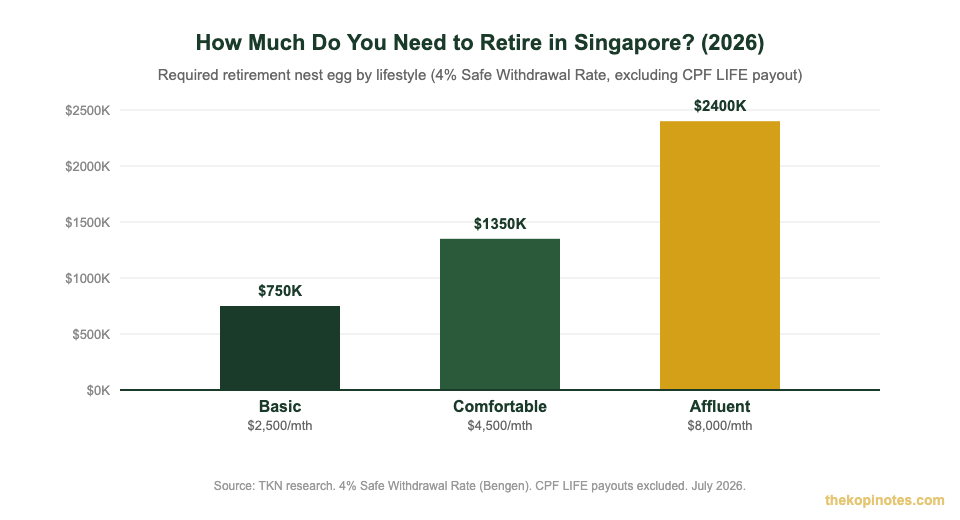
A practical starting point is the 25x Rule, derived from the widely-cited 4% Safe Withdrawal Rate (SWR). Take your desired annual retirement spending, multiply by 25, and you get your target nest egg. A portfolio this size lets you withdraw 4% annually without depleting your capital over a 30-year retirement — assuming a balanced investment portfolio.
Here’s what that looks like for three common Singapore retirement lifestyles:
| Retirement Lifestyle | Monthly Expenses | Annual Expenses | Nest Egg Needed (25x) |
|---|---|---|---|
| Basic — HDB, hawker meals, public transport | $2,500 | $30,000 | $750,000 |
| Comfortable — condo or private, dining out, short trips | $4,500 | $54,000 | $1,350,000 |
| Affluent — high-end lifestyle, regular overseas travel, private medical | $8,000 | $96,000 | $2,400,000 |
Source: TKN research based on MAS Financial Literacy data. 4% SWR (Bengen, 1994). CPF LIFE payouts excluded — add those to reduce the personal portfolio target. As at July 2026.
The good news: your CPF LIFE payout will cover part of these expenses. If you hit the Full Retirement Sum (FRS) of $213,000 in 2026, you’ll receive roughly $1,640–$1,760 per month from age 65. So your personal investment portfolio only needs to cover the gap above your CPF payout.
For example: if you want $4,500/month in retirement and CPF LIFE covers $1,700, your portfolio only needs to produce $2,800/month — requiring a nest egg of around $840,000 rather than $1,350,000. That’s a much more achievable target.
For a personalised calculation based on your current savings, expected CPF payout, and target retirement age, use our Singapore retirement calculator.
CPF — Your Foundation for Retirement
Your Central Provident Fund (CPF) is the cornerstone of retirement planning in Singapore. Your employer and you contribute monthly into three accounts: the Ordinary Account (OA at 2.5% interest), Special Account (SA at 4%), and MediSave Account (MA at 4%). When you turn 55, your OA and SA savings are swept into a Retirement Account (RA) — up to the retirement sum tier you choose.
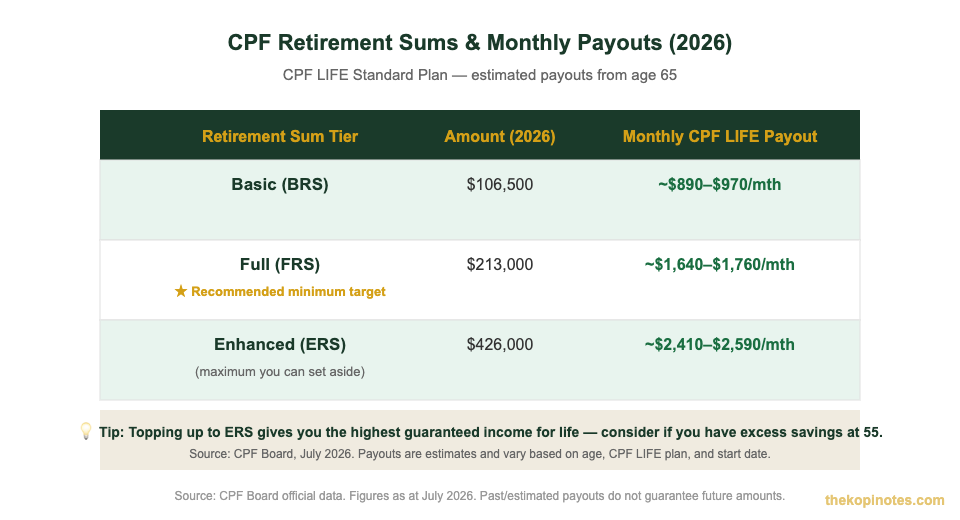
In 2026, there are three retirement sum tiers:
| CPF Retirement Sum | Amount (2026) | Est. Monthly Payout from Age 65 |
|---|---|---|
| Basic Retirement Sum (BRS) | $106,500 | ~$890–$970/month |
| Full Retirement Sum (FRS) ★ | $213,000 | ~$1,640–$1,760/month |
| Enhanced Retirement Sum (ERS) | $426,000 | ~$2,410–$2,590/month |
Source: CPF Board, July 2026. Payouts are estimates for the CPF LIFE Standard Plan. ★ = recommended minimum target for most Singaporeans.
The ERS is the maximum you can set aside in your RA. If you have excess OA or SA savings above the ERS at 55, you can withdraw them as cash.
CPF LIFE (Lifelong Income for the Elderly) is the annuity scheme that converts your RA savings into monthly payouts for life. You’re automatically enrolled at age 65, though you can defer payouts up to age 70 — every year of deferral increases your monthly payout by approximately 6–7%.
CPF Voluntary Top-Ups: One of Singapore’s Best Tax Moves
You can top up your own or your parents’ CPF SA or RA under the Retirement Sum Topping-Up Scheme (RSTU). Every dollar you contribute gets you a dollar-for-dollar income tax relief, up to $8,000 for yourself and another $8,000 for a family member — that’s $16,000 in annual tax relief.
Your SA earns a guaranteed 4% per year from the government. That’s hard to beat for risk-free, tax-sheltered savings. For a detailed look at how to maximise your CPF through the SA shielding strategy and voluntary top-ups, see our guide on CPF investment strategy Singapore.
SRS Account: Tax-Efficient Retirement Savings
The Supplementary Retirement Scheme (SRS) is a voluntary government-run scheme that lets you contribute up to $15,300 per year (Singapore citizens and PRs) and deduct every single dollar from your taxable income.
Here’s the tax advantage in plain numbers: if you earn $120,000 per year and contribute the maximum $15,300 to SRS, you save approximately $2,754 in income tax immediately — that’s an 18% instant return before your money even gets invested. Do that for 20 years and you’ve sheltered $306,000 from full taxation while it compounds inside the SRS account.
The withdrawal rules are what make SRS powerful: from age 62, only 50% of your SRS withdrawals are taxed as income. For most retirees with lower post-retirement income, this means an effective tax rate close to zero on SRS withdrawals.
SRS funds can be invested in Singapore-listed ETFs, S-REITs, unit trusts, endowus portfolios, and bonds. Platforms like Endowus (code: 2V343) and Syfe (code: SRPRFFFCD) accept SRS investments. For a complete SRS walkthrough, read our guide on generating passive income Singapore through tax-efficient structures.
Best Investments for Retirement in Singapore
Once you’ve maximised CPF voluntary top-ups and SRS contributions, building a personal investment portfolio is the next priority. Here’s a comparison of the main options, by risk level:
| Investment | Expected Return | Risk | Best For |
|---|---|---|---|
| Singapore Savings Bonds (SSB) | ~3–3.5% p.a. | Very Low | Capital preservation, liquidity buffer |
| Singapore T-Bills | ~3.5–4% p.a. | Very Low | Short-term cash parking |
| S-REITs | 5–7% distribution yield | Medium | Regular passive income in retirement |
| Robo-Advisors (Syfe, Endowus) | 5–8% p.a. | Medium | Hands-off diversified investing |
| Global ETFs (VWRA, CSPX on LSE) | 7–10% p.a. (historical) | Medium-High | Long-term growth, 10+ year horizon |
Source: SGX, MAS, fund factsheets, TKN research. Past returns do not guarantee future performance. As at July 2026.
For most Singaporeans with a 10+ year investment horizon, a core-satellite approach works well:
- Core (60–70%): Low-cost global ETFs like VWRA or CSPX — long-term compound growth
- Satellite (20–30%): S-REITs for regular dividend income — see our guide to the best S-REITs in Singapore 2026
- Buffer (10%): Singapore Savings Bonds — liquid and risk-free. Read our Singapore Savings Bonds guide to get started
If managing individual investments feels overwhelming, robo-advisors like Syfe and Endowus automatically rebalance your portfolio and adjust risk as you approach retirement. Endowus is particularly popular for retirement because it lets you invest CPF OA and SRS funds alongside cash — all in one platform.
Step-by-Step Retirement Action Plan by Age
Retirement planning is not a one-time event. It’s a rolling process that evolves as your income grows and your timeline shortens. Here’s what to prioritise at each life stage:
In Your 20s: Build the Habit Early
Your greatest advantage at this age is time. Even small amounts compounded over 40 years create life-changing wealth.
- Set up a Regular Savings Plan (RSP) — even $200–$300/month into a global ETF builds a powerful long-term base
- Open an SRS account and contribute even a small amount — starting early builds the habit and gives you decades of tax-sheltered compounding
- Make sure your CPF contributions are on track (your employer handles this, but check your CPF statement annually)
- Get basic term life and disability insurance in place before any serious health issues arise
In Your 30s–40s: Accelerate Your Savings Rate
Income typically grows fastest in your 30s and 40s. This is when your retirement savings rate has the most impact.
- Maximise SRS contributions ($15,300/year) — at the 22% marginal tax rate, this saves $3,366 annually in taxes
- Consider CPF voluntary top-ups to your SA for the guaranteed 4% return and additional tax relief
- Increase your ETF and REIT allocation as income grows — aim for at least 20% savings rate of take-home pay
- Review your investment allocation every 2–3 years and rebalance if needed
In Your 50s–60s: Consolidate and De-Risk
The focus shifts from accumulation to preservation and income generation.
- Gradually shift portfolio allocation towards more income-generating assets — higher REIT weighting, Singapore Savings Bonds
- Decide your CPF Retirement Sum tier — BRS, FRS, or ERS — based on your total retirement income picture
- Consider deferring CPF LIFE payout start date beyond 65 for higher monthly income (each year of deferral adds ~6–7% to monthly payout)
- Plan your drawdown strategy: which account to tap first and in what order to minimise lifetime tax
Common Retirement Planning Mistakes in Singapore
Retirement planning is simpler than most think — but a few common mistakes can cost you dearly over a 30-year retirement horizon.
Underestimating how much you need. Most Singaporeans fail to account for inflation. At 2.5% annual inflation, your expenses double in 28 years. A plan that looks sufficient today may fall $500,000 short by retirement if you haven’t factored this in.
Relying entirely on CPF. CPF LIFE is designed to cover basic needs — not a comfortable retirement. Treating it as your entire plan leaves a significant income gap. The FRS payout of ~$1,700/month covers HDB living costs, but not much beyond that.
Not using the SRS. High-income earners lose thousands in unnecessary tax every year by not contributing to SRS. At a 22% marginal rate, contributing $15,300 saves $3,366 per year — that’s already a 22% guaranteed return before your money does anything.
Starting too late. The maths is stark: $500 invested monthly from age 25 to 65 at 7% p.a. grows to approximately $1.32 million. Start at 35 instead? Just $606,000 — less than half, for only 10 fewer years of contributions.
Being too conservative. Keeping all retirement savings in cash or bank deposits guarantees you’ll fall behind inflation. Even a modest allocation to global ETFs — just 30–40% of your portfolio — dramatically improves long-term outcomes without undue risk.
Frequently Asked Questions
How much do I need to retire comfortably in Singapore?
For a comfortable retirement in Singapore — condo living, dining out occasionally, and a short holiday or two per year — you typically need around $4,500/month in today’s dollars. Using the 25x rule, that means a personal investment portfolio of approximately $1,350,000, on top of your CPF LIFE payout of around $1,700/month (assuming FRS). If your CPF covers $1,700 of that $4,500, your portfolio only needs to produce the remaining $2,800/month — requiring around $840,000. Use the Singapore retirement calculator for your personalised figure.
What is the CPF Full Retirement Sum (FRS) in 2026?
The CPF Full Retirement Sum (FRS) in 2026 is $213,000. If you set aside this amount in your CPF Retirement Account (RA) when you turn 55, you will receive approximately $1,640–$1,760 per month under the CPF LIFE Standard Plan starting from age 65. The FRS increases each year — CPF Board has announced it will rise by approximately 3.5% annually through to 2027. The Enhanced Retirement Sum (ERS) is $426,000, giving payouts of approximately $2,410–$2,590 per month. Source: CPF Board, July 2026.
Can I retire early in Singapore? What is FIRE?
Yes — Financial Independence, Retire Early (FIRE) is achievable in Singapore, though it requires a higher savings rate and larger nest egg. Because CPF LIFE payouts don’t begin until age 65, early retirees need their personal investment portfolio to cover all expenses from their retirement date until 65, then only the gap above CPF payouts thereafter. A typical early retirement target for a 45-year-old in Singapore aiming for $4,500/month would be $1.5–$2 million in personal savings, depending on withdrawal rate and timeline assumptions.
What is the SRS account and should I open one?
The Supplementary Retirement Scheme (SRS) is a voluntary government savings scheme that gives you dollar-for-dollar income tax relief on contributions up to $15,300 per year (for Singapore citizens and PRs). You invest your SRS funds in eligible assets — Singapore-listed ETFs, REITs, unit trusts, bonds — and only 50% of withdrawals are taxed after age 62. If you’re in the 18% tax bracket or above, the SRS is almost always worth maximising. It’s one of the most tax-efficient retirement tools available to Singaporeans.
What is the best investment for retirement in Singapore?
There’s no single best investment — it depends on your age, risk tolerance, and income needs. That said, for most Singaporeans a core-satellite approach works well: 60–70% in low-cost global ETFs (like VWRA or CSPX on the London Stock Exchange) for long-term growth, 20–30% in S-REITs for regular dividend income, and 10% in Singapore Savings Bonds as a liquid buffer. For hands-off investors, robo-advisors like Syfe and Endowus offer diversified, auto-rebalancing portfolios that accept both cash and SRS funds.
At what age should I start retirement planning in Singapore?
The short answer: as early as possible. The compound interest effect is most powerful over long time horizons. Someone who starts investing $300/month at age 25 at 7% p.a. will have approximately $790,000 by age 65. Starting at 35 with the same amount? About $369,000 — less than half. That said, it’s never too late to start. If you’re in your 40s or 50s, you can still catch up by increasing your savings rate, maximising SRS contributions, and reducing lifestyle inflation as your income grows.
Start Building Your Retirement Portfolio Today
Open a brokerage or robo-advisor account and take the first step. Use our referral links for exclusive sign-up bonuses.
This article was researched with the help of AI. While we strive to keep all information accurate and up to date, there may be errors. If you notice any discrepancies, please contact us.