How to Start Investing in Singapore (2026): Complete Beginner’s Guide
Step-by-step guide covering stocks, ETFs, CPF, REITs and robo-advisors — for every budget and risk level.
Starting to invest in Singapore is simpler than most people think. You can begin with as little as SGD 100 through a robo-advisor or regular savings plan, or buy global ETFs on the London Stock Exchange through Interactive Brokers or Syfe. Singapore’s no-capital-gains-tax environment means every dollar of growth stays in your pocket — making it one of the best places in the world to build long-term wealth.
Not financial advice. All figures are for educational reference only. Data as at June 2026 unless noted.
- Singapore has no capital gains tax — all investment profits are yours to keep
- You can start with SGD 100 via robo-advisors like Syfe or regular savings plans (RSPs)
- For ETF investing, IBKR and Syfe Brokerage offer the lowest fees for most beginners
Table of Contents
Contents — Click to expand
- Why Singapore Is the Best Place to Start Investing
- How Much Money Do You Need to Start?
- Investment Options for Singapore Beginners
- How to Choose the Right Investment for You
- Opening a Brokerage Account in Singapore
- Using CPF and SRS to Invest
- Common Mistakes Beginners Make
- Your First Investment: A Step-by-Step Plan
- Frequently Asked Questions
Why Singapore Is the Best Place to Start Investing
Singapore investors enjoy one of the most favourable tax environments in the world. There is no capital gains tax — meaning if you buy shares at SGD 10,000 and sell them for SGD 15,000, you keep the full SGD 5,000 profit. There is also no dividend tax for most investments, though withholding tax may apply depending on where the ETF or stock is listed.
This matters enormously over a long investing horizon. In many countries, investors lose 15–30% of their gains to tax every year. In Singapore, that drag does not exist for most investment types. Your money compounds uninterrupted.
Beyond tax, Singapore gives you access to global markets through well-regulated brokers, CPF and SRS schemes that offer tax relief on contributions, and a growing ecosystem of robo-advisors built specifically for local investors.
How Much Money Do You Need to Start?
You do not need tens of thousands of dollars to start investing in Singapore. The entry point depends on what you invest in and which platform you use.
| Investment Type | Minimum Amount | Platform |
|---|---|---|
| Robo-advisor (global ETFs) | SGD 1 | Syfe Core, StashAway |
| Regular Savings Plan (RSP) | SGD 100/month | FSMOne, POEMS, OCBC |
| ETFs (direct purchase) | ~SGD 130–400 (1 lot) | IBKR, Syfe Brokerage, moomoo |
| Singapore Blue-Chip Stocks | ~SGD 300–3,000 (1 lot = 100 shares) | Any SG broker |
| S-REITs | ~SGD 100–500 (1 lot) | Any SG broker |
Source: Broker and platform websites, June 2026
The honest answer: start with whatever you can comfortably set aside each month without touching. Consistency matters far more than the starting amount. SGD 300 a month invested for 20 years in a global ETF returning 7% per year grows to roughly SGD 155,000 — without adding a single additional dollar.
Investment Options for Singapore Beginners
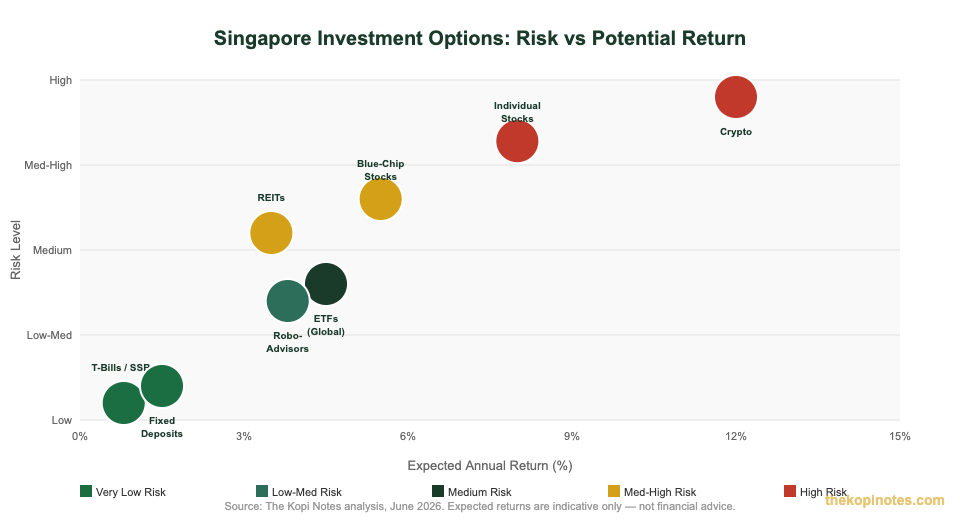
Singapore offers a wide range of investment vehicles. Here is an honest look at each one — what it is, who it suits, and the key numbers you need to know.
1. Robo-Advisors
Robo-advisors like Syfe and StashAway automatically invest your money into a diversified portfolio of ETFs based on your risk level. You answer a few questions, transfer money, and the platform does the rest — including rebalancing.
Annual management fees typically run 0.35–0.65% of your portfolio. For total beginners or those who want a hands-off approach, robo-advisors are the easiest starting point in Singapore. The trade-off is you give up some control and pay a fee layer above the underlying ETF costs.
2. ETFs (Exchange-Traded Funds)
An ETF (Exchange-Traded Fund) is a basket of hundreds or thousands of stocks bundled into a single fund that trades like a share. Instead of picking individual companies, you buy one ETF and instantly own a slice of every company inside it.
For Singapore investors, the two most popular ETF types are global equity ETFs listed on the London Stock Exchange (like CSPX or VWRA) and SGX-listed ETFs. London Stock Exchange ETFs are preferred by most experienced investors because they are Ireland-domiciled, meaning only 15% withholding tax on dividends (vs 30% for US-listed ETFs) and no US estate tax risk. You can read more about ETF investing in our Singapore REIT ETF guide.
3. S-REITs (Singapore Real Estate Investment Trusts)
S-REITs are companies listed on the SGX that own and operate real estate — shopping malls, logistics warehouses, offices, data centres, and hospitals. They are required by law to distribute at least 90% of their taxable income to unitholders, which is why S-REITs typically yield 5–7% per year.
If you want passive income in Singapore, S-REITs are one of the most accessible options. The risk: S-REITs are sensitive to interest rates and property market cycles. When rates rise, REIT prices tend to fall. See our guide to the best S-REITs in Singapore 2026 for a full comparison.
4. T-Bills and Singapore Savings Bonds (SSBs)
T-Bills (Treasury Bills) and SSBs (Singapore Savings Bonds) are issued by the Singapore government and are among the safest investments you can make. As at June 2026, 6-month T-bill yields are around 3–3.5% per annum.
They are ideal for your emergency fund or the low-risk portion of your portfolio. The downside: returns are modest, and SSBs have a SGD 200,000 individual cap. For details on current rates, see our Singapore T-bills 2026 guide.
5. Individual Stocks
Buying individual company shares — DBS, Singtel, Sea Limited — offers the potential for higher returns but comes with higher risk. A single company can underperform the broader market or even go bankrupt. For most beginners, individual stocks should come after you have built a solid ETF or REIT base.
How to Choose the Right Investment for You
The right investment depends on three things: your time horizon, your risk tolerance, and how hands-on you want to be. Here is a simple framework.
| Your Situation | Recommended Starting Point |
|---|---|
| Absolute beginner, < SGD 5,000 to start | Robo-advisor (Syfe Core or StashAway) |
| Beginner, want to learn, > SGD 5,000 | Global ETF (CSPX or VWRA via IBKR) |
| Want regular income | S-REIT ETF or individual blue-chip S-REITs |
| Ultra-conservative, short horizon | T-Bills or Singapore Savings Bonds |
| Monthly investment of SGD 100–500 | Regular Savings Plan (RSP) via FSMOne |
| Near retirement, need capital preservation | Mix of SSBs, T-Bills, and dividend REITs |
Source: The Kopi Notes framework, June 2026. Not financial advice — consult a licensed adviser for personalised guidance.
A common approach for Singapore beginners is the “core and explore” method. Put 70–80% of your investment budget into a low-cost global ETF (your core), and use the remaining 20–30% to explore individual stocks or sector ETFs as you learn. This lets you build wealth steadily while developing your investing skills without betting everything on one idea.
Opening a Brokerage Account in Singapore
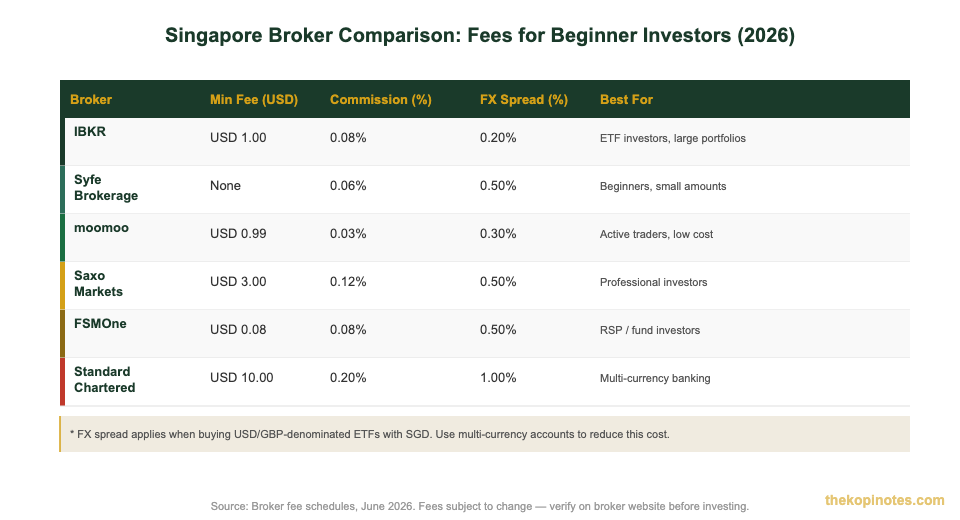
You need a brokerage account to buy stocks, ETFs, and REITs. Singapore has several good options depending on your budget and what you plan to invest in.
Interactive Brokers (IBKR) — Best for ETF Investors and Larger Portfolios
IBKR charges just USD 1 minimum commission per trade, making it the most cost-effective choice for buying LSE-listed ETFs (CSPX, VWRA, IWDA) with SGD. You fund your account in SGD and convert at near-interbank rates. IBKR’s interface has a learning curve, but it is worth it once you get past the setup. Use referral code jianxiong368 when signing up for IBKR.
Syfe Brokerage — Best for Beginners
Syfe Brokerage offers 0% commission for the first 3 months and a clean mobile interface perfect for beginners. You can buy ETFs and Singapore stocks without needing to understand complex order types. Use our Syfe referral code (SRPRFFFCD) for a welcome bonus when you sign up.
moomoo Singapore — Best for Active Traders
moomoo offers among the lowest commissions in Singapore — 0.03% per trade with a USD 0.99 minimum. It also provides advanced charting tools and real-time market data. Great for those who want to trade actively or invest in US stocks as well as SG stocks. See our full moomoo Singapore review for the full breakdown.
FSMOne — Best for Regular Savings Plans
If you want to invest a fixed amount monthly automatically, FSMOne’s RSP (Regular Savings Plan) lets you buy ETFs and funds for as low as SGD 100 per month. Use FSMOne referral code P0544985 when you open an account. Fee is just 0.08% per transaction — one of the lowest in Singapore for RSPs.
Using CPF and SRS to Invest
Singapore offers two government-backed schemes that let you invest with tax advantages: the CPF Investment Scheme (CPFIS) and the Supplementary Retirement Scheme (SRS).
CPF Investment Scheme (CPFIS)
If your CPF Ordinary Account (OA) has more than SGD 20,000, you can invest the excess under CPFIS. However, CPF OA money already earns a guaranteed 2.5% per year. Before you invest it, ask yourself: can you reliably beat 2.5% after fees? Many people find that index ETFs outperform over 10+ years, but short-term volatility can be unsettling when your CPF is on the line.
CPFIS-eligible investments include selected unit trusts, SGX-listed ETFs, and Singapore Government Bonds. LSE-listed ETFs like CSPX or VWRA are not CPFIS-eligible. For a full breakdown of how to optimise your CPF, see our guide on CPF investment strategy Singapore.
Supplementary Retirement Scheme (SRS)
SRS contributions reduce your taxable income in the year you make them. Singapore citizens and PRs can contribute up to SGD 15,300 per year; foreigners can contribute up to SGD 35,700. The money sits in an SRS account at DBS, UOB, or OCBC and can be invested in a wide range of assets — including LSE-listed ETFs via SRS-compatible brokers like Saxo or IBKR.
Withdrawals are taxed at 50% of the prevailing income tax rate — effectively halving your tax on SRS gains. If you are in a high income bracket (22–24% tax), the SRS can be a powerful retirement planning tool alongside your regular brokerage investments. Use our Singapore retirement calculator to model the impact on your long-term wealth.
Common Mistakes Beginners Make
Learning from other people’s mistakes is cheaper than making your own. Here are the most common errors Singapore beginner investors make — and how to avoid them.
1. Waiting for the “right time” to invest. Time in the market beats timing the market. A Singapore investor who put SGD 10,000 into a global ETF in January 2020 — right before COVID crashed markets — still ended up ahead by 2022. Starting early, even imperfectly, is almost always better than waiting.
2. Putting everything into a single stock or sector. Diversification is not exciting, but it is what protects you. A single bad bet on one company should not destroy years of savings. Start with broad market ETFs before narrowing into specific stocks or themes.
3. Ignoring fees. A 1% annual fee difference might seem small, but over 20 years it compounds into a 20%+ difference in your final balance. Use low-cost ETFs (TER of 0.07–0.20%) and brokers with competitive commissions.
4. Panic-selling during market dips. Every bear market in history has eventually recovered. The investors who came out worst were not those who held through the dip — they were those who sold at the bottom and bought back in at the top. Set a long-term plan and stick to it.
5. Skipping an emergency fund. Before you invest a single dollar, make sure you have 3–6 months of expenses in a liquid account (high-interest savings or T-bills). Investing money you might need in 6 months forces you to sell at the worst time.
Your First Investment: A Step-by-Step Plan
Here is a practical, no-jargon action plan for a Singapore beginner starting with SGD 3,000.
Step 1: Build your emergency fund first. Make sure you have 3 months of expenses in a high-yield savings account before touching any investment account.
Step 2: Open a brokerage account. For most beginners, Syfe Brokerage (simple interface, low cost) or IBKR (lowest fees for ETFs) are the best choices. Have your SingPass, NRIC, and income details ready. Takes about 10 minutes online.
Step 3: Fund your account. Transfer your SGD investment budget. For IBKR, you will convert SGD to USD at near-interbank rates. For Syfe, you can transfer directly in SGD.
Step 4: Buy a global ETF. For a Singapore investor with a long-term horizon, a single ETF like CSPX (S&P 500, Ireland-domiciled) or VWRA (global all-world, accumulating) covers thousands of companies instantly. Start with one ETF and add more later as you learn.
Step 5: Set up a monthly transfer. Automate a fixed monthly transfer to your brokerage account and buy more ETF units each month. This is dollar-cost averaging — you buy more units when prices are low and fewer when they are high, smoothing out market volatility over time.
Step 6: Review annually, not daily. Check your portfolio once every 3–6 months. Daily price-checking breeds anxiety and impulsive decisions. Your investment goals are measured in years or decades, not days.
Disclaimer: The above is for educational purposes only and does not constitute financial advice. Investment values can go up or down. Seek advice from a MAS-licensed financial adviser if you need personalised guidance.
Frequently Asked Questions
How much money do I need to start investing in Singapore?
You can start with as little as SGD 1 through robo-advisors like Syfe Core or StashAway. If you want to buy ETFs directly, you will need enough to cover one lot — typically SGD 130–400 for LSE-listed ETFs like CSPX or VWRA via IBKR. For Singapore stocks, one lot is 100 shares, so starting amounts range from SGD 300 to SGD 3,000 depending on the stock price.
Is investing in Singapore safe for beginners?
All investments carry risk, but Singapore’s regulatory framework (MAS oversight) and access to diversified instruments like global ETFs make it a relatively safe environment compared to many markets. Keeping most of your money in diversified ETFs rather than individual stocks significantly reduces risk. Always start by reading the fund’s Key Information Document (KID) and understanding what you are buying before putting any money in.
Do I pay tax on investment gains in Singapore?
Singapore does not have capital gains tax. If you buy shares at SGD 10,000 and sell at SGD 15,000, you keep the full SGD 5,000 — no tax owed. Dividends from Singapore companies are also generally tax-exempt for individual investors. However, withholding tax may be deducted at source by foreign companies or funds — for example, US dividend withholding tax is 30% for US-domiciled ETFs, reduced to 15% for Ireland-domiciled ETFs like CSPX or VWRA.
What is the best investment for a Singapore beginner?
For most Singapore beginners, a low-cost global ETF is the best starting investment. CSPX (tracks the S&P 500, Ireland-domiciled, 0.07% TER) or VWRA (tracks global markets, accumulating, 0.22% TER) give you instant diversification across hundreds or thousands of companies. If you want a completely hands-off approach, a robo-advisor like Syfe or StashAway will build and manage a diversified ETF portfolio for you automatically.
Can I invest using my CPF or SRS in Singapore?
Yes, but with some restrictions. CPF Ordinary Account funds above SGD 20,000 can be invested under the CPF Investment Scheme (CPFIS) in selected unit trusts and SGX-listed ETFs — but not in LSE-listed ETFs like CSPX. SRS (Supplementary Retirement Scheme) funds can be invested more broadly, including in LSE-listed ETFs via SRS-compatible brokers. SRS contributions also reduce your taxable income, making them tax-efficient for higher earners.
Which broker should I use to start investing in Singapore?
For most beginners, Syfe Brokerage (simple interface, low fees, good for ETFs and Singapore stocks) or Interactive Brokers (IBKR, lowest fees for buying LSE-listed ETFs with SGD) are the top choices. If you want to invest monthly automatically, FSMOne’s Regular Savings Plan (RSP) is excellent and starts from just SGD 100 per month. moomoo is great if you also want US stocks with competitive fees and strong charting tools.
How long does it take to see returns on investments in Singapore?
Short-term returns are unpredictable — the stock market can rise or fall 20–30% in any given year. However, over long periods (10+ years), globally diversified equity portfolios have historically delivered 7–10% annualised returns before inflation. Singapore’s no-capital-gains-tax environment means all those gains compound uninhibited. The key is to invest consistently, stay diversified, and not panic during short-term market dips.
Ready to Start Investing in Singapore?
Open a brokerage account today and take your first step towards financial freedom. Use our referral links for exclusive sign-up bonuses.
This article was researched with the help of AI. While we strive to keep all information accurate and up to date, there may be errors. If you notice any discrepancies, please contact us.