
How to Invest in Singapore as a Couple: Joint Accounts, CPF Top-Ups, and Merging Your Money (2026)
A practical guide for Singapore couples — what you can and can’t combine across CPF, SRS, and brokerage accounts, and how to team up on investing anyway.
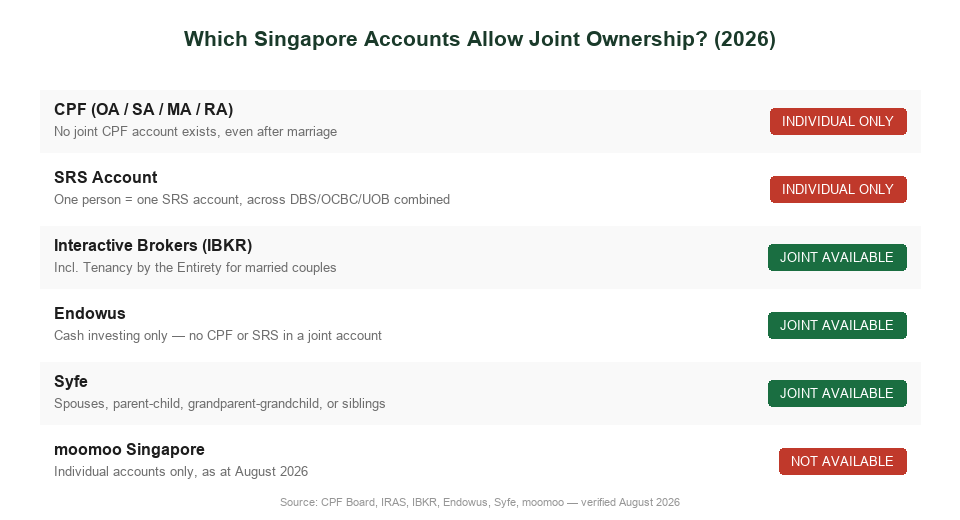
In Singapore, your CPF and SRS accounts can never be joint — they stay individual even after marriage. What you can do is open a joint brokerage or robo-advisor account with your spouse, since Interactive Brokers, Endowus and Syfe all now offer this, or top up each other’s CPF for extra household tax relief. Here’s how Singapore couples actually combine their investing in 2026.
Not financial advice. All figures are for educational reference only. CPF, SRS, and tax relief figures verified against CPF Board and IRAS official sources. Data verified as at 4 August 2026.
- CPF and SRS are always individual accounts in Singapore — marriage doesn’t change that, and there’s no way to merge balances.
- Interactive Brokers, Endowus and Syfe now let you open a joint account with your spouse; moomoo doesn’t offer this yet.
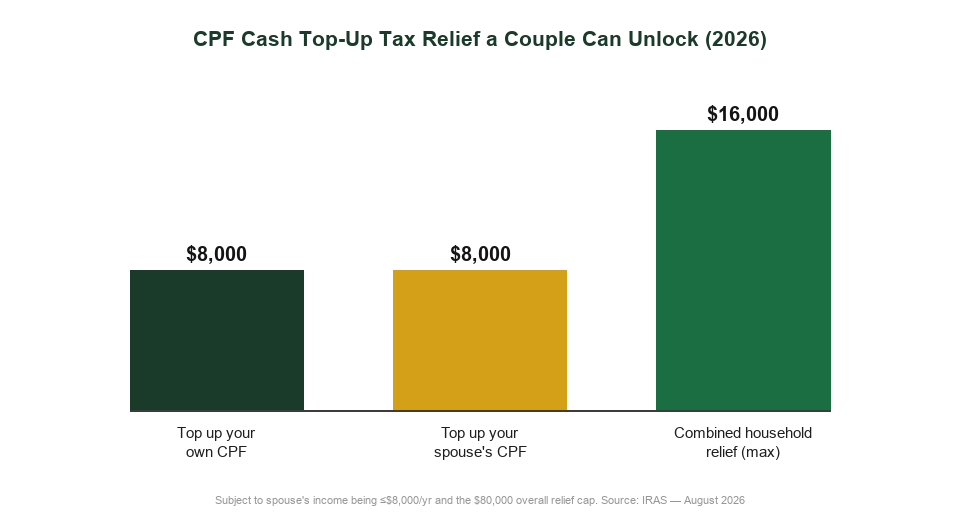
- Topping up your spouse’s CPF can unlock up to $8,000 more in tax relief a year, on top of the $8,000 you can claim for topping up your own.
Table of Contents
The Problem: Why “Just Combine Everything” Doesn’t Work
Getting married in Singapore changes a lot about your finances, but it doesn’t change how CPF and SRS work. Newlywed couples often assume they can pool their retirement savings the way they might pool a joint bank account. They can’t, and finding that out mid-conversation with a bank officer is a common source of confusion.
Until recently, brokerages made this worse. Most Singapore platforms only offered individual accounts, so couples who wanted to invest “together” ended up with an awkward workaround: one spouse held everything in their own name, or the couple tracked a shared portfolio across two separate logins with a spreadsheet.
That’s changed. Endowus launched joint accounts, Syfe followed with its own joint account feature, and Interactive Brokers has long supported joint ownership structures for couples. So the real question for Singapore couples in 2026 isn’t “can we combine our investing” — it’s “which parts should stay separate, and which parts are worth combining.”
This guide walks through both halves: what’s permanently individual (CPF, SRS), and what you can now genuinely combine (brokerage and robo-advisor accounts), plus the one lever — CPF cash top-ups — that lets you support your spouse’s retirement savings even though the accounts themselves stay apart.
CPF and SRS Are Always Individual — Here’s What That Means
Your CPF Ordinary Account (OA), Special Account (SA), MediSave Account (MA), and Retirement Account (RA) are tied to your own NRIC. There is no joint CPF account, no way to merge balances with your spouse, and no way to withdraw from your spouse’s CPF on their behalf without a formal arrangement like a Lasting Power of Attorney.
The one thing marriage does let you do is nominate your spouse under the CPF Nomination Scheme, so your CPF savings pass to them quickly after your death, without going through probate. That’s an estate-planning tool, not a way to combine accounts while you’re both alive.
Your Supplementary Retirement Scheme (SRS) account works the same way. Under IRAS rules, each person may hold exactly one SRS account, across DBS, OCBC and UOB combined — there’s no joint SRS account, and your spouse cannot contribute directly into your SRS account on your behalf using their own name. Each spouse who wants SRS tax relief needs to open and fund their own SRS account individually.
| Account | Can It Be Joint? | What Marriage Changes |
|---|---|---|
| CPF (OA/SA/MA/RA) | No | You can nominate your spouse and top up their account for tax relief |
| SRS | No | Nothing — each spouse needs their own SRS account and relief is individual |
Source: CPF Board and IRAS official guidance on CPF accounts and SRS contributions. Data as at 4 August 2026.
This individual structure matters most when deciding who should fund SRS. SRS tax relief is only useful to the extent it lowers your own taxable income, so it makes the most sense for whichever spouse sits in the higher marginal tax bracket. Read our CPF investment strategy guide for how to think about CPF and SRS allocation together as a household, even though the accounts themselves can’t merge.
Joint Brokerage and Robo-Advisor Accounts in Singapore (2026)
This is the part that’s genuinely new. Several Singapore platforms now let couples open a shared account, rather than just linking two separate individual logins. Here’s what each one actually offers, as at August 2026.
Interactive Brokers (IBKR) supports joint accounts for Singapore residents, including a “Tenancy by the Entirety” structure designed for married couples — each spouse holds an equal, undivided interest, and if one spouse passes away, full ownership automatically passes to the survivor. This gives couples access to IBKR’s full brokerage platform — stocks, ETFs, options and more — under one shared account.
Endowus launched joint accounts as a standalone account type, separate from either spouse’s individual Endowus account, with its own login. It’s a “joint-alternate” structure, meaning either spouse has full access to manage the account. The one restriction worth knowing: Endowus joint accounts are Cash investing only — you cannot invest CPF or SRS money through a joint account, which lines up with the fact that CPF and SRS can’t be joint in the first place.
Syfe rolled out joint accounts too, but with tighter eligibility rules. Both account holders must be at least 18, both need their own individual Syfe account first, and you must share one of four recognised relationships: spouses, parent and child, grandparent and grandchild, or siblings. Syfe joint accounts are also joint-alternate, and you can hold up to five joint accounts (on top of your personal account), though each joint account is limited to two people. One practical limitation: Syfe doesn’t yet support internal transfers between an individual account and a joint account — you’d need to withdraw to your bank account and redeposit.
moomoo Singapore does not currently offer joint accounts — as at August 2026, every moomoo account is individual. If a joint brokerage account matters to you, that rules moomoo out for now, even though it remains a low-cost option for individual investing.
A few other platforms offer related, narrower features: FSMOne, for instance, offers joint or beneficiary account structures aimed at long-term or custodial holding rather than everyday joint-alternate access. If a specific platform isn’t covered here, check its help centre directly — account features change quickly, and this is one area where every provider does things slightly differently.
| Platform | Joint Account? | Structure | Eligible Relationships | Key Limitation |
|---|---|---|---|---|
| IBKR | Yes | Joint / Tenancy by the Entirety | Married couples (and other joint structures) | More paperwork to open than an individual account |
| Endowus | Yes | Joint-alternate, standalone account | Not formally restricted | Cash investing only — no CPF or SRS |
| Syfe | Yes | Joint-alternate, up to 5 joint accounts | Spouses, parent-child, grandparent-grandchild, siblings | No internal transfer between individual and joint accounts |
| moomoo | No | — | — | Individual accounts only, as at August 2026 |
Source: Interactive Brokers Singapore, Endowus and Syfe help centres, moomoo Singapore. Verified 4 August 2026.
Before opening a joint account with anyone — including a spouse — understand what “joint-alternate” really means: either holder can withdraw, transfer, or change settings without the other’s sign-off. That’s convenient day to day, but it also means the account runs on trust, not on requiring both signatures. If you’d rather each keep full individual control while still investing toward shared goals, you can get most of the benefit by simply using the Syfe referral code and sign-up bonus or Endowus referral code to open two individual accounts and tracking your combined household allocation yourselves.
Using CPF Cash Top-Ups as a Couple
Since you can’t merge CPF accounts, the closest thing Singapore gives couples to “combined” retirement saving is the Retirement Sum Topping-Up Scheme (RSTU) — cash top-ups from one spouse into the other’s CPF account.
Here’s how the numbers work. You can claim up to $8,000 in tax relief each year for topping up your own CPF Special, MediSave or Retirement Account. On top of that, you can claim another $8,000 for topping up a loved one’s account — including your spouse’s — provided your spouse doesn’t have more than $8,000 in annual income in the year before the top-up, and isn’t already at their CPF top-up ceiling. Both reliefs sit inside IRAS’s overall personal income tax relief cap of $80,000 a year.
This is especially useful if one spouse earns significantly less, works part-time, or has taken a career break — situations where their own CPF Special or Retirement Account balance grows slowly. A top-up from the higher-earning spouse both boosts that spouse’s retirement savings at CPF’s guaranteed rates (2.5% p.a. on the Ordinary Account, 4% p.a. on Special, MediSave and Retirement Account monies, both unchanged as at Q3 2026), and reduces the household’s overall taxable income.
There’s a ceiling to watch: top-ups can only bring a member’s Retirement Account up to the prevailing Full Retirement Sum ($220,400 for members below 55 in 2026) or Enhanced Retirement Sum ($440,800 for those 55 and above). Once your spouse hits that ceiling, further top-ups stop earning fresh relief.
If your household includes a lower-income spouse, it’s also worth checking the Matched Retirement Savings Scheme (MRSS), where the government matches every dollar of cash top-ups to an eligible member’s Retirement Account, dollar for dollar, up to $2,000 a year with a $20,000 lifetime cap. Combined with a spousal top-up, MRSS can meaningfully stretch a household’s retirement contributions for the spouse who needs it most.
None of this requires a joint account of any kind — RSTU top-ups are simply a transfer from your bank account into your spouse’s CPF account, done through the CPF website or app. It’s the one place in the Singapore system where “individual accounts” and “combining as a household” genuinely meet in the middle.
A 4-Step Action Plan for Couples
Here’s how to put all of this together, in order.
Step 1: Keep CPF and SRS individual, and optimise by earner. Since neither account can be joint, decide who funds SRS based on whose marginal tax bracket benefits most from the relief, and don’t assume it should default to whichever spouse “handles the finances.”
Step 2: Decide if a joint brokerage or robo account fits how you operate as a couple. A joint-alternate account at IBKR, Endowus, or Syfe is convenient if you’re comfortable with either partner having full access. If you’d rather keep individual control, two individual accounts with a shared tracking spreadsheet works just as well — use our guide to the right order for funding CPF, SRS, and cash accounts to plan each partner’s sequence.
Step 3: Use CPF cash top-ups to balance the household’s retirement savings. If one spouse has a much smaller CPF Special or Retirement Account balance, a top-up from the other spouse — within the $8,000 relief limit — grows their retirement savings at a guaranteed rate while lowering your combined tax bill.
Step 4: Revisit the plan after major life events. A new home, a child, or a career break changes how much each spouse can save and which accounts matter most. Our goal-based investing guide and the Singapore retirement calculator are both worth rerunning together as a couple at least once a year.
Investing as a couple in Singapore isn’t about forcing everything into one account. It’s about knowing exactly which parts of the system are permanently individual, using the parts that are genuinely joint where they suit you, and using CPF top-ups to support each other within the rules either way.
Not financial advice. Account features and tax relief rules can change — always check CPF Board, IRAS, or your platform’s help centre for the current terms before making a decision. Data verified as at 4 August 2026.
Frequently Asked Questions
Can my spouse and I have a joint CPF account in Singapore?
No. CPF Ordinary, Special, MediSave and Retirement Accounts are always individual, tied to your own NRIC — this doesn’t change after marriage. You can nominate your spouse to receive your CPF savings after your death, and top up their account for tax relief, but the accounts themselves can never be merged or jointly held.
Can we open a joint SRS account?
No. Under IRAS rules, each person can hold only one SRS account, and it must be individual — across DBS, OCBC and UOB combined. If both you and your spouse want SRS tax relief, each of you needs to open and fund your own separate SRS account.
Which Singapore brokers or robo-advisors offer joint accounts for couples?
As at August 2026, Interactive Brokers, Endowus, and Syfe all offer joint accounts. IBKR supports a Tenancy by the Entirety structure for married couples across its full brokerage platform. Endowus and Syfe both offer joint-alternate cash accounts, though Endowus’s joint accounts are cash-only (no CPF or SRS). moomoo Singapore does not currently offer joint accounts.
What happens to a joint investment account if one spouse passes away?
This depends on the account structure. Under IBKR’s Tenancy by the Entirety, full ownership automatically passes to the surviving spouse. Endowus’s joint-alternate accounts work similarly — the surviving account holder keeps full access and control. Always confirm the exact succession terms with your platform, since this affects estate planning alongside your CPF nomination.
Should the higher-income or lower-income spouse open the SRS account?
Generally the higher-income spouse benefits more, since SRS tax relief only reduces that individual’s own taxable income, and higher earners sit in higher marginal tax brackets where the same dollar of relief is worth more. A lower-income spouse can still open an SRS account, but the tax savings will be smaller relative to their income.
How much can I save by topping up my spouse's CPF?
You can claim up to $8,000 in tax relief a year for cash top-ups to a spouse’s CPF Special, MediSave or Retirement Account, on top of another $8,000 for topping up your own — a possible $16,000 in combined relief, subject to your spouse’s income being no more than $8,000 in the prior year and the overall $80,000 personal income tax relief cap.
Ready to Start Investing as a Couple?
Open an individual or joint account and start building your household’s investments today. Use our referral links for exclusive sign-up bonuses.
This article was researched with the help of AI. While we strive to keep all information accurate and up to date, there may be errors. If you notice any discrepancies, please contact us.