How to Invest in Singapore: What to Do With $100, $1,000, or $10,000 (2026)
A practical, capital-tier guide for every Singapore investor
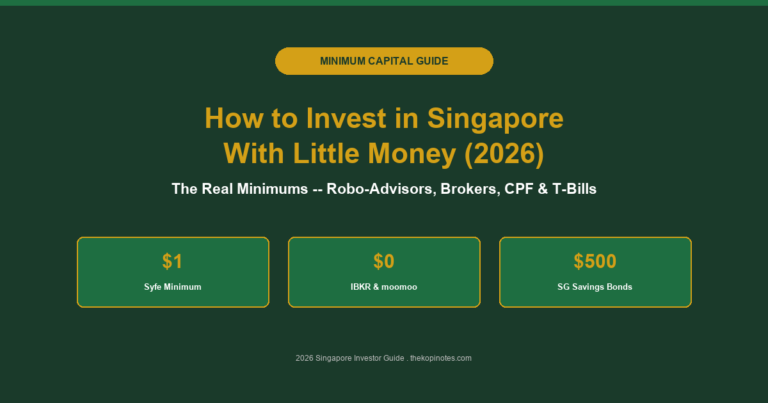
Investing in Singapore in 2026 is more accessible than ever, whatever your starting capital. With just $100 you can earn near risk-free returns through Singapore Savings Bonds or T-bills. With $1,000 you can begin a monthly Regular Savings Plan into global ETFs. And with $10,000 you can invest directly in low-cost ETFs via IBKR and pay less than $10 a year in brokerage fees — leaving the vast majority of your returns untouched.
Not financial advice. All figures are for educational reference only. Data as at September 2026 unless noted.
- $100: Singapore Savings Bonds, T-bills, or a robo-advisor with zero minimum
- $1,000: Regular Savings Plan (RSP) into global ETFs via FSMOne or a robo-advisor portfolio
- $10,000: Direct ETF investing via IBKR for maximum cost efficiency — less than $8/yr in fees
Choosing the Right Platform for Your Budget
The biggest mistake new investors make is picking a platform designed for a different capital tier. Using IBKR with $500 means each $3 trade commission wipes out 0.6% of your portfolio before you’ve even started. Using a robo-advisor with $50,000 means you’re paying 0.65% per year on fees you could eliminate by going direct.
Here is the quick-reference table. Match your capital to your starting strategy, then read the detailed section below for step-by-step guidance.
| Starting Capital | Best First Move | Platform | Min. Investment |
|---|---|---|---|
| $100 – $999 | SSB / T-bills / Robo | Syfe, Endowus, DBS | $0 – $500 |
| $1,000 – $4,999 | RSP into global ETFs | FSMOne, Syfe | $100/month |
| $5,000 – $19,999 | Robo-advisor or RSP | Syfe, Endowus | $1 |
| $10,000+ | Direct ETF investing | IBKR | USD 3 / trade |
Source: Platform websites, September 2026. Fees and minimums subject to change.
How to Invest $100 in Singapore
Starting small is not a disadvantage — it is a habit-building exercise. The goal at this stage is not to maximise returns. It is to start, stay consistent, and build the reflex of setting money aside every month.
Option 1: Singapore Savings Bonds (SSB)
The SSB is the safest investment you can make in Singapore. It is backed by the Singapore government, you can redeem it any month without penalty, and the interest compounds each year you hold it. The minimum investment is $500, and the interest rate is reset monthly by MAS — typically 2.5–3.2% p.a. for a 10-year average return. Check the MAS website for the latest allotment amounts and interest rates.
If you have less than $500, park your cash in a high-yield savings account first while you accumulate. Many accounts now pay 3–4% p.a. when you credit your salary and make a few card spends.
Option 2: Singapore T-Bills
Six-month T-bills are auctioned roughly every two weeks by MAS. The minimum is $1,000, and cut-off yields have recently been in the 3.0–3.6% p.a. range. Unlike the SSB, T-bills are not redeemable early — you get your money back only when they mature in six months. That makes them suitable for cash you know you will not need for half a year. You can apply via your bank’s internet banking or ATM using your CPF or SRS funds too. See our full Singapore T-bills 2026 guide for step-by-step instructions.
Option 3: A Robo-Advisor with No Minimum
If you want exposure to global equities from day one, a robo-advisor is the easiest entry point. Syfe referral code SRPRFFFCD gives you a fee waiver on your first $30,000 for six months. Endowus is another strong option — use Endowus referral code 2V343 to get $20 off advisory fees.
Both platforms invest your money into diversified portfolios of ETFs and rebalance automatically. For $100, Syfe’s Core Growth or Equity100 portfolio is a good starting point. You can set up a recurring top-up from $1 and add more whenever you have spare cash.
How to Invest $1,000 in Singapore
With $1,000 you have enough to start a proper investment strategy — not just save. The key decision is whether you want hands-off investing (robo-advisor) or slightly more control with lower long-term fees (Regular Savings Plan into ETFs).
Regular Savings Plans (RSP): Your Best Friend at This Stage
A Regular Savings Plan lets you buy a fixed dollar amount of ETFs every month, regardless of price. You invest $100 or $500 or whatever you can afford, and the platform buys you fractional or whole ETF units automatically. This is dollar-cost averaging in its simplest form — you buy more units when prices fall and fewer when prices rise.
FSMOne offers RSPs into a wide range of ETFs including the Nikko AM STI ETF and Infinity Global Stock Index Fund for as little as $100 per month. Use the FSMOne referral code P0544985 when you sign up. Syfe also offers an RSP product through Syfe Trade, where you can set up automated purchases of ETFs listed on SGX and selected overseas exchanges.
Robo-Advisor at $1,000: Still a Strong Choice
At $1,000, robo-advisors remain a compelling option. Syfe charges 0.65% per year at this level, which works out to $6.50 a year. That is a fair price for automatic rebalancing, dividend reinvestment, and a globally diversified portfolio with no need to pick stocks or ETFs yourself.
The chart below shows which platforms are accessible at different starting capital levels:
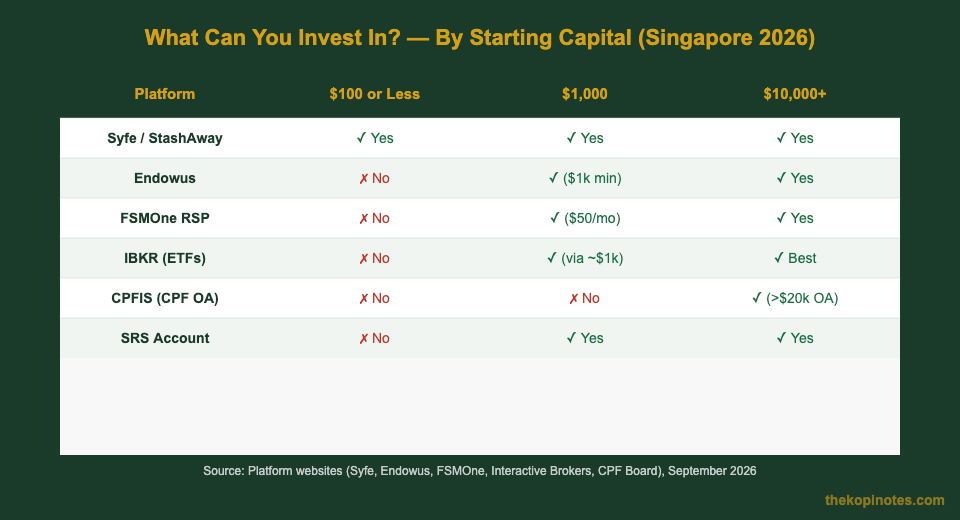
Source: Platform websites, September 2026.
The $1,000 Action Plan
Here is what to do with your first $1,000: put $500 into an SSB for safety and liquidity, and put $500 into a robo-advisor or RSP for growth. Then set a $200/month recurring top-up. You now have a balanced starter portfolio with both a safety net and a growth engine. Use the Singapore retirement calculator to project where that gets you over 10 or 20 years.
How to Invest $10,000 in Singapore
At $10,000 the maths start to favour doing it yourself — specifically, buying ETFs directly via Interactive Brokers (IBKR). Here is why.
A robo-advisor charging 0.65% p.a. on $10,000 costs you $65 a year. IBKR charges you USD 3 per trade — roughly SGD 4. If you rebalance twice a year, your total brokerage cost is about SGD 8 per year. That is a saving of roughly $57 a year, which compounds significantly over time.
Why IBKR and Why ETFs on the London Stock Exchange?
Singapore investors typically buy UCITS ETFs listed on the London Stock Exchange (LSE) rather than US-listed ETFs. The key reason is US estate tax. If you hold US-domiciled ETFs (like those on the NYSE) and you pass away, your estate may owe 40% US estate tax on assets above USD 60,000. UCITS ETFs domiciled in Ireland — like CSPX (iShares Core S&P 500) and VWRA (Vanguard FTSE All-World) — are not subject to this tax.
IBKR supports LSE trading directly. You fund your account in SGD, convert to GBP at a competitive FX rate (typically 0.03–0.20% spread), and buy ETFs on the LSE. IBKR’s commission is fixed at USD 3 per LSE trade on the fixed pricing plan.
To open an IBKR account, use referral code jianxiong368 — it gives you a cash bonus after your first trade.
Which ETFs Should a Singapore Investor Buy?
For most investors, two ETFs are all you need:
- VWRA (Vanguard FTSE All-World Acc, LSE) — a single ETF covering 3,600+ global stocks. Total Expense Ratio (TER): 0.22% p.a. No dividends to manage — it’s accumulating.
- CSPX (iShares Core S&P 500 Acc, LSE) — 500 largest US companies. TER: 0.07% p.a. If you want US equity overweight.
Both are Ireland-domiciled UCITS ETFs, so there is no US estate tax risk for Singapore investors. For a beginner with $10,000, buying $10,000 of VWRA in a single trade and holding it for 10+ years is a perfectly valid strategy.
Fee Comparison: Does Platform Choice Really Matter?
Let us put actual dollar amounts to the fee differences. At small portfolio sizes, robo-advisor fees are affordable. But at $50,000 and above, the annual cost drag becomes meaningful.
| Platform | Annual Fee Rate | $5,000/yr | $20,000/yr | $50,000/yr |
|---|---|---|---|---|
| Syfe | 0.65% → 0.25% | $32.50 | $130 | $225 |
| Endowus | 0.30% – 0.60% | ~$25 | ~$100 | ~$150 |
| IBKR (direct ETF) | USD 3/trade | ~SGD 8 | ~SGD 8 | ~SGD 8 |
Note: Syfe fee tiers: 0.65% (<$20k), 0.55% ($20k–$50k), 0.45% ($50k–$100k). IBKR assumes 2 trades/year at USD 3 each ≈ SGD 8. Plus ETF TER applies to all platforms. Source: Platform websites, September 2026.
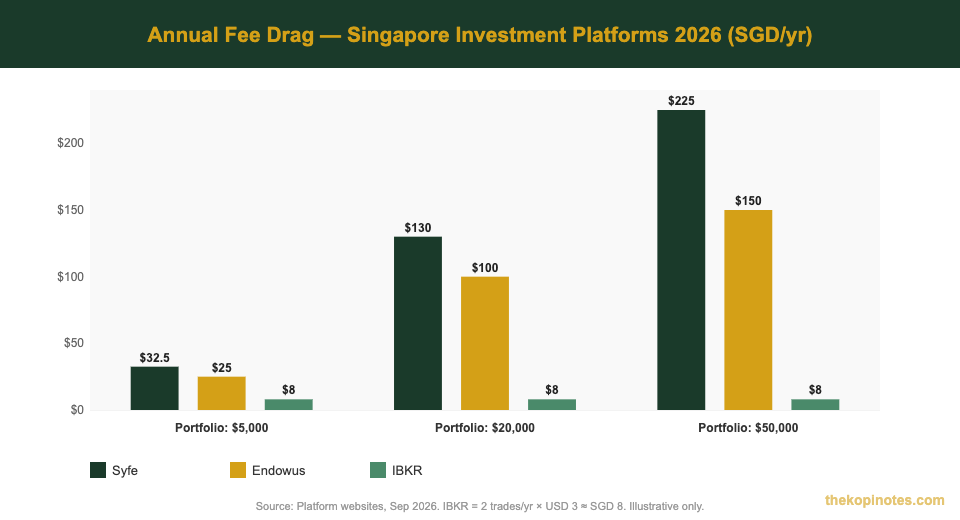
Source: Platform websites, September 2026. Illustrative only — actual fees depend on portfolio size and tier qualification.
The fee difference between a robo-advisor and IBKR at $50,000 is roughly $142–$217 per year. Over 20 years at 7% p.a. growth, that saved fee compounds to approximately $5,000–$8,000 — real money. That said, robo-advisors provide value beyond pure cost: automatic rebalancing, fractional shares, no need to understand ETF mechanics, and lower mental load. The right choice depends on how involved you want to be in managing your portfolio.
Using CPF and SRS to Invest
Cash investing is just one piece of the picture. As a Singapore resident, you also have access to two powerful tax-advantaged vehicles: your CPF and the Supplementary Retirement Scheme (SRS). Knowing the right order to invest — CPF, SRS, or cash first — can significantly improve your net returns. See our full guide on CPF, SRS or Cash: which to invest first.
CPF Ordinary Account (OA): The 2.5% Floor
Your CPF Ordinary Account earns a guaranteed 2.5% per annum — risk-free. Before you start investing, be clear that moving CPF into equities means giving up that guaranteed return. Unless you believe your investments will consistently beat 2.5% after fees over the long run, leaving CPF in the OA is not a bad choice.
To invest your CPF OA money in ETFs, you need at least $20,000 in the account (the first $20,000 must remain uninvested). This is the CPFIS $20,000 set-aside rule. Once you exceed that threshold, you can invest the excess through a CPFIS-approved broker. Read more about this in our CPF investment strategy Singapore guide.
SRS: Tax Savings + Investment Returns
The Supplementary Retirement Scheme (SRS) lets Singapore citizens and PRs contribute up to $15,300 per year (foreigners: $35,700). Every dollar you contribute reduces your taxable income dollar-for-dollar in the year you contribute. When you withdraw at age 62, only 50% of withdrawals are taxable — making SRS an excellent long-term tax planning tool.
You can invest your SRS balance in the same ETFs and funds available through regular brokerage accounts, including CSPX and VWRA via IBKR, and robo-advisor portfolios via Endowus (which charges 0.30% for SRS investments). For a Singapore investor in the 15% tax bracket contributing $15,300 a year, the upfront tax saving alone is $2,295 per year. See our Singapore Savings Bonds guide for how SSB compares to SRS within fixed income.
Frequently Asked Questions
How much money do I need to start investing in Singapore?
You can technically start with $1 on platforms like Syfe. However, $500 is the practical minimum for Singapore Savings Bonds, and $1,000 is a reasonable floor for a Regular Savings Plan. To invest directly in ETFs via IBKR, you need enough to make the USD 3 commission cost-efficient — most people start with at least $3,000–$5,000 to avoid commission drag exceeding 0.1% per trade.
Is it better to use a robo-advisor or buy ETFs directly?
It depends on your portfolio size and how involved you want to be. Below $20,000, robo-advisors offer good value — the fee of $65–$130 per year buys you automatic rebalancing, fractional shares, and simplicity. Above $20,000–$30,000, the fee drag starts to compound meaningfully and direct ETF investing via IBKR becomes worth the additional complexity. Many investors start with a robo-advisor and migrate to direct investing once comfortable.
Can I invest my CPF money in ETFs?
Yes, but with important conditions. Only CPF OA money above the first $20,000 can be invested through CPFIS. You must use a CPFIS-approved broker. The range of available ETFs is narrower than what you can access with cash — mainly STI ETFs and selected unit trusts. Before investing CPF, remember that your OA already earns a guaranteed 2.5% p.a. — you need to consistently beat this hurdle after fees for CPF investing to make financial sense.
Should I invest via SRS?
If you are in Singapore’s 11.5% tax bracket or above, the SRS is generally worth using. The upfront tax saving on your contribution is immediate and guaranteed. The catch is illiquidity — withdrawals before age 62 incur a 5% penalty plus full tax on the amount withdrawn. SRS works best as a long-term retirement vehicle, not a pool of money you might need in 3–5 years. Use cash investing first for any goals within a 10-year horizon.
What's the safest investment for a beginner in Singapore?
Singapore Savings Bonds (SSB) are the safest investment available to retail investors in Singapore. They are fully guaranteed by the Singapore government, can be redeemed any month without penalty, and currently earn 2.5–3.2% p.a. over 10 years. T-bills are equally safe but less flexible — you cannot redeem them early. Both are excellent parking spots while you build your investment knowledge and confidence. Never invest in equities money you cannot afford to lock up for at least 5 years.
Is there capital gains tax on investments in Singapore?
No. Singapore does not impose capital gains tax. When you sell shares or ETFs at a profit, you keep 100% of the gain. However, dividends from Singapore-listed REITs and stocks are subject to a 17% withholding tax for companies, though individual investors generally do not pay personal income tax on dividends. For overseas ETFs like CSPX and VWRA, dividends are subject to Irish withholding tax of 15% (for US-source dividends via Ireland-domiciled funds), which is already accounted for in the fund’s performance figures.
The Kopi Notes provides educational personal finance content for Singaporeans. Nothing on this page constitutes financial advice. All investment products carry risk, including the risk of losing capital. Past performance does not guarantee future results. Always do your own research or consult a licensed financial adviser before investing.
This article was researched with the help of AI. While we strive to keep all information accurate and up to date, there may be errors. If you notice any discrepancies, please contact us.