Investing · Retirement Planning
Singapore Retirement Planning: Complete 2026 Guide
How much you need, where to invest, and when to start — for everyday Singaporeans
Singapore retirement planning is the process of building enough savings and investments to cover your living costs from the day you stop working until the end of your life — without running out of money. Most Singaporeans need between S$750,000 and S$2.1 million in total retirement assets, depending on lifestyle. CPF provides a solid foundation, but typically covers only 30–50% of what you need. The rest must come from your own investments and savings.
Not financial advice. All figures are for educational reference only. Data as at July 2026 unless noted.
- You need S$750K to S$2.1M to retire in Singapore, depending on your lifestyle
- CPF LIFE provides a monthly income floor — but personal investments are essential on top
- Start by age 35 to maximise compounding. Use a Singapore retirement calculator to set your personal target
📋 Table of Contents
How Much Do You Need to Retire in Singapore?
The most common question about retirement planning in Singapore is: “What is my magic number?” The honest answer is — it depends on how you want to live.
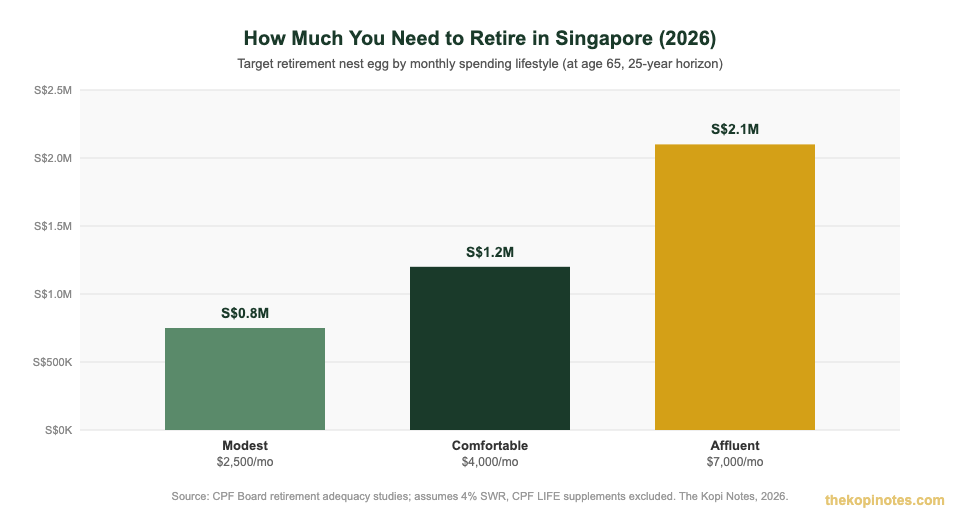
A useful rule of thumb is the 4% Sustainable Withdrawal Rate (SWR). This means your retirement nest egg should be 25 times your annual spending. Here is what that looks like in Singapore dollars:
| Lifestyle | Monthly Spend | Annual Spend | Target Nest Egg (25×) |
|---|---|---|---|
| Modest | S$2,500 | S$30,000 | S$750,000 |
| Comfortable | S$4,000 | S$48,000 | S$1,200,000 |
| Affluent | S$7,000 | S$84,000 | S$2,100,000 |
Source: CPF Board retirement adequacy studies; 4% SWR assumption, 25-year horizon from age 65. CPF LIFE payouts not included. The Kopi Notes, July 2026.
These targets seem daunting. But here is the key: you do not need to save this entire amount yourself. CPF will contribute a meaningful monthly income stream through CPF LIFE. You just need to close the gap between your CPF payout and your target monthly spending.
If your comfortable lifestyle requires S$4,000/month, and CPF LIFE pays you S$1,400/month, you need to fund S$2,600/month from your own investments. Over 25 years, that gap requires roughly S$780,000 in additional savings — invested wisely.
CPF and Your Retirement Plan
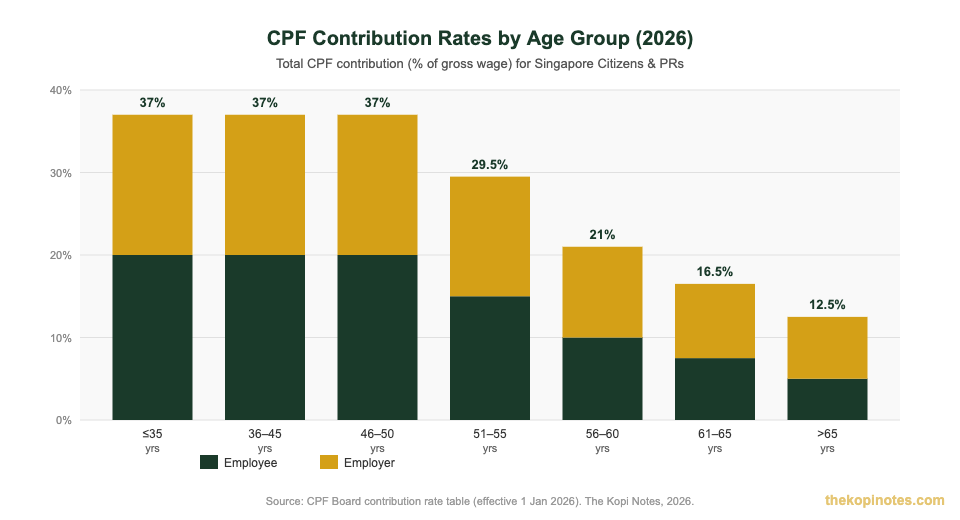
CPF (Central Provident Fund) is Singapore’s mandatory social security system. Every working Singaporean contributes a portion of their salary to CPF — and your employer tops it up too.
Your CPF savings are split across three accounts: Ordinary Account (OA), Special Account (SA), and MediSave Account (MA). For retirement, the most important is the Retirement Account (RA), which is created at age 55 by merging your OA and SA balances.
CPF LIFE: Your Retirement Income for Life
CPF LIFE (Lifelong Income For the Elderly) is an annuity scheme that pays you a monthly income from age 65 for the rest of your life. The amount you receive depends on how much you set aside in your Retirement Account.
In 2026, the three key CPF retirement thresholds are:
| CPF Tier | Amount (2026) | Est. Monthly Payout from Age 65 |
|---|---|---|
| Basic Retirement Sum (BRS) | S$106,500 | ~S$850–S$950/month |
| Full Retirement Sum (FRS) | S$213,000 | ~S$1,300–S$1,500/month |
| Enhanced Retirement Sum (ERS) | S$426,000 | ~S$2,300–S$2,500/month |
Source: CPF Board 2026 Retirement Sum figures. Payout estimates are indicative and vary by CPF LIFE plan (Standard vs Basic). The Kopi Notes, July 2026.
Most Singaporeans aim for at least the Full Retirement Sum (FRS). Aiming for the Enhanced Retirement Sum (ERS) gives you a stronger CPF LIFE payout — about S$2,400/month — which covers a comfortable lifestyle on its own. A good CPF investment strategy can help you reach these milestones faster.
Investment Strategies for Retirement in Singapore
Relying solely on CPF for retirement is risky. The FRS payout of about S$1,400/month is enough for a very modest lifestyle — but most Singaporeans want more than that in retirement. You need to build a personal investment portfolio alongside CPF.
1. Robo-Advisors (Best for Beginners)
Robo-advisors like Syfe and Endowus are ideal if you are just starting out. They invest your money in diversified global ETF portfolios automatically, based on your risk profile and retirement timeline. Fees are low — typically 0.3–0.65% per year.
Endowus is unique because it lets you invest your CPF OA savings in globally diversified funds — a powerful way to grow your CPF beyond the 2.5% OA interest rate. Use referral code 2V343 for Endowus.
2. ETF Investing (Best for Long-Term Wealth Building)
Buying low-cost ETFs like VWRA (Vanguard FTSE All-World, LSE-listed) or CSPX (iShares Core S&P 500 UCITS ETF) is one of the most effective strategies for Singapore retirement investors. These UCITS ETFs avoid the 40% US estate tax that plagues direct US-listed ETFs. Over 20–30 years, even modest monthly contributions compound significantly.
For example: investing S$1,000/month into a diversified ETF portfolio earning 7% annually for 25 years would grow to approximately S$810,000 — significantly closing the retirement gap.
3. Singapore REITs (Best for Retirement Income)
Singapore REITs (Real Estate Investment Trusts) pay out 90% of their taxable income as dividends — making them a natural fit for generating passive income in Singapore. Dividend yields of 5–7% are typical across the sector. In retirement, a S$400,000 REIT portfolio could generate S$20,000–S$28,000 per year in passive income. Check out the Singapore REIT ETF guide for a low-effort way to access the sector.
4. CPF OA Top-Ups and SA Top-Ups
Voluntarily topping up your SA (or RA after 55) earns 4% per annum — risk-free and guaranteed. This is one of Singapore’s best-kept retirement secrets. Top-ups also come with income tax relief of up to S$8,000 per year (for self top-ups) and an additional S$8,000 for cash top-ups to your spouse or parents’ CPF accounts.
Retirement Timeline by Age in Singapore
When should you start planning? The honest answer is: yesterday. But here is a practical guide for wherever you are in your journey.
In Your 20s: Build the Foundation
You have the most powerful asset in investing: time. Compound interest works best over 30–40 years. Set up a regular investment plan — even S$300/month in a low-cost ETF or robo-advisor — and automate it. Do not try to time the market. Max out your SA voluntary top-ups to earn the guaranteed 4%. Open a brokerage account and start building good habits.
In Your 30s: Accelerate and Diversify
Your career earnings are rising. This is the decade to seriously grow your retirement portfolio. Aim to be saving and investing 20–30% of your take-home pay. This is also the decade to decide your “comfortable” retirement lifestyle number and use a retirement calculator to plot your path to it. Diversify across CPF, ETFs, and REITs.
In Your 40s: Catch Up if Needed
If you started late, your 40s are the decade to close the gap. Consider maxing SA/RA top-ups for the tax relief and guaranteed 4% return. Shift any idle cash in your OA into higher-yielding investments via the CPF Investment Scheme (CPFIS) — though be selective; not all CPF-approved funds are worth the risk.
In Your 50s: Protect and Consolidate
At age 55, your OA and SA are merged into your Retirement Account. Make sure you have at least the Full Retirement Sum (FRS) set aside. Gradually shift your investment portfolio towards more defensive assets — dividend-paying REITs, Singapore Savings Bonds, or T-bills — to reduce volatility as you approach retirement. Avoid taking on new financial commitments or high-risk investments.
At 65+: Harvest and Enjoy
CPF LIFE payouts begin at age 65. You can also withdraw your CPF savings above the Retirement Account minimum. From your investment portfolio, apply the 4% SWR rule — withdraw no more than 4% of the portfolio’s value in year one, then adjust for inflation. Maintain a cash buffer of 12–24 months of expenses so you never have to sell investments at a bad time.
Where to Invest for Retirement in Singapore
Your choice of investment platform matters — fees compound just like returns do. Here is a quick overview of the main options for Singapore retirement investors:
| Platform | Best For | Annual Fee | Min. Investment |
|---|---|---|---|
| Endowus (CPF/Cash/SRS) | CPF OA investing, globally diversified funds | 0.25–0.60% | S$1,000 |
| Syfe (Core / REIT+) | Passive ETF, REIT income | 0.35–0.65% | S$1 |
| IBKR (Direct ETF) | DIY LSE-listed ETFs (CSPX, VWRA) | ~0.00–0.07% | US$0 (no min) |
| FSMOne | Regular Savings Plan, unit trusts | 0.08–0.50% | S$50/month RSP |
Source: Platform fee schedules as published by each broker, July 2026. The Kopi Notes, 2026.
For hands-off retirement investing, Endowus (referral code 2V343) and Syfe (referral code SRPRFFFCD) are the easiest starting points. For DIY investors who want to buy UCITS ETFs directly, Endowus referral code 2V343 and use referral code jianxiong368 at IBKR to get started. For regular savings plans, the FSMOne referral code P0544985 offers access to low-cost monthly investment plans.
Common Retirement Planning Mistakes in Singapore
1. Relying entirely on CPF. CPF LIFE at FRS pays roughly S$1,400/month. For most Singaporeans, that is not enough for a comfortable retirement. You must build a personal investment portfolio alongside CPF.
2. Starting too late. Every decade you delay starting your investments roughly doubles the monthly savings required to reach the same nest egg. Starting at 35 instead of 25 means contributing almost twice as much per month to achieve the same retirement fund by 65.
3. Holding too much cash. Cash sitting in a savings account earns 0.05–3.5% at most — inflation in Singapore runs at about 2–3% per year. In real terms, idle cash loses purchasing power. Keep only 6–12 months of expenses in cash, and invest the rest.
4. Ignoring Singapore’s tax advantages. Voluntary CPF SA/MA top-ups give you tax relief AND a guaranteed 4% return. SRS (Supplementary Retirement Scheme) contributions reduce your taxable income by up to S$15,300/year for Singapore Citizens and PRs. These are essentially free returns that most people overlook.
5. Withdrawing CPF too early. At age 55, you can withdraw CPF savings above your Retirement Account minimum. Many people do this — then spend it. That money is better left in CPF or reinvested, where it continues earning 2.5–4% risk-free.
6. Not accounting for healthcare costs. Medical inflation in Singapore runs at 5–8% per year. A serious illness in retirement can wipe out years of savings. Ensure you have an Integrated Shield Plan (ISP) and, if appropriate, a rider before you retire.
Frequently Asked Questions: Singapore Retirement Planning
How much do I need to retire comfortably in Singapore?
What is the retirement age in Singapore in 2026?
Can I retire in Singapore with just CPF?
When can I withdraw my CPF savings?
How does the SRS help with retirement planning in Singapore?
What is the best investment for retirement in Singapore?
Disclaimer: This article is for educational and informational purposes only. It does not constitute financial, tax, or legal advice. Always conduct your own research and consult a licensed financial adviser before making any investment decisions. All figures and rates are as at July 2026 and subject to change. The Kopi Notes may earn referral fees from broker links on this page.
This article was researched with the help of AI. While we strive to keep all information accurate and up to date, there may be errors. If you notice any discrepancies, please contact us.