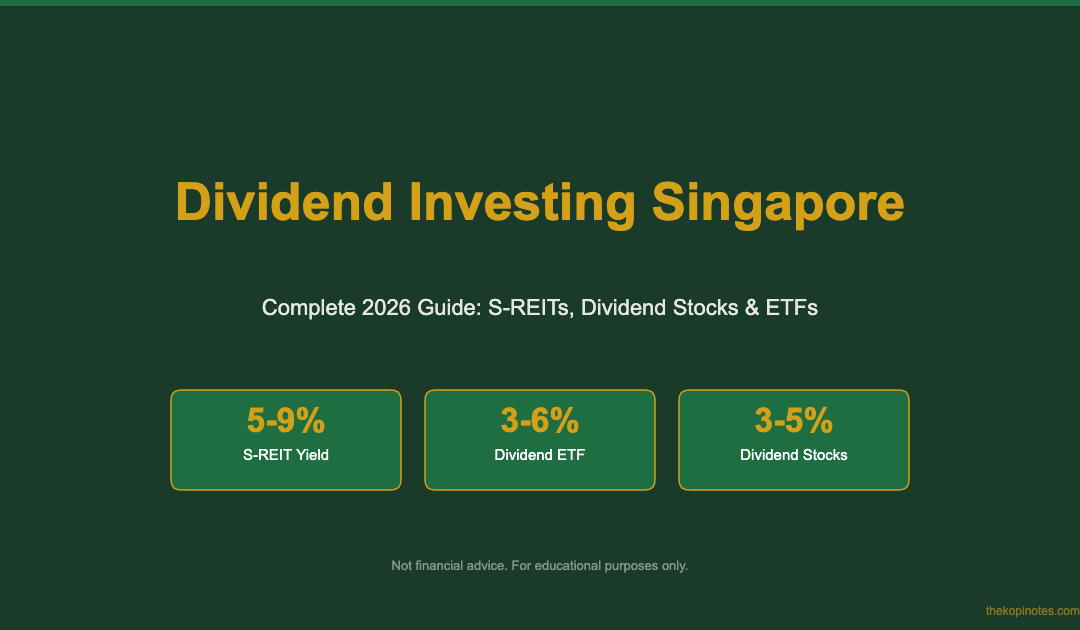
Dividend Investing Singapore: Complete Guide for 2026
Dividend investing in Singapore means building a portfolio of income-generating assets — S-REITs, dividend stocks, and ETFs — that pays you regular cash distributions. In 2026, Singapore dividend investors can target yields of 3%–9% depending on their asset mix, with S-REITs the highest-yielding local option and CPF/SRS-eligible ETFs offering tax-efficient income. This guide covers exactly how to start, what to buy, and which platforms to use.
Not financial advice. All figures are for educational reference only. Data as at July 2026 unless noted.
- S-REITs offer the highest local yields (5%–9%) but require research and concentration risk management
- Dividend ETFs (like CLR or ES3) give instant diversification at 3%–5% yield with minimal effort
- Use CPF OA and SRS to invest tax-efficiently — eligible ETFs and REITs can supercharge retirement income
Table of Contents
Contents — Click to expand
- What Is Dividend Investing?
- Why Singapore Investors Love Dividend Investing
- Best Dividend-Paying Assets in Singapore
- Yield Comparison: S-REITs vs Stocks vs ETFs
- How to Build a Dividend Portfolio
- Best Platforms for Dividend Investing
- CPF and SRS Dividend Investing
- Tax Treatment of Dividends
- DCA and Dividend Reinvestment
- Common Mistakes to Avoid
- FAQ
What Is Dividend Investing?
Dividend investing is a strategy where you buy shares, REITs, or ETFs that pay regular cash distributions — and use that income to fund your lifestyle or reinvest it to grow your portfolio faster. Instead of waiting to sell assets at a higher price, you get paid just for holding them.
In Singapore, the most common dividend-paying assets are S-REITs (Singapore Real Estate Investment Trusts), blue-chip dividend stocks like DBS, OCBC, and SingTel, and exchange-traded funds (ETFs) listed on SGX.
Why Singapore Investors Love Dividend Investing
No dividend tax. Singapore does not tax dividends from Singapore-domiciled companies. What the company pays you, you keep — unlike the US where dividend income is taxed at 15%–37%.
No capital gains tax. If your stock or REIT rises and you sell, you pay zero tax on the profit.
S-REIT ecosystem. Singapore has one of Asia’s deepest REIT markets — over 40 S-REITs covering office, retail, industrial, healthcare, and data centre real estate. By law, REITs must distribute at least 90% of taxable income, which is why S-REITs yield 5%–9%.
CPF and SRS support. You can invest CPF Ordinary Account (OA) and Supplementary Retirement Scheme (SRS) funds into dividend-paying ETFs and select S-REITs — making dividend investing uniquely tax-efficient for Singapore residents.
Best Dividend-Paying Assets in Singapore
1. S-REITs (Singapore Real Estate Investment Trusts)
S-REITs are the cornerstone of dividend investing in Singapore. They must legally distribute at least 90% of taxable income, giving yields of 5%–9% in 2026. Top picks include CapitaLand Integrated Commercial Trust (~5.2%), Mapletree Industrial Trust (~5.8%), and Suntec REIT (~7.1%). See our guide on best S-REITs Singapore 2026 for individual picks.
2. Dividend Stocks (SGX Blue Chips)
DBS, OCBC, and UOB — Singapore’s three banks — consistently pay dividends yielding 3%–5%. In 2026, DBS pays a quarterly dividend of $0.54/share (~4.5% annual yield). Other reliable payers: SingTel (~5%), Keppel Corporation (~3%), and CapitaLand Investment (~4%).
3. Dividend ETFs
ETFs give instant diversification. Key Singapore dividend ETFs in 2026: Lion-Phillip S-REIT ETF (CLR, ~4.5%), NikkoAM-STI ETF (G3B, ~3.8%), SPDR STI ETF (ES3, ~3.7%), and ABF Singapore Bond Index Fund (A35, ~3.1%). Most are CPF OA and SRS eligible. Read our Singapore REIT ETF guide for a deep dive.
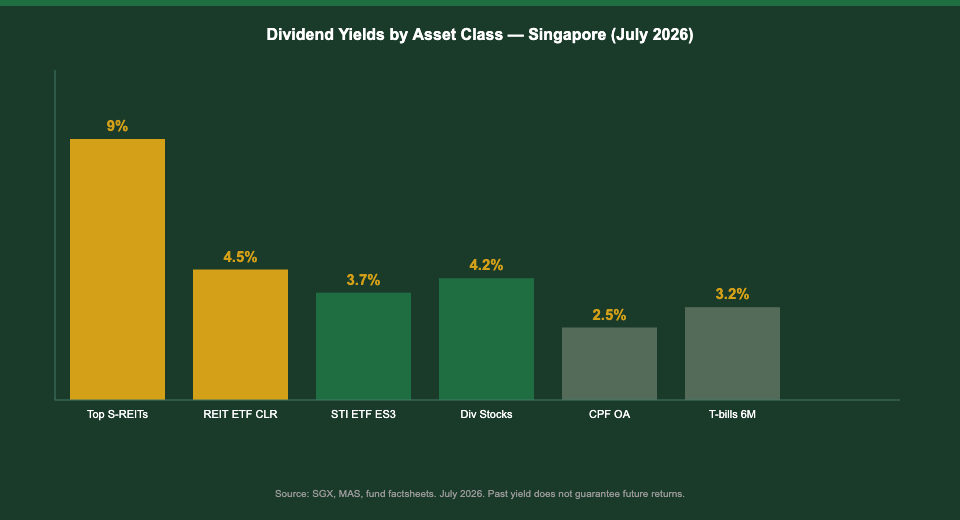
Yield Comparison: S-REITs vs Dividend Stocks vs ETFs
| Asset Type | Yield Range | Frequency | CPF OA | SRS |
|---|---|---|---|---|
| Top S-REITs | 5%–9% | Quarterly/Semi-annual | Select | Select |
| SGX Blue-Chip Stocks | 3%–5% | Semi-annual | Select | Yes |
| S-REIT ETFs (CLR, CFA) | 4%–5% | Quarterly/Semi-annual | Yes | Yes |
| STI ETFs (ES3, G3B) | 3%–4% | Semi-annual | Yes | Yes |
| Singapore T-Bills (6M) | ~3.2% | At maturity | Yes | Yes |
| CPF OA (guaranteed) | 2.5% | Annual | N/A | N/A |
Source: SGX, fund manager factsheets, MAS, CPF Board. July 2026. Past distributions are not indicative of future payouts.
How to Build a Dividend Portfolio in Singapore
Step 1: Define Your Income Goal
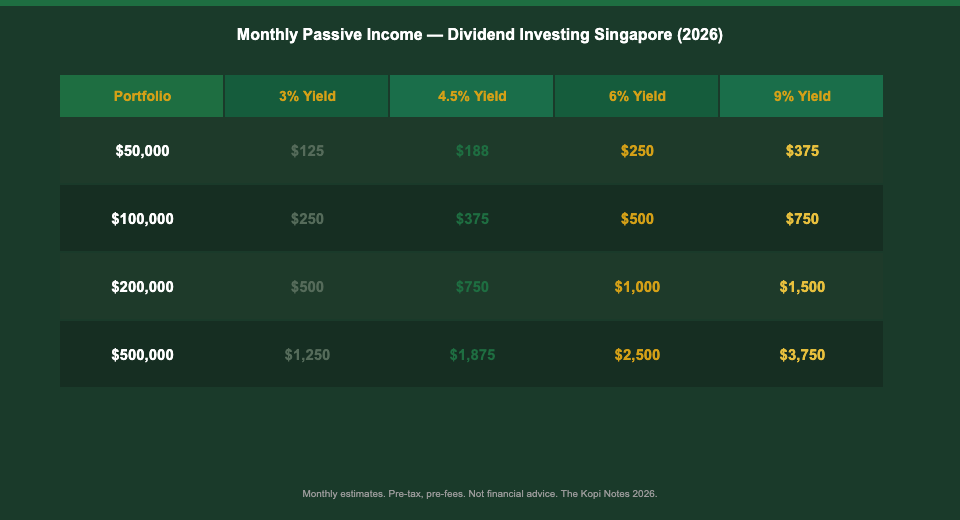
Capital Needed = (Monthly Income × 12) ÷ Target Yield. Want $1,000/month at 5%? You need $240,000. At 7% (S-REIT heavy), around $171,000.
Step 2: Choose Your Strategy
Simple ETF Approach: Buy CLR + ES3 and contribute monthly. Low effort, CPF/SRS eligible.
Core + Satellite: Use a dividend ETF as core (60–70%) and add 3–5 individual S-REITs for extra yield. Most TKN readers use this approach.
Pure S-REIT Portfolio: Pick 5–8 S-REITs across sectors (office, industrial, retail, healthcare, data centre). Higher yield, more monitoring required.
Step 3: Invest Consistently
Set up a Regular Savings Plan (RSP) with FSMOne or Syfe to automate monthly contributions. See our passive income Singapore 2026 guide for a full walkthrough.
Best Platforms for Dividend Investing in Singapore
| Platform | Min Commission | CPF/SRS | RSP | Best For |
|---|---|---|---|---|
| FSMOne | S$10 (0.08%) | CPF + SRS | Yes (S$50/mo) | ETFs, S-REITs, low fees |
| Syfe | 0.35–0.65% p.a. | SRS | Yes | Hands-off, REIT+ portfolio |
| Endowus | 0.25–0.60% p.a. | CPF + SRS | Yes | CPF investors, managed funds |
| IBKR Singapore | S$2.50 or 0.05% | No | No | International dividend stocks |
| DBS Vickers | S$10 (0.12%) | CPF + SRS | Via RSP | DBS customers, CDP linkage |
Source: Platform websites, July 2026. Fees subject to change.
For beginners, FSMOne (referral P0544985) is the best starting point — lowest commission on SGX, CPF/SRS eligible, RSP from S$50/month. For hands-off managed investing, Syfe (SRPRFFFCD) and Endowus (2V343) are strong picks.
CPF and SRS Dividend Investing
CPF OA earns 2.5% guaranteed. Invest it in a dividend ETF yielding 3.5%–5% and you earn more without extreme risk. Need a minimum $20,000 CPF OA balance first, then open a CPFIS account with FSMOne or DBS Vickers. CPFIS-OA approved: ES3, G3B, CLR, A35.
SRS gives an upfront tax deduction on every dollar contributed. At a 22% tax bracket ($120k income), contributing $15,300 to SRS saves $3,366 in tax — an instant 22% return. Invest those SRS funds into dividend ETFs for both tax savings and income. See our CPF investment strategy guide. Use our Singapore retirement calculator to plan your numbers.
Tax Treatment of Dividends in Singapore
Singapore-sourced dividends: Tax-exempt. Dividends paid by Singapore-resident companies and S-REITs are tax-exempt for individual investors — no withholding tax, no income tax on dividends.
No capital gains tax. When you sell dividend stocks or REITs at a profit, you pay zero tax — on both short-term and long-term gains.
SRS withdrawals: After age 62, only 50% of SRS withdrawals are taxable, spread over 10 years — very low effective tax on SRS-funded dividend income in retirement.
Tax rules can change. Check the IRAS website for current guidance or consult a licensed tax professional.
Dollar Cost Averaging and Dividend Reinvestment
DCA means investing a fixed amount at regular intervals — say $500/month into a dividend ETF — regardless of market conditions. FSMOne’s RSP automates this from $50/month. Syfe and Endowus offer similar automation.
Common Dividend Investing Mistakes to Avoid
Chasing yield without checking gearing. A 9% yield is meaningless if the REIT cuts DPU due to high debt. Always check gearing (ideally below 40%).
Concentration risk. Putting 50%+ into one sector exposes you to sector shocks. Spread across industrial, office, healthcare, and data centre.
Ignoring total return. High yield means nothing if unit price keeps falling. Track total return (price change + distributions).
Not using CPF and SRS. These give guaranteed returns plus tax savings. Maximise them before investing in a taxable account.
Selling during downturns. Dividend investors get paid to hold. When a REIT drops 20%, the DPU may still be intact. Selling locks in losses and stops your income stream.
Frequently Asked Questions
How much do I need to start dividend investing in Singapore?
What is the average dividend yield in Singapore?
Are dividends taxed in Singapore?
What is the best dividend stock in Singapore?
Can I use CPF to invest in dividend stocks?
How do S-REITs pay dividends?
How much monthly passive income can I get from dividend investing?
What is the difference between dividend investing and growth investing?
Start Building Your Dividend Portfolio Today
Use our referral codes for fee savings and bonus credits when you sign up:
Disclaimer: This article is for informational and educational purposes only and does not constitute financial advice. Dividend yields and prices fluctuate. Past distributions do not guarantee future payouts. Always consult a licensed financial adviser before making investment decisions. Data accurate as at July 2026.
This article was researched with the help of AI. While we strive to keep all information accurate and up to date, there may be errors. If you notice any discrepancies, please contact us.