What Is DPU in Singapore REITs? Distribution Per Unit Explained (2026 Guide)
Your plain-English guide to S-REIT distributions — how DPU is calculated, why it matters, and how to compare REITs using DPU in 2026.
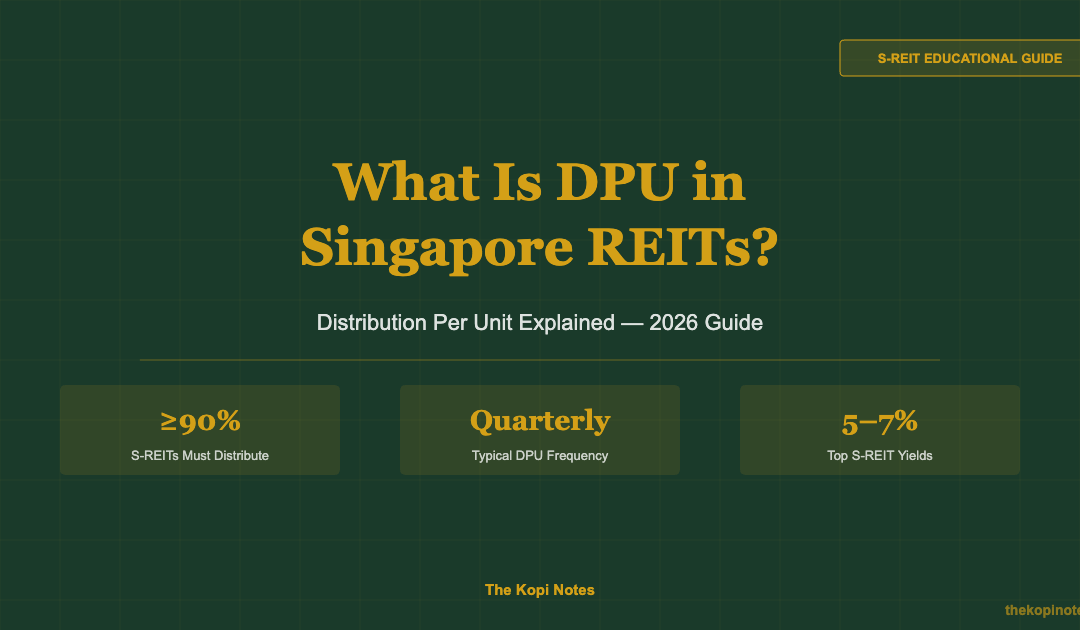
DPU, or Distribution Per Unit, is the cash payout that Singapore REIT (S-REIT) investors receive for each unit they hold. S-REITs must distribute at least 90% of their taxable income to qualify for tax-exempt status in Singapore. DPU is typically paid quarterly or semi-annually and is one of the most important metrics for income investors comparing S-REITs in 2026.
Not financial advice. All figures are for educational reference only. Data as at Q1 2026 unless noted.
- DPU = the cash you receive per REIT unit, typically paid quarterly or semi-annually
- Singapore law requires REITs to distribute ≥90% of taxable income — making S-REITs naturally high-yield
- Yield = DPU ÷ Share Price × 100 — a higher DPU does not always mean a better deal if the price is also higher
Table of Contents
Contents — Click to expand
What Is DPU (Distribution Per Unit)?
DPU stands for Distribution Per Unit. It is the amount of cash a REIT pays to each unit holder over a specific period — usually one quarter or one half-year.
Think of it like this: if you own 10,000 units of a REIT and the quarterly DPU is 2.5 Singapore cents, you receive SGD 250 for that quarter. Over a full year of four quarterly distributions, your total income would be SGD 1,000.
In Singapore, REITs are structured as trusts rather than companies. Instead of dividends, they pay distributions. The term “DPU” is the S-REIT equivalent of “dividend per share” in regular stocks.
Under the Monetary Authority of Singapore (MAS) regulations, S-REITs must distribute at least 90% of their taxable income each year to qualify for tax-exempt status at the trust level. This is why S-REITs consistently pay out large distributions — it is a regulatory requirement, not just goodwill.
Most S-REITs pay DPU quarterly (every three months) or semi-annually (every six months). Quarterly payers give you a steadier income stream. Check each REIT’s distribution policy on its SGX listing page.
How Is DPU Calculated?
The basic formula for DPU is straightforward:
Here is a worked example using approximate figures:
- A REIT earns SGD 500 million in net property income (NPI) for the year
- After expenses and deductions, its distributable income is SGD 400 million
- It has 3.5 billion units in issue
- DPU = SGD 400 million ÷ 3.5 billion = ~11.4 Singapore cents per unit per year
The REIT would then pay this in two semi-annual distributions of ~5.7 cents each, or four quarterly distributions of ~2.85 cents each.
One thing to watch: REITs sometimes issue new units through rights issues or private placements. When the unit count increases, the DPU can fall even if total distributable income stays the same. This is called DPU dilution, and it is one reason why DPU growth — not just yield — matters to long-term investors.
DPU vs Dividend: What’s the Difference?
Many new investors confuse DPU with dividends. They are similar in spirit — both are cash payments to investors — but there are key structural differences:
| Feature | DPU (S-REIT) | Dividend (Regular Stock) |
|---|---|---|
| Legal structure | Trust distribution to unitholders | Company payout to shareholders |
| Minimum payout | ≥90% of taxable income (regulatory) | At board’s discretion — no legal minimum |
| Frequency | Quarterly or semi-annually | Varies — often once or twice a year |
| Tax (SG residents) | Tax-exempt at individual level (qualifying distributions) | Generally tax-exempt (one-tier system) |
| Predictability | High — legal obligation to distribute most income | Lower — board can cut or skip dividends |
Source: MAS REIT Regulations, Singapore Income Tax Act
For Singapore-resident individual investors, both S-REIT DPU and Singapore company dividends are generally tax-exempt at the individual level. This makes S-REITs particularly attractive as a passive income vehicle compared to bonds or fixed deposits, where interest income is fully taxable.
Why DPU Matters for S-REIT Investors
DPU is the heartbeat of any S-REIT. Here is why you need to understand it before buying any REIT.
1. It determines your income. If you are investing in REITs for passive income in Singapore, DPU is the most direct measure of how much cash you will receive. A higher DPU at the same share price means more income per dollar invested.
2. It drives yield. REIT yield is calculated as: Annual DPU ÷ Current Share Price × 100. A REIT paying 12 cents of DPU at SGD 2.00 has a 6% yield. If the price drops to SGD 1.80, the yield rises to 6.7% — even though the DPU is unchanged.
3. DPU growth signals financial health. A REIT that grows its DPU over time is increasing the income paid to unitholders. This happens through rental uplifts, DPU-accretive acquisitions, or improved portfolio performance. Growing DPU is the S-REIT equivalent of growing earnings per share for a regular company.
4. DPU cuts are a red flag. When a REIT cuts its DPU, it often signals financial stress — higher debt costs, weaker occupancy, or a poorly-timed acquisition. Watch for consecutive DPU cuts as a signal to investigate further before adding to your position.
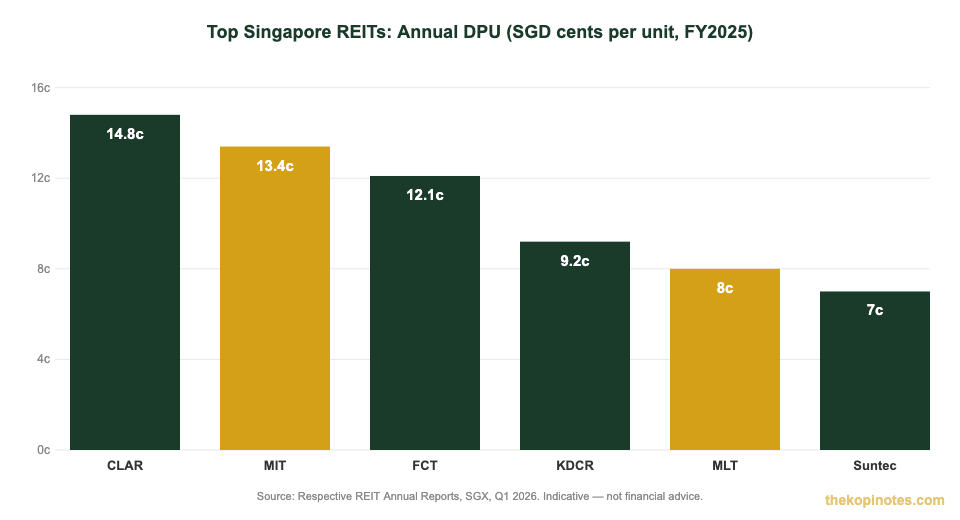
Top S-REITs by DPU: 2026 Comparison
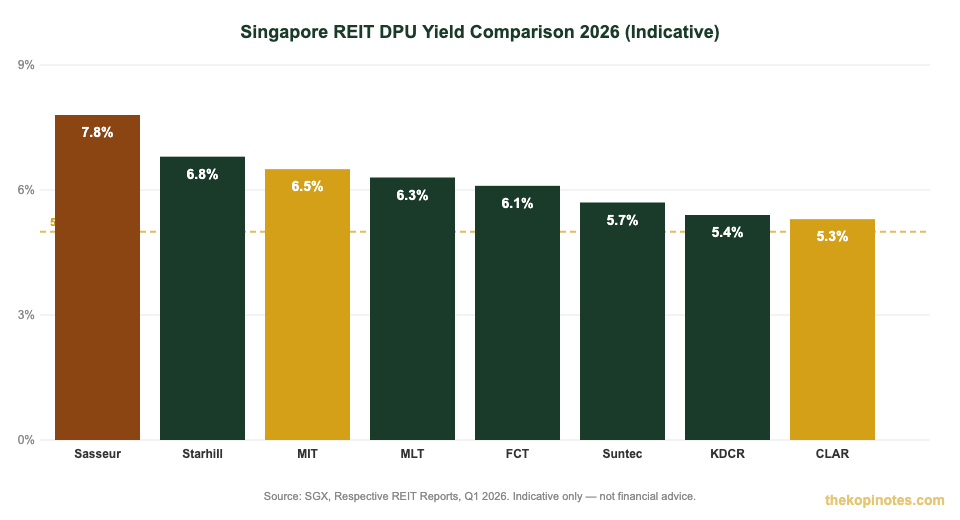
Below is a comparison of the annual DPU and indicative yield for major S-REITs as at Q1 2026. Use this as a starting reference only — always check the latest REIT financial results before investing. For a deeper breakdown of each REIT’s fundamentals, see our guide to the best S-REITs in Singapore 2026.
| REIT (Ticker) | Sector | Annual DPU (FY2025) | Indicative Yield | Pay Frequency |
|---|---|---|---|---|
| CapitaLand Ascendas REIT (A17U) | Industrial | ~14.8 cents | ~5.3% | Semi-annual |
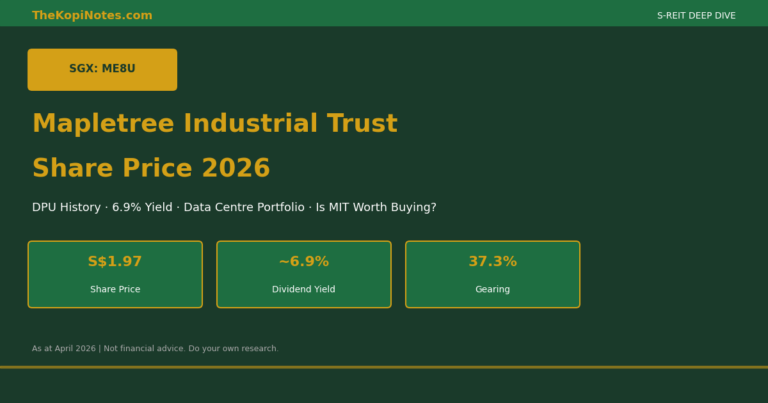
| Mapletree Industrial Trust (MI1U) | Industrial | ~13.4 cents | ~6.5% | Quarterly |
| Frasers Centrepoint Trust (J69U) | Retail | ~12.1 cents | ~6.1% | Quarterly |
| Keppel DC REIT (AJBU) | Data Centre | ~9.2 cents | ~5.4% | Semi-annual |
| Mapletree Logistics Trust (M44U) | Logistics | ~8.0 cents | ~6.3% | Quarterly |
| Suntec REIT (T82U) | Commercial/Retail | ~7.0 cents | ~5.7% | Semi-annual |
| Starhill Global REIT (P40U) | Retail/Hotel | ~3.2 cents | ~6.8% | Semi-annual |
| Sasseur REIT (CRPU) | Outlet Mall (China) | ~5.4 cents | ~7.8% | Semi-annual |
Source: Respective REIT financial results, SGX announcements, Q1 2026. DPU figures are indicative estimates for FY2025. Yields based on share prices as at Q1 2026. Not financial advice. Verify with official REIT announcements before investing.
Note that a higher yield does not always mean a better investment. Sasseur REIT carries the highest yield at ~7.8%, but it is a China-focused outlet mall REIT with a different risk profile compared to Singapore-focused REITs like FCT or MIT. Always assess the quality of the underlying properties and the sustainability of the DPU before investing.
For investors who want S-REIT exposure via a managed portfolio, the Syfe referral code gives access to Syfe’s REIT+ portfolio, which holds a diversified basket of S-REITs automatically rebalanced.
DPU Growth vs Yield: Which Should You Prioritise?
This is one of the most common debates among S-REIT investors. Here is the plain-English answer.
If you need income now, focus on yield. A REIT paying a 6.5% yield gives you more cash per dollar invested today. This is especially useful if you are retired or drawing down your portfolio. Our Singapore retirement calculator can help you work out how much S-REIT income you need to cover your living expenses.
If you are building wealth for the future, focus on DPU growth. A REIT that grows its DPU at 3–5% per year compounds your income over time. In 10 years, a 4% DPU growth rate turns a 5% starting yield into an effective yield-on-cost of over 7%.
The sweet spot for most Singapore investors is a REIT with a decent yield (5–7%) AND a track record of stable or growing DPU. Avoid REITs whose DPU has declined for two or more consecutive years without a clear recovery plan in place.
How to Evaluate DPU When Picking S-REITs
Here are five questions to ask before buying any S-REIT based on its DPU:
1. Is the DPU sustainable? Check the REIT’s distribution payout ratio — what percentage of distributable income is actually being paid out. Ratios above 100% are unsustainable. Ratios of 90–100% are typical for S-REITs. Ratios below 90% suggest the REIT is retaining some income, which can mean future DPU flexibility.
2. How has DPU trended over 5 years? Look at historical DPU data in the REIT’s annual reports. Stable or growing DPU is a positive signal. Declining DPU over 3+ years warrants caution. Track historical DPU in each REIT’s investor relations section or on SGX.
3. What is the debt (gearing) level? REITs with high gearing (above 40%) are more exposed to rising interest rates, which can compress DPU. MAS allows S-REITs to gear up to 50%. For a broader view of how debt affects REIT returns, see the CPF investment strategy guide.
4. What proportion of debt is fixed-rate? REITs with more fixed-rate debt are better insulated from rate rises. If 70%+ of a REIT’s debt is on floating rates, a jump in SIBOR or SORA will directly hurt the next DPU.
5. Are there planned equity raises or large acquisitions? Both can dilute DPU short-term. A well-executed DPU-accretive acquisition is positive — but poorly priced deals permanently dilute returns. Check SGX announcements when a REIT announces any major transaction.
For a deeper comparison of S-REITs by DPU, yield, and fundamentals, see our best S-REITs Singapore 2026 guide. If you want to buy individual REITs through a low-cost broker, the FSMOne referral code (P0544985) offers competitive SGX transaction fees. The Singapore REIT ETF guide covers how to access the full S-REIT market through a single fund if you prefer passive diversification.
Disclaimer: All figures in this article are for educational reference only based on data available as at Q1 2026. DPU changes each quarter. Do not make investment decisions based solely on this article. Always read the latest REIT financial results and consult a licensed financial adviser if needed.
Frequently Asked Questions
What does DPU mean in a Singapore REIT?
DPU stands for Distribution Per Unit. It is the cash amount paid to each REIT unitholder for a specific period — typically one quarter or one half-year. In Singapore, REITs must distribute at least 90% of their taxable income, which is why DPU is the primary income metric for evaluating S-REITs. If you own 10,000 units and the DPU is 3.0 cents per quarter, you receive SGD 300 every three months, or SGD 1,200 per year.
How is REIT DPU yield calculated?
REIT DPU yield is calculated as: Annual DPU ÷ Current Share Price × 100. For example, if a REIT pays an annual DPU of 12 cents and its share price is SGD 2.00, the yield is 6%. Yield rises when the share price falls and falls when the share price rises — even if the DPU itself has not changed. This is why it is important to track both the DPU amount and the current share price when comparing S-REITs.
Is DPU from Singapore REITs taxable for individual investors?
For individual Singapore tax residents, S-REIT distributions (DPU) are generally tax-exempt at the individual level, as long as the REIT qualifies for tax transparency treatment under the Income Tax Act. This is a key advantage of S-REITs over bonds or fixed deposits, where the interest received is fully taxable. Non-resident individual investors are typically subject to a 10% withholding tax on S-REIT distributions. Always verify your tax position with a qualified tax professional, as rules can change.
What is a good DPU yield for a Singapore REIT in 2026?
There is no single “good” DPU yield figure — what matters is the yield in relation to the risk profile and whether the DPU is sustainable and growing. As a rough benchmark, most major S-REITs offer indicative yields of 5–7% as at Q1 2026. A yield above 7% can signal either a great opportunity or higher risk — investigate the REIT’s debt levels, occupancy rates, and tenant quality carefully. Consistency and growth of DPU over 3–5 years is often more important than the raw yield figure alone.
What causes a Singapore REIT's DPU to fall?
A REIT’s DPU can fall for several reasons: (1) Lower net property income — from weaker occupancy, declining rents, or tenant defaults; (2) Higher borrowing costs — rising interest rates increase floating-rate debt costs, reducing distributable income; (3) Unit dilution — issuing new units through rights issues or private placements spreads the same distributable income over more units; (4) Capital retention — some REITs choose to retain more income to fund capex or reduce debt rather than distributing it. A single year of DPU decline is not always alarming, but a sustained multi-year downtrend warrants closer scrutiny of the REIT’s fundamentals.
Can I use CPF or SRS funds to buy S-REITs for DPU income?
Yes, most S-REITs listed on the SGX Mainboard are eligible for both the CPF Investment Scheme (CPFIS) and the Supplementary Retirement Scheme (SRS). Using CPF-OA funds to buy S-REITs allows you to earn DPU income within your CPF account, which can be used for housing or retirement needs. SRS investments in REITs benefit from tax deferral until withdrawal. Note that CPFIS has an opportunity cost — the CPF-OA rate is 2.5% per annum, so a REIT yielding below this level may not make sense for CPFIS use. Always check the current CPFIS eligible securities list on the CPF Board website before investing.
Ready to Start Earning S-REIT DPU?
Open an investment account and start building your Singapore REIT income portfolio today.
This article was researched with the help of AI. While we strive to keep all information accurate and up to date, there may be errors. If you notice any discrepancies, please contact us.