How to Start Investing in Singapore (2026 Beginner’s Guide)
A complete step-by-step guide for Singapore residents — from picking the right account to buying your first ETF or stock.
To start investing in Singapore, open a brokerage account (IBKR, Syfe, or moomoo are popular choices), fund it with at least SGD 100–500, and buy a diversified ETF such as CSPX or VWRA listed on the London Stock Exchange. Singapore investors pay no capital gains tax and no dividend income tax, making it one of the most tax-friendly investing environments in the world. This guide walks you through every step.
Not financial advice. All figures are for educational reference only. Data as at June 2026 unless noted.
Table of Contents
Contents — Click to expand
- Why Every Singapore Resident Should Invest
- How Investing Works: Key Concepts Explained
- Singapore’s Investing Landscape: CPF, SRS, and Tax Advantages
- What to Invest In: Stocks, ETFs, Robo-Advisors, and Bonds
- Step-by-Step: How to Start Investing in Singapore
- Best Platforms for Singapore Beginner Investors
- Common Beginner Mistakes to Avoid
- Frequently Asked Questions
Why Every Singapore Resident Should Invest
Singapore’s bank savings accounts currently offer 0.05%–2% p.a. on everyday savings — well below the city-state’s historical inflation rate of around 2–3% p.a. Keeping all your money in cash means your purchasing power shrinks every year in real terms.
The CPF Ordinary Account pays 2.5% p.a., which helps, but it is ring-fenced for housing and retirement — it isn’t freely accessible. For money you want to grow over 10, 20, or 30 years, investing in equities has historically delivered 7–10% p.a. in total returns (including dividends) over long periods.
Consider the difference between a Singapore resident who invests SGD 500 per month from age 25 versus one who starts at 35:
| Scenario | Start Age | Monthly Contribution | Portfolio at 65 (7% p.a.) |
|---|---|---|---|
| Early starter | 25 | SGD 500 | SGD 1,313,000 |
| Late starter | 35 | SGD 500 | SGD 609,000 |
Source: Compound interest calculation at 7% p.a. return. For illustration only; actual returns will vary.
Starting 10 years earlier more than doubles the outcome, thanks to compounding. The earlier you start investing in Singapore, the more time your money has to grow — even with the same monthly amount.
How Investing Works: Key Concepts Explained
Before putting money to work, it helps to understand a few foundational concepts. These are not abstract — they directly affect how much you earn and how much risk you take on.
What is an asset class? Assets are grouped by how they behave. Equities (stocks and ETFs) historically deliver the highest long-run returns but are volatile short-term. Bonds are more stable but lower-returning. Cash equivalents like T-bills and Singapore Savings Bonds preserve capital with modest yield. REITs sit between equities and bonds — they pay dividends but fluctuate in price. A well-diversified portfolio combines several asset classes.
What is an ETF? An Exchange Traded Fund is a basket of securities — for example, the iShares Core S&P 500 UCITS ETF (ticker: CSPX) holds all 500 companies in the S&P 500 index. When you buy one share of CSPX, you own a tiny slice of Apple, Microsoft, Amazon, and 497 other companies simultaneously. ETFs are low-cost (typical TER of 0.07–0.20% p.a.) and highly diversified, making them the most recommended starting point for Singapore beginner investors.
What is compound growth? Compounding means your returns earn returns. A SGD 10,000 portfolio growing at 7% p.a. becomes SGD 10,700 after year 1, and then earns 7% on SGD 10,700 in year 2 — not just the original SGD 10,000. Over 30 years at 7% p.a., SGD 10,000 grows to SGD 76,122 without adding a single dollar more. This is why time in the market beats timing the market.
What is diversification? Spreading investments across many companies, sectors, and geographies reduces the risk that any single company’s failure wipes out your portfolio. A global ETF like VWRA holds over 3,700 companies across 50 countries — if one company collapses, the impact is tiny.
Singapore’s Investing Landscape: CPF, SRS, and Tax Advantages
Singapore is one of the world’s most investor-friendly jurisdictions. Understanding the local landscape helps you optimise your returns.
No capital gains tax. Singapore does not tax investment gains. If you buy shares at SGD 10 and sell at SGD 50, the SGD 40 profit is entirely yours. This is a significant advantage over investors in the UK (28% CGT on equity gains), Australia (up to 45% on short-term gains), or the US (15–20% on long-term gains).
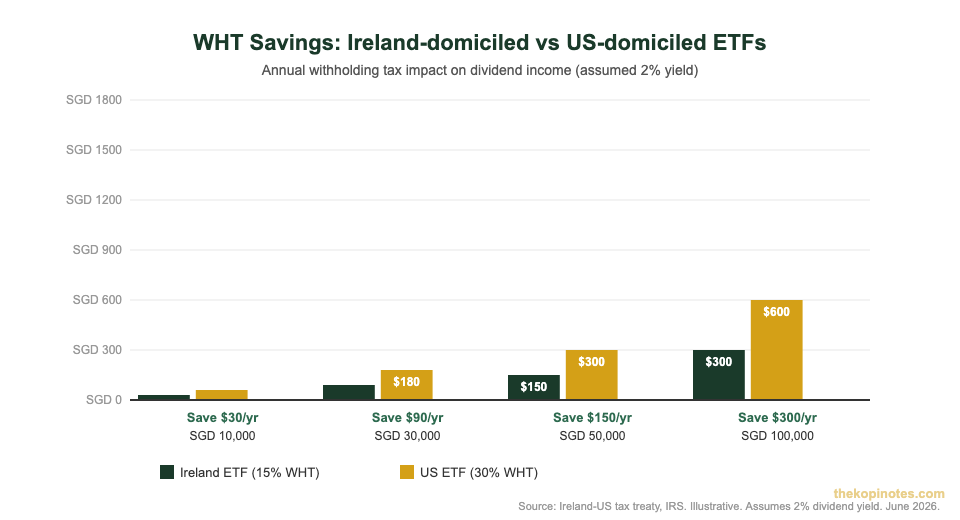
No dividend income tax. Singapore also does not tax dividend income received by individuals. Dividends from Singapore-listed companies and most overseas ETFs land in your account free of local income tax. Note: Ireland-domiciled ETFs (like CSPX, VWRA) still have 15% US dividend withholding tax deducted at source under the Ireland-US tax treaty — but this is lower than the 30% charged on US-domiciled ETFs (like VOO or SPY).
CPF Investment Scheme (CPFIS). If you have CPF Ordinary Account (OA) savings above SGD 20,000, you can invest the excess in approved instruments — certain SGX-listed ETFs, unit trusts, and Singapore Savings Bonds. Note that ETFs listed on the London Stock Exchange (like CSPX and VWRA) are not eligible for CPFIS — only SGX-listed products qualify.
Supplementary Retirement Scheme (SRS). SRS contributions reduce your taxable income dollar-for-dollar, giving you an immediate tax saving at your marginal rate. You can invest SRS funds in a broad range of instruments including ETFs (through eligible brokers like DBS Vickers, Phillip Securities, or FSMOne). Withdrawals after 62 are only 50% taxable, and the effective rate is usually very low.
| Account Type | What It Is | Tax Benefit | Best Used For |
|---|---|---|---|
| Cash (brokerage) | Regular brokerage account | No CGT, no dividend tax | Most flexible — any instrument |
| CPFIS (OA) | CPF investment arm | 2.5% floor rate on idle OA | SGX-listed ETFs, SSBs |
| SRS | Voluntary retirement scheme | Tax deduction on contributions | Unit trusts, ETFs (via SRS brokers) |
Source: CPF Board, IRAS, as at June 2026.
For most beginners, starting with a cash brokerage account is the simplest path. You can explore our CPF investment strategy Singapore guide once you have your cash account set up.
What to Invest In: Stocks, ETFs, Robo-Advisors, and Bonds
Singapore investors have access to a wide range of investment products. Here is a practical breakdown of the main options and which type of investor each suits best.
Global ETFs (recommended for most beginners). ETFs like CSPX (S&P 500) and VWRA (global equities) provide instant diversification at very low cost. CSPX has a TER of 0.07% p.a. — on a SGD 50,000 portfolio, that’s just SGD 35 per year in management fees. Singapore investors should buy these on the London Stock Exchange (LSE) rather than US exchanges to benefit from lower withholding tax (15% vs 30%) and avoid US estate tax risk above USD 60,000.
Singapore REITs (S-REITs). Real Estate Investment Trusts listed on SGX pay dividends quarterly and offer exposure to commercial property. They suit investors who want regular income. Explore the passive income Singapore guide for a detailed look at S-REIT investing. You can also check the Singapore REIT ETF guide for a fund-based approach.
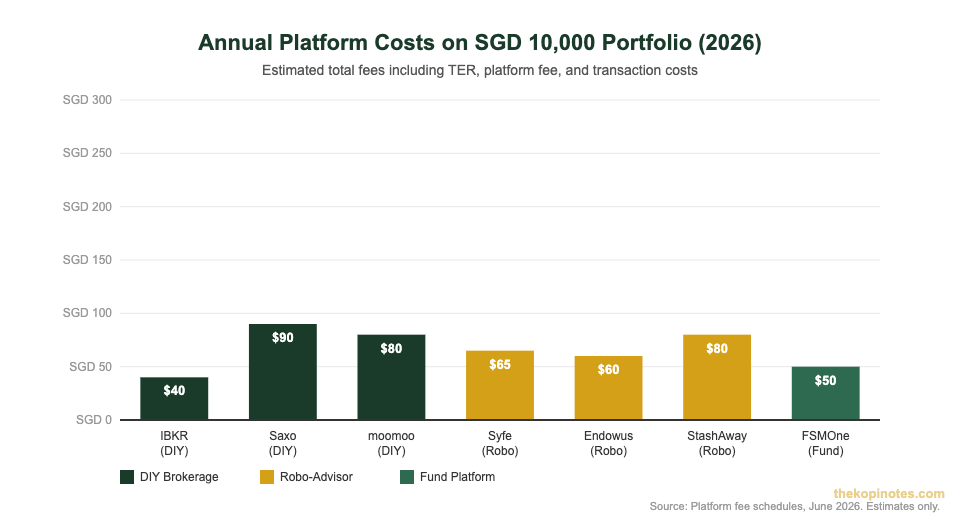
Robo-Advisors. Platforms like Syfe, Endowus, and StashAway automate portfolio construction and rebalancing. They’re ideal for beginners who want a hands-off approach. Fees typically range from 0.4–0.65% p.a. on top of the underlying ETF costs. While more expensive than DIY ETF investing, they remove the decision-making burden entirely.
Singapore Savings Bonds (SSBs) and T-bills. For the conservative portion of your portfolio, Singapore government instruments offer capital safety with yields currently around 2.5–3.5% p.a. The full Singapore Savings Bonds guide and Singapore T-bills 2026 guide cover these in detail.
Individual stocks. Picking individual companies is possible but requires significant research and carries higher risk than diversified ETFs. For most Singapore beginners, individual stocks are better approached after establishing a core ETF portfolio first.
Step-by-Step: How to Start Investing in Singapore
Here is a practical, actionable sequence that works for most Singapore residents starting from zero.
Step 1 — Build your emergency fund first. Before investing a single dollar, ensure you have 3–6 months of living expenses in an accessible savings account or Singapore Savings Bond. Investing money you might need in an emergency forces you to sell at potentially the worst time — market downturns are also often economic downturns.
Step 2 — Define your goal and time horizon. Are you investing for retirement in 30 years, a house downpayment in 5 years, or general wealth building? Your time horizon dictates how much risk you can tolerate. A 30-year horizon can ride out 50% market drops; a 5-year horizon cannot. Use the Singapore retirement calculator to estimate how much you need to save monthly to hit your target.
Step 3 — Choose your account type. For most beginners: open a cash brokerage account. If you are employed and above age 18, also consider topping up your SRS account for the immediate income tax deduction — contributions up to SGD 15,300 per year (for Singapore citizens) are deductible.
Step 4 — Open a brokerage account. Compare platforms based on commissions, minimum investment, available products, and ease of use. See the platform table in the next section. Most accounts can be opened online in 15–30 minutes with Singpass.
Step 5 — Fund your account and make your first purchase. Transfer your first investing sum — even SGD 200–500 is enough to start with some brokers. Then place your first buy order. For a beginner, buying one unit of CSPX or VWRA on the LSE is a solid starting point. Set up a monthly bank transfer so you invest regularly without thinking about it — this is called dollar-cost averaging (DCA) and removes the stress of timing the market.
Step 6 — Review quarterly, not daily. Checking your portfolio every day is counterproductive — markets fluctuate daily and watching short-term swings encourages emotional decisions. Review your allocation every quarter, rebalance annually if your target allocation has drifted significantly, and otherwise leave your investments alone to compound.
Best Platforms for Singapore Beginner Investors
Choosing the right platform depends on how hands-on you want to be, your investment amount, and whether you prioritise cost or convenience.
| Platform | Type | Min. Investment | Commission (ETF) | Best For |
|---|---|---|---|---|
| Interactive Brokers (IBKR) | DIY Brokerage | No minimum | USD 1.70/trade (LSE) | Cost-conscious investors with SGD 5,000+ |
| moomoo Singapore | DIY Brokerage | SGD 0 | SGD 0.99–1.99/trade | Beginners wanting a clean app |
| Syfe Brokerage | DIY + Robo | SGD 0 | SGD 1.49/trade (no FX fee) | Beginners wanting no FX conversion fees |
| Endowus | Robo-Advisor | SGD 1,000 | 0.25–0.60% p.a. | CPF/SRS investing, hands-off approach |
| FSMOne | Fund Platform | SGD 100 (RSP) | 0.08% per RSP order | Regular savings plan (RSP) investing |
| StashAway | Robo-Advisor | SGD 0 | 0.20–0.80% p.a. | Fully automated, risk-adjusted portfolios |
Source: Platform fee schedules, June 2026. Commission rates may vary; verify with each platform before investing.
For beginners who want to keep costs low and control their own investments, opening a Syfe referral code account or moomoo account is a strong starting point — both have no minimum balance and low per-trade fees. For a fully automated approach, use our Endowus referral code for a fee waiver on your first investment. FSMOne referral code is excellent if you want to set up a monthly RSP and forget about it.
For a deeper comparison of robo-advisors, see Syfe vs Endowus 2026.
Common Beginner Mistakes to Avoid
Waiting for the “perfect” time to invest. There is no perfect time. Research consistently shows that investors who try to time the market underperform those who invest regularly regardless of conditions. A Singapore investor who invested SGD 1,000 every month in the S&P 500 from 2000 to 2020 — including through the dot-com crash, Global Financial Crisis, and COVID — would have outperformed one who tried to time each entry.
Investing in products you don’t understand. If you can’t explain in one sentence what an investment does and how it makes money, don’t put money into it. This applies especially to structured products, leveraged ETFs, options, and cryptocurrency — all carry risks that go well beyond standard equity investing.
Overconcentration in Singapore stocks. Many Singapore retail investors overweight local stocks (SGX blue chips, banks, S-REITs) because they feel familiar. Singapore’s stock market represents less than 0.5% of global market cap. A globally diversified ETF gives you far better diversification without sacrificing returns.
Panic selling during downturns. Market corrections of 10–20% happen roughly every 1–2 years; bear markets (drops of 20%+) happen every 5–10 years. Every significant market crash in history has eventually been followed by a full recovery and new highs. The investors who suffered permanent losses were those who sold at the bottom.
Ignoring fees. A 1% annual fee difference might seem small, but on a SGD 200,000 portfolio over 20 years at 7% p.a., it costs approximately SGD 76,000 in lost compounding. Use low-cost ETFs and platforms — the moomoo Singapore review is a useful comparison for platform costs.
Skipping the emergency fund. Investing money you need within 1–2 years forces you to sell investments at the worst possible time. Market downturns often coincide with job losses and economic stress — exactly when you need accessible cash most.
Not financial advice. All figures are for educational reference only. Past performance does not guarantee future results. Always do your own research before investing.
Frequently Asked Questions
How much money do I need to start investing in Singapore?
You can start investing in Singapore with as little as SGD 100 through platforms like FSMOne’s Regular Savings Plan, or with no minimum on moomoo and Syfe. For direct ETF purchases on the London Stock Exchange through IBKR, you’ll need enough to cover at least one share (CSPX trades around USD 500–550 per share, and VWRA around USD 100 per share as at June 2026). A practical starting point that balances diversification and cost-efficiency is around SGD 500–1,000.
What is the best investment for beginners in Singapore?
For most Singapore beginners, a globally diversified, low-cost ETF is the best starting investment. VWRA (Vanguard FTSE All-World UCITS ETF) listed on the LSE gives exposure to 3,700+ companies across 50 countries at a TER of just 0.22% p.a. Alternatively, a robo-advisor like Syfe or Endowus automates the entire process. Avoid individual stocks until you have at least 1–2 years of investing experience and a solid core portfolio.
Is investing in Singapore safe for beginners?
All investing carries risk — there is no guaranteed return. However, investing in regulated products through MAS-licensed brokers and platforms is safe in the sense that your assets are segregated and protected under Singapore’s regulatory framework. The main risk beginners face is market risk (prices falling), not regulatory risk. Diversified ETFs reduce company-specific risk substantially. Staying invested for at least 5–10 years significantly reduces the probability of negative real returns based on historical data.
Can I use my CPF to invest in stocks and ETFs?
Yes, through the CPF Investment Scheme (CPFIS) you can invest CPF Ordinary Account funds above SGD 20,000 in approved instruments — including certain SGX-listed ETFs (such as the Nikko AM STI ETF and Lion-OCBC Securities APAC REITS ETF), unit trusts, and Singapore Savings Bonds. ETFs listed on overseas exchanges like the London Stock Exchange (CSPX, VWRA) are NOT eligible for CPFIS. Given that CPF OA earns a guaranteed 2.5% p.a., it’s worth carefully assessing whether investing via CPFIS makes sense for your situation — many financial planners recommend maximising CPF contributions before investing in riskier assets.
Do I pay tax on investment gains in Singapore?
No. Singapore does not impose capital gains tax on individuals. If you buy shares at SGD 5 and sell at SGD 50, the SGD 45 gain is entirely tax-free. Singapore also does not tax dividend income received by individuals. The one exception to be aware of: US-listed ETFs and stocks pay dividends subject to 30% US withholding tax for non-US investors, which is deducted at source before you receive the dividend. This is why Singapore investors prefer Ireland-domiciled ETFs listed on the LSE — they benefit from a lower 15% WHT under the Ireland-US tax treaty.
How do I choose between a robo-advisor and a DIY brokerage?
Choose a robo-advisor (Syfe, Endowus, StashAway) if you want zero decision-making, automatic rebalancing, and don’t mind paying 0.4–0.65% p.a. extra in platform fees. Choose a DIY brokerage (IBKR, moomoo) if you’re comfortable selecting your own ETFs, want the lowest possible costs, and have at least SGD 3,000–5,000 to invest (so that per-trade commissions are a small percentage of each purchase). The break-even point where DIY becomes cheaper than a robo-advisor is typically around SGD 10,000–20,000 in total portfolio value, depending on how frequently you invest.
Ready to Start Your Investing Journey?
Open a brokerage account today and make your first investment. Use our referral links for exclusive sign-up bonuses available to Singapore residents.
This article was researched with the help of AI. While we strive to keep all information accurate and up to date, there may be errors. If you notice any discrepancies, please contact us.