How to Invest in Singapore While Saving for a BTO Flat: Balancing CPF, Renovation, and Your Portfolio (2026)
A BTO purchase pulls CPF and cash out of your investing plan for years — here’s how to sequence downpayment, grants, renovation, and investing without stalling either goal.
A BTO flat needs at least a 25% downpayment, payable in cash and/or CPF Ordinary Account savings, with an HDB concessionary loan covering up to 75% at 2.6% per year. You can keep investing while you save, as long as you plan your CPF Ordinary Account balance, Enhanced Housing Grant, and renovation budget around your key collection date instead of against it.
Not financial advice. All figures are for educational reference only. Data verified as at 15 August 2026.
- Your BTO downpayment is at least 25% of the price — cash, CPF Ordinary Account (OA), or both — with an HDB loan covering up to 75% at 2.6% a year.
- The Enhanced CPF Housing Grant tops up your OA for free, but it isn’t really free — you refund it with accrued interest when you eventually sell.
- Don’t stop investing entirely for years. Keep a clear split between your BTO fund (safe, short-term) and your long-term portfolio.
Table of Contents
Contents — Click to expand
- Why a BTO Purchase Changes Your Investing Timeline
- How Much of Your CPF a BTO Actually Needs
- CPF Housing Grants: Useful Money With a Catch
- Renovation Costs and Loans: Don’t Let This Wreck Your Plan
- Balancing Your OA, Your BTO Fund, and Long-Term Investing
- A Worked Example: Saving for a $500,000 BTO While Still Investing
- What to Do This Week
- Frequently Asked Questions
Why a BTO Purchase Changes Your Investing Timeline
Getting a Build-To-Order (BTO) flat is one of the biggest financial events in a young Singaporean’s life. Unlike a resale flat, you apply, wait three to five years for the flat to be built, then pay your downpayment and collect your keys.
That long wait is actually a gift for investors. You have years to plan, not months. But it also means your CPF Ordinary Account (OA), the account most people also use to invest, is quietly earmarked for a big withdrawal down the road.
Many couples make one of two mistakes. Some stop investing completely the moment they book a flat, parking everything in cash “just in case.” Others keep investing aggressively and forget that a chunk of their OA balance is already spoken for. This guide shows you how to avoid both.
How Much of Your CPF a BTO Actually Needs
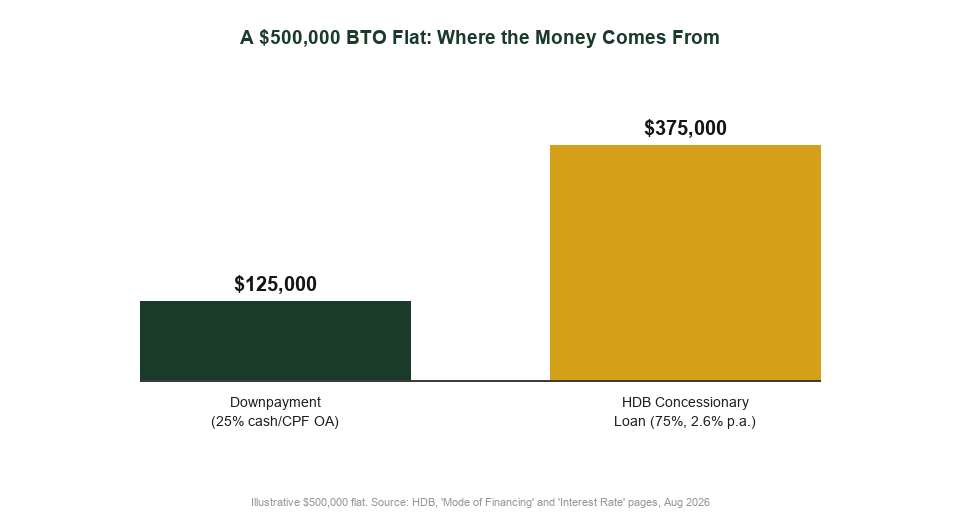
According to HDB’s official financing rules, your downpayment is at least 25% of the purchase price. You can pay this in cash, CPF OA savings, or a mix of both. The remaining amount can be covered by an HDB concessionary loan of up to 75% of the price, or a bank loan if you prefer.
The HDB concessionary loan rate is pegged at 0.1 percentage points above the CPF OA interest rate. With OA sitting at 2.5% per year through 2026, that makes the HDB loan rate 2.6% per year — a rate that hasn’t moved much in decades and is usually cheaper than a bank loan once you account for rate volatility.
Here’s the part many first-time buyers miss: if you take an HDB loan and use CPF for your monthly instalments, CPF Board lets you choose to retain up to $20,000 in your OA rather than draining it to zero. That $20,000 buffer can keep compounding at the OA floor rate, or be a starting point for CPF-linked investing later, instead of disappearing entirely into your flat.
| Cost Component | Minimum Share | Can You Use CPF OA? |
|---|---|---|
| Downpayment | At least 25% of purchase price | Yes, in full or partly, alongside cash |
| HDB concessionary loan | Up to 75% of purchase price | Monthly instalments payable via OA |
Source: HDB, “Mode of Financing” and “Interest Rate” pages; CPF Board, “Retain $20,000 in your OA if you are taking a housing loan”, Aug 2026.
CPF Housing Grants: Useful Money With a Catch
If your household income is below the eligibility ceiling, you may qualify for the Enhanced CPF Housing Grant (EHG) on a BTO purchase. In 2026, eligible first-timer families can receive up to $120,000, and eligible first-timer singles up to $60,000, on a sliding scale where lower income earns a bigger grant. The income ceiling is $9,000 average gross monthly household income for families, and $4,500 for singles.
That’s real money. But here’s the catch that catches people off guard: the EHG isn’t cash in your pocket. It’s credited straight into your CPF OA, and when you eventually sell the flat, you have to refund the grant amount plus the CPF accrued interest it would have earned, back into your CPF account, before you can use the sale proceeds freely.
This doesn’t make the grant a bad deal. Free top-up money at CPF’s guaranteed floor rate is still valuable. It just means you shouldn’t mentally “spend” the grant as if it’s yours to keep outright — treat it as CPF-locked money that boosts your retirement account, not your investing capital.
Renovation Costs and Loans: Don’t Let This Wreck Your Plan
Key collection isn’t the finish line — it’s the start of another few months of renovation spending. A basic 4-room BTO renovation can easily run $30,000 to $60,000, and it’s common to underestimate this cost while you’re still focused on the downpayment.
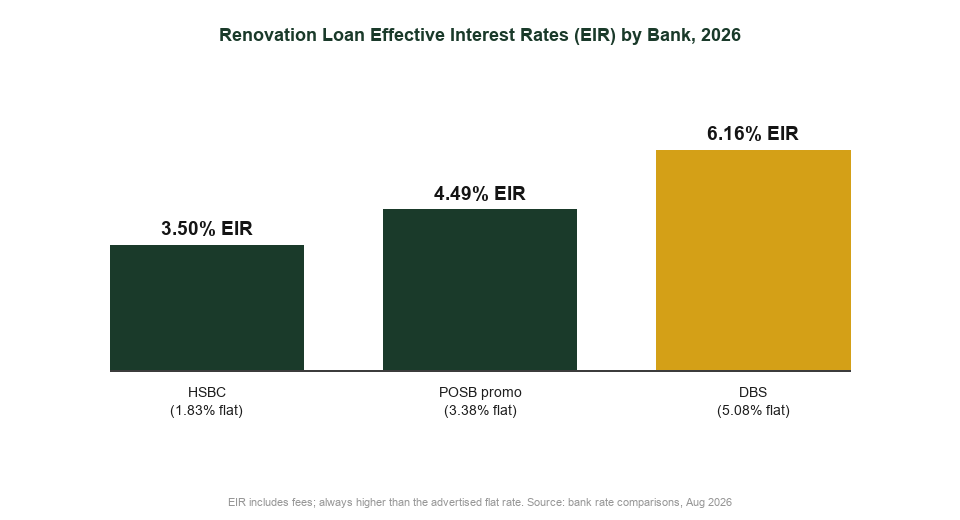
If you don’t have enough cash saved for renovation, banks offer renovation loans, typically advertised at 1.83% to 5.08% flat per year. The number that actually matters is the Effective Interest Rate (EIR), which folds in processing fees and the monthly-rest computation method. EIRs on these loans commonly land between 3.5% and 6.2% a year, well above the flat rate you see advertised.
Before taking a renovation loan, compare the EIR across at least three banks, not the flat rate. A loan advertised as “3.38% flat” can carry an EIR near 4.5%, while a genuinely cheaper offer at “1.83% flat” might land closer to 3.5% EIR. That’s a meaningful gap on a $40,000 loan over five years.
| Bank | Advertised Flat Rate | Effective Interest Rate (EIR) |
|---|---|---|
| HSBC | from 1.83% p.a. | from 3.50% p.a. |
| POSB (promo) | 3.38% p.a. | 4.49% p.a. |
| DBS | 5.08% p.a. | 6.16% p.a. |
Rates change frequently and vary by promotion and loan tenure. Source: bank renovation loan comparisons (moneysmart.sg, singsaver.com.sg, loanadvisor.sg), Aug 2026 — always confirm current rates directly with the bank before applying.
Balancing Your OA, Your BTO Fund, and Long-Term Investing
The cleanest way to think about this is three separate buckets, not one blended pile of money.
Bucket 1: Your CPF OA. This is largely earmarked for the downpayment and monthly instalments once your loan starts. Don’t count on using it for CPF Investment Scheme (CPFIS) equities if you know a BTO downpayment is coming in the next few years — keep it liquid at the guaranteed OA rate instead.
Bucket 2: Your BTO and renovation cash fund. Money you’ll need in cash within the next one to three years — renovation, stamp duty if applicable, legal fees — belongs in something safe and liquid, like Singapore Savings Bonds or a high-yield savings account, not in equities that could be down 20% right when you need the cash.
Bucket 3: Your long-term investing portfolio. Money you won’t need for five, ten, or more years — retirement savings, a separate brokerage account — can stay invested in a diversified portfolio and keep compounding, completely separate from your housing plans.
The mistake to avoid is treating all three buckets as one. If you liquidate long-term investments to cover a renovation bill because you didn’t plan Bucket 2 properly, you lock in whatever losses the market handed you that month. Our goal-based investing guide covers this bucket approach in more depth for other savings goals.
A Worked Example: Saving for a $500,000 BTO While Still Investing
Say you and your partner have a BTO booked, priced at $500,000, keys arriving in three years. Here’s a simple way to sequence your money.
| Bucket | Target Amount | Where It Sits |
|---|---|---|
| Downpayment (25%) | $125,000 | CPF OA, topped up by ongoing salary contributions plus any EHG received |
| Renovation and move-in cash | $40,000 | Singapore Savings Bonds or high-yield savings, built up over the 3-year wait |
| Long-term investing (unrelated to BTO) | Ongoing, no fixed target | Diversified portfolio, kept completely separate |
Illustrative example only. Actual downpayment, EHG eligibility, and renovation costs vary by flat type, income, and personal choices.
Notice that the third bucket doesn’t stop just because a BTO is coming. As long as Buckets 1 and 2 are realistically funded by key collection, there’s no reason to halt long-term investing for three straight years — doing so just means missing out on years of compounding for a goal that’s already covered elsewhere.
What to Do This Week
Step 1: Check your CPF OA balance and estimate how much of it will realistically go toward your downpayment.
Step 2: If you haven’t already, check your Enhanced CPF Housing Grant eligibility on the HDB or CPF website using your household income.
Step 3: Open a separate savings vehicle — Singapore Savings Bonds or a high-yield account — specifically for renovation and move-in cash, so it’s never confused with your long-term portfolio.
Step 4: If you’re taking a renovation loan later, shortlist banks by EIR, not the advertised flat rate.
Not financial advice. Every household’s income, flat type, and grant eligibility differs — use the official CPF housing usage calculator and speak with HDB directly for numbers specific to your situation. Data verified as at 15 August 2026.
Frequently Asked Questions
How much CPF do I need for a BTO downpayment?
Your downpayment is at least 25% of the purchase price, payable in cash, CPF Ordinary Account savings, or a mix of both, according to HDB’s official financing rules. The remaining amount can be covered by an HDB concessionary loan of up to 75% of the price.
What is the HDB concessionary loan interest rate in 2026?
The HDB concessionary loan rate is pegged at 0.1 percentage points above the CPF Ordinary Account interest rate. With the OA rate at 2.5% per year through 2026, the HDB concessionary loan rate is 2.6% per year.
Is the Enhanced CPF Housing Grant free money?
Not entirely. The EHG is credited into your CPF Ordinary Account, up to $120,000 for eligible first-timer families or $60,000 for eligible first-timer singles in 2026, but you must refund the grant amount plus CPF accrued interest when you eventually sell the flat.
Should I stop investing while saving for a BTO?
Not necessarily. If your downpayment and renovation funds are realistically covered by your CPF OA and a separate short-term savings vehicle, there’s little reason to pause unrelated long-term investing. The key is keeping BTO-related savings and long-term investments in clearly separate buckets.
How much should I budget for BTO renovation?
Costs vary widely by flat size and finishing choices, but a basic 4-room BTO renovation commonly runs from roughly $30,000 to $60,000. If you need financing, compare renovation loans by Effective Interest Rate (EIR), not the advertised flat rate, since EIR typically runs 1 to 2 percentage points higher.
Can I keep money in my CPF OA instead of using it all for my flat?
Yes. If you’re taking an HDB loan and paying instalments with CPF, CPF Board allows you to retain up to $20,000 in your Ordinary Account rather than using it all for your flat, according to CPF Board’s official guidance.
Ready to Keep Your Long-Term Portfolio Growing Alongside Your BTO?
Open a brokerage or robo-advisor account through our referral links, and use our retirement calculator to see how your numbers add up.
This article was researched with the help of AI. While we strive to keep all information accurate and up to date, there may be errors. If you notice any discrepancies, please contact us.