ESG Investing Singapore: Complete 2026 Guide
What ESG means, the best ESG ETFs on the LSE, and how Singapore investors can build a sustainable portfolio — with real SGD costs and tax considerations.
ESG investing in Singapore means putting your money into funds that screen companies on Environmental, Social, and Governance criteria — alongside traditional financial metrics. For Singapore investors, the most cost-efficient route is through Ireland-domiciled ESG ETFs listed on the London Stock Exchange (LSE), which offer 15% withholding tax (versus 30% for US-domiciled funds) and zero US estate tax exposure. Top options include the Xtrackers MSCI World ESG (XZWD) at 0.15% TER and the iShares MSCI World ESG Screened ETF (SUWS) at 0.20% TER.
Not financial advice. All figures are for educational reference only. Data as at June 2026 unless noted.
- ESG ETFs on the LSE give you sustainable investing with a Singapore tax advantage — 15% WHT vs 30% for US funds
- The cheapest ESG option for global equities is Xtrackers MSCI World ESG (XZWD) at just 0.15% TER
- Robo-advisors like Endowus and Syfe also offer ESG portfolios if you prefer a hands-off approach
Table of Contents
Contents — Click to expand
- What Is ESG Investing?
- Why ESG Matters for Singapore Investors in 2026
- Best ESG ETFs for Singapore Investors (LSE-Listed)
- ESG ETF Costs and Tax Efficiency
- ESG Robo-Advisors in Singapore
- How to Buy ESG ETFs in Singapore
- ESG vs Traditional Investing: Does It Cost You Returns?
- Who Should Consider ESG Investing?
- Frequently Asked Questions
What Is ESG Investing?
ESG stands for Environmental, Social, and Governance. These are three lenses used to evaluate a company beyond just its financial results.
Environmental looks at how a company manages its carbon footprint, water usage, waste, and climate risk. Think: does this company have a credible net-zero plan, or is it a major polluter with no accountability?
Social covers how a company treats its people — workers, supply chains, communities. It includes labour practices, diversity and inclusion, data privacy, and community relations.
Governance is about how a company is run. Are the board and management accountable? Is executive pay reasonable? Are shareholders’ interests protected?
When you invest in an ESG ETF, you are buying a fund that applies one or more of these screens before selecting which companies to include. Some funds exclude certain sectors entirely — weapons manufacturers, tobacco companies, thermal coal producers. Others use a “best-in-class” approach, picking the top ESG scorers within each industry.
The key difference from traditional ETFs: ESG ETFs use an extra layer of filtering. That filtering is not free — it typically adds a small cost to the fund’s Total Expense Ratio (TER). However, as ESG investing has gone mainstream, that cost premium has narrowed significantly. Today, some LSE-listed ESG ETFs are actually cheaper than their non-ESG counterparts.
Why ESG Matters for Singapore Investors in 2026
Singapore is a small, open economy highly exposed to global climate and geopolitical risk. The Monetary Authority of Singapore (MAS) has made sustainable finance a strategic priority — and Singapore investors are increasingly aware that the companies they invest in carry real ESG risks.
Here are three concrete reasons ESG is relevant to you as a Singapore investor right now:
1. Regulatory momentum is accelerating. MAS published its Sustainable Finance Action Plan in 2021 and has since rolled out requirements for Singapore-listed companies to disclose climate-related risks under TCFD frameworks. From 2025, Singapore Exchange (SGX)-listed companies must provide climate disclosures. This pushes capital toward better-governed, lower-risk businesses — which ESG ETFs are already skewed toward.
2. Climate risk is financial risk. A Singapore investor heavily weighted toward fossil fuel companies or high-water-usage industries is exposed to stranded asset risk as energy transition accelerates. ESG screens automatically reduce exposure to these long-term structural risks.
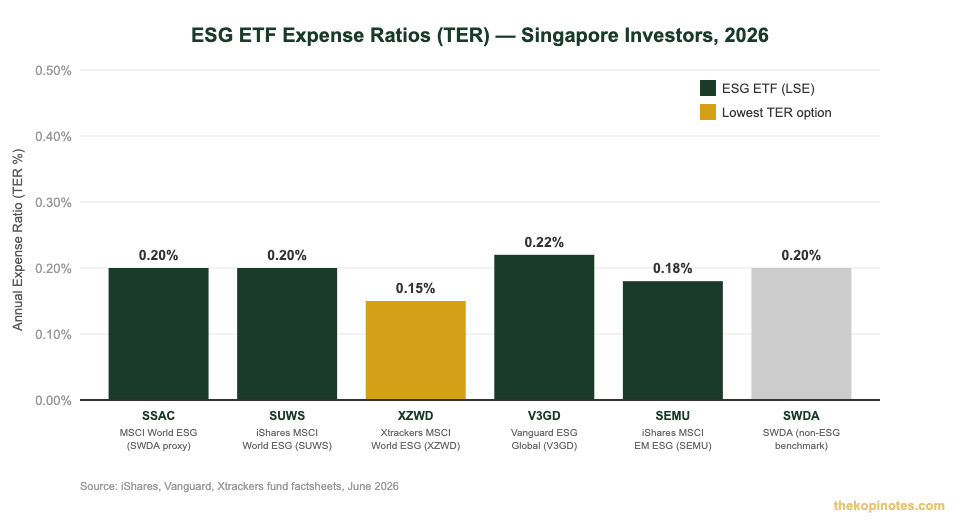
3. The cost premium has almost disappeared. In 2020, ESG ETFs carried a meaningful fee premium over standard index funds. By 2026, the cheapest ESG global ETF on the LSE (Xtrackers MSCI World ESG, XZWD) costs just 0.15% per year — identical to or cheaper than many non-ESG alternatives. You are not paying much extra for the screen anymore.
One important caveat: ESG ratings are not standardised. Different data providers — MSCI, Sustainalytics, FTSE Russell — use different methodologies and can reach very different conclusions about the same company. A company rated AAA by MSCI ESG might score poorly on Sustainalytics. Always check what screening methodology a specific ETF uses before investing.
Best ESG ETFs for Singapore Investors (LSE-Listed)
All ETFs below are Ireland-domiciled, LSE-listed, and available through major Singapore brokers. Ireland domicile is critical: it means you pay only 15% withholding tax on US dividends (through the Ireland-US tax treaty) instead of 30% on a US-domiciled fund. You also have zero US estate tax exposure regardless of portfolio size — unlike US-listed ETFs, which expose non-US investors to estate tax above USD 60,000.
| ETF | Ticker (LSE) | Index Tracked | TER | Structure | AUM |
|---|---|---|---|---|---|
| Xtrackers MSCI World ESG | XZWD | MSCI World ESG Leaders | 0.15% | Acc | ~USD 5bn |
| iShares MSCI World ESG Screened | SUWS | MSCI World ESG Screened | 0.20% | Acc | ~USD 3bn |
| Vanguard ESG Global All Cap | V3GD | FTSE Global All Cap ESG | 0.22% | Acc | ~USD 1.5bn |
| iShares MSCI EM ESG Enhanced | SEMU | MSCI EM ESG Enhanced | 0.18% | Acc | ~USD 0.8bn |
| Xtrackers MSCI World ESG Screened | XWLD | MSCI World ESG Screened | 0.17% | Acc | ~USD 2bn |
Source: Xtrackers, iShares, Vanguard fund factsheets, June 2026. AUM approximate.
All five are accumulating ETFs — meaning dividends are automatically reinvested inside the fund. You do not receive cash distributions. For a Singapore investor, this is ideal: you pay no dividend tax, no withholding tax on distributions, and you only trigger capital gains when you sell (Singapore has no capital gains tax for individuals).
Which one to pick? For most Singapore investors wanting simple, low-cost global ESG exposure, XZWD (Xtrackers at 0.15% TER) is the standout choice on cost alone. If you prefer the iShares brand and a slightly more conservative ESG screen, SUWS is a solid alternative. V3GD adds small-cap coverage — useful if you want broader diversification beyond large and mid-cap stocks.
ESG ETF Costs and Tax Efficiency
The two main costs Singapore investors face when buying ESG ETFs are the TER and the brokerage commission. Let’s break both down.
TER (Total Expense Ratio): This is the annual management fee deducted from the fund’s Net Asset Value (NAV) daily. It covers index licensing, custody, administration, and fund management. You do not pay this separately — it is automatically deducted from the fund’s performance. For example, if XZWD returns 10% in a year but has a 0.15% TER, your net return is approximately 9.85%.
Brokerage commissions: These are one-off transaction costs charged by your broker when you buy or sell. Interactive Brokers (IBKR) is typically the cheapest for LSE ETF trades — around USD 1.70 per trade for Singapore investors accessing the London Stock Exchange. Saxo and MooMoo charge more, typically 0.08%–0.12% of trade value with a minimum fee.
Withholding tax advantage: This is the big structural win for Singapore investors using Ireland-domiciled ESG ETFs. US dividends flowing into an Irish ETF are taxed at 15% (under the Ireland-US tax treaty). The same dividends flowing into a US ETF (like a US ESG fund on NYSE) would be taxed at 30% — double the rate. For a SGD 100,000 portfolio earning 2% in US dividends annually, the 15% WHT saves you approximately SGD 300 per year versus holding a US-domiciled equivalent.
| Cost Factor | Ireland-Domiciled ESG ETF (LSE) | US-Domiciled ESG ETF (NYSE) |
|---|---|---|
| US Dividend WHT | 15% | 30% |
| US Estate Tax (above USD 60k) | None | Up to 40% |
| Singapore Capital Gains Tax | None | None |
| Typical TER range (ESG) | 0.15%–0.22% | 0.10%–0.25% |
| Best for SG Investors? | Yes | No |
Source: MAS, IRS publication 515, Ireland-US tax treaty. Data as at June 2026.
One more point on SRS compatibility: ESG ETFs on the LSE are not eligible for CPF Investment Scheme (CPFIS) purchases. However, you can buy them through your Supplementary Retirement Scheme (SRS) account via brokers that support SRS investing, such as IBKR or Saxo. This lets you defer income tax on the invested amount while building your ESG portfolio — a meaningful tax benefit for higher-income Singaporeans.
ESG Robo-Advisors in Singapore
If picking individual ESG ETFs sounds complicated, Singapore’s robo-advisors offer a simpler path. You deposit money, choose an ESG or sustainable portfolio, and the robo-advisor does the rest — rebalancing automatically and reinvesting dividends.
Here are the main options:
Endowus: Offers a dedicated ESG portfolio alongside its standard portfolios. The ESG portfolio invests in a mix of global equity and fixed income ESG funds. One key advantage: you can invest your CPF Ordinary Account (OA) and SRS savings through Endowus — making it one of the few ways to apply ESG criteria to your CPF investments. Management fee starts at 0.25% per year on top of the underlying fund TERs. You can sign up using the Endowus referral code for a fee waiver on your first SGD 10,000.
Syfe: Syfe’s Earth portfolio is a purpose-built ESG option. It invests in a basket of globally diversified ESG ETFs, primarily LSE-listed. Syfe charges 0.35%–0.65% per year depending on your portfolio size, with no minimum investment. The hands-off nature makes it ideal for beginners. Use the Syfe referral code SRPRFFFCD for a fee waiver on your first three months.
StashAway: StashAway launched an ESG-oriented portfolio using ETFs screened against MSCI ESG ratings. Its fee structure is similar to Syfe’s — 0.2%–0.8% per year sliding scale. StashAway is particularly popular for its risk-managed approach.
The main trade-off with robo-advisors is the additional management layer fee. You pay the underlying ETF TER plus the robo-advisor’s fee — typically 0.25%–0.65% extra per year. For smaller portfolios (under SGD 30,000), this convenience premium is worth it. For larger portfolios, buying the ETFs directly through IBKR and paying just the TER is more cost-efficient in the long run.
How to Buy ESG ETFs in Singapore
You can buy LSE-listed ESG ETFs through any broker with access to the London Stock Exchange. Here is a step-by-step for the most common platforms:
Interactive Brokers (IBKR) — Recommended for most investors
IBKR is the lowest-cost option for buying LSE ETFs. The commission is USD 1.70 per trade (minimum), making it very efficient for lump sums of SGD 3,000 or more. Steps: open an IBKR account → fund in SGD or USD → search for the ETF ticker (e.g. XZWD) → select the London Stock Exchange as the exchange → place a limit order in GBP or USD. IBKR referral code: jianxiong368.
Syfe Brokerage — Best for beginners
Syfe’s brokerage platform is simpler and more Singapore-friendly. No minimum investment and a clean mobile interface. Commission is slightly higher than IBKR for larger trades, but the platform is easier to navigate. Use Syfe referral code SRPRFFFCD for your first three months free.
FSMOne — Good for Regular Savings Plans
FSMOne allows you to set up a Regular Savings Plan (RSP) to auto-invest a fixed SGD amount monthly into ETFs. This is useful for dollar-cost averaging into ESG ETFs without manually placing trades each month. Use the FSMOne referral code P0544985 for onboarding benefits.
Saxo Markets
Saxo offers access to LSE ETFs with a slightly higher commission than IBKR but a better interface for beginners. The FX spread (converting SGD to GBP for LSE trades) adds a small cost — typically 0.25%–0.50% on conversion.
Whichever broker you choose, here is the universal process: fund account → search for ESG ETF ticker → select LSE as exchange → place order → hold for the long term. ESG ETFs are not trading instruments — the compounding benefit comes from holding for 10+ years.
ESG vs Traditional Investing: Does It Cost You Returns?
This is the question every Singapore investor asks before switching to ESG. The honest answer: the evidence is mixed, and the gap has narrowed.
Historically, some ESG indices underperformed their parent benchmarks because they excluded high-performing energy stocks during oil booms. However, from 2015 to 2023, the MSCI World ESG Leaders index outperformed the standard MSCI World index in 8 out of 9 years. The 2022 energy price spike temporarily reversed this — but over a full market cycle, performance differences between ESG and non-ESG global equity indices have been small.
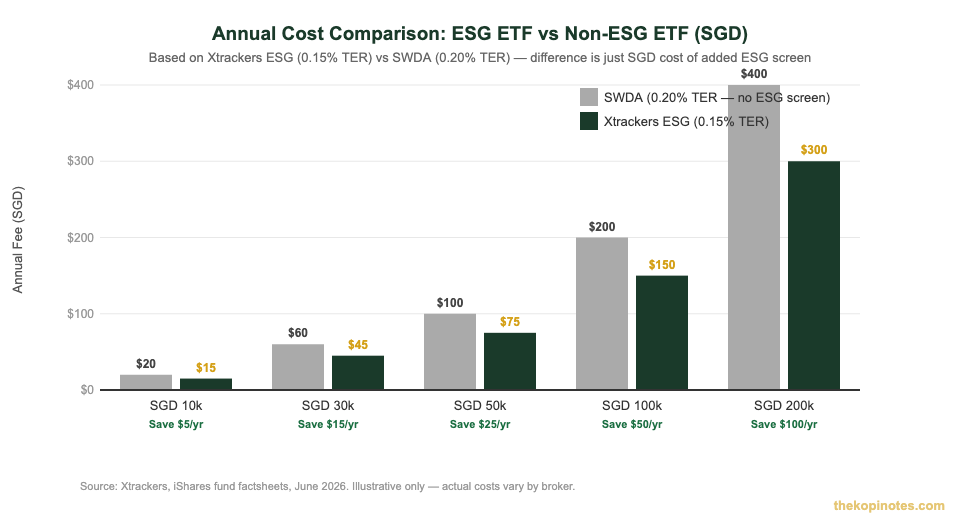
What matters more for a Singapore long-term investor is the cost structure. Let’s compare two portfolios over 20 years:
| Scenario | ETF | TER | Annual cost on SGD 100k | 20-year cost drag |
|---|---|---|---|---|
| Traditional | SWDA (iShares Core MSCI World) | 0.20% | SGD 200 | ~SGD 5,200 |
| ESG (cheapest) | XZWD (Xtrackers ESG) | 0.15% | SGD 150 | ~SGD 3,900 |
| Saving by going ESG | -0.05% | SGD 50/yr | ~SGD 1,300 |
Illustrative only. 20-year cost drag assumes 7% nominal return, compounded annually. Source: TKN calculations, June 2026.
In this specific case — XZWD vs SWDA — switching to ESG actually saves you money on TER. The ESG version costs 0.05% less per year. Over 20 years on a SGD 100,000 starting portfolio, that difference compounds to approximately SGD 1,300 in your favour.
The performance difference between the two indices over 10 years has been less than 0.5% per year in either direction — well within the margin of error for any long-term portfolio. You are not giving up meaningful return to go ESG, especially using a low-cost LSE ETF.
For those building a passive income strategy in Singapore, ESG ETFs are compatible with a dividend and growth blend — especially when combined with Singapore REITs for local income.
Who Should Consider ESG Investing?
ESG investing is not just for people who care deeply about sustainability. Here is a practical breakdown:
ESG is a good fit if you:
- Want global equity exposure with a built-in tilt away from the highest climate-risk and governance-risk companies
- Are comfortable that ESG ratings differ by provider and the screen is imperfect
- Plan to hold for 10+ years and want to align your investments with long-term structural trends (energy transition, better governance)
- Already use a robo-advisor and want to opt into their ESG portfolio with zero extra effort
- Are investing through SRS and want to deploy tax-deferred savings into something future-oriented
Stick to traditional ETFs if you:
- Are extremely cost-sensitive and every basis point matters (though as shown above, XZWD is actually cheaper than SWDA)
- Want the broadest possible market exposure including sectors ESG funds exclude (weapons, tobacco, thermal coal)
- Are uncomfortable with the fact that ESG ratings are not standardised and can feel subjective
- Prefer a simpler approach and are already invested in CSPX or VWRA with no plans to change
If you are starting fresh and deciding between an ESG and non-ESG global equity ETF, the cost argument for ESG has strengthened significantly. A Singapore retirement calculator can help you model how different fee levels affect your long-term wealth — the difference between 0.15% and 0.20% TER compounds meaningfully over 30 years.
For those managing CPF funds, note that most LSE ETFs are not CPF-investable. For CPF, your best options remain Singapore Savings Bonds, T-bills, or selected SGX-listed funds. Read the CPF investment strategy guide and the Singapore Savings Bonds guide for the full picture.
For income-focused investors, the Singapore REIT ETF guide pairs well with ESG equity ETFs — combining sustainable global equity growth with local REIT income in a single portfolio.
Not financial advice. All figures are for educational reference only. Always conduct your own due diligence or consult a licensed financial adviser before investing. Data as at June 2026.
Frequently Asked Questions
What is ESG investing and is it worth it in Singapore?
ESG investing means selecting funds based on Environmental, Social, and Governance criteria alongside financial returns. For Singapore investors in 2026, it is worth considering because the cheapest ESG ETF on the LSE (XZWD at 0.15% TER) is actually cheaper than some non-ESG alternatives, so you are not sacrificing cost-efficiency. Long-term performance between ESG and non-ESG global indices has been similar over 10-year periods, with ESG slightly ahead in recent years.
What is the best ESG ETF for Singapore investors?
The best ESG ETF for most Singapore investors is the Xtrackers MSCI World ESG (XZWD), listed on the London Stock Exchange. It has the lowest TER at 0.15%, is Ireland-domiciled (meaning 15% US dividend withholding tax instead of 30%), accumulates dividends automatically, and tracks the MSCI World ESG Leaders index covering around 390 large and mid-cap developed market companies with strong ESG scores.
Can I buy ESG ETFs using my CPF or SRS in Singapore?
LSE-listed ESG ETFs are not eligible for the CPF Investment Scheme (CPFIS). However, you can invest in them through your Supplementary Retirement Scheme (SRS) account via brokers that support SRS investing, such as Interactive Brokers or Saxo. Alternatively, Endowus allows you to invest CPF-OA funds into ESG-screened unit trusts through its platform, which is the main way to apply ESG criteria to your CPF savings.
Are ESG ETFs on the LSE safe? What are the risks?
ESG ETFs on the LSE are regulated UCITS funds — they meet strict EU/UK fund regulations covering diversification, custody, and investor protection. The main risks are market risk (the underlying stocks can fall in value), tracking error (the fund may not perfectly replicate its index), and ESG rating risk (the criteria used to select stocks are not standardised and can feel subjective). ESG ETFs are not immune to market downturns — they fell alongside non-ESG funds in 2022. They are appropriate for long-term investors (10+ year horizon), not for those who need liquidity in the short term.
Is ESG investing the same as impact investing?
No. ESG investing and impact investing are related but different. ESG ETFs screen and rank publicly listed companies based on ESG data — you are still investing in large-cap stocks on public markets. Impact investing typically refers to direct investments in private projects or companies where capital directly enables a measurable social or environmental outcome (e.g. a solar farm in Southeast Asia). ESG ETFs are much more accessible and liquid than impact investments, but the causal link between your investment and real-world change is more indirect.
Which broker is best for buying ESG ETFs in Singapore?
Interactive Brokers (IBKR) is the most cost-efficient broker for buying LSE-listed ESG ETFs, with commissions as low as USD 1.70 per trade. It is best for portfolios above SGD 5,000 per investment. For beginners or smaller amounts, Syfe Brokerage and FSMOne are simpler options with no minimum investment. If you want a fully automated ESG portfolio without picking ETFs yourself, Endowus (for CPF/SRS) and Syfe Earth portfolio (for cash investments) are the easiest entry points in Singapore.
Ready to Start ESG Investing in Singapore?
Open a brokerage account or robo-advisor account and start building your sustainable portfolio today.
This article was researched with the help of AI. While we strive to keep all information accurate and up to date, there may be errors. If you notice any discrepancies, please contact us.