How to Invest in Stocks in Singapore (2026 Guide)
Your plain-English guide to getting started with stock investing — brokers, strategies, costs, and more.
Investing in stocks in Singapore means buying shares in companies listed on the SGX or global exchanges like NYSE and LSE — through a licensed brokerage account. You can start with as little as S$100. The most cost-effective approach for most Singaporeans is to invest in a low-cost index ETF like CSPX or VWRA via IBKR or moomoo, keeping fees under S$2 per trade and building wealth passively over time.
Not financial advice. All figures are for educational reference only. Data as at June 2026 unless noted.
- Open a brokerage account (IBKR, moomoo, or Syfe Trade are lowest cost for Singapore investors)
- Start with broad index funds/ETFs — they beat most active stock pickers over 10+ years
- Invest regularly, keep costs low, stay the course — time in the market beats timing the market
Table of Contents
- Why Invest in Stocks?
- How the Stock Market Works in Singapore
- Step 1: Choose the Right Broker
- Step 2: Open Your Brokerage Account
- Step 3: What to Buy — Stocks vs ETFs
- Investing Strategies for Beginners
- Understanding Costs and Fees
- Managing Risk as a Singapore Investor
- Using CPF and SRS for Stock Investing
- Frequently Asked Questions
Why Invest in Stocks?
Leaving your money in a savings account earns you 0.05% to 3.5% per year at best. Over 20 years, that barely keeps pace with inflation. Stocks, on the other hand, have delivered an average of about 7–10% per year over the long run for diversified global portfolios.
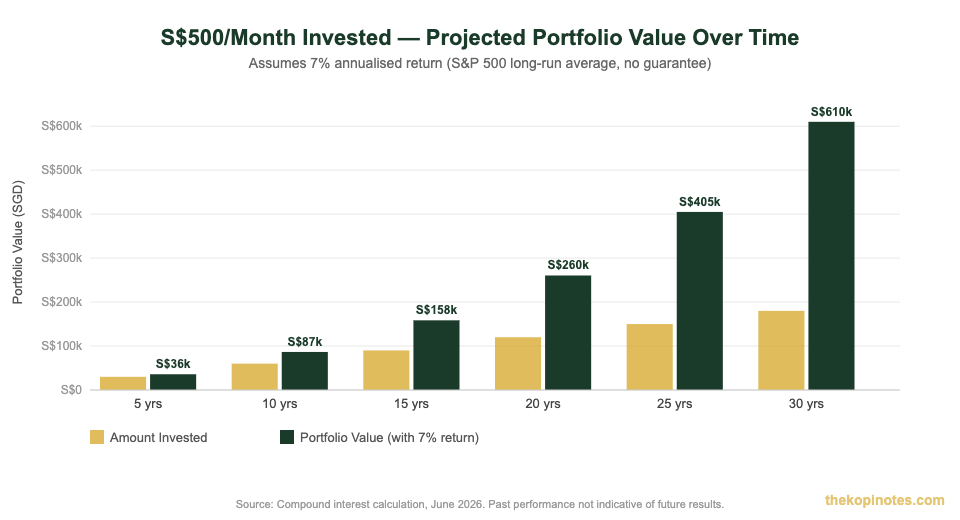
Here’s a concrete example. If you invest S$500 per month starting today, at a 7% annual return:
| Years Invested | Amount Invested | Portfolio Value | Gain |
|---|---|---|---|
| 10 years | S$60,000 | S$86,918 | +S$26,918 |
| 20 years | S$120,000 | S$260,462 | +S$140,462 |
| 30 years | S$180,000 | S$606,438 | +S$426,438 |
Source: Compound interest calculation at 7% annualised return, June 2026. Past performance is not indicative of future results.
That S$500/month over 30 years turns S$180,000 in contributions into over S$600,000 — more than 3× your money. The difference is compound growth, and you cannot get it from a bank savings account.
For Singapore investors, stocks are also one of the few asset classes with no capital gains tax. You keep 100% of your profits when you sell. That makes long-term investing here even more attractive than in countries like the US or UK.
How the Stock Market Works in Singapore
When you buy a stock, you’re buying a small ownership stake in a company. If the company grows and becomes more profitable, the stock price tends to rise. Many companies also pay dividends — cash payments to shareholders, typically quarterly or semi-annually.
Singapore has its own stock exchange — the SGX (Singapore Exchange) — where local companies like DBS, Singtel, and CapitaLand are listed. But most Singapore investors also buy US stocks (listed on the NYSE/Nasdaq) and London-listed ETFs for broader global diversification.
You need a licensed brokerage account to buy and sell stocks. Think of a broker as the middleman between you and the exchange. You deposit funds, place an order, and the broker executes it on your behalf.
There are two types of stocks to understand:
| Type | What It Is | Example |
|---|---|---|
| Individual Stock | Shares in one specific company | DBS Bank, Apple, NVIDIA |
| Index ETF | A basket of hundreds of stocks in one fund | CSPX (S&P 500), VWRA (global) |
| REITs | Property companies that pay regular dividends | CapitaLand Integrated Commercial Trust |
Source: The Kopi Notes, June 2026.
For most beginners, ETFs are the best starting point. You get instant diversification across hundreds of companies with one purchase, at very low cost.
Step 1: Choose the Right Broker
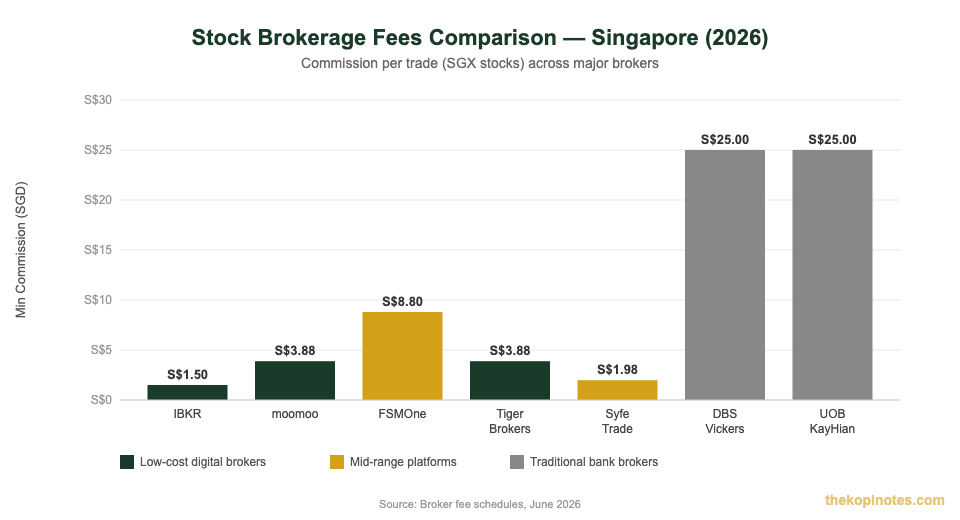
Your broker choice matters a lot — fees compound just like returns. Pay S$25 per trade versus S$1.50, and over 10 years of monthly investing, you could give up thousands in unnecessary costs.
Here are the main brokers Singapore investors use in 2026:
| Broker | Min Commission (SGX) | Min Commission (US) | Best For |
|---|---|---|---|
| IBKR (Interactive Brokers) | S$1.50 | USD 0.35 | ETF investors, active traders |
| moomoo | S$0 (promo) / S$3.88 | USD 0.99 | Beginners, US stock investors |
| Syfe Trade | S$1.98 | USD 1.49 | Simple UI, low minimums |
| Tiger Brokers | S$0 (promo) / S$3.88 | USD 0.99 | US + SG stocks |
| FSMOne | S$8.80 | USD 8.80 | Regular savings plans, ETFs |
| DBS Vickers | S$25.00 | USD 25.00 | Bank account integration |
Source: Broker fee schedules, June 2026. Promotional rates subject to change.
Our recommendation: IBKR is the best all-round broker for most Singapore investors. It has the lowest fees, access to global markets including LSE-listed ETFs, and solid security. Use our referral code jianxiong368 when signing up. Alternatively, if you want a simpler interface as a beginner, moomoo is a strong second choice. For a managed option that also offers stock trading, check the Syfe referral code and sign-up bonus.
Step 2: Open Your Brokerage Account
Opening a brokerage account takes about 15–30 minutes. You’ll do it entirely online. Here’s what to expect:
What you need:
- Singapore NRIC (or passport for foreigners)
- Bank account details for funding
- Mobile phone for verification
- Around 15–20 minutes
The process (using IBKR as example):
- Go to interactivebrokers.com.sg and click “Open Account” — use referral code jianxiong368
- Enter your personal details, verify your identity via Singpass or manual upload
- Set up your account type (Individual is fine for most people)
- Receive approval email in 1–3 business days
- Fund your account via bank transfer (minimum S$0 — no minimum deposit at IBKR)
- Start buying
For moomoo, the process is similar and even faster. They often have new account promotions — free shares or cash vouchers. You can also use FSMOne referral code P0544985 if you prefer FSMOne’s platform, which has an excellent regular savings plan feature.
One important note: you’ll need to fund your account before you can buy anything. Bank transfers to digital brokers usually clear within 1 business day. Traditional bank brokers may take longer.
Step 3: What to Buy — Stocks vs ETFs
This is the question most beginners agonise over. Here’s the honest answer: for most people, a broad market ETF is better than picking individual stocks.
Research consistently shows that 80–90% of active fund managers fail to beat the market index over 15+ years, even with professional research teams. Individual investors do even worse on average. The S&P 500 has returned about 10% per year over the past 30 years — you don’t need to pick the next Apple to grow wealth.
For beginner investors in Singapore, we recommend starting with one of these:
- CSPX — iShares Core S&P 500 UCITS ETF. Tracks the 500 largest US companies. TER: 0.07%. Listed on LSE. No US estate tax risk for Singapore investors.
- VWRA — Vanguard FTSE All-World UCITS ETF. Tracks ~3,700 companies across 47 countries. TER: 0.22%. Instant global diversification.
- ES3 — SPDR STI ETF. Tracks Singapore’s top 30 companies. Good for SGX exposure, but concentrated in banks and property.
Once you’re comfortable, you can add individual stocks as a “satellite” allocation (say, 10–20% of your portfolio) while keeping the core in index ETFs.
If you want broader diversification or a hands-off approach, consider a Endowus referral code (code: 2V343) — it’s a MAS-licensed digital advisor that invests in low-cost institutional funds and can even use your CPF-OA funds.
Investing Strategies for Beginners
There’s no shortage of investing strategies — but most of the complexity is unnecessary for the average person. Here are the three approaches that actually work for Singapore investors:
1. Dollar-Cost Averaging (DCA) — The default strategy
You invest a fixed amount (say S$300 or S$500) into the same fund every month, regardless of whether markets are up or down. When prices are low, you automatically buy more units. When prices are high, you buy fewer. Over time, this smooths out volatility and removes the stress of trying to “time the market”.
DCA is perfect for salaried employees who want to invest automatically from their monthly paycheck. FSMOne and Syfe both offer automatic monthly investment plans — check the Syfe referral code and sign-up bonus for details.
2. Lump Sum Investing — If you have a windfall
If you receive a bonus, inheritance, or large sum, research shows that investing it all at once outperforms DCA about 2/3 of the time (because markets tend to go up over time). However, psychologically, most people feel better DCA-ing a lump sum over 6–12 months. Either approach is fine.
3. Core-Satellite Portfolio — For those who want some stock picking
Put 80% of your portfolio in broad index ETFs (the “core”) and 10–20% in individual stocks or sector ETFs you have a view on (the “satellite”). This captures market returns while letting you express specific investment ideas without betting the farm.
For retirement planning context, use our Singapore retirement calculator to see how much you need to invest monthly to hit your retirement target.
Understanding Costs and Fees
Costs are the single biggest controllable factor in your investment returns. Even a 1% annual fee difference compounded over 30 years can cost you hundreds of thousands of dollars.
There are three types of fees to watch:
1. Brokerage commission — paid every time you buy or sell. With IBKR, this is S$1.50 minimum for SGX stocks or USD 0.35 for US stocks. Traditional bank brokers charge S$25–S$50 minimum. Over 120 monthly trades (10 years), that’s S$180 vs S$3,000.
2. ETF expense ratio (TER) — Expense ratio, or Total Expense Ratio (TER), is the annual fee the fund deducts from its Net Asset Value (NAV). CSPX charges 0.07%. An expensive active unit trust might charge 1.5–2%. On S$100,000, that’s S$70/year vs S$2,000/year.
3. FX spread — When you convert SGD to USD or GBP to buy ETFs, brokers charge a spread. IBKR charges approximately 0.2 basis points (very low). Bank brokers can charge 1–2%. On a S$20,000 trade, that’s S$4 vs S$400.
The bottom line: stick to low-cost index ETFs (TER under 0.25%) via a low-fee broker (IBKR, moomoo, or Syfe Trade). That combination minimises all three cost layers.
Managing Risk as a Singapore Investor
All investing involves risk. Stocks can — and do — fall 30–50% during recessions and crises. The S&P 500 fell 34% in March 2020 (COVID) and 19% in 2022. If you panic-sell at the bottom, you lock in those losses.
Here’s how to manage risk sensibly:
Diversify. Don’t put all your money in one stock or one sector. A broad index ETF like VWRA gives you exposure to 3,700 companies across 47 countries. If one company goes bankrupt, it barely moves your portfolio.
Invest only money you don’t need for 5+ years. Short-term money (emergency fund, upcoming housing costs) should stay in cash or Singapore Savings Bonds. Check our Singapore Savings Bonds guide for safe short-term options.
Don’t use leverage. Margin investing (borrowing to invest) can amplify losses as much as gains. As a beginner, stick to cash-only investing.
Rebalance annually. If stocks run up and now represent 90% of your portfolio (vs your target 70%), sell some stocks and buy bonds or cash equivalents to rebalance. This is “selling high, buying low” in practice.
For further context on generating income alongside growth, read our guide on passive income Singapore strategies.
Using CPF and SRS for Stock Investing
Singapore investors have access to two powerful tax-advantaged accounts that most people underuse.
CPF Investment Scheme (CPFIS)
If your CPF Ordinary Account (OA) balance exceeds S$20,000, you can invest the excess in approved stocks and ETFs under CPFIS. Your CPF OA currently earns 2.5% guaranteed — so only invest CPF if you’re confident of beating that return over the long run. For most people, a low-cost S&P 500 ETF historically clears this bar. Read our CPF investment strategy guide for a full breakdown.
Supplementary Retirement Scheme (SRS)
SRS lets you contribute up to S$15,300 per year (Singapore citizens/PRs) and get an immediate income tax deduction on the full amount. Your SRS money grows tax-free until withdrawal at retirement. You can invest your SRS balance in stocks, ETFs, and unit trusts. This is one of the most tax-efficient ways to invest in Singapore — especially for those in the 15–22% tax bracket.
Frequently Asked Questions
How much money do I need to start investing in stocks in Singapore?
You can start with as little as S$100. Most digital brokers like IBKR and moomoo have no minimum deposit requirement. If you’re investing in ETFs, one unit of CSPX costs approximately US$500 (around S$670), though fractional shares are available on some platforms. For regular savings plans via FSMOne or Syfe, you can start from S$50–S$100 per month.
Is investing in stocks taxed in Singapore?
There is no capital gains tax in Singapore — you keep 100% of your profits when you sell shares. However, US stocks do have a 30% withholding tax on dividends paid to Singapore investors (this can drop to 15% under the US-Singapore tax treaty via W-8BEN form). LSE-listed ETFs like CSPX have a lower 15% fund-level withholding tax, making them more tax-efficient for Singapore investors than US-listed ETFs like VOO.
Which broker is best for investing in stocks in Singapore?
IBKR (Interactive Brokers) is the best overall broker for most Singapore investors — lowest fees (from S$1.50 per trade), access to global markets including LSE ETFs, and strong regulation. For beginners who want a simpler interface, moomoo is a strong choice and often has new account promotions. For a managed option, Syfe Trade offers clean UX with competitive rates. Avoid traditional bank brokers (DBS Vickers, UOB KayHian) for regular investing due to high minimum commissions of S$25+.
Should I invest in SGX stocks or US stocks?
Both have merits. SGX (Singapore Exchange) stocks — particularly REITs and banks — offer attractive dividend yields and are denominated in SGD (no currency risk). US stocks (S&P 500 via CSPX or VWRA) offer much broader diversification and have historically delivered stronger long-run returns. Most Singapore investors hold a mix: global ETFs as the core position, with some SGX REITs for dividend income. Our guide on the best S-REITs in Singapore 2026 covers the top local options.
What is the difference between stocks and ETFs?
A stock is a share in a single company — buying Apple stock means you own a tiny piece of Apple. An ETF (Exchange Traded Fund) holds a basket of many stocks in one fund. For example, CSPX holds all 500 companies in the S&P 500 index. ETFs give you instant diversification at very low cost. Individual stocks give you potentially higher returns if you pick well, but much higher risk if you pick badly. For most beginners, ETFs are the smarter starting point.
Can I use my CPF to invest in stocks?
Yes, through the CPF Investment Scheme (CPFIS). You can invest CPF Ordinary Account (OA) money that exceeds S$20,000, and CPF Special Account (SA) money that exceeds S$40,000, into approved instruments including stocks and ETFs. Your OA currently earns a guaranteed 2.5% — only invest if you expect to beat this consistently over the long run. For most people, a low-cost global index ETF or index fund has historically cleared this bar. See our CPF investment strategy guide for full details.
How do I invest in stocks if I am a complete beginner?
Start here: (1) Open an IBKR account (use referral code jianxiong368) or moomoo account — takes 15–30 minutes online. (2) Fund it with S$500–S$1,000 to start. (3) Buy one unit of CSPX or VWRA — a broad global ETF. (4) Set a monthly reminder to add more. (5) Don’t check your portfolio every day — the long game is what matters. That’s it. You don’t need to understand options, derivatives, or complex strategies to build long-term wealth.
This article was researched with the help of AI. While we strive to keep all information accurate and up to date, there may be errors. If you notice any discrepancies, please contact us.