Investing in Singapore: The Complete Beginner’s Guide (2026)
ETFs, REITs, robo advisors, CPF investing, and brokers — everything you need to start building wealth in Singapore.
Investing in Singapore gives you access to one of Asia’s most investor-friendly environments — no capital gains tax, no dividend tax, and a range of options from CPF-linked robo advisors to globally diversified ETFs on the London Stock Exchange. Whether you have SGD 100 or SGD 100,000 to start, this guide walks you through every major investment option available to Singapore residents in 2026.
Not financial advice. All figures are for educational reference only. Data as at June 2026 unless noted.
- Singapore has zero capital gains tax and zero dividend tax — this puts more of your returns in your pocket compared to most countries.
- Start with a globally diversified ETF (like VWRA or CSPX on the LSE) or a robo advisor (like Syfe or Endowus) if you want a hands-off approach.
- Use CPF and SRS accounts to invest tax-efficiently before using cash — these give you immediate tax savings.
Table of Contents
Contents — Click to expand
- Why Invest in Singapore?
- Singapore’s Tax Advantages for Investors
- The Main Investment Options in Singapore
- Investing in ETFs in Singapore
- Investing in S-REITs
- Robo Advisors in Singapore
- CPF and SRS Investing
- How to Choose a Broker
- How to Start Investing in Singapore: Step by Step
- Frequently Asked Questions
Why Invest in Singapore?
Singapore’s investing environment is genuinely one of the best in the world for retail investors. The country’s political stability, strong rule of law, and transparent financial regulations make it a safe place to grow wealth. But the real advantages are financial.
First, there’s no capital gains tax. If you buy VWRA at SGD 100 and sell it at SGD 200, you keep the entire SGD 100 profit. Second, there’s no dividend tax. S-REIT dividends, ETF distributions, and stock dividends all land in your account untouched by the Singapore government. Third, the CPF system provides a mandatory savings foundation that earns 2.5–6% per annum, giving every Singapore resident a head start.
The result? A Singapore investor building a globally diversified portfolio keeps significantly more of their returns than investors in most other developed countries. For example, a UK investor pays 20–45% capital gains tax on profits above a small annual allowance. You pay zero.
The cost of living is high, but the investing environment more than compensates.
Singapore’s Tax Advantages for Investors
Understanding Singapore’s tax rules is the foundation of smart investing here. Here’s what matters in 2026:
| Tax Type | Singapore Rule | Why It Matters |
|---|---|---|
| Capital Gains Tax | 0% | You keep 100% of your investment gains |
| Dividend Tax (local) | 0% | S-REIT dividends are fully yours |
| US Dividend WHT (US ETFs) | 30% | Reason to avoid US-domiciled ETFs like VOO or SPY |
| US Dividend WHT (Ireland ETFs) | 15% | Why Singapore investors prefer CSPX over VOO |
| US Estate Tax (US ETFs) | 40% above USD 60k | A major hidden risk for Singapore investors |
| SRS Contributions | Tax-deductible (up to SGD 15,300/yr) | Invest and reduce your income tax simultaneously |
Source: IRAS, IRS, MAS, as at June 2026
The key takeaway: Singapore investors should buy Ireland-domiciled ETFs listed on the London Stock Exchange (LSE) — not US-listed ETFs. This alone saves you 15 percentage points of withholding tax on dividends and eliminates US estate tax risk.
The Main Investment Options in Singapore
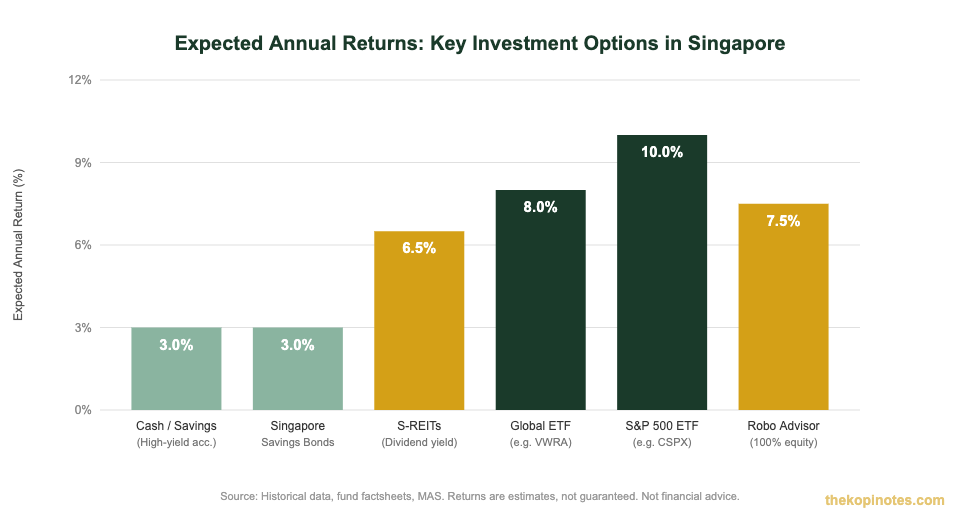
Singapore investors have more options than most realise. Here’s a clear overview of what’s available, who it suits, and what the typical returns look like:
| Option | Risk Level | Typical Returns | Min. Start | Time Commitment |
|---|---|---|---|---|
| High-Yield Savings | Very Low | 2–3.5% p.a. | SGD 1 | Minimal |
| Singapore Savings Bonds | Very Low | ~3% p.a. (step-up) | SGD 500 | Minimal |
| T-bills | Very Low | ~3% p.a. (6-month) | SGD 1,000 | Low |
| S-REITs | Medium | 5–8% dividend yield | ~SGD 200 | Medium |
| Global ETFs (LSE) | Medium | 7–10% p.a. historically | ~SGD 135 | Low |
| Robo Advisors | Medium | 6–9% p.a. (equity) | SGD 100–1,000 | Very Low |
Source: MAS, fund factsheets, platform data, June 2026. Past performance does not guarantee future returns.
Investing in ETFs in Singapore
Exchange-Traded Funds (ETFs) are the most efficient way for most Singapore investors to build long-term wealth. An ETF is a basket of stocks or bonds that you buy as a single unit through your brokerage account — just like buying a share.
The key decision for Singapore investors is which exchange to buy from. Here’s why this matters:
US-listed ETFs like VOO (Vanguard S&P 500) or VT (total world) look attractive — they have very low expense ratios. But as a Singapore resident, you face two problems. First, a 30% withholding tax (WHT) is deducted from all dividends. Second, US estate tax applies to holdings above USD 60,000 — at a rate of up to 40%. If you hold USD 200,000 in VOO and something happens to you, your heirs could owe USD 56,000 in US estate tax.
Ireland-domiciled ETFs listed on the LSE solve both problems. They use Ireland’s 15% WHT treaty rate on US dividends (half the US rate), and they’re not subject to US estate tax at all. For a SGD 100,000 portfolio, this WHT difference saves you approximately SGD 750 per year assuming a 3% dividend yield.
The most popular ETFs among Singapore investors in 2026:
- VWRA (Vanguard FTSE All-World Acc, USD) — ~3,700 stocks across 50+ countries. TER: 0.22% p.a. The simplest one-fund portfolio.
- CSPX (iShares Core S&P 500, USD) — 500 largest US companies. TER: 0.07% p.a. For US-heavy investors.
- IWDA (iShares Core MSCI World, USD) — ~1,400 developed world stocks. TER: 0.20% p.a. Excludes emerging markets.
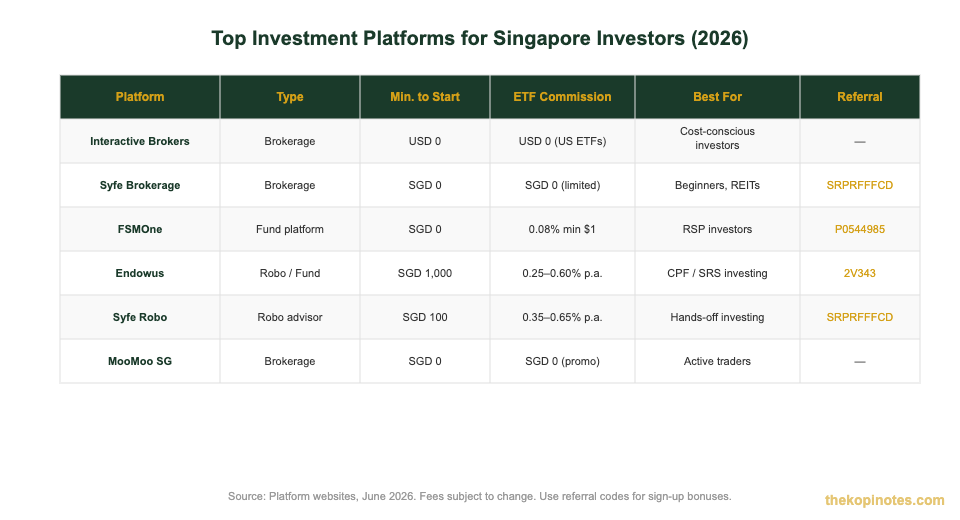
You can buy these through Interactive Brokers (IBKR), Saxo Markets, or MooMoo Singapore. You can also access global ETFs through Syfe referral code (use SRPRFFFCD for a bonus) or via the FSMOne referral code (use P0544985) through their regular savings plan.
Investing in S-REITs
Singapore Real Estate Investment Trusts (S-REITs) are listed on the Singapore Exchange (SGX) and must distribute at least 90% of their taxable income as dividends. This makes them a core income-generating vehicle for Singapore investors.
S-REITs give you exposure to commercial real estate — offices, retail malls, data centres, industrial parks, and hospitals — without having to buy property directly. You earn regular quarterly or semi-annual dividends, often yielding 5–8% per year.
For more detail, see our guide to the best S-REITs in Singapore 2026 and our overview of passive income Singapore strategies.
If you prefer ETF-style diversification over individual REIT picking, the Singapore REIT ETF guide covers the Lion-Phillip S-REIT ETF and NikkoAM-StraitsTrading Asia ex Japan REIT ETF — both SGX-listed and CPF-investable.
Robo Advisors in Singapore
Robo advisors are digital investment platforms that build and manage a diversified portfolio for you automatically. You answer a few risk-tolerance questions, deposit your money, and the platform handles everything — asset allocation, rebalancing, dividend reinvestment.
For Singapore investors who don’t want to manage their own ETF portfolio, robo advisors are the simplest entry point. They’re also among the only platforms that let you invest CPF and SRS savings in globally diversified funds.
The three leading robo advisors in Singapore in 2026 are:
- Endowus — Singapore’s most CPF/SRS-compatible platform. Invests in institutional-class funds with fee rebates passed back to you. Use Endowus referral code 2V343 for a bonus on your first investment.
- Syfe — offers both a robo product (Core Portfolios) and a direct brokerage. Best for beginners who want simplicity. Use Syfe referral code SRPRFFFCD to get started.
- StashAway — risk-managed allocation using Economic Regime-based Asset Allocation (ERAA). Good for investors who want a more actively managed approach.
Annual fees for robo advisors range from 0.35% to 0.65% p.a. depending on portfolio size. This is higher than buying ETFs directly via IBKR, but the convenience and CPF/SRS access are worth it for many investors. The syfe vs endowus 2026 comparison article has a full head-to-head if you’re deciding between the two.
CPF and SRS Investing
Two tax-advantaged vehicles unique to Singapore deserve special attention.
CPF (Central Provident Fund) is Singapore’s mandatory pension scheme. Your CPF Ordinary Account (OA) earns 2.5% p.a. guaranteed. You can invest CPF OA funds above SGD 20,000 in approved instruments — including certain unit trusts, ETFs on SGX, and endowment plans — through the CPF Investment Scheme (CPFIS). For a detailed breakdown, read our CPF investment strategy Singapore guide.
SRS (Supplementary Retirement Scheme) lets you contribute up to SGD 15,300 per year (Singapore citizens/PRs) and deduct the full amount from your taxable income. If you’re in the 15% income tax bracket, that’s a guaranteed SGD 2,295 tax saving every year. You invest SRS funds through approved banks and can hold unit trusts, Singapore stocks, ETFs, and more. Withdrawals from age 62 are taxed at 50% of the amount — which at modest withdrawal amounts often works out to near-zero tax.
The priority order for most Singapore investors: max out CPF contributions → contribute to SRS → invest remaining cash in ETFs or REITs.
How to Choose a Broker
Your broker determines which markets you can access, what fees you pay, and how easy the platform is to use. Here’s what matters for Singapore investors in 2026:
Interactive Brokers (IBKR) is the gold standard for cost-conscious investors buying global ETFs. Commission on LSE-listed ETFs is USD 0 under the IBKR Lite/IBKR Pro structure (though FX conversion applies). Minimum deposit: none. Best for portfolios above SGD 20,000.
Syfe Brokerage offers zero-commission trading on a limited set of SGX stocks and ETFs. Best for S-REIT and SGX ETF investors who want a clean, simple interface. Use referral code SRPRFFFCD.
FSMOne is best known for its Regular Savings Plan (RSP), which lets you invest from SGD 50/month into unit trusts and ETFs automatically. Low-cost for small regular investments. Use referral code P0544985.
MooMoo Singapore runs frequent zero-commission promotions and has a strong charting platform. Good for active traders and those starting out. See the full moomoo Singapore review for details.
How to Start Investing in Singapore: Step by Step
Here’s a practical starting sequence for a new Singapore investor in 2026:
Step 1: Build a 6-month emergency fund. Keep 3–6 months of expenses in a high-yield savings account (GXS, MariBank, or Trust Bank currently offer 2.5–3% p.a.). Don’t invest money you might need urgently.
Step 2: Clear high-interest debt. Any debt above 5% p.a. interest — credit cards, personal loans — should be paid off before you start investing. The guaranteed return of clearing a 25% credit card rate beats any investment.
Step 3: Max your SRS contribution. Contribute SGD 15,300 to your SRS account. Invest it in a global ETF or robo advisor within the SRS account. The immediate tax deduction is a guaranteed return on day one.
Step 4: Open a brokerage account. For most investors starting out, Syfe Brokerage (for SGX/S-REITs) or a robo advisor like Endowus (for CPF/SRS/cash) is the easiest entry point. As your portfolio grows above SGD 30,000, consider opening an IBKR account for lower transaction costs on LSE ETFs.
Step 5: Start with a simple one-fund portfolio. VWRA gives you exposure to ~3,700 companies across the world’s major economies in a single purchase. Dollar cost average — invest a fixed amount monthly regardless of market conditions. Use our Singapore retirement calculator to project how your monthly contributions compound over time.
Step 6: Add complexity only when needed. Once your ETF base is established, consider adding S-REIT exposure for income, T-bills or Singapore Savings Bonds for the low-risk portion of your portfolio. Check our Singapore T-bills 2026 guide and Singapore Savings Bonds guide for current rates.
Disclaimer: This guide is for educational purposes only. It is not financial advice. Always do your own research and consider consulting a licensed financial adviser before making investment decisions. Data as at June 2026.
Frequently Asked Questions
How much money do I need to start investing in Singapore?
You can start with as little as SGD 100 through robo advisors like Syfe, or SGD 500 for Singapore Savings Bonds. To buy individual ETFs on the LSE through IBKR, you’ll need enough for one unit of the ETF — VWRA trades at roughly USD 100–120 per unit, and CSPX at roughly USD 500–600 per unit. There’s no account minimum at IBKR itself. For regular monthly investing, FSMOne’s Regular Savings Plan (RSP) allows contributions from SGD 50 per month into ETFs and unit trusts.
Is investing in Singapore safe?
Singapore’s financial system is regulated by MAS (Monetary Authority of Singapore), one of the world’s most respected central banks and regulators. Bank deposits up to SGD 75,000 are insured by the Singapore Deposit Insurance Corporation (SDIC). Investment products like ETFs and unit trusts are not deposit-insured — they carry market risk and can fall in value. However, holding diversified global ETFs through regulated brokers is as safe as investing gets. The risk is market volatility, not counterparty failure.
Should I invest in US ETFs like VOO or Irish ETFs like CSPX?
For Singapore investors, Ireland-domiciled ETFs like CSPX (iShares Core S&P 500, listed on LSE) are almost always preferable to US-listed ETFs like VOO. The reasons: Ireland ETFs pay only 15% withholding tax on US dividends (vs 30% for US ETFs), and they have no US estate tax risk — a tax that applies to non-US persons holding US-domiciled assets above USD 60,000 at rates up to 40%. For a SGD 100,000 portfolio earning a 3% yield, the WHT saving alone is approximately SGD 750 per year. Over 30 years, this compounds into a very significant difference.
Can I invest using CPF or SRS funds in Singapore?
Yes, both CPF and SRS funds can be invested. CPF Ordinary Account (OA) funds above SGD 20,000 can be invested through the CPF Investment Scheme (CPFIS) in approved instruments — including SGX-listed ETFs, unit trusts, and endowment plans. SRS contributions (up to SGD 15,300/year for citizens and PRs) can be invested in a broader range of instruments including global ETFs through approved SRS operators. Endowus is the leading platform for investing both CPF and SRS in globally diversified funds with low fees.
What is the best investment platform for beginners in Singapore?
For absolute beginners, a robo advisor is the easiest starting point. Syfe and Endowus both offer simple onboarding, automatic rebalancing, and low minimum investments. If you want to invest your CPF or SRS savings, Endowus is currently the most capable platform. For those comfortable buying ETFs directly, Syfe Brokerage offers zero-commission trading on SGX-listed securities, while Interactive Brokers (IBKR) is the most cost-effective option for buying LSE ETFs as your portfolio grows. Use our referral codes for sign-up bonuses: Syfe (SRPRFFFCD), Endowus (2V343), FSMOne (P0544985).
Do I pay tax on investment gains in Singapore?
Singapore does not impose capital gains tax, so profits from selling shares, ETFs, or REITs are tax-free. Singapore also does not tax dividends at the personal level — S-REIT dividends, ETF distributions (from SGX-listed products), and stock dividends are all received tax-free. The main tax consideration is withholding tax deducted at source on foreign-domiciled investments — for example, 15% WHT on dividends from Ireland-domiciled ETFs investing in US stocks. This is not a Singapore tax but a US/Irish source tax. Singapore has no estate duty and no inheritance tax.
Ready to Start Investing in Singapore?
Open an account with one of our recommended platforms and use our referral codes for exclusive sign-up bonuses.
This article was researched with the help of AI. While we strive to keep all information accurate and up to date, there may be errors. If you notice any discrepancies, please contact us.