Singapore Brokerage Guide 2026: Best Platforms, Fees & How to Choose
A complete guide for Singapore investors — compare brokers, understand fees, and find the right platform for your needs in 2026.
A Singapore brokerage is a licensed platform that lets you buy and sell stocks, ETFs, and other investments. The main options in 2026 are Interactive Brokers (IBKR), Saxo Markets, MooMoo, Syfe, Tiger Brokers, and FSMOne. IBKR is the lowest-cost choice for larger portfolios, while MooMoo and Syfe suit beginners. FSMOne is the only platform that fully supports both CPF and SRS investing for equities.
Not financial advice. All figures are for educational reference only. Data as at June 2026 unless noted.
- IBKR has the lowest commissions (from USD 0.005 per share) — best for larger portfolios investing in US stocks or LSE-listed ETFs.
- MooMoo, Syfe, and Tiger are easiest for beginners with low minimums and a clean app experience.
- Only FSMOne lets you invest CPF Ordinary Account savings in equities — critical if you want to use your CPF for stocks or ETFs.
Table of Contents
Contents — Click to expand
What Is a Singapore Brokerage?
A brokerage — sometimes called a stockbroker or online trading platform — is a licensed intermediary that executes buy and sell orders on your behalf on stock exchanges like the Singapore Exchange (SGX), New York Stock Exchange (NYSE), Nasdaq, or London Stock Exchange (LSE).
In Singapore, retail brokerages must be licensed by the Monetary Authority of Singapore (MAS) under the Securities and Futures Act. You can verify any broker’s licence on the MAS Financial Institutions Directory.
Most Singapore investors use a brokerage to buy individual stocks, ETFs (exchange-traded funds), REITs, and bonds. Some platforms also offer options trading, margin accounts, and access to overseas markets. The key variables between platforms are commission fees, minimum deposit, market access, and how easy the platform is to use.
Types of Brokerages in Singapore
There are three main categories of brokerage in Singapore, each with a different fee structure and target user.
Traditional brokerages like DBS Vickers, OCBC Securities, and Phillip Securities are backed by local banks. They’re safe and familiar, but their fees are the highest — often 0.18% to 0.28% per trade with a minimum of SGD 25. If you’re doing small, infrequent trades, the minimums eat into your returns quickly.
Online / digital brokerages — IBKR, Saxo, MooMoo, Syfe, Tiger Brokers — operate entirely via app or web platform. They charge significantly lower commissions and have lower (or zero) minimum deposits. This is where most cost-conscious Singapore investors have shifted in recent years.
Robo-advisors with brokerage arms — Syfe and Endowus both started as robo-advisors and later launched brokerage accounts. They offer a hybrid: managed portfolios alongside a self-directed account. If you want both, these platforms let you keep everything in one place. You can explore syfe vs endowus 2026 to see how they compare.
Fund supermarkets like FSMOne let you buy unit trusts, ETFs, and bonds alongside stocks — and critically, they accept CPF Ordinary Account (OA) savings for eligible investments. If you want to put your CPF money to work in stocks or ETFs, FSMOne is your only mainstream option among the digital brokers.
Top Singapore Brokerages Compared (2026)
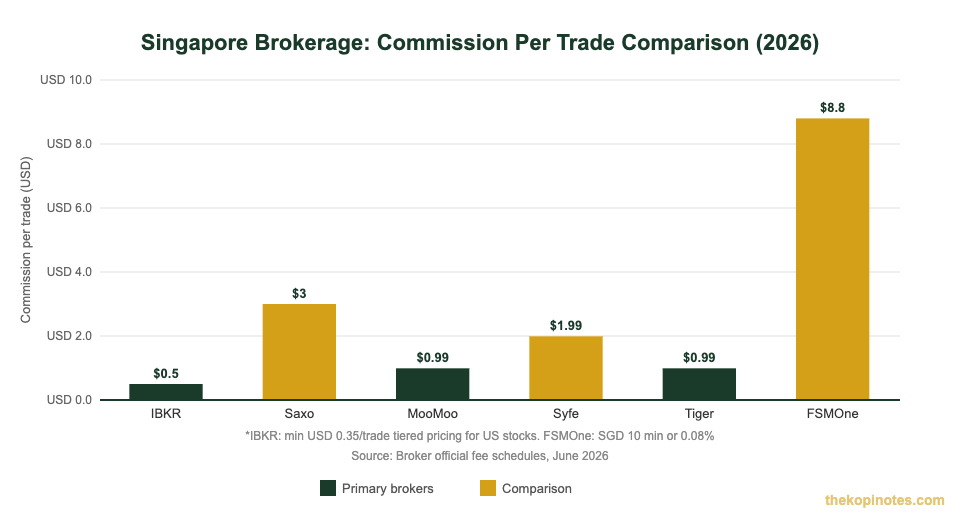
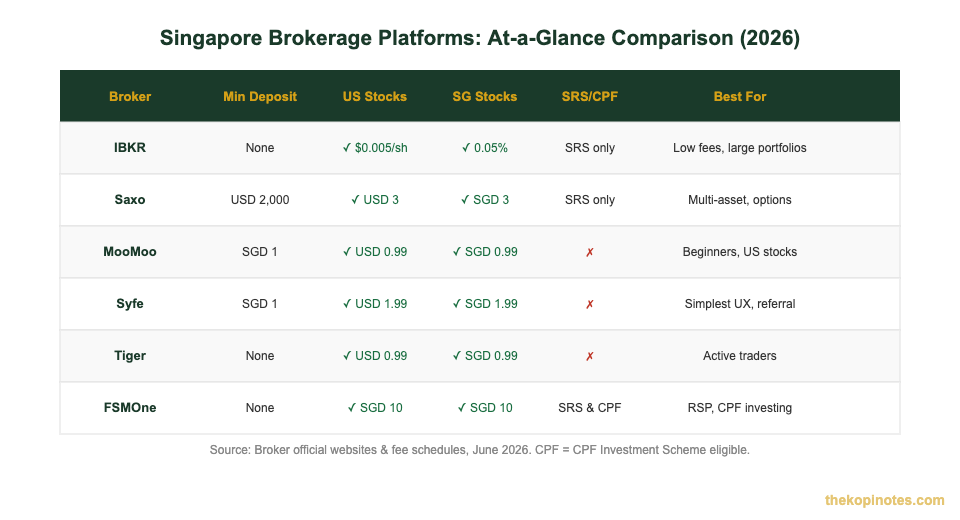
Here’s how the six most popular Singapore brokerages stack up across the metrics that matter most — commissions, minimum deposit, market access, and key features. All data is from each broker’s official fee schedule as at June 2026.
| Broker | US Stocks Commission | SG Stocks Commission | Min Deposit | CPF/SRS |
|---|---|---|---|---|
| IBKR | USD 0.005/share (min USD 1) | 0.05% (min USD 1.50) | None | SRS only |
| Saxo Markets | USD 3 min | SGD 3 min | USD 2,000 | SRS only |
| MooMoo SG | USD 0.99 flat | SGD 0.99 flat | SGD 1 | No |
| Syfe Trade | USD 1.99 flat | SGD 1.99 flat | SGD 1 | No |
| Tiger Brokers | USD 0.99 flat | SGD 0.99 flat | None | No |
| FSMOne | SGD 10 min or 0.08% | SGD 10 min or 0.08% | None | SRS & CPF OA |
Source: Broker official fee schedules, June 2026. IBKR tiered pricing shown. Flat commissions from MooMoo/Tiger are promotional rates — verify current rates before trading.
For most Singapore investors buying US stocks or LSE-listed ETFs, IBKR is the clear winner on cost for portfolios above SGD 10,000. A SGD 50,000 portfolio with 2 trades per month pays roughly SGD 3–5 per trade at IBKR, versus SGD 15–20 at FSMOne. Over 10 years, that difference compounds meaningfully.
Understanding Brokerage Fees
Brokerage fees in Singapore have several components. Understanding all of them helps you calculate the true cost of each trade — not just the headline commission.
Commission is the fee charged per trade. It’s either a flat rate (e.g. USD 0.99) or percentage-based (e.g. 0.08% of trade value). Flat rates favour smaller trades; percentage rates favour larger ones.
FX spread is what brokers charge when you convert SGD to USD or GBP to buy overseas stocks. IBKR’s FX conversion costs around 0.002% — one of the cheapest in the market. MooMoo and Tiger typically charge 0.1–0.3% on FX, which adds up if you trade frequently.
Platform / custody fees are monthly or quarterly charges for holding your investments. IBKR charges no custody fee if your account balance exceeds USD 100,000 or if you pay at least USD 10 in commissions per month. Saxo charges a custody fee of 0.12% per year on stock holdings above SGD 100,000. MooMoo and Tiger currently charge no custody fees for Singapore investors.
Clearing and settlement fees apply to SGX trades. The SGX charges a clearing fee of 0.0325% on the contract value. This fee is passed through by all brokers — it’s not a profit centre for them, just a cost of trading on the local exchange.
| Fee Type | What It Covers | Typical Range | Who Charges It |
|---|---|---|---|
| Commission | Per-trade execution fee | USD 0.99 – SGD 25+ | All brokers |
| FX Spread | Currency conversion cost | 0.002% – 0.3% | Most brokers |
| Custody / Platform Fee | Annual holding charge | 0% – 0.12% p.a. | Saxo, some others |
| SGX Clearing Fee | SGX settlement | 0.0325% of value | All (for SGX trades) |
Source: SGX, broker fee schedules, June 2026.
Here’s a worked example. You buy 100 shares of DBS Group (SGX: D05) at SGD 40 each — a SGD 4,000 trade.
At FSMOne: SGD 10 commission + SGD 1.30 SGX clearing = SGD 11.30 total cost (0.28%)
At MooMoo: SGD 0.99 commission + SGD 1.30 clearing = SGD 2.29 total (0.06%)
The difference is small on one trade. But if you make 24 trades a year over 10 years, you save roughly SGD 2,200 by choosing the cheaper broker. That’s money still invested and compounding for you.
How to Choose the Right Singapore Brokerage
The right brokerage depends on what you’re investing in, how often you trade, and how much you have to invest. Here’s how to think through it.
If you’re investing in US stocks or LSE-listed ETFs like CSPX or VWRA, prioritise low FX conversion costs and low per-trade commissions. IBKR wins here — its FX rates are the cheapest available to retail investors, and at USD 0.005 per share, commissions are negligible for most trade sizes. For moomoo Singapore users, the flat USD 0.99 commission is also very competitive for smaller trades.
If you’re investing in Singapore stocks and REITs, any of the digital brokers work well. MooMoo and Tiger charge SGD 0.99 flat — far cheaper than the 0.18–0.28% you’d pay at DBS Vickers or OCBC Securities. If you’re also doing a CPF investment strategy, FSMOne is your only viable option among digital brokers.
If you’re a complete beginner, Syfe Trade or MooMoo are easiest to start with. Both have zero minimum deposits (just SGD 1 to fund), clean mobile apps, and helpful onboarding. You can explore the Syfe referral code and sign-up bonus before opening an account — new users typically get cash credits or free trades. Or check the FSMOne referral code if you want to invest in regular savings plans (RSP) at the same time.
If you’re building a retirement portfolio, use our Singapore retirement calculator to work out your target corpus first. Then choose a broker based on whether you need CPF/SRS access and your expected trade frequency.
Here’s a simple decision framework:
| Your Situation | Best Singapore Brokerage |
|---|---|
| Portfolio > SGD 30k, US stocks / LSE ETFs | IBKR |
| Beginner, first brokerage account | MooMoo or Syfe Trade |
| Want to invest CPF OA in stocks/ETFs | FSMOne |
| Active trader, options, multi-asset | Saxo or IBKR |
| Regular savings plan (RSP) into ETFs | FSMOne or Syfe |
Source: TKN analysis based on publicly available fee schedules, June 2026.
CPF and SRS Investing Through a Brokerage
This is one area where Singapore’s brokerage landscape gets confusing. Not every broker accepts CPF or SRS funds, and the rules differ between the two schemes.
SRS (Supplementary Retirement Scheme) is accepted by IBKR, Saxo, MooMoo (via CPFIS-approved sub-account), and FSMOne. If you have SRS savings you want to invest in stocks or ETFs, most digital brokers support this — but you’ll need to link your SRS account during the application process.
CPF Investment Scheme (CPFIS) — specifically CPF Ordinary Account (OA) funds — can only be invested through CPFIS-approved agents. Among the platforms covered here, FSMOne is the most accessible digital broker that accepts CPF OA for equities. To use CPF OA money, you need to open a CPF Investment Account with a CPFIS agent and link it to your FSMOne account.
Important caveat: CPF OA currently earns a guaranteed 2.5% per year. For CPF investing to make sense, your investment portfolio needs to consistently beat 2.5% — which is achievable with broad market ETFs over the long run, but not guaranteed. Consider your passive income Singapore goals carefully before moving CPF funds into equities.
If you’re unsure whether to invest your CPF or leave it in the OA, read our detailed CPF investment strategy guide — it walks through the numbers and when it makes sense to invest versus leave funds in CPF.
How to Open a Brokerage Account in Singapore
Opening a brokerage account in Singapore is fully digital and typically takes 1–3 business days for approval. Here’s the general process.
Step 1: Choose your broker using the decision framework above. Have your SingPass ready — all MAS-licensed brokers use MyInfo to verify your identity, so you don’t need to scan documents manually.
Step 2: Complete the application. You’ll answer questions about your investment experience, risk tolerance, and income (required by MAS for suitability assessment). Answer honestly — there’s no “wrong” answer that bars you from investing, but providing inaccurate information is a compliance risk.
Step 3: Fund your account. Most digital brokers accept PayNow or bank transfer. IBKR also accepts international wire transfers if you’re funding in USD directly. Minimum funding varies: SGD 1 for MooMoo/Syfe, USD 2,000 for Saxo, none for IBKR/Tiger/FSMOne.
Step 4: Place your first order. Search for the stock or ETF ticker on the platform. Always verify you’re buying on the correct exchange — for example, CSPX trades on the London Stock Exchange (LSE), not the NYSE. Buying the wrong ticker (like the US-listed IVV instead of CSPX) is a common beginner mistake with significant tax consequences for Singapore investors.
If you want to invest in S-REITs alongside your brokerage account, see our guide to the Singapore REIT ETF guide for a structured approach to building an income portfolio.
Not financial advice. The choice of brokerage depends on your individual circumstances. All fee data as at June 2026 — verify with the broker before trading.
Frequently Asked Questions
What is the best Singapore brokerage for beginners in 2026?
MooMoo Singapore and Syfe Trade are the easiest starting points for beginners. Both require only SGD 1 to fund, offer clean mobile apps, and charge flat commissions of under USD 2 per US stock trade. MooMoo has slightly lower commissions (USD 0.99) while Syfe offers a smoother onboarding experience. If you also want to do a regular savings plan (RSP) into ETFs, FSMOne is worth considering — it lets you automate monthly investments from as little as SGD 50.
Which Singapore brokerage has the lowest fees?
Interactive Brokers (IBKR) has the lowest fees for most investors buying US stocks or LSE-listed ETFs. Its tiered pricing starts at USD 0.005 per share with a minimum of USD 1 per order — significantly cheaper than flat-fee brokers for larger trades. IBKR also has the cheapest FX conversion rates (around 0.002%), which matters if you’re converting SGD to USD or GBP frequently. For SGX stocks with smaller trade sizes, MooMoo and Tiger Brokers charge a flat SGD 0.99, which beats IBKR’s percentage-based SGX fee on trades under SGD 3,000.
Can I use CPF money to buy stocks through a Singapore brokerage?
Yes, but only through CPF Investment Scheme (CPFIS)-approved agents. Among the popular digital brokers, FSMOne is the most accessible option for using CPF Ordinary Account (OA) savings to invest in stocks and ETFs. You’ll need to open a CPF Investment Account with a CPFIS-approved agent (DBS, OCBC, or UOB) and link it to your FSMOne account. Note that CPF OA currently earns 2.5% guaranteed — your investments need to beat this consistently to make CPFIS worthwhile. SRS funds are more widely accepted and can be invested through IBKR, Saxo, and FSMOne.
Is my money safe in a Singapore brokerage?
Yes, provided you use an MAS-licensed broker. MAS requires brokers to hold client assets in segregated accounts — your stocks and cash are legally separate from the broker’s own funds and cannot be used to pay the broker’s debts if it becomes insolvent. Securities held in SGX’s Central Depository (CDP) are directly in your name. For international brokers like IBKR, assets are held in custody under Singapore’s Securities and Futures Act rules. Always verify a broker’s MAS licence at the MAS Financial Institutions Directory before depositing funds.
Do I need a CDP account to use a Singapore brokerage?
Not necessarily. For SGX-listed stocks, there are two models: a CDP-linked account (your stocks are held directly in your CDP account under your name) or a custodian account (the broker holds your stocks in their name on your behalf). Traditional brokers like DBS Vickers and Phillip Securities use CDP-linked accounts. Digital brokers like MooMoo, Syfe, and Tiger use custodian accounts — simpler to open, but your shareholding is not directly in CDP. IBKR uses a custodian model for most markets. Neither is unsafe, but CDP-linked accounts give you direct voting rights and easier corporate action processing.
Can I have accounts with multiple Singapore brokerages?
Yes, and many experienced investors do. A common setup is IBKR for US stocks and LSE ETFs (lowest cost), FSMOne for CPF OA investing or RSPs, and MooMoo or Tiger for Singapore stocks. There’s no MAS restriction on holding multiple brokerage accounts. The only things to track are the combined cost of maintaining each account (inactivity fees, custody fees) and your consolidated tax position — Singapore has no capital gains tax, but you’ll need to track dividends if you invest through SRS.
Ready to Open Your Singapore Brokerage Account?
Use our referral links for exclusive sign-up bonuses and cash credits when you open a new account.
This article was researched with the help of AI. While we strive to keep all information accurate and up to date, there may be errors. If you notice any discrepancies, please contact us.