Investing in Stocks Singapore: Complete Beginner’s Guide (2026)
A practical guide for Singapore investors — which stocks to buy, which brokers to use, and how to avoid common beginner mistakes.
Investing in stocks in Singapore means buying shares in companies listed on the Singapore Exchange (SGX) or international markets like the US NYSE and NASDAQ. You can start with as little as S$100 through platforms like moomoo, Tiger Brokers, or IBKR. Singapore investors pay zero capital gains tax and zero withholding tax on Singapore dividends — making it one of the most tax-friendly environments in the world for retail investors.
Not financial advice. All figures are for educational reference only. Data as at June 2026 unless noted.
- Singapore has zero capital gains tax — every dollar of profit from stocks is yours to keep.
- Start with a low-cost broker like moomoo or IBKR, fund S$500–S$1,000, and buy your first SGX blue chip or US ETF.
- If stock-picking feels overwhelming, a robo-advisor or regular savings plan (RSP) lets you invest automatically each month.
Table of Contents
Contents — Click to expand
- Why Invest in Stocks in Singapore?
- SGX Stocks vs US Stocks — Which Should You Buy?
- How to Start Investing in Stocks in Singapore
- Best Brokers for Investing in Stocks Singapore
- Stock Investing Strategies for Singapore Beginners
- Tax Rules for Singapore Stock Investors
- Common Mistakes to Avoid
- Frequently Asked Questions
Why Invest in Stocks in Singapore?
Singapore is genuinely one of the best places in the world to be a retail stock investor. Here’s why that matters for you.
First, zero capital gains tax. In Australia, you pay up to 50% on your stock profits. In the US, it can be 15–20% for long-term gains. In Singapore? You keep every cent of profit from selling stocks. That’s not a loophole — it’s deliberate government policy to encourage investment.
Second, zero withholding tax on Singapore dividends. When DBS pays you a dividend, 100% of it lands in your account. No deductions. For SGX-listed stocks, this makes dividends especially powerful for building passive income in Singapore.
Third, the SGX gives you access to some of Asia’s most stable, well-governed companies — banks like DBS, OCBC, and UOB; industrial REITs; infrastructure plays. These aren’t glamorous but they’ve delivered consistent dividends for decades.
That said, investing always carries risk. Stock prices go up and down. A company can cut its dividend. A sector can fall out of favour. The goal of this guide is to help you start investing in stocks Singapore with a clear head — not to promise you’ll get rich.
SGX Stocks vs US Stocks — Which Should You Buy?
This is the question every Singapore beginner wrestles with. The honest answer: both have a place in your portfolio, but they work differently.
SGX stocks are companies listed on the Singapore Exchange. You buy them in SGD, pay no FX conversion fees, and trade during Singapore hours (9am–5pm). The biggest names — DBS, Singtel, CapitaLand — are household names. Most pay dividends quarterly or semi-annually.
US stocks — listed on NYSE or NASDAQ — give you access to the world’s largest companies: Apple, Microsoft, Nvidia, Amazon. These tend to be higher growth but lower dividend yield. You’ll pay USD, which means FX conversion costs each time you buy or sell.
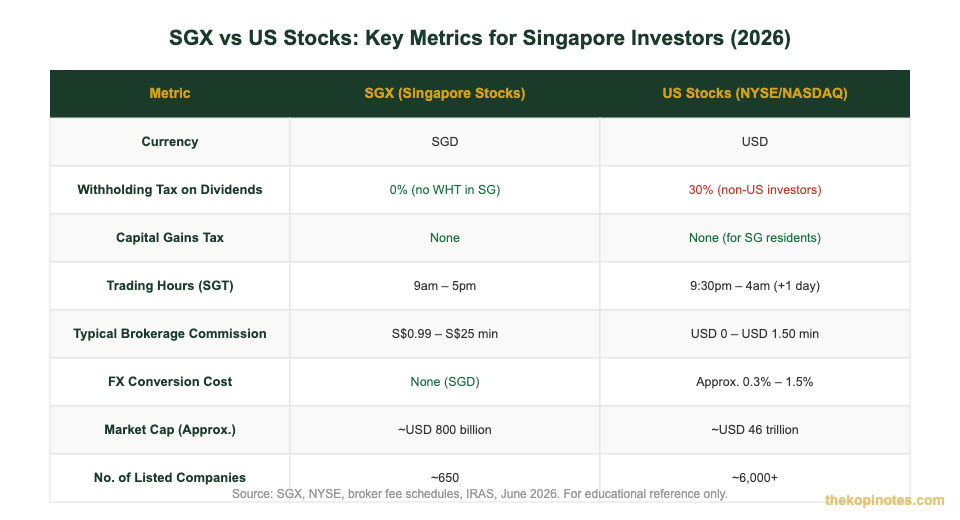
One critical difference: US dividend withholding tax. If you own US-listed stocks as a Singapore resident, the US government withholds 30% of every dividend before it reaches you. On a S$10,000 portfolio paying 2% dividends, that’s S$60 per year lost to US tax — not huge, but it compounds.
For most Singapore beginners, a sensible split is something like 60–70% in diversified global exposure (through ETFs or blue-chip US stocks) and 30–40% in SGX dividend stocks or REITs. Check out the Singapore REIT ETF guide for one approach to getting diversified exposure through a single fund.
| Factor | SGX Stocks | US Stocks |
|---|---|---|
| Currency | SGD (no FX cost) | USD (FX conversion applies) |
| Dividend WHT | 0% (none) | 30% withheld |
| Capital Gains Tax | None | None (for SG residents) |
| Trading Hours (SGT) | 9am – 5pm | 9:30pm – 4am (next day) |
| Typical Dividend Yield | 3–6% (blue chips, REITs) | 0.5–2% (growth-focused) |
Source: SGX, IRS, broker fee schedules, June 2026.
How to Start Investing in Stocks in Singapore
Starting is simpler than most people think. Here’s the step-by-step process every Singapore beginner should follow.
Step 1: Open a brokerage account. You need a brokerage account to buy stocks. For beginners, moomoo Singapore or Tiger Brokers are popular choices — low fees, user-friendly apps, and no minimum deposit. For larger portfolios (S$10,000+), Interactive Brokers (IBKR) offers the lowest commissions globally. If you want a fully managed option, consider Syfe’s referral code for a sign-up bonus when opening a Syfe Trade account.
Step 2: Fund your account. Most Singapore brokers accept PayNow or bank transfer. You can start with as little as S$100 on some platforms. For IBKR, the recommended starting amount is USD 1,000 to make the commission structure worthwhile.
Step 3: Research your first stock or ETF. For complete beginners, starting with an index ETF (like one that tracks the S&P 500 or the Straits Times Index) is lower risk than picking individual stocks. If you want individual stocks, focus on companies you understand — their business model, how they make money, whether they’re profitable.
Step 4: Place your first order. Log into your broker app. Search for the stock ticker. Select “Market Order” (buys at current price) or “Limit Order” (buys at a price you set). Enter the number of shares. Confirm. Done.
Step 5: Track and rebalance. Check your portfolio monthly, not daily. Daily price movements are noise. What matters is whether your companies are still growing their earnings and dividends over years. Use the Singapore retirement calculator to see how your stock portfolio grows over time.
Best Brokers for Investing in Stocks Singapore
Choosing the right broker is one of the most important decisions you’ll make as a new investor. The wrong broker costs you in commissions, FX spreads, and platform fees — all of which eat into your returns.
Here’s what to look for: low minimum commission per trade, competitive FX conversion rates, a clean mobile app, and access to both SGX and US markets.
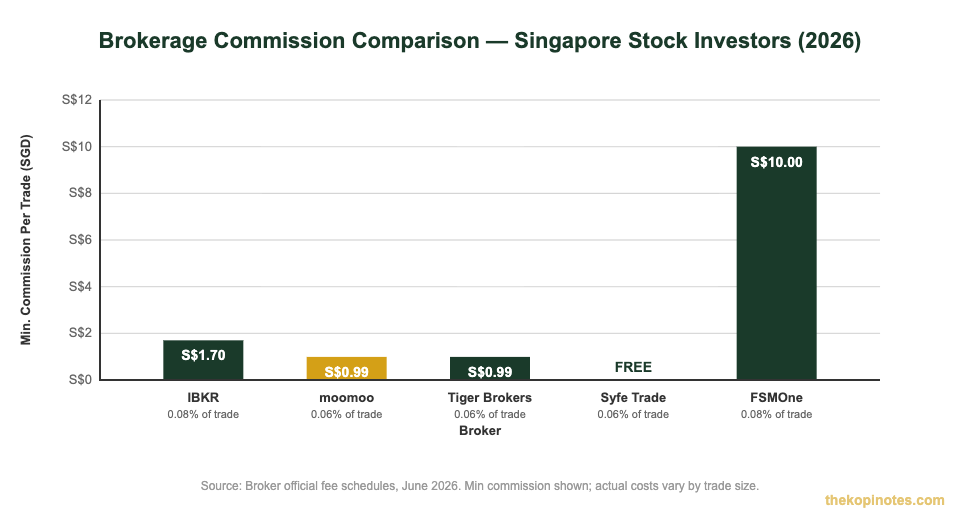
| Broker | Min. Commission (SGX) | Min. Commission (US) | Best For |
|---|---|---|---|
| IBKR | S$1.70 | USD 0.35 min | Large portfolios, US stocks |
| moomoo SG | S$0.99 | USD 0.99 min | Beginners, active traders |
| Tiger Brokers | S$0.99 | USD 0.99 min | SGX + US access, beginners |
| Syfe Trade | Free (first 3/month) | USD 0.99 | Beginners, small trades |
| FSMOne | S$10 min | USD 8.80 min | RSP investors, funds |
Source: Broker official fee pages, June 2026. Commissions exclude platform fees and GST where applicable.
For a deeper comparison of platforms, see our moomoo Singapore review and the Syfe vs Endowus 2026 comparison. If you plan to invest regularly, FSMOne’s referral code gets you a bonus when you sign up.
Stock Investing Strategies for Singapore Beginners
There’s no single “right” way to invest in stocks. But there are a few strategies that work well for Singapore investors — depending on your goals, time horizon, and how much attention you want to give your portfolio.
1. Dollar-Cost Averaging (DCA) — This is the beginner-friendly approach. Instead of trying to time the market, you invest a fixed amount every month regardless of price. If you put S$500 into a stock or ETF every month, you automatically buy more units when prices are low and fewer when prices are high. Over 10–20 years, this smooths out the bumps and removes emotion from investing.
Platforms like FSMOne and Syfe let you automate DCA through Regular Savings Plans (RSPs). Check out our guide on CPF investment strategy if you want to understand how to layer stocks on top of your CPF savings.
2. Dividend Investing — Singapore blue chips are famous for their dividends. DBS pays around 5–6% dividend yield. REITs often pay 5–8%. If your goal is passive income — money arriving in your account without you working for it — dividend stocks on SGX are a strong fit. The zero withholding tax on Singapore dividends makes this even more attractive compared to US dividend stocks.
See the best S-REITs in Singapore 2026 guide for names worth researching.
3. Growth Investing — This means buying companies growing their revenue and earnings faster than average — often US tech stocks like Nvidia, Microsoft, or smaller high-growth names. Growth stocks typically pay little or no dividend; all the return comes from share price appreciation. Higher potential returns, but also more volatility and higher risk. Not ideal for money you’ll need within 5 years.
4. Index Investing — Buy an ETF that tracks a broad market index (like the S&P 500 or MSCI World) and hold it forever. You get instant diversification across hundreds of companies, very low fees, and returns that match the overall market. Most actively managed funds underperform index funds over 10+ years. This is the Warren Buffett-recommended approach for most investors.
Tax Rules for Singapore Stock Investors
Singapore’s tax rules for stock investors are among the most favourable in the world. Here’s what you need to know.
Capital Gains Tax: Zero. Singapore does not tax profits from selling stocks. If you buy DBS at S$30 and sell at S$40, you keep the full S$10 per share gain. No tax return needed for capital gains.
Dividend Tax (Singapore stocks): Zero. SGX-listed companies pay dividends from after-tax profits. As an individual investor, you receive these dividends tax-free. This applies to banks, REITs, blue chips — all SGX stocks.
US Dividend Withholding Tax: 30%. This is the catch with US stocks. The US government withholds 30% of dividends paid to non-US investors before the money reaches your account. On a USD 10,000 US stock portfolio paying 2% dividends, that’s USD 60 per year withheld — paid to the IRS, not to you. The withholding is automatic; you can’t claim it back as a Singapore resident.
SRS (Supplementary Retirement Scheme): You can invest in stocks and ETFs using your SRS account. Contributions to SRS reduce your taxable income. SRS funds can be invested in SGX stocks and selected ETFs through brokers like FSMOne and DBS Vickers. Withdrawals after age 63 are taxed at 50% of the applicable income tax rate — a significant discount. Read our Singapore Savings Bonds guide for another SRS-compatible low-risk option.
CPF Investment Scheme (CPFIS): You can use CPF OA funds above S$20,000 (and SA funds above S$40,000) to invest in approved stocks and ETFs. However, many Singaporeans find that CPF OA’s guaranteed 2.5% return is hard to beat after transaction costs and risk. Tread carefully here — losses come out of your retirement savings.
Common Mistakes to Avoid When Investing in Stocks Singapore
Most beginner investors make the same mistakes. Knowing them in advance saves you thousands of dollars and years of frustration.
1. Trying to time the market. Nobody — not even professional fund managers — can consistently predict when markets will go up or down. Research shows that missing just the 10 best trading days per decade can cut your returns in half. Stay invested. Time in the market beats timing the market.
2. Putting all your money in one or two stocks. Concentration risk is real. If you put S$20,000 into a single company and it goes bankrupt (think Hyflux, Eagle Hospitality REIT), you lose everything. Spread across at least 10–15 stocks or use a diversified ETF.
3. Ignoring fees. A 1% annual fee on a S$100,000 portfolio costs you S$1,000 every year — and that compounds. Use a low-cost broker. Avoid unit trusts with upfront sales charges of 2–5%. Fees are the only guaranteed negative return in investing.
4. Investing money you need soon. Stock markets can drop 30–50% in a recession. If you need the money within 3 years, keep it in Singapore T-bills or fixed deposits instead. Stocks are for long-term money only.
5. Letting emotions drive decisions. Panic-selling during a market crash locks in your losses. Buying a “hot stock” because your colleague mentioned it is FOMO investing. Build a plan, stick to it, and review it quarterly — not daily.
Remember: investing in stocks carries risk, including the risk of losing your capital. Past performance does not guarantee future results. Speak to a licensed financial adviser if you need personalised advice.
Frequently Asked Questions
How do I start investing in stocks in Singapore as a beginner?
Open a brokerage account with a low-cost broker like moomoo, Tiger Brokers, or IBKR. Fund it with S$500–S$1,000. Start by buying one or two diversified ETFs (like a Straits Times Index ETF or an S&P 500 ETF) rather than individual stocks. Once you understand how the market works, you can gradually add individual stock positions.
Is investing in stocks in Singapore safe?
No investment in stocks is risk-free — prices go up and down, and you can lose money. However, Singapore has a well-regulated stock market overseen by MAS, and SGX-listed companies meet strict disclosure requirements. Diversifying across multiple stocks or using index ETFs reduces your risk significantly compared to concentrating in one or two names.
How much money do I need to start investing in stocks in Singapore?
You can technically start with as little as S$100 on platforms like moomoo or Tiger Brokers. In practice, S$500–S$1,000 is a more realistic starting amount — enough to buy a meaningful position in one or two stocks and not have commissions eat up a large percentage of your trade. For IBKR, starting with at least USD 1,000 makes the fee structure worthwhile.
Do I need to pay tax on stock profits in Singapore?
No. Singapore does not have capital gains tax, so profits from selling stocks are completely tax-free for individual investors. Dividends from SGX-listed stocks are also received tax-free in your hands, as companies pay dividends from after-tax profits. The main tax to watch is the 30% US withholding tax on dividends from US-listed stocks, which is automatically deducted before dividends reach your account.
What is the difference between investing in SGX stocks and US stocks?
SGX stocks are listed in Singapore, traded in SGD, and pay dividends with 0% withholding tax. US stocks (NYSE/NASDAQ) offer access to global giants like Apple and Microsoft, but dividends are subject to 30% US withholding tax, and you pay FX conversion costs to convert SGD to USD. SGX is better for dividend income; US markets offer broader growth opportunities.
Can I invest in stocks using my CPF or SRS in Singapore?
Yes to both, with conditions. CPF OA funds above S$20,000 can be invested in approved SGX stocks and ETFs through the CPF Investment Scheme (CPFIS). SRS funds can be invested in a broader range of stocks and ETFs through brokers like FSMOne and DBS Vickers. SRS investments grow in a tax-deferred environment, making them especially useful for higher-income earners looking to reduce their taxable income today.
Ready to Start Investing in Stocks?
Open a brokerage account today and buy your first stock. Use our referral links for exclusive sign-up bonuses.
This article was researched with the help of AI. While we strive to keep all information accurate and up to date, there may be errors. If you notice any discrepancies, please contact us.