How to Invest in Singapore When Your Pay Includes Stock Options or RSUs (2026)
What ESOP and RSU vesting actually costs you in tax, the deemed exercise trap if you leave Singapore, and how to avoid ending up with too much of your net worth in one stock.
Stock options and RSUs are taxed as employment income in Singapore, not capital gains — ESOP gains when you exercise, RSU and ESOW gains when they vest. You owe tax even if you haven’t sold a single share. If you leave your job or leave Singapore while options are still unexercised, IRAS’s deemed exercise rule can tax you anyway. Plan your tax bill and your diversification before you need to.
Not financial advice. All figures are for educational reference only. Data verified as at 16 August 2026.
- ESOP is taxed when you exercise; RSUs and ESOW are taxed when they vest — both as employment income, at your marginal tax rate, whether or not you sell.
- If you’re not a Singapore Citizen and you cease Singapore employment or leave Singapore while holding unexercised options, IRAS’s deemed exercise rule can tax you on gains you haven’t actually realised.
- Don’t let concentrated stock quietly become most of your net worth — set aside cash for the tax bill and diversify as shares vest, not years later.
Table of Contents
Contents — Click to expand
- Why Getting Paid in Stock Options or RSUs Changes Your Investing Plan
- ESOP vs RSU: What’s Actually Different
- When You Actually Owe Tax: Exercise Date vs Vesting Date
- The Deemed Exercise Rule: Leaving Your Job or Leaving Singapore
- A Worked Example: What a $40,000 RSU Vesting Actually Costs You
- The Hidden Risk: Too Much of Your Net Worth in One Stock
- What to Do When Your Options or RSUs Vest
- Frequently Asked Questions
Why Getting Paid in Stock Options or RSUs Changes Your Investing Plan
If you work at a tech company, a listed MNC, or a fast-growing startup in Singapore, part of your pay probably comes as equity — Employee Share Option Plans (ESOP) or Restricted Stock Units (RSUs), rather than cash alone. That changes how you should think about investing in three ways.
First, IRAS taxes ESOP and RSU gains as employment income, not as investment gains. That means real cash tax is due in the year you exercise or vest, even if you never sell a single share. Second, equity pay is lumpy and concentrated. Instead of choosing when and how much to invest, a chunk of your net worth is tied to one company’s share price on a schedule you don’t control. Third, if you’re a work pass holder or new Permanent Resident, leaving your job or leaving Singapore can trigger tax on shares you haven’t even received yet.
None of this is a reason to turn down equity pay. It’s a reason to treat vesting events as a deliberate investing decision, not something that just happens to you.
ESOP vs RSU: What’s Actually Different
An Employee Share Option Plan (ESOP) gives you the right, not the obligation, to buy a fixed number of shares at a preset “exercise price” after a vesting period. You only exercise if the market price is above your exercise price — otherwise the option is worthless and you simply let it lapse.
A Restricted Stock Unit (RSU) is a form of Employee Share Ownership (ESOW) plan. Instead of a right to buy, you’re promised actual shares once a vesting condition — usually time, sometimes performance — is met. Most RSU plans don’t require you to pay anything for the shares, so the entire value at vesting is your taxable gain.
According to IRAS’s official e-Tax Guide on the tax treatment of ESOP and ESOW plans, gains from stock options are taxed under Section 10(1)(b) of the Income Tax Act as employment income, based on where and when the option is exercised or the shares vest.
| Feature | ESOP (Stock Option) | RSU / ESOW |
|---|---|---|
| What you get | A right to buy shares at a fixed price | A promise of actual shares |
| Taxable event | Date you exercise the option | Date the shares vest |
| Taxable amount | Market value at exercise minus exercise price | Market value at vesting (usually the full amount) |
| If price falls before you act | You simply don’t exercise — no tax, no loss | You still owe tax on the vesting-date value, even if you sell lower later |
| Cash outlay to receive shares | Yes — you pay the exercise price | Usually none |
Source: IRAS e-Tax Guide, “Tax Treatment of ESOP and Other Forms of ESOW Plans” (iras.gov.sg, updated 30 Jan 2026), and IRAS “Gains from the exercise of stock options” page.
When You Actually Owe Tax: Exercise Date vs Vesting Date
Here’s the mistake that catches out a lot of first-time equity earners: assuming tax only applies once you cash out. It doesn’t. For ESOP, the taxable event is the date you exercise your option — when you actually buy the shares at your fixed price. For RSU and other ESOW plans, it’s the date the shares vest and become yours, regardless of whether you sell them that day, a year later, or never.
This creates a real “phantom tax” risk. If your RSUs vest when the stock is at $50 and you don’t sell, you still owe tax on that $50 value. If the stock later drops to $30 and you sell then, you’ve paid tax on a gain you never actually banked in cash — and Singapore has no mechanism to claim that loss back against other income, since it isn’t a capital loss in the tax sense either.
Your employer reports your ESOP and RSU gains to IRAS via Appendix 8B, which is due by 1 March of the year following the exercise or vesting. You must then declare this employment income yourself when you file your annual tax return.
| Step | Deadline |
|---|---|
| Employer reports your gain (Appendix 8B) | 1 March of the following year |
| You e-file your income tax return | 18 April of the following year |
| You paper-file your income tax return | 15 April of the following year |
The good news: Singapore doesn’t tax capital gains. Once you’ve paid income tax on the exercise or vesting-date value, any further gain when you eventually sell the shares generally isn’t taxed again — and any further loss generally isn’t deductible either, unless IRAS considers you to be in the business of trading shares.
The Deemed Exercise Rule: Leaving Your Job or Leaving Singapore
If you’re a work pass holder or a Permanent Resident and you hold unexercised ESOP or unvested ESOW granted for your Singapore employment, there’s a rule you need to know before you resign, get transferred overseas, or move away for good: the deemed exercise rule.
Under this rule, IRAS treats you as if you had exercised your options or received your shares on the date you cease Singapore employment or leave Singapore, even though nothing has actually been exercised, vested, or sold. The deemed gain is calculated as the open market price of the shares one month before your cessation date (or the grant date, if that’s later) minus your exercise price or the price you paid.
This can create a genuine cashflow problem: you may owe tax on shares you can’t yet sell, don’t legally own, or that later turn out to be worth far less. IRAS does allow you to apply for a reassessment of the deemed gain, but only within four years from the Year of Assessment following the year the deemed exercise rule was applied — so for a deemed gain taxed in YA2026, the deadline to apply for reassessment is 31 December 2030.
If you’re on a work pass or SPR and you’re weighing up an overseas transfer, a resignation, or emigrating with a meaningful amount of unvested equity still on the table, it’s worth speaking to a tax adviser before you make the move — not after you get the tax bill. For the separate question of US estate tax and withholding tax if your equity is in US-listed shares, see our guide to US stock tax rules for Singapore investors.
A Worked Example: What a $40,000 RSU Vesting Actually Costs You
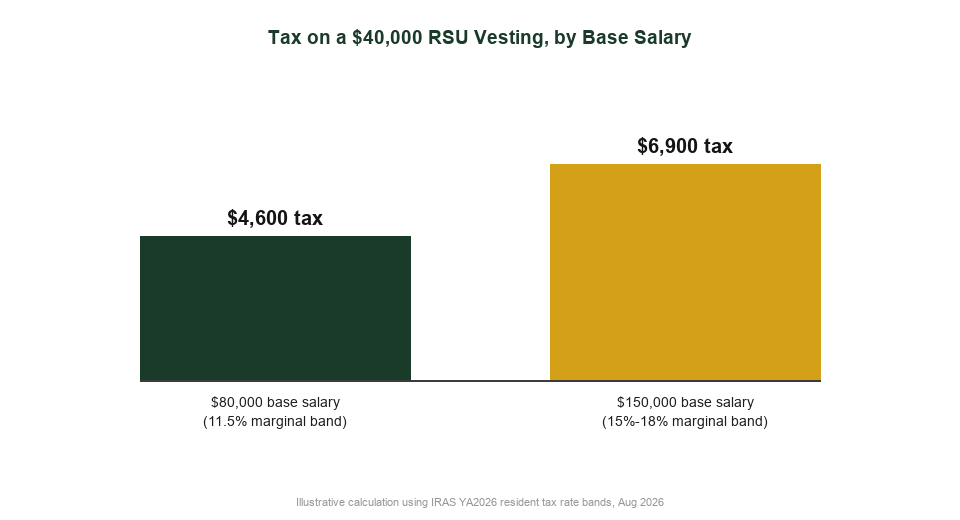
Say your RSUs vest and the shares are worth $40,000 on the vesting date. That $40,000 is added straight on top of your base salary as employment income, taxed at Singapore’s progressive resident rates for Year of Assessment 2026, which range from 0% on the first $20,000 to 24% on income above $1,000,000.
Because tax is progressive, the actual dollar cost of that $40,000 tranche depends on how much you already earn. Using IRAS’s official YA2026 rate bands, here’s the marginal tax on the same $40,000 vesting at two different base salaries.
| Base Salary | Chargeable Income After Vesting | Marginal Tax on the $40,000 Tranche |
|---|---|---|
| $80,000 | $120,000 | ~$4,600 (falls entirely in the 11.5% band) |
| $150,000 | $190,000 | ~$6,900 (spans the 15% and 18% bands) |
Illustrative calculation, ignoring reliefs, using IRAS’s official YA2026 resident tax rate table (iras.gov.sg, verified 16 Aug 2026). Actual tax depends on your full chargeable income and reliefs claimed.
Because no cash automatically gets withheld the way it might with a US employer, many Singapore-based employees are caught off guard when the tax bill lands the following year. The practical fix: whenever RSUs vest or you exercise ESOP, sell enough shares immediately to cover your estimated marginal tax rate, and park that amount somewhere safe — T-bills or a Singapore Savings Bond — until your tax bill is due.
The Hidden Risk: Too Much of Your Net Worth in One Stock
Equity pay is easy to accumulate and easy to ignore. Every vesting event adds a little more, and because it’s already “your” money sitting in a brokerage account, there’s no obvious moment that forces you to think about it — unlike a salary decision you actively make each year.
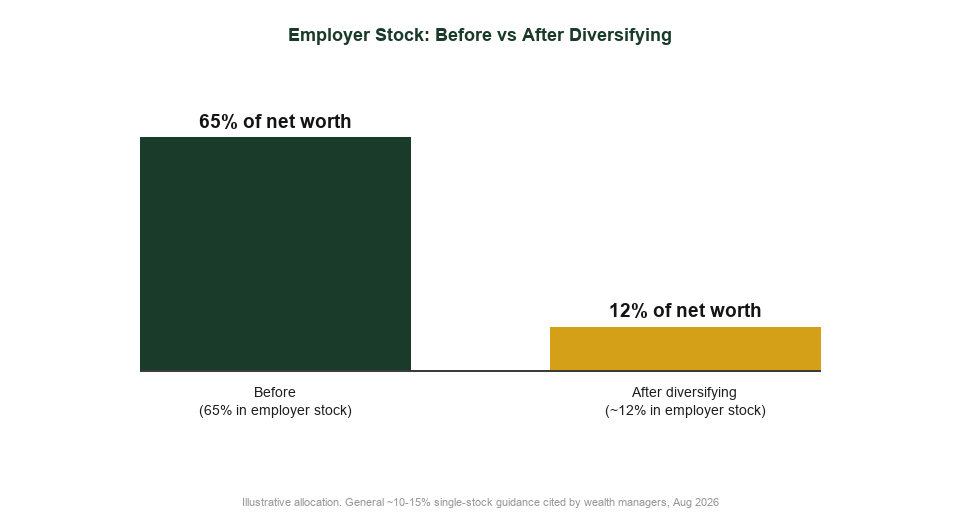
The problem is concentration risk. Your paycheck and your portfolio both depend on the same company. If your employer has a bad year, you could be dealing with a shrinking bonus, a hiring freeze, or a layoff at the exact same time your largest asset is falling in value. Diversified ETF investors don’t face that correlated double-hit.
There’s no single Singapore regulator threshold for this, but wealth managers commonly suggest capping any single stock — including your own employer’s — at roughly 10% to 15% of your total net worth. Above that, you’re making a concentrated bet you probably didn’t choose deliberately.
What to Do When Your Options or RSUs Vest
You don’t need a complicated strategy — you need a repeatable one. Here’s a practical sequence to run through every time shares vest or you exercise options.
1. Set aside cash for tax first. Sell enough shares immediately to cover your estimated marginal tax rate on the gain, and park it in something safe and short-term like T-bills or a Singapore Savings Bond until your tax bill is due the following year.
2. Diversify on a schedule, not out of loyalty. Selling your own company’s stock can feel disloyal or like you’re betting against yourself. It isn’t — it’s basic risk management. Consider selling a fixed percentage of every vesting tranche and reinvesting it elsewhere, rather than making an emotional decision each time.
3. Reinvest proceeds into a diversified portfolio. Globally diversified ETFs, top-ups to your CPF Ordinary or Special Account, or voluntary SRS contributions are all reasonable homes for the cash, depending on your goals and time horizon. If you’re unsure how hands-on you want to be with the reinvested proceeds, our guide on choosing between a DIY broker, a robo-advisor, or a financial adviser walks through the trade-offs.
4. Respect your company’s trading windows. Most listed companies restrict when employees can trade company shares to designated windows outside of blackout periods, to avoid insider trading issues. Check your employer’s policy before you sell.
5. Get advice before a big move. If you’re planning to resign, transfer overseas, or leave Singapore permanently while holding a meaningful amount of unvested equity, talk to a tax adviser first — the deemed exercise rule means timing can materially change your tax bill.
Once you’ve diversified, treat the proceeds like any other investable cash: fold it into your existing plan rather than treating it as separate “bonus money.” Our CPF investment strategy guide and retirement planning calculator are good starting points for folding equity-pay proceeds into your broader numbers. If you open a new brokerage or robo account to do it, our Syfe referral code and sign-up bonus page has the current offer.
Frequently Asked Questions
Are stock options and RSUs taxed the same way in Singapore?
No. ESOP gains are taxed in the year you exercise the option, based on the market value at exercise minus your exercise price. RSU and other ESOW gains are taxed in the year the shares vest, usually on the full market value, since most RSU plans don’t require you to pay anything for the shares.
Do I owe tax on RSUs if I haven't sold any shares yet?
Yes. IRAS taxes RSU gains as employment income on the vesting date, regardless of whether you sell immediately, hold the shares, or the price later falls. The tax bill is based on the market value when the shares vested, not what you eventually receive from a sale.
What is the deemed exercise rule and does it apply to me?
It’s an IRAS rule that treats you as having exercised unexercised ESOP or unvested ESOW on the date you cease Singapore employment or leave Singapore, even if nothing has actually vested or been exercised. It mainly affects non-Singapore-Citizen employees, such as work pass holders and Permanent Residents, who hold equity granted for their Singapore employment.
Is there capital gains tax when I later sell my vested shares?
Generally no. Singapore doesn’t have a capital gains tax, so once you’ve paid income tax on the exercise or vesting-date value, further gains when you sell typically aren’t taxed again — and further losses typically aren’t deductible either, unless IRAS considers you to be trading shares as a business.
How much of my portfolio should be in my employer's stock?
There’s no official Singapore regulatory limit, but wealth managers commonly suggest keeping any single stock — including your employer’s — to roughly 10% to 15% of your total net worth, to avoid your job and your portfolio taking a hit from the same bad news at the same time.
Can I use RSU or ESOP proceeds to top up my CPF or SRS?
Yes. Once you’ve sold shares and the cash is in your bank account, you can make voluntary CPF top-ups or SRS contributions like any other cash, subject to the usual annual SRS caps ($15,300 for citizens and PRs, $35,700 for foreigners) and CPF top-up limits.
Ready to Diversify Your Equity Pay Into a Real Portfolio?
Open a brokerage or robo-advisor account through our referral links, and use our retirement calculator to see how the numbers add up once your equity pay is diversified.
This article was researched with the help of AI. While we strive to keep all information accurate and up to date, there may be errors. If you notice any discrepancies, please contact us.