How to Invest in Singapore When Buying US Stocks: Estate Tax, Withholding Tax and the W-8BEN Form Explained (2026)
Two tax costs most Singapore investors never look up before buying US stocks — and how to reduce or avoid both.
Buying US stocks and ETFs from Singapore comes with two tax costs most investors never look up: a flat 30% withholding tax on every US dividend, and — for anyone holding more than roughly USD 60,000 in US-domiciled stocks — exposure to US estate tax at rates up to 40% on the excess. Singapore has no tax treaty with the US, so neither cost can be softened by treaty relief the way it can for UK or several European investors.
Not financial or tax advice. All figures are for educational reference only and are not a substitute for advice from a qualified cross-border tax professional or estate planner. Data verified as at 5 August 2026.
- Every US-domiciled stock or ETF dividend paid to a Singapore investor is withheld at a flat 30% — there is no US-Singapore tax treaty to reduce this.
- Hold more than roughly USD 60,000 in US-domiciled stocks or ETFs at death, and everything above that is exposed to US estate tax at rates up to 40% — a threshold that has not changed in decades.
- Every broker that gives you US market access (IBKR, moomoo, Tiger Brokers) requires a W-8BEN form; it is valid for about 3 years and many brokers auto-renew it for you.
- Ireland-domiciled UCITS ETFs like VWRA or CSPX cut the withholding tax to 15% and remove the US estate tax exposure entirely — the trade-off is a narrower selection of pre-built funds rather than individual stock picking.
Table of Contents
Contents — Click to expand
- Why Buying US Stocks From Singapore Isn’t Tax-Neutral
- US Dividend Withholding Tax: Why You Pay the Full 30%
- The W-8BEN Form: What It Is, and How Long It Lasts
- US Estate Tax: The USD 60,000 Threshold Few Investors Know
- The Fix: Ireland-Domiciled UCITS ETFs
- Direct US Stocks vs UCITS ETFs: Which Should You Use?
- What Singapore Investors Should Do
- Frequently Asked Questions
Why Buying US Stocks From Singapore Isn’t Tax-Neutral
It is remarkably easy for a Singapore investor to open a brokerage account and buy Apple, Tesla, or a US-listed S&P 500 ETF like VOO within minutes. IBKR, moomoo, and Tiger Brokers all offer instant onboarding, zero or near-zero commissions, and access to thousands of US-listed names. What none of them advertise loudly is that buying US stocks directly, as a non-US person, comes with two tax mechanics baked into the US tax code that most “how to invest in Singapore” guides skip entirely.
The first is a withholding tax on every dividend you receive — not a filing you do later, but money that never reaches your account in the first place. The second is a US estate tax exposure that only becomes relevant if you pass away while holding US-domiciled assets, which is exactly why it is so easy to overlook while you are alive and investing.
Singapore’s lack of a tax treaty with the United States makes both of these costs unusually blunt. Investors in the UK, for example, can use the US-UK estate tax treaty to claim the full US exemption amount instead of the USD 60,000 threshold non-treaty countries get. Singapore residents get no such relief on either front.
None of this means you should avoid US stocks — the US market remains the largest and most liquid in the world, and many Singapore investors reasonably want direct exposure to it. It means you should know the real after-tax cost and the estate tax mechanics before you decide how much to hold, and in what form.
US Dividend Withholding Tax: Why You Pay the Full 30%
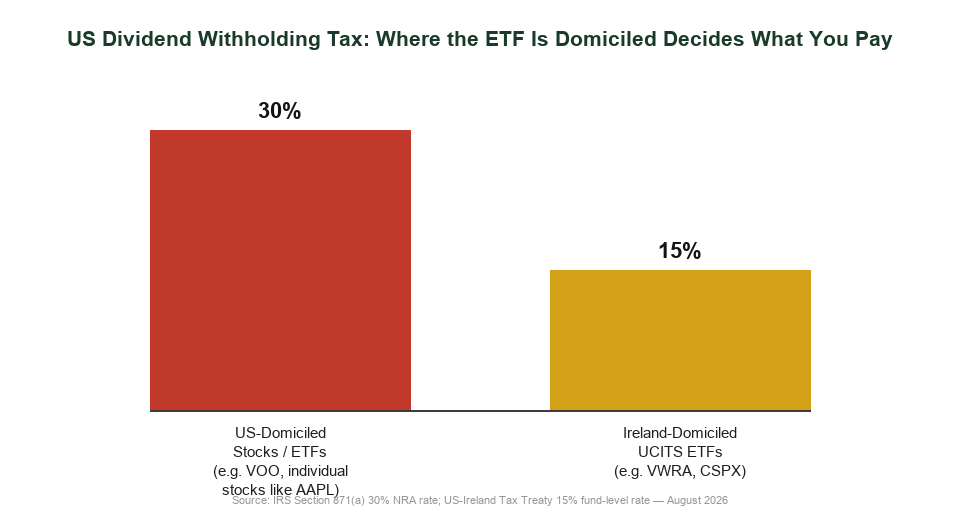
Under US Internal Revenue Code Section 871, any US-source dividend paid to a non-resident alien is subject to a 30% withholding tax by default. This is not something you pay later when filing taxes — your broker withholds it automatically before the dividend ever lands in your account.
That 30% rate can be reduced for investors whose home country has an income tax treaty with the United States that covers portfolio dividends — UK residents, for instance, typically pay only 15%. Singapore has never signed such a treaty with the US, so Singapore-resident investors buying US-domiciled stocks or ETFs directly are stuck at the full 30% rate, with no way to claim a reduction through their broker.
To put this in concrete terms: if you hold USD 50,000 of a US-domiciled dividend ETF yielding 2% a year, your gross dividend is USD 1,000. At 30% withholding, USD 300 disappears before you ever see it, leaving USD 700. That is a real, recurring drag on total return — not a one-off cost, and not something Singapore’s own tax system compensates for, since Singapore does not tax dividend income for individuals in the first place.
The W-8BEN Form: What It Is, and How Long It Lasts
Before any broker lets you trade US-listed securities, you will be asked to complete IRS Form W-8BEN — “Certificate of Foreign Status of Beneficial Owner for United States Tax Withholding and Reporting.” This form does exactly what its name suggests: it certifies to the IRS, through your broker, that you are not a US person, which is what allows the broker to apply the correct non-resident withholding rate rather than treat you as a US taxpayer.
The good news is that this step is largely painless in practice. IBKR, moomoo, and Tiger Brokers all generate and collect the W-8BEN electronically during account opening, and several auto-renew it on your behalf when it approaches expiry. Per IRS rules, a signed W-8BEN remains valid from its signing date through the end of the third following calendar year — for example, a form signed in 2026 stays valid through 31 December 2029, unless your personal circumstances change (such as a change of residency) before then.
You do not need to do anything with the W-8BEN to claim a lower withholding rate as a Singapore resident, because — as covered above — there is no lower treaty rate available to you. Its only function for a Singapore investor is confirming your non-US status so the standard 30% rate applies correctly, rather than the far more punitive backup withholding rate that applies to unverified accounts.
US Estate Tax: The USD 60,000 Threshold Few Investors Know
This is the part of buying US stocks that surprises the most Singapore investors, because it has nothing to do with income tax and everything to do with what happens to your portfolio if you die while holding it.
Under US estate tax rules, a “non-resident alien” — which includes almost every Singapore citizen or PR who is not also a US citizen or green card holder — gets a unified credit that shields only USD 60,000 of US-situs assets from US estate tax. This is dramatically smaller than the USD 15 million-plus exemption available to US citizens and domiciliaries in 2026, and unlike that figure, the USD 60,000 threshold is not adjusted for inflation and has stayed fixed for decades.
“US-situs assets” includes US real estate and, critically for investors, stock issued by US corporations — this covers individual US stocks like Apple or Tesla, and US-domiciled ETFs like VOO or SPY, regardless of which Singapore or international broker you use to hold them, and regardless of the fact that you have never set foot in the US.
Above that USD 60,000 threshold, the taxable amount is taxed under a graduated federal schedule that starts at 18% and climbs to a top rate of 40% on amounts over USD 1 million, filed by your estate’s executor on IRS Form 706-NA within nine months of death. This is a real administrative and financial burden placed on your family at an already difficult time — not a hypothetical.
A Worked Example
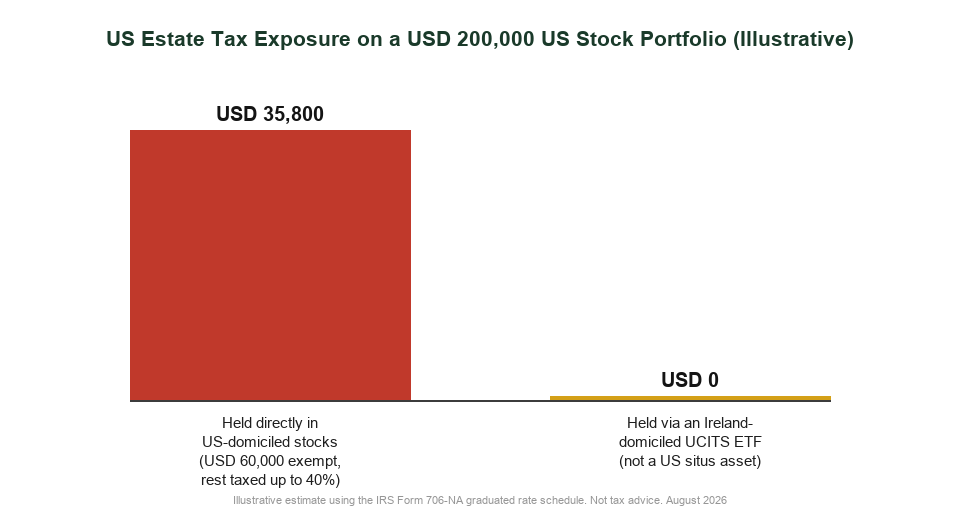
Say a Singapore investor holds USD 200,000 in US-domiciled stocks and ETFs directly through a brokerage account, and passes away holding that position. The first USD 60,000 is exempt under the non-resident alien unified credit. The remaining USD 140,000 is taxable.
| Item | Amount |
|---|---|
| US-domiciled stock/ETF portfolio | USD 200,000 |
| Non-resident alien exemption (unified credit) | − USD 60,000 |
| Taxable amount | USD 140,000 |
| Estimated federal estate tax (Form 706-NA graduated schedule) | ≈ USD 35,800 |
Illustrative calculation using the published IRS Form 706-NA graduated rate schedule (18%-40%). Excludes potential deductions, state-level considerations, and professional planning strategies. Not tax advice — consult a qualified cross-border estate planner for your actual situation.
Nearly USD 36,000 — roughly 18% of the entire portfolio — could be owed to the US government before the estate is settled, purely because the assets happened to be shares of US-incorporated companies. This is on top of, and separate from, Singapore’s own (currently nil) estate duty regime.
The Fix: Ireland-Domiciled UCITS ETFs
Both problems above share a single root cause: the ETF or stock is domiciled in the United States. Change the domicile, and both costs largely disappear.
Ireland-domiciled UCITS ETFs — funds like Vanguard’s VWRA (FTSE All-World) or iShares’ CSPX (S&P 500), both listed on the London Stock Exchange — hold the same underlying US companies but are structured as Irish funds. Two things follow from that structural difference:
1. Lower withholding tax. Ireland has a tax treaty with the United States that reduces the withholding tax on dividends the fund receives from US companies to 15%, versus the 30% a Singapore investor would pay holding those same companies directly. This saving happens silently inside the fund’s net asset value — you do not need to file anything to receive it.
2. No US estate tax exposure. Because the fund itself is an Irish legal entity, shares in it are not classified as US-situs assets for US estate tax purposes — even though the fund’s underlying holdings are almost entirely US companies. This means an Irish-domiciled UCITS ETF holding is not subject to the USD 60,000 threshold or the graduated US estate tax schedule described above, no matter how large the position grows.
This is precisely why our VWRA ETF Singapore guide consistently favours LSE-listed, Ireland-domiciled global ETFs over their US-listed equivalents for Singapore-based long-term investors — the tax structure, not just the index tracked, is a genuine differentiator.
Direct US Stocks vs UCITS ETFs: Which Should You Use?
Neither option is universally “correct” — they suit different goals. Here’s how they compare on the factors that matter most.
| Factor | Direct US-Domiciled Stocks/ETFs | Ireland-Domiciled UCITS ETFs |
|---|---|---|
| Dividend withholding tax | 30% | 15% (fund-level) |
| US estate tax exposure | Yes, above USD 60,000 | None |
| Individual stock picking | Yes — any US-listed name | No — pre-built fund only |
| Listing venue | NYSE / Nasdaq (USD) | LSE (USD), some SGX-listed options |
| Broker access | IBKR, moomoo, Tiger Brokers, Syfe Trade | IBKR, Saxo, moomoo (LSE access) |
| Best suited for | Investors who want to pick specific companies and accept the tax trade-off | Long-term, diversified holders who want to minimise tax drag and estate risk |
Source: IRS Section 871(a), IRS Form 706-NA instructions, US-Ireland tax treaty. Data as at August 2026.
Many Singapore investors run a hybrid approach in practice: a core global equity position in an Ireland-domiciled UCITS ETF like VWRA for the bulk of long-term wealth, plus a smaller, deliberately-sized “satellite” allocation to individual US stocks through a broker like IBKR for names they specifically want to hold. Keeping that satellite portion comfortably under the USD 60,000 estate tax threshold is a simple way to enjoy direct stock ownership without meaningful estate tax exposure.
What Singapore Investors Should Do: A 4-Step Action Plan
Step 1: Add up your US-domiciled exposure across every account. Check your IBKR, moomoo, Tiger Brokers, and any Syfe or Endowus self-managed portfolios for individual US stocks and US-listed ETFs like VOO, SPY, or QQQ. This is the figure that matters for the USD 60,000 estate tax threshold — not your total net worth, and not your CPF or SRS balances, which are entirely unaffected by US estate tax.
Step 2: Decide how much direct US exposure you actually want. If your US-domiciled holdings are comfortably below USD 60,000 and likely to stay there, the estate tax risk is limited, though the 30% dividend withholding tax still applies every year regardless of position size.
Step 3: Shift core, long-term holdings into Ireland-domiciled UCITS ETFs. For the bulk of a buy-and-hold global equity allocation, VWRA or CSPX on the LSE typically make more sense than their US-listed counterparts once you weigh the 15-percentage-point withholding tax saving and the removal of estate tax exposure against the narrower fund selection. Read our VWRA ETF Singapore guide for the step-by-step buying process.
Step 4: If you still want direct US stock exposure, keep it deliberately sized and get proper advice. For larger direct US holdings, a qualified cross-border estate planner can advise on structures such as holding through a non-US trust or company, or restructuring exposure through UCITS ETFs — options that go well beyond the scope of this guide but are worth exploring once your US-domiciled position grows meaningfully past USD 60,000.
If you are still deciding how to structure your overall portfolio across CPF, SRS, and cash before allocating anything to US or global equities, our guide on the right order for CPF, SRS, and cash investing is a useful starting point, and our risk profile framework can help you size any equity allocation, US or otherwise, appropriately.
Not financial or tax advice. US tax rules for non-resident aliens are complex and depend on your full circumstances — always confirm your position with a qualified cross-border tax professional or estate planner before making decisions based on portfolio size. Data verified as at 5 August 2026.
Frequently Asked Questions
Do Singapore investors pay tax on US stock dividends?
Yes, indirectly. Singapore itself does not tax dividend income for individuals, but the United States withholds 30% at source on dividends paid by US-domiciled stocks and ETFs to non-resident aliens, including Singapore investors, before the money ever reaches your account. Singapore has no tax treaty with the US to reduce this rate.
What is the US estate tax exemption for Singapore investors?
Non-resident aliens, including Singapore citizens and PRs without US citizenship or a green card, get a unified credit that shields only USD 60,000 of US-situs assets — including US-domiciled stocks and ETFs — from US estate tax. Amounts above that are taxed at graduated rates up to 40%. This is separate from, and much smaller than, the multi-million-dollar exemption available to US persons.
Do I need to fill out a W-8BEN form to buy US stocks from Singapore?
Yes. Every broker offering US market access — including IBKR, moomoo, and Tiger Brokers — requires a completed W-8BEN form before you can trade US-listed securities. It confirms your non-US status for withholding tax purposes and is valid through the end of the third calendar year after signing, after which it needs to be renewed (often automatically by your broker).
Does VWRA or CSPX have the same US estate tax problem as US stocks?
No. VWRA and CSPX are Ireland-domiciled UCITS ETFs. Even though both funds hold mostly US companies, shares in the fund itself are treated as Irish, not US, assets for US estate tax purposes — so they are not subject to the USD 60,000 threshold or the graduated US estate tax rates that apply to direct US stock and US-domiciled ETF holdings.
Is CPF or SRS money affected by US estate tax?
No. CPF and SRS accounts are Singapore-domiciled and entirely outside the scope of US estate tax, regardless of size. US estate tax only applies to US-situs assets, such as directly-held US stocks, US-domiciled ETFs, and US real estate — it does not extend to CPF, SRS, SGX-listed shares, or Ireland-domiciled UCITS ETFs.
Can I avoid the 30% withholding tax on US dividends entirely?
Not on directly-held US-domiciled stocks or ETFs — as a Singapore resident with no US tax treaty, 30% is the rate that applies, with no reduction available. The practical way to lower this cost is switching to Ireland-domiciled UCITS ETFs like VWRA or CSPX, which benefit from the US-Ireland tax treaty and pay a reduced 15% withholding rate at the fund level instead.
Ready to Build a Tax-Aware Global Portfolio?
Whether you want direct US stock access or a tax-efficient Ireland-domiciled ETF core, open your account through our referral links for sign-up bonuses.
This article was researched with the help of AI. While we strive to keep all information accurate and up to date, there may be errors. If you notice any discrepancies, please contact us.