How to Invest in Singapore During a Rate Hike Cycle: 2026 Strategy Guide
With the Fed raising rates for the first time in three years, your investment strategy needs a rethink. Here is exactly what to do.
The US Federal Reserve raised its benchmark rate to 3.75%–4.00% on 16 September 2026 — its first hike in three years. For Singapore investors, this changes the landscape significantly. Singapore 6-month T-bills now yield 1.70%, SSBs pay 2.25% over 10 years, and S-REITs have sold off 8.2% year-to-date. This guide tells you exactly how to adjust your portfolio for a higher-rate environment.
Not financial advice. All figures are for educational reference only. Data verified as at 22 September 2026 unless noted.
- Rate hikes are good for T-bills, SSBs, and Singapore bank stocks — allocate more here now.
- Rate hikes hurt S-REITs and growth stocks in the short term — do not panic-sell, but reduce exposure if you are overweight.
- Your CPF rates (OA 2.5%, SA 4%) are unchanged — keep maxing CPF and SRS for the tax break.
Table of Contents
Contents — Click to expand
- What Is a Rate Hike Cycle and Why Does It Matter?
- How Rising Rates Affect Your Singapore Investments
- Rate Hike Winners: T-Bills, SSBs, and Bank Stocks
- Rate Hike Headwinds: S-REITs and Growth Stocks
- CPF and SRS: Your Rate-Proof Foundation
- Your 2026 Rate Hike Investment Strategy
- Step-by-Step Action Plan
- Frequently Asked Questions
What Is a Rate Hike Cycle and Why Does It Matter?
A rate hike cycle is when a central bank — like the US Federal Reserve — raises its benchmark interest rate repeatedly over a period of months or years. It does this to cool inflation. Higher rates make borrowing more expensive, which slows spending and brings prices down.
You might ask: “Why should I care about what the US Fed does? I am in Singapore.” Here is the thing — Singapore’s financial markets are deeply connected to global interest rates. When US rates rise, several things happen in Singapore almost immediately:
- Singapore government securities (T-bills, SSBs) pay higher yields to remain competitive with US Treasuries.
- The Singapore Overnight Rate Average (SORA) trends higher, raising borrowing costs for companies, REITs, and homeowners.
- Global capital shifts toward safe assets like bonds and cash, putting pressure on equities.
In September 2026, the Fed raised its target range by 25 basis points to 3.75%–4.00%. It was the first hike since 2023, and markets have already priced in at least one more hike before year-end. Singapore T-bill yields jumped to a 2026 high of 1.70% right after the announcement.
This is the environment you are investing in. Knowing what it means for each asset class is the first step.
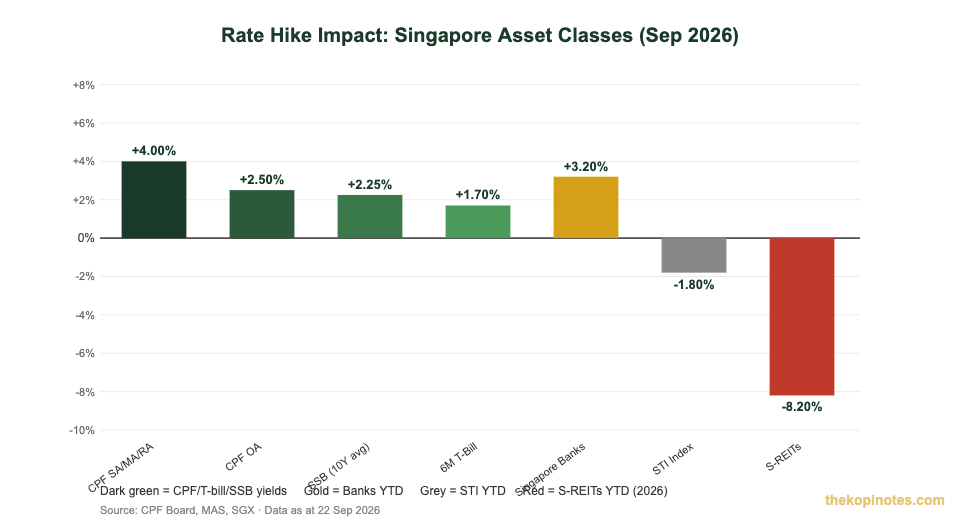
Source: CPF Board, MAS, SGX · Data as at 22 Sep 2026
How Rising Rates Affect Your Singapore Investments
Different assets react very differently to rising rates. Some benefit. Some suffer. Here is a clear breakdown:
| Asset | Impact | Current Yield / Return | Why |
|---|---|---|---|
| 6-Month T-Bill | ✓ Positive | 1.70% p.a. | Yield rises with global rates; no price risk held to maturity |
| SSB (10-year avg) | ✓ Positive | 2.25% avg | Stepped interest rises with rate environment; redeemable anytime |
| CPF OA | → Neutral | 2.50% p.a. | Government-guaranteed floor; unchanged by market rates |
| CPF SA / MA / RA | → Neutral | 4.00% p.a. | Floor confirmed until 31 Dec 2026; extra interest on first $60k |
| Singapore Banks (DBS/OCBC/UOB) | ✓ Positive | +3%–5% YTD | Higher rates expand net interest margin; ~S$275M extra NII per 25bps for DBS |
| S-REITs | ✗ Negative | −8.2% YTD | Higher debt costs squeeze distributions; investors rotate to bonds |
| Global ETFs (CSPX / VWRA) | → Mixed | Varies | Tech dragged by higher discount rates; banks and value partially offset |
Source: MAS, CPF Board, SGX, TKN analysis · Data as at 22 Sep 2026
Rate Hike Winners: T-Bills, SSBs, and Singapore Bank Stocks
Singapore T-Bills
Singapore T-bills — short-term government securities issued by MAS — are the most direct beneficiaries of rising rates. They are auctioned every two weeks (6-month) or monthly (1-year). After the September 2026 Fed hike, the 6-month cut-off yield jumped to 1.70% p.a.
That is higher than most savings accounts in Singapore right now. You can buy T-bills using cash, CPF OA funds, or SRS funds — making them one of the most versatile low-risk options available. For a step-by-step guide to buying T-bills, see our Singapore T-bills 2026 guide.
Singapore Savings Bonds (SSBs)
SSBs are the other big winner. The September 2026 issue pays an average of 2.25% per year over 10 years. Unlike T-bills, SSBs do not have a fixed maturity you must commit to — you can redeem any month without penalty. You can only buy up to S$200,000 of SSBs in total and S$10,000 per issue, applied through DBS, OCBC, or UOB internet banking. Read our full Singapore Savings Bonds guide.
Singapore Bank Stocks (DBS, OCBC, UOB)
Rising rates directly expand the net interest margin (NIM) of banks — the spread between what they pay depositors and what they charge borrowers. DBS management has estimated that a 25 basis point rate hike generates approximately S$275 million in additional net interest income annually for the bank alone.
Together, DBS, OCBC, and UOB make up roughly 40–54% of the Straits Times Index (STI). When bank stocks rise on a rate hike, the STI tends to outperform. If you hold a Singapore REIT ETF and want more rate hike upside, look at STI ETFs or direct bank stock exposure as a complement.
Rate Hike Headwinds: S-REITs and Growth Stocks
Why S-REITs Struggle During Rate Hikes
S-REITs borrow heavily to buy properties. When interest rates rise, two things happen. First, the cost of their existing and new debt goes up, squeezing distributions. Second, investors compare REITs against risk-free assets like T-bills — when T-bills yield 1.70%, a REIT yielding 5% does not look as attractive as when T-bills paid 1.00%.
S-REITs are down 8.2% year-to-date in 2026 as the market priced in the rate hike even before September’s announcement. Does that mean you should dump all your REITs? Not necessarily. REITs are long-term income assets. If you hold them through rate cycles, you collect distributions while prices recover. If you are overweight REITs relative to your target, this is a good time to rebalance. See our guide on passive income Singapore strategies for 2026 for a balanced approach.
Growth Stocks and Global ETFs (CSPX / VWRA)
Growth stocks — priced on future earnings — are sensitive to interest rates because a higher discount rate reduces the present value of future profits. This drives sell-offs in tech-heavy indices when rates rise.
For holders of CSPX (S&P 500 UCITS ETF) or VWRA (global all-world ETF), the impact is more muted. Both indices include a mix of value, financials, and tech. Banks and financials in the S&P 500 actually benefit from rate hikes, partially offsetting the drag from high-growth tech names. Do not exit CSPX or VWRA on a rate hike alone. Long-term investors should stay the course.
CPF and SRS: Your Rate-Proof Foundation
One thing the rate hike cycle does NOT change is the value of maxing your CPF and SRS contributions. These remain the most tax-efficient savings vehicles for Singaporeans.
CPF Ordinary Account (OA) earns 2.50% p.a. — guaranteed by the Singapore government, floor rate confirmed through 31 December 2026. The CPF Special Account (SA), Medisave Account (MA), and Retirement Account (RA) all earn 4.00% p.a. as a floor. The first S$60,000 in combined CPF accounts earns an additional 1% extra interest (first S$20,000 in OA earns yet another 1% extra on top).
For SRS, the contribution cap is S$15,300 per year for citizens and PRs, and S$35,700 for foreigners. Every dollar you put into SRS reduces your taxable income by that amount. You can invest SRS funds in T-bills, SSBs, unit trusts, and ETFs. For a complete strategy on account sequencing, read our guide on CPF investment strategy Singapore.
In a rising rate environment, CPF’s 4% SA rate becomes relatively less dominant as market rates catch up — but it remains risk-free and tax-advantaged, which no market instrument can match. Do not stop topping up CPF just because T-bills improved. They serve different purposes.
Your 2026 Rate Hike Investment Strategy
Here is a suggested portfolio framework for different risk profiles in a rate hike environment. Use our Singapore retirement calculator to work out your specific targets.
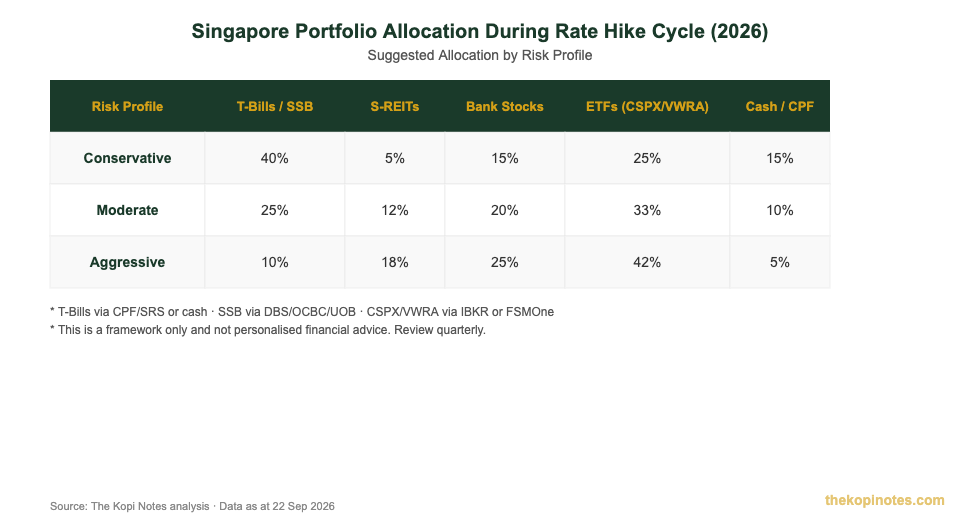
Source: TKN analysis · Not financial advice · Data as at 22 Sep 2026
Conservative Profile (under 5 years or low risk tolerance)
Lean heavily into T-bills and SSBs — 40% allocation gives you 1.70%–2.25% risk-free yield. Pair with 15% in bank stocks via the STI ETF for rate hike upside, and 25% in diversified global ETFs like CSPX or VWRA for long-term compounding.
Moderate Profile (5–15 year horizon)
Drop T-bill/SSB allocation to 25% and increase ETF exposure to 33%. Keep some S-REIT exposure (12%) for income, but choose REITs with low gearing and long debt maturities. Consider using a robo-advisor like Syfe (referral code SRPRFFFCD) for auto-rebalancing during volatile markets.
Aggressive Profile (15+ year horizon)
Long-horizon investors can treat the S-REIT sell-off as a selective buying opportunity. Prioritise REITs with fixed-rate debt and strong sponsors. Keep global ETF exposure high (42%) — equities have historically returned 8–10% annually over long periods, outpacing rate hike headwinds. Use FSMOne (referral code P0544985) for low-cost SRS investing in ETFs and unit trusts.
Step-by-Step Action Plan for Singapore Investors (September 2026)
Here is what to actually do this week:
| Step | Action | Platform |
|---|---|---|
| 1 | Apply for the next 6-month T-bill auction (24 Sep 2026) | DBS / OCBC / UOB iBanking · CDP linked account |
| 2 | Review S-REIT exposure — if above 20% of portfolio, trim to target weight | Your broker · SGX CDP |
| 3 | Apply for September 2026 SSB issue (closes 26 Sep) for 2.25% avg yield | DBS / OCBC / UOB iBanking · Max S$10k per issue |
| 4 | Top up SRS for the year if not yet done — S$15,300 cap (citizens/PRs) | DBS / OCBC / UOB SRS account |
| 5 | Continue regular ETF purchases (CSPX or VWRA) — do not stop DCA | IBKR (code jianxiong368) · FSMOne (code P0544985) |
| 6 | Review full portfolio against target allocation | TKN Retirement Calculator |
Source: TKN analysis · Not financial advice · Data as at 22 Sep 2026
For the complete framework on CPF, SRS, and cash sequencing — especially now that T-bill yields are rising — read our robo-advisor vs DIY comparison: robo-advisor vs DIY investing in Singapore.
Not financial advice. All data for educational purposes only. Data verified as at 22 September 2026. Review your portfolio with a licensed financial adviser before making changes.
Frequently Asked Questions
How to invest in Singapore during a rate hike cycle?
During a rate hike cycle, prioritise low-risk, higher-yield instruments like Singapore T-bills (1.70%) and SSBs (2.25% avg). Reduce overweight positions in S-REITs, which are sensitive to rising borrowing costs. Maintain regular ETF contributions (CSPX/VWRA) for long-term compounding. Keep topping up CPF and SRS for guaranteed returns and tax benefits. Data verified as at 22 September 2026.
Should I sell my S-REITs now that rates are rising?
Not necessarily. If you are a long-term investor, holding through rate cycles is usually the right call. S-REITs are down 8.2% year-to-date in 2026, but that may already price in the rate hikes. Trim only if you are overweight relative to your target allocation. Prioritise REITs with fixed-rate debt and strong sponsors. Never sell in panic during a rate-driven sell-off.
What is the current Singapore T-bill rate in September 2026?
The 6-month Singapore T-bill cut-off yield hit 1.70% p.a. at the September 10, 2026 auction — the highest 2026 level. The next auction is 24 September 2026. Apply through DBS, OCBC, or UOB internet banking using cash, CPF OA funds, or SRS funds. Verified against MAS auction results as at 22 Sep 2026.
Is CPF OA better than T-bills right now?
CPF OA earns 2.50% p.a. — higher than the 6-month T-bill’s 1.70%. However, CPF OA money is locked in CPF until withdrawal criteria are met, while T-bill proceeds return to your bank after 6 months. CPF OA remains attractive for its government guarantee and higher rate, but T-bills offer more liquidity. Both have their place in a well-structured portfolio.
Should I invest in Singapore bank stocks now?
Singapore bank stocks (DBS, OCBC, UOB) historically benefit from rate hike cycles due to expanding net interest margins. A 25bps hike generates roughly S$275M in additional annual NII for DBS alone. However, bank stocks may have already risen in anticipation — check valuations before buying. One option is buying the STI ETF (ES3) for ~40–54% bank exposure with blue-chip diversification.
How does the Fed rate hike affect my Singapore mortgage?
Singapore home loan rates are pegged to SORA or bank fixed rates. As SORA trends higher with the Fed, floating-rate mortgages will become more expensive. If you are on a floating rate package, compare fixed-rate packages from your bank now. A 25bps hike may add roughly S$60–100 per month to a S$500,000 floating rate mortgage. Speak to a licensed mortgage broker for personalised advice.
This article was researched with the help of AI. While we strive to keep all information accurate and up to date, there may be errors. If you notice any discrepancies, please contact us.