Whole Life Insurance Singapore Q4 2026: How the Rate Hike Changed the BTIR Debate
Table of Contents
Jump to a Section
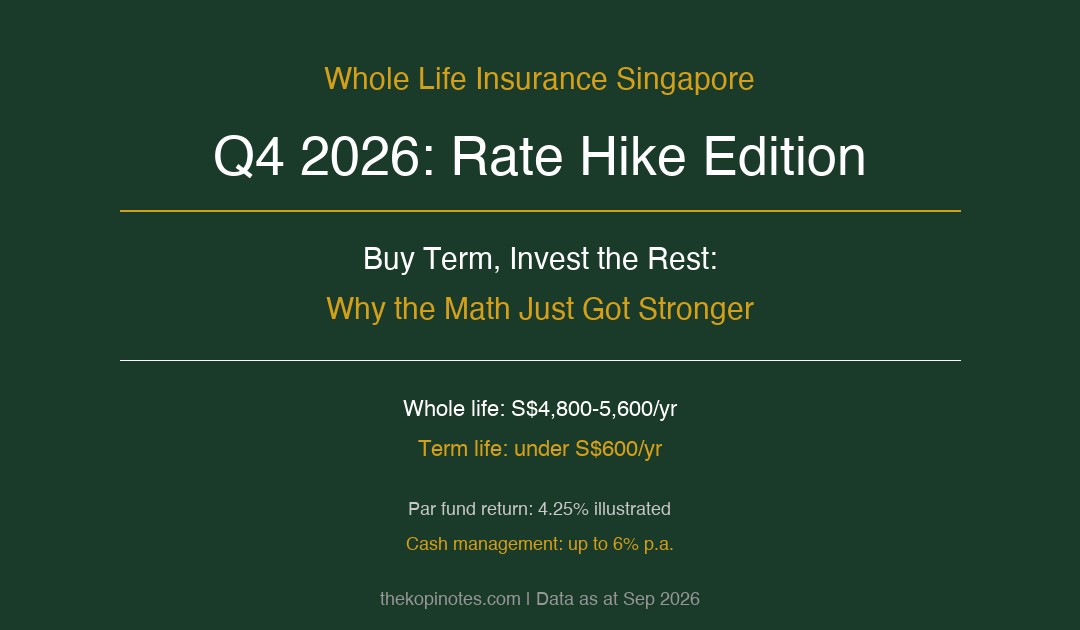
Whole life insurance in Singapore costs 6-7 times more per year than an equivalent term life policy. That premium gap has always been the centrepiece of the buy-term-invest-the-rest (BTIR) argument. After September 2026’s rate hike pushed cash management returns to 4.5-6% p.a., the opportunity cost of that gap just got bigger.
Not financial advice. All figures are for educational reference only. Data verified as at 22 September 2026.
- Whole life premiums run S$4,800-5,600/year for S$500,000 sum assured; term life costs under S$600/year for the same cover.
- The annual premium difference of roughly S$4,200-5,000 can now earn 4.5-6% p.a. in MAS-regulated cash management accounts.
- LIA-illustrated par fund returns are capped at 4.25% p.a. — below what risk-free cash management now offers.
- Whole life still makes sense for specific situations: estate planning, forced savings discipline, and uninsurables.
What Is Whole Life Insurance in Singapore?
Whole life insurance is a permanent life insurance policy that covers you for your entire life — not just a fixed term of 10, 20, or 30 years. Unlike term life, it does not expire as long as you pay the premiums. It also builds a cash value over time that you can borrow against or surrender the policy to receive.
In Singapore, almost every whole life policy sold is a participating (par) plan. This means a portion of your premium goes into the insurer’s participating fund, which is invested in a mix of bonds, equities, and properties. You then share in the profits through annual bonuses (reversionary bonuses) and a terminal bonus paid when you claim or surrender the policy.
The structure has two components:
- Guaranteed cash value: A minimum floor that accrues over time, regardless of investment performance.
- Non-guaranteed bonus: Additional value from the par fund’s investment returns, which depend on market conditions.
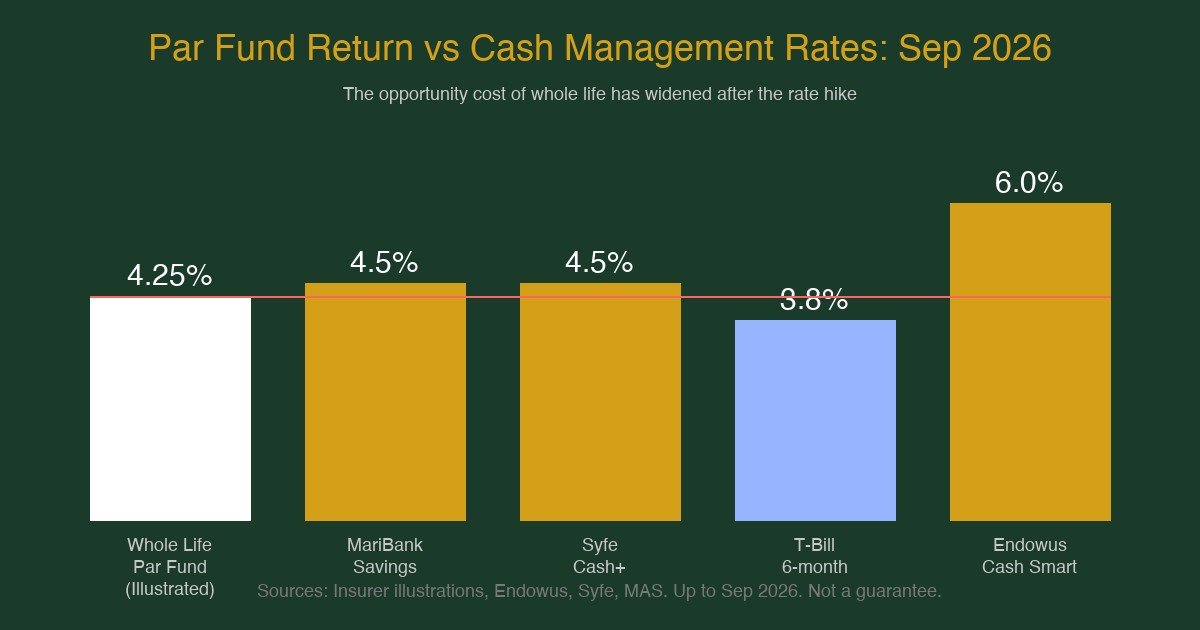
The total illustrated return (guaranteed plus non-guaranteed) is projected at 4.25% p.a. under LIA Singapore guidelines as of 2026. This is not a promise — it is a maximum illustration rate used by all insurers for par products.
For more context on how whole life fits the broader Singapore insurance picture, see the complete life insurance comparison guide and the life vs term insurance breakdown.
Current Premium Comparison: Whole Life vs Term Life
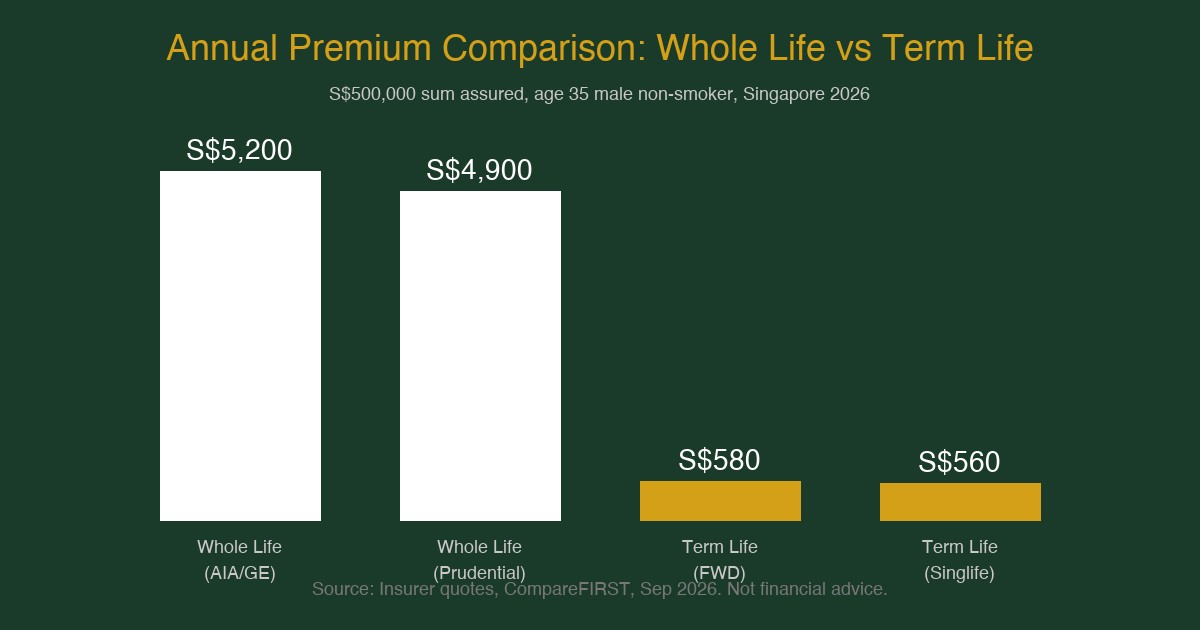
Here is what you actually pay for S$500,000 in life coverage in Singapore as of September 2026, for a 35-year-old male non-smoker in good health:
| Policy Type | Insurer | Annual Premium | Coverage Duration | Cash Value? |
|---|---|---|---|---|
| Whole Life (par) | AIA | S$5,200 | Whole of life | Yes |
| Whole Life (par) | Great Eastern | S$4,800 | Whole of life | Yes |
| Term Life (30yr) | FWD | S$580 | 30 years | No |
| Term Life (30yr) | Singlife | S$560 | 30 years | No |
Source: Insurer quotes via CompareFIRST, September 2026. Indicative only — actual premiums depend on health status, exact age and underwriting.
The annual premium gap between whole life and term life is roughly S$4,200 to S$4,640 per year. Over 30 years, that totals S$126,000 to S$139,200 in additional premiums for whole life — before considering what you could have earned by investing that gap.
How September 2026’s Rate Hike Changed the Equation
For years, critics of the BTIR strategy pointed to one weakness: the “invest the rest” part requires discipline and returns are not guaranteed. In a low-rate world, cash savings accounts barely paid 1-2% p.a., and the temptation to spend rather than invest was real.
September 2026’s Federal Reserve rate hike — combined with MAS’s continued accommodative tightening — changed that calculus. As of Q4 2026, Singapore retail investors can access MAS-regulated cash management accounts paying 4.5-6% p.a. with no lock-in:
| Platform | Product | Current Rate (up to) | Lock-in |
|---|---|---|---|
| Endowus | Cash Smart | Up to 6.0% p.a. | None |
| Syfe | Cash+ | Up to 4.5% p.a. | None |
| MariBank | Savings | Up to 4.5% p.a. | None |
Rates as at September 2026. Variable — rates change with market conditions. Not guaranteed.
The key insight: if even the conservative “invest the rest” option (a high-interest savings account, not an equity fund) now pays more than the illustrated par fund return of 4.25% p.a., the financial argument for whole life has weakened materially.
This does not mean whole life is always wrong. But it does mean the trade-off is now starkest in recent memory.
Par Fund Returns Explained: What 4.25% Actually Means
When your insurer illustrates whole life policy values, they use a projected return of 4.25% p.a. under LIA guidelines. This single number deserves unpacking.
First, the 4.25% is an illustration rate, not a guaranteed return. It represents the maximum rate Singapore insurers can use in product illustrations — not a prediction of what you will actually earn. Par fund returns in past years have ranged from 3.5% to 5.5%, depending on the insurer and market conditions.
Second, the 4.25% is the gross par fund investment return. What you as a policyholder actually receive is lower, after:
- The insurer’s management expenses and overheads
- Mortality and morbidity charges (the cost of the insurance protection itself)
- A share allocated to other policyholders in the fund
The net return credited to your policy — what shows up in your cash value projection — is typically 2-3.5% p.a. in the early years, growing as charges reduce relative to the cash value in later years.
Compare that directly to the current high-rate environment, and the trade-off becomes clearer:
The BTIR Math for Q4 2026: What the Numbers Actually Show
Let us run the numbers for a 35-year-old male non-smoker buying S$500,000 in life cover. We will compare whole life (Great Eastern, S$4,800/year) against term life plus investing the difference (Singlife, S$560/year).
Annual premium gap: S$4,800 – S$560 = S$4,240
Now consider three scenarios for “investing the rest” over 30 years, from conservative to moderate:
| Invest The Rest Scenario | Annual Return | Portfolio Value After 30 Years |
|---|---|---|
| Cash management only (e.g. Syfe Cash+) | 4.5% | S$290,000 |
| Endowus Cash Smart (current rate) | 6.0% | S$358,000 |
| Global index fund (CSPX/VWRA historical avg) | 7-8% | S$430,000-530,000 |
Illustrative projections using compound interest. Not guaranteed. Market returns are variable. Assumes steady annual investment of S$4,240 for 30 years.
For comparison, the projected whole life cash surrender value after 30 years of premiums (using the 4.25% illustrated rate) is typically in the range of S$250,000-320,000 for a S$500,000 sum assured policy — a figure you should confirm with the actual product illustration from your insurer before making any decision.
At the conservative cash management scenario alone, the BTIR approach at current rates produces a comparable or better financial outcome — while keeping your term life protection in force for the same period.
The important caveat: cash management rates will not stay at 4.5-6% forever. If rates fall, the “invest the rest” returns shrink accordingly. But for the foreseeable horizon of Q4 2026 onwards, the math favours BTIR more strongly than it has since pre-2020.
Use the TKN retirement calculator to model how different investment returns affect your financial position over time.
When Whole Life Insurance Still Makes Sense in Singapore 2026
The BTIR argument is compelling for many Singaporeans. But whole life insurance is not universally wrong — it serves specific needs that pure term life cannot meet:
1. You struggle with investment discipline
The biggest practical weakness of BTIR is behavioural: many people say they will invest the premium difference, but do not consistently do so. A whole life policy forces savings through premium payments. For those who lack the discipline to invest autonomously, the forced savings element has real value, even at a lower return than the market could provide.
2. Estate planning and legacy transfer
High-net-worth individuals in Singapore sometimes use whole life insurance held in trust (under Section 73 of the Conveyancing and Law of Property Act) as a tax-efficient, probate-free method of transferring assets to beneficiaries. The guaranteed payout, estate planning flexibility, and assignment capability make whole life a useful tool in more complex financial structures.
3. You are currently uninsurable or have health risks
If you have a pre-existing condition that makes standard term life unavailable or heavily loaded, converting a group policy’s conversion privilege to a whole life plan (without re-underwriting) may be the only path to permanent protection. Whole life’s guaranteed acceptance for conversions is a structural advantage here.
4. Coverage needs that outlast any term
If you have lifelong dependents — a child with special needs, for example — term life ends. Whole life provides permanent protection regardless of age, ensuring your dependent is covered even after term policies would have expired.
For everyone else — healthy, investment-disciplined, without complex estate needs — the Q4 2026 rate environment makes BTIR the stronger default. Get term life from a low-cost insurer, invest the premium difference in a globally diversified ETF or a high-yield cash account, and revisit annually.
The Q4 2026 Verdict
Whole life insurance is not a bad product — it is simply a different product than many Singapore buyers think they are getting. The cash value is real. The guaranteed protection is real. But the opportunity cost of the premium gap has risen materially in 2026.
In concrete terms:
- The illustrated par fund return (4.25% p.a.) is now below what you can earn in a regulated, no-lock-in cash management account.
- The annual premium gap (S$4,200-4,600) invested consistently over 30 years outperforms most whole life cash value illustrations under current rate conditions.
- Term life provides the same death and TPD protection — at a fraction of the cost — for most working Singapore families.
The BTIR strategy is not new. What is new in Q4 2026 is that even the most conservative version of it — simply putting the premium difference into a bank savings product or cash management fund — now matches or beats the whole life par fund illustration on a raw return basis.
Before making any decision, request the actual product illustration from your insurer or financial adviser, and read the full policy documents. The LIA’s CompareFIRST portal lets you compare par product illustrations side by side, free of charge.
Put the Premium Difference to Work
If BTIR is right for you, these MAS-regulated platforms let you invest the premium gap with no lock-in — and no sales commission:
Frequently Asked Questions: Whole Life Insurance Singapore 2026
Is whole life insurance worth it in Singapore in 2026?
What is the par fund return for whole life insurance in Singapore?
How much does whole life insurance cost in Singapore?
What is buy-term-invest-the-rest (BTIR) and does it work in Singapore?
Can I switch from whole life to term life insurance in Singapore?
Does whole life insurance have a cash value in Singapore?
Is whole life insurance tax-deductible in Singapore?
What happens to whole life insurance if the insurer fails?
Get Free Insurance Advice
Speak with a licensed insurance advisor. No obligation, no cost.
By submitting this form, you agree to our Privacy Policy.
This article was researched with the help of AI. While we strive to keep all information accurate and up to date, there may be errors. If you notice any discrepancies, please contact us.