ⓘ Data verified as at 6 September 2026. Premiums and product details change — confirm with your insurer before buying.
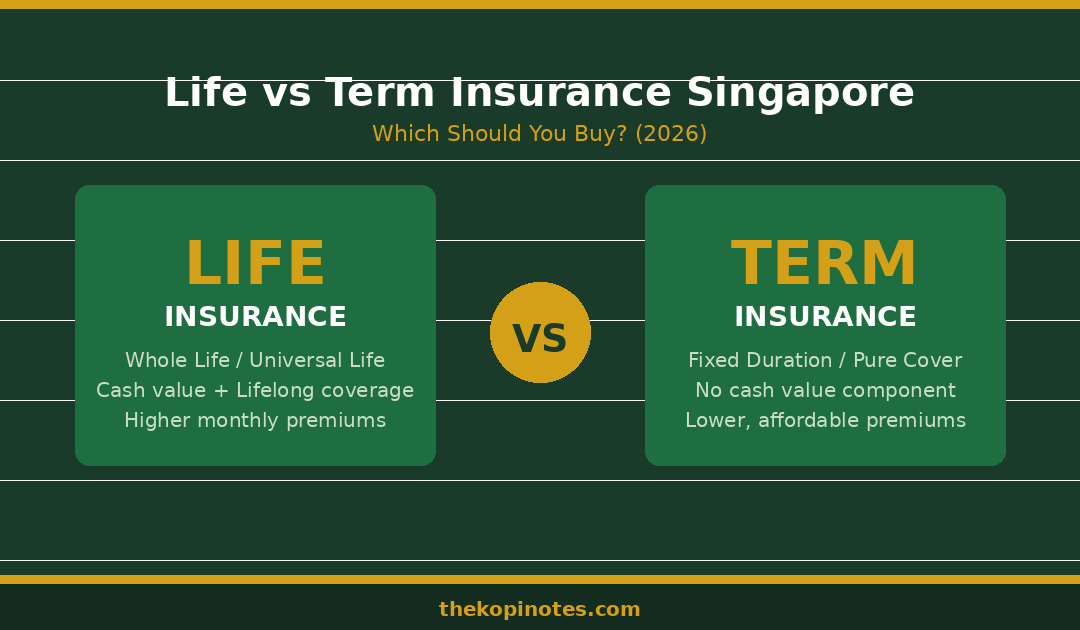
When people compare life vs term insurance, they are really asking one question: do you need coverage that builds cash value, or do you need the most protection for the lowest cost? The two products serve different needs, and the cheaper one is not automatically the better one.
Term insurance is a type of life insurance — the family name covers whole life, universal life, term life, critical illness, and disability income. The confusion arises because Singaporeans often use “life insurance” to mean whole life specifically, while “term” means pure-protection term life. That is the comparison this guide unpacks.
What Does “Life Insurance” Mean?
Life insurance is the broad category that covers any policy paying a benefit when you die, become totally and permanently disabled, or are diagnosed with a covered condition. In Singapore, MAS-regulated life insurance products include term life, whole life, universal life, critical illness plans, and disability income insurance.
When Singaporeans say “life insurance” in everyday conversation, they usually mean whole life — a policy that combines death coverage with a savings or investment component. The MAS Life Insurance Survey and the Life Insurance Association (LIA) Singapore use “life insurance” in the umbrella sense.
This guide focuses on the comparison that matters most for most buyers: term life vs whole life.
What Is Term Insurance?
Term insurance pays a death or total permanent disability (TPD) benefit if you die or become permanently disabled within the policy term. Once the term ends, the cover stops and you get nothing back.
You choose the coverage period when you buy. Common options in Singapore run to age 65, age 70, or age 99 (which functions like lifelong cover but at term pricing). Most policies offer coverage from 5 to 40 years, or to a specific age. See our guide on how to choose the right term length for a full breakdown.
Term insurance is pure protection. There is no cash value and no investment element. You pay for the cover and that is all you get. If you outlive the policy, your premiums are gone. That is not a bad thing — it is the same logic as car insurance.
Most Singapore insurers offer term life: AIA, Great Eastern, Prudential, FWD, Singlife, Manulife, Etiqa, and Tokio Marine, among others.
What Is Whole Life Insurance?
Whole life insurance covers you for your entire life — the death benefit pays whenever you die, as long as premiums are kept up. The premium is fixed and does not increase with age.
Most whole life plans in Singapore are participating policies. They accumulate a guaranteed cash value over time, plus non-guaranteed bonuses that depend on the insurer’s investment performance. You can surrender the policy for the cash value if you no longer want it, though surrendering early typically means getting back less than you paid in.
Premiums are usually payable for a limited period — 10, 15, or 20 years — or for life. Limited-pay whole life is popular: you finish paying by age 65 and remain covered for life.
Universal life is a variation that offers more flexibility in premium payment and sum assured, often used for estate planning rather than income protection.
Life vs Term Insurance: Key Differences
| Feature | Term Insurance | Whole Life Insurance |
|---|---|---|
| Coverage duration | Fixed period (e.g. to age 65 or 70) | Lifelong |
| Cash value | None | Yes (grows over time) |
| Premiums | Much lower | Significantly higher |
| Surrender value | None | Yes (after a few years) |
| Sum assured | Fixed at purchase | Fixed + potential bonuses |
| Best for | Income replacement during working years | Lifelong needs, estate planning |
| SRS/CPF-fundable | Some plans, check with insurer | Some plans, check with insurer |
Cost Comparison
For the same sum assured, term insurance costs a fraction of what whole life costs. A S$500,000 term plan to age 65 for a healthy 30-year-old non-smoking male typically costs far less per year than the equivalent face value in a whole life policy — the difference is often five to ten times.
The reason: term premiums cover only the mortality risk. Whole life premiums cover the same risk plus fund the cash value component.
Advocates of the buy term, invest the rest (BTIR) strategy argue that you get more protection for the same budget, and the remaining money invested in ETFs or a robo-advisor often outperforms the cash value growth in a whole life policy. Critics of BTIR note that the strategy requires genuine discipline to invest the savings, and that whole life offers a form of forced savings for those who otherwise would not invest.
Neither side is wrong. The better choice depends on your cash flow, discipline, and what you actually need the money to do. Use our life insurance comparison guide to see how different products stack up side by side.
Who Should Choose Term Insurance?
Term insurance fits most Singaporeans in their working years — especially if the priority is protecting dependants against the loss of income.
Choose term if you have a mortgage, a young family, or significant financial obligations that will shrink over time. The logic: your need for coverage is highest when your children are young and your debts are large. By the time the mortgage is paid and the kids are independent, the coverage need has fallen.
Term also makes sense if budget is tight. A S$500,000 death benefit for a 30-year-old costs very little per month. That leaves room in the budget for CPF top-ups, SRS contributions, and investments — all of which build retirement assets more transparently than a whole life policy’s non-guaranteed bonuses.
If you want riders for added protection, term plans can include critical illness riders and disability income cover at low additional cost.
To work out how much cover you need, see our guide on how much life insurance cover to buy.
Who Should Choose Whole Life?
Whole life is not a bad product. It is simply a different product, solving a different problem.
Choose whole life if you want coverage that does not expire. Someone with a lifelong dependant — such as a child with a disability — needs a policy that pays out regardless of when death occurs, not one that lapses at age 70.
Whole life also suits people who want a forced savings component built into their protection. The cash value grows slowly but it is there, and it is accessible through partial surrender or policy loans. For those who find it hard to invest consistently, a whole life policy provides a guaranteed savings floor that self-discipline-based investment strategies do not.
Estate planning is another use case. Some high-net-worth Singaporeans hold whole life or universal life policies specifically to transfer wealth to the next generation in a tax-efficient, CPF-nomination-independent way.
If cost is not the primary concern and you want lifelong certainty, whole life delivers something term cannot: the guarantee that your family receives a payout no matter when you die.
Can You Have Both?
Many Singaporeans hold both — a foundational whole life policy bought young when premiums were low, topped up with a larger term policy during the peak income and debt years.
The combination is sensible: whole life gives permanent base coverage, while the term layer provides the high sum assured needed during the mortgage and child-raising period. When the term expires, the whole life policy continues.
The trade-off is premium cost. Two policies cost more than one. Run the numbers against a pure-term plus investment approach before committing.
Frequently Asked Questions
Is term insurance the same as life insurance?
Which is better: term or whole life insurance?
Can I convert a term policy to whole life?
What happens when a term policy expires?
How much does life insurance cost in Singapore?
Is there a minimum or maximum sum assured?
Disclaimer: This article is for informational purposes only and does not constitute financial, insurance, or investment advice. Policy terms, premiums, and benefits vary by insurer and product. Consult a MAS-licensed financial adviser before purchasing any insurance product. The Kopi Notes is not affiliated with any insurer.
Get Free Insurance Advice
Speak with a licensed insurance advisor. No obligation, no cost.
By submitting this form, you agree to our Privacy Policy.
This article was researched with the help of AI. While we strive to keep all information accurate and up to date, there may be errors. If you notice any discrepancies, please contact us.