How to Invest in Singapore: The Q4 2026 Year-End Checklist
Seven action items every Singapore investor should complete before 31 December 2026 — SRS top-up, CPF cash top-up, portfolio rebalancing, and more.
For Singapore investors, Q4 is the most valuable quarter of the year — not because of market movements, but because of deadlines. Topping up your SRS account by 31 December 2026 saves tax immediately. A CPF cash top-up earns you 4.0% guaranteed on top of an $8,000–$16,000 tax deduction. Rebalancing your portfolio costs nothing in Singapore because there is no capital gains tax. Here are the seven things you should do before the year ends.
Not financial advice. All figures are for educational reference only. Data verified as at 9 September 2026.
- Top up your SRS account by 31 Dec 2026 — S’porean/PR cap is $15,300 and the tax deduction is immediate.
- Make a CPF cash top-up to your SA or RA by 31 Dec — you earn 4.0% p.a. and get up to $8,000 in tax relief.
- Rebalance your portfolio while it’s free — Singapore has zero capital gains tax, making year-end rebalancing cost-nothing.
Table of Contents
Contents — Click to expand
- Why Q4 Is the Action Quarter for Singapore Investors
- Checklist Item 1: Top Up Your SRS Account
- Checklist Item 2: Make a CPF Cash Top-Up
- Checklist Item 3: Rebalance Your Portfolio
- Checklist Item 4: Review Your Platform Fees
- Checklist Item 5: Check Your Emergency Fund
- Checklist Item 6: Review Your Passive Income
- Q4 2026 Checklist Summary
- Frequently Asked Questions
Why Q4 Is the Action Quarter for Singapore Investors
Most investors focus on picking the right stocks or ETFs. However, for Singaporeans, some of the highest-return “investments” you can make are not market plays at all — they are government-backed schemes with hard annual deadlines.
Both the Supplementary Retirement Scheme (SRS) and CPF cash top-ups reset on 31 December every year. Miss the deadline and you lose that year’s contribution room forever. You cannot carry it forward.
Here is the sequence that maximises your outcome for 2026:
- Top up SRS first (immediate tax deduction, flexible investment choices)
- Then CPF cash top-up to SA or RA (guaranteed 4.0% return + tax relief)
- Then rebalance your non-CPF/SRS portfolio
- Review fees and platform fit for 2027
The exact order matters because both the SRS and CPF top-up relief are subject to the same overall $80,000 personal income tax relief cap. If you are close to the cap, you need to decide which gives you more value. More on that below.
Checklist Item 1: Top Up Your SRS Account by 31 December 2026
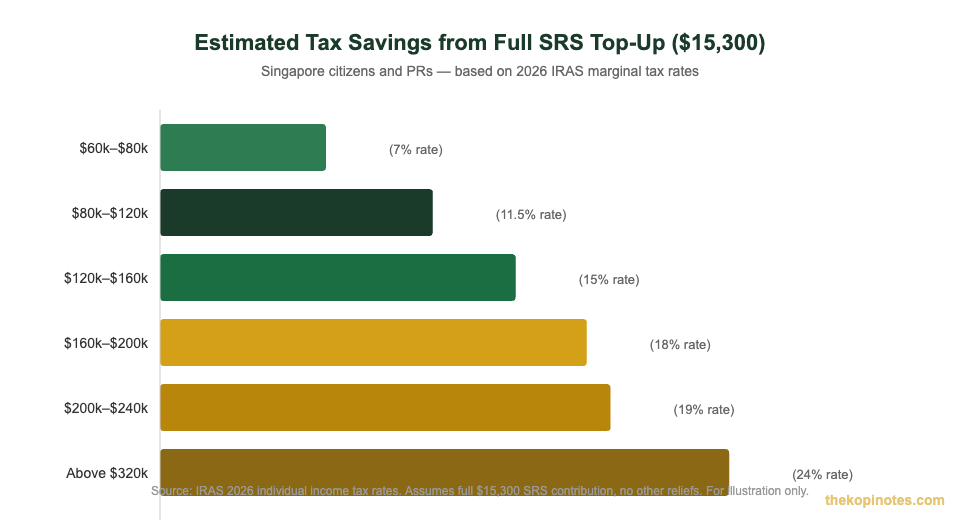
The SRS (Supplementary Retirement Scheme) is Singapore’s voluntary, tax-deferred retirement scheme. Every dollar you contribute reduces your taxable income for that year of assessment. That translates directly to income tax savings — the exact amount depends on your marginal tax rate.
For example, if you earn $120,000 a year and top up the full $15,300, you save approximately $2,295 in income tax (based on a 15% marginal rate for income between $80,001 and $120,000). That is an immediate 15% guaranteed return before your SRS money is even invested.
| Investor Type | Annual SRS Cap | Tax Relief |
|---|---|---|
| Singapore Citizen / PR | $15,300 | Up to $15,300 off taxable income |
| Foreigner (EP/SP holder) | $35,700 | Up to $35,700 off taxable income |
Source: IRAS SRS Contributions page; contribution limits unchanged for 2026.
Once your SRS is topped up, you have flexibility in how you invest it. You can invest your SRS money in ETFs, Singapore equities, unit trusts, or robo-advisors. Endowus and Syfe both allow SRS investing — you can use an Endowus referral code to start with a fee waiver. The key rule: SRS money must stay invested until you reach the statutory retirement age (64 as of July 2026) to withdraw penalty-free.
If you have not opened an SRS account yet, you can do so at DBS, OCBC, or UOB. It takes about 10 minutes online.
Checklist Item 2: Make a CPF Cash Top-Up to Your SA or RA
If you are below 55, you can top up your CPF Special Account (SA). If you are 55 or older, you top up your Retirement Account (RA) instead. Both earn 4.0% per annum — the floor rate extended by the government through 31 December 2026.
Here is why a CPF top-up is worth considering before 31 December. The tax relief is up to $8,000 for a top-up to your own SA/RA, and another $8,000 for topping up your spouse, parents, or siblings — a combined maximum of $16,000 in tax relief.
| Top-Up To | Max Tax Relief | Interest Rate | Condition |
|---|---|---|---|
| Own SA / RA | $8,000 | 4.0% p.a. | SA/RA balance below FRS ($220,400) |
| Family members’ SA/RA | $8,000 | 4.0% p.a. | Family member’s SA/RA below FRS |
| Combined Maximum | $16,000 | 4.0% p.a. | Subject to $80k overall relief cap |
Source: IRAS CPF Cash Top-up Relief page; CPF Board interest rate announcement Q3 2026.
There is one important caveat. CPF money is illiquid. Once topped up, you cannot withdraw it until you meet specific conditions (retirement age, physical incapacitation, permanent emigration). So do not top up CPF if you will need that cash in the next 5–10 years. For longer-term retirement money, the 4.0% guaranteed return is excellent — especially since Singapore T-bills and SSBs are currently yielding below 3%.
If you want to go deeper on CPF strategy, the CPF investment strategy Singapore guide covers the full CPFIS approach, SA shielding, and when to invest CPF rather than leave it earning 4.0%.
Checklist Item 3: Rebalance Your Investment Portfolio
Year-end is the natural moment to check if your portfolio allocation has drifted. If global equities had a strong year, your equity allocation may now be 70% when your target was 60%. That extra 10% in equities means more downside exposure than you planned for.
Rebalancing is free in Singapore. There is no capital gains tax. If you sell an overweight position and buy an underweight one, you pay no tax on the gain. This is a genuine advantage that Singapore investors should exploit.
The practical process:
- List all holdings and their current value (stocks, ETFs, REITs, bonds, cash)
- Calculate your current percentage allocation across asset classes
- Compare to your target allocation (e.g. 70% equity / 20% bonds / 10% REITs)
- Sell or reduce overweight positions; buy the underweight ones
- Or simply direct new contributions to underweight categories — no selling needed
Most investors only need to rebalance once a year. For more detail on when and how to rebalance, see the portfolio rebalancing guide for Singapore investors.
One practical tip: for CPF and SRS accounts, rebalancing is also tax-free. If you use Endowus or Syfe for your SRS money, ask them to rebalance your portfolio before year-end.
Checklist Item 4: Review Your Platform Fees
You rebalance your portfolio allocation each year. You should also review your platform choice. As your portfolio grows, the platform that was best at $10,000 may not be best at $100,000.
Here is a quick reference for 2026:
| Platform | Annual Fee | Commission Per Trade | Best For |
|---|---|---|---|
| Interactive Brokers (IBKR) | $0 custody | From $0.50 (LSE ETFs) | Portfolios $30k+ |
| Syfe Brokerage | $0 custody | $1.99 per trade (SGX) | Beginners, local stocks |
| Endowus (SRS/CPF) | 0.30–0.40% p.a. | No trade commission | SRS/CPF managed investing |
| Syfe (robo-advisor) | 0.25–0.65% p.a. | No trade commission | Hands-off, smaller amounts |
| FSMOne | $0 custody (equities) | 0.08% min $10 (SGX) | Regular savings plans, funds |
Source: Platform pricing pages as at September 2026. Verify current pricing before making decisions.
If you are investing in LSE-listed ETFs (CSPX, VWRA) with a portfolio over $30,000, IBKR is typically the most cost-effective. For CPF or SRS-linked managed portfolios, Endowus offers CPF investing at a flat 0.40% fee and SRS at 0.30%. For beginners making smaller monthly contributions, a Syfe referral code can help you start with a fee discount.
Use the Singapore retirement calculator to see how a 0.5% fee difference compounds over 20–30 years. At $100,000 invested, a 0.5% annual fee drag costs you roughly $35,000 in missed growth over 20 years (assuming 7% gross return). Platform fees are silent but significant.
Checklist Item 5: Check Your Emergency Fund Before Increasing Investments
Before you deploy more money into markets in 2027, make sure your emergency fund is solid. The rule of thumb is 3 to 6 months of living expenses in liquid form.
“Liquid” means you can access the money within 1–3 business days without penalty. Cash in a savings account works. T-bills and Singapore Savings Bonds are near-liquid and yield more than most savings accounts — check the Singapore T-bills 2026 guide for current rates.
If you have not yet built your emergency fund, do not top up SRS or CPF ahead of it. SRS money is locked until retirement age and CPF is illiquid. An emergency fund trapped in SRS is inaccessible when you need it most.
Once your emergency fund is solid, only then does it make sense to direct surplus cash into SRS, CPF top-ups, and investment portfolios. A simple rule: Emergency Fund → SRS → CPF Top-Up → Investment Portfolio.
Checklist Item 6: Review Your Passive Income and REIT DPU
Q4 is a good time to tally the dividends and REIT DPU (Distribution Per Unit — basically how much cash each REIT unit pays you) you received this year. This gives you a clear picture of your passive income run-rate.
For Singapore-listed REITs, most pay distributions twice a year — typically in Q2 and Q4. That means Q4 distributions are often landing right now (September to December). If you hold REITs, check the cum-dividend dates carefully. Buying before the cum-date means you receive the distribution; buying after means you do not.
If you want to build a passive income stream from REITs and dividends, the passive income Singapore guide gives a framework for building a portfolio that pays regular distributions — covering yield vs growth REITs, how to read a distribution notice, and how much capital you need to replace a meaningful portion of your salary with passive income.
For T-bill and SSB holders, Q4 is also the time to check upcoming maturity dates. If T-bill rates have dropped from when you last invested, you may want to roll to SSBs for duration, or redeploy into growth ETFs if your emergency fund is already fully funded.
Q4 2026 Investor Checklist Summary
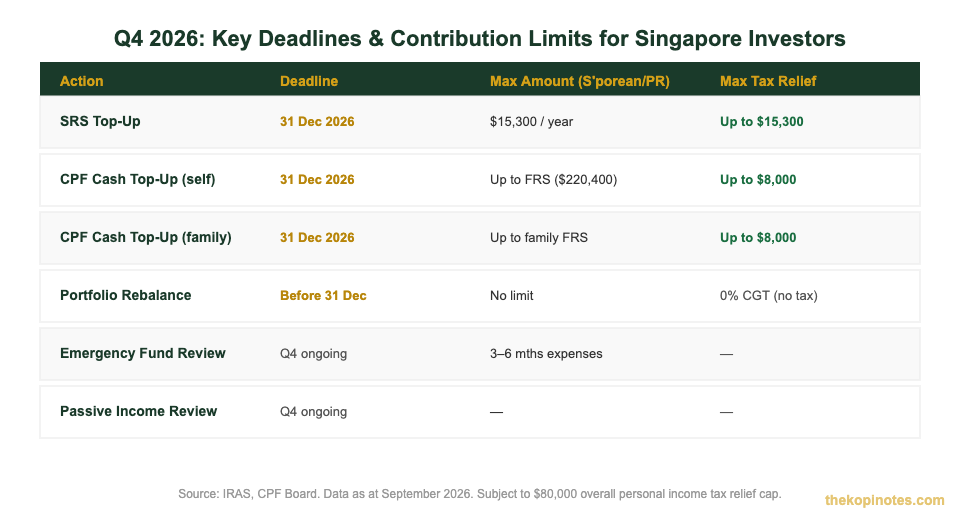
Here is the full Q4 checklist at a glance. All tax-related items (SRS and CPF top-ups) are subject to the $80,000 overall personal income tax relief cap shared across all relief types, including earned income relief, NSman relief, and parent relief.
| Action Item | Deadline | Benefit | Max Amount |
|---|---|---|---|
| Top up SRS | 31 Dec 2026 | Tax deduction + deferred growth | $15,300 (S’pore/PR) |
| CPF cash top-up (own SA/RA) | 31 Dec 2026 | 4.0% p.a. + $8,000 tax relief | $8,000 (for tax relief) |
| CPF cash top-up (family) | 31 Dec 2026 | 4.0% p.a. + $8,000 tax relief | $8,000 (for tax relief) |
| Portfolio rebalance | Before 31 Dec 2026 | Free — 0% CGT in Singapore | No limit |
| Review platform fees | Q4 (before new year) | Reduce ongoing drag on returns | — |
| Verify emergency fund | Q4 (before year-end) | 3–6 months expenses liquid | — |
| Tally passive income / REIT DPU | Q4 (quarterly review) | Track progress vs income goal | — |
Source: IRAS, CPF Board, various platform pricing pages. All figures as at September 2026.
Frequently Asked Questions
What is the SRS contribution deadline for 2026?
How much tax relief can I get from a CPF cash top-up?
What is the CPF SA interest rate in Q4 2026?
Should I top up SRS or CPF first?
Does Singapore have capital gains tax on portfolio rebalancing?
How much should I keep in an emergency fund before investing more?
What should I do with T-bills or SSBs maturing in Q4 2026?
This article is for informational and educational purposes only. It does not constitute financial, tax, or investment advice. All figures are sourced from IRAS and CPF Board official publications and verified as at 9 September 2026. Consult a qualified financial adviser for advice tailored to your situation. The Kopi Notes may earn referral fees from linked platforms.
This article was researched with the help of AI. While we strive to keep all information accurate and up to date, there may be errors. If you notice any discrepancies, please contact us.