Best Brokerage in Singapore 2026: True Cost Analysis at SGD 10k, 50k & 100k
October 2026 · 13 min read
📋 In This Guide
IBKR, Syfe, FSMOne, moomoo, and Saxo are the five brokerages most Singapore ETF investors consider. Syfe wins on cost for beginners using its Regular Savings Plan — you pay SGD 0 in commissions on automated CSPX or VWRA buys. IBKR wins for active investors from around SGD 10,000 onwards, charging as little as GBP 1.70 per LSE trade. FSMOne and Saxo stand out for SRS-compatible investing. This guide shows the real numbers across all three portfolio sizes so you can make the right choice for your situation.
Not financial advice. All figures are for educational reference only. Fee data as at October 2026 — verify directly with each broker before opening an account.
Why Brokerage Costs Erode Your Returns More Than You Think
Most Singapore investors focus on which ETF to buy — CSPX, VWRA, or a REIT ETF — and pay little attention to where they buy it. That is a mistake that compounds against you every year.
Consider a simple example. You invest SGD 12,000 per year into CSPX through 12 monthly purchases of SGD 1,000 each. Over 20 years, assuming a 7% annual return:
- At SGD 0 annual brokerage cost (Syfe RSP): your portfolio grows to approximately SGD 492,000.
- At SGD 136 annual brokerage cost (FSMOne, by commission): your portfolio grows to approximately SGD 484,000 — you give up SGD 8,000 in compounding.
- At SGD 300+ annual brokerage cost (some bank-linked platforms): the gap widens to SGD 17,000+ over 20 years.
That SGD 8,000 to SGD 17,000 gap is real money lost to transaction costs alone — before you even account for FX spreads, custody fees, and platform charges that some brokers layer on top.
Brokerage cost also interacts with your CPF investment strategy. If you are deploying CPFIS or SRS funds, only certain brokers are eligible — and the commission structure can be completely different from your standard cash account.
The three cost categories that matter for Singapore investors buying LSE-listed ETFs like CSPX (iShares Core S&P 500 UCITS ETF) or VWRA (Vanguard FTSE All-World UCITS ETF) are:
- Commission per trade — the fee charged each time you buy or sell
- FX spread — the implicit cost of converting SGD to GBP (or USD) at an inflated rate
- Custody / platform fee — an ongoing annual percentage charged on assets held
All three need to be added together to get your true all-in annual cost. Let’s do that now.
Best Brokerages in Singapore 2026: Quick Comparison
Here is a high-level comparison of the five major brokerages that Singapore investors use for LSE-listed ETFs and US stocks. Costs shown are for LSE ETFs (e.g. CSPX in GBP) unless noted.
| Broker | Commission (LSE ETF) | FX Spread | Custody Fee | SRS? | RSP? |
|---|---|---|---|---|---|
| IBKR | GBP 1.70 min (0.05%) | ~0.002% (very tight) | None | ✗ | ✗ |
| Syfe | 0% (RSP) / 0.02–0.04% (manual) | ~0.5% | None | ✗ | ✓ (CSPX, VWRA) |
| FSMOne | 0.12% min USD 3.88 (US ETFs) | ~0.3–0.5% | 0.03% p.a. | ✓ | ✓ (ETF RSP) |
| moomoo | US: $0 + $0.99/trade platform fee | ~0.3–0.6% | None | ✗ | ✗ |
| Saxo | GBP 3.00 min (Classic plan) | ~0.5% | None | ✓ | ✗ |
Source: Individual broker fee schedules, October 2026. LSE ETF costs based on London Stock Exchange-listed instruments (e.g. CSPX, VWRA in GBP). moomoo LSE fee data estimated; verify before trading. GBP/SGD rate assumed at 1.72 for SGD conversions.
Annual Cost Breakdown at SGD 10k, 50k & 100k
To make the numbers real, let us use a consistent scenario: an investor who makes 12 trades per year at SGD 800 per trade, investing into LSE-listed ETFs like CSPX or VWRA. This represents a disciplined monthly DCA approach — one of the most common strategies among Singapore passive investors.
We calculate annual commission cost only (FX and custody fees are noted separately below). All SGD figures use GBP/SGD 1.72.
SGD 10,000 Portfolio (Starting Investor)
At this portfolio size, you are likely just getting started. The priority is keeping fees low so compounding is not immediately sabotaged. At SGD 800 per trade:
- Syfe (RSP): SGD 0 — the clear winner here. Automated monthly buys of CSPX or VWRA cost nothing in commission. Perfect for building discipline on a small budget.
- IBKR: Approximately SGD 35/year (12 × GBP 1.70 × 1.72). Cheap for what it is, but the SGD 2,500 minimum deposit and slightly more complex platform may be a barrier for true beginners.
- moomoo: Approximately SGD 13/year in platform fees for US-listed equivalents (12 × $0.99 ≈ SGD 16). Note that for LSE ETFs, fees may differ — verify before trading.
- Saxo: Approximately SGD 62/year (12 × GBP 3.00 × 1.72). High relative to portfolio size at 0.6% of assets.
- FSMOne: Approximately SGD 61/year (12 × USD 3.88 × ~1.31 SGD/USD) for US-listed ETFs via SRS; custodian fee adds SGD 3. Best used as an SRS vehicle rather than primary brokerage.
At SGD 10k, Syfe’s RSP is the best starting point. The zero-commission model lets every dollar of your monthly contribution go to work immediately.
SGD 50,000 Portfolio (Growing Investor)
At SGD 50k, you have built meaningful holdings. Commission as a percentage of total portfolio value shrinks, but the absolute cost difference between brokers starts to matter more in dollar terms. IBKR becomes increasingly attractive at this level.
At SGD 800 per trade, 12 times per year:
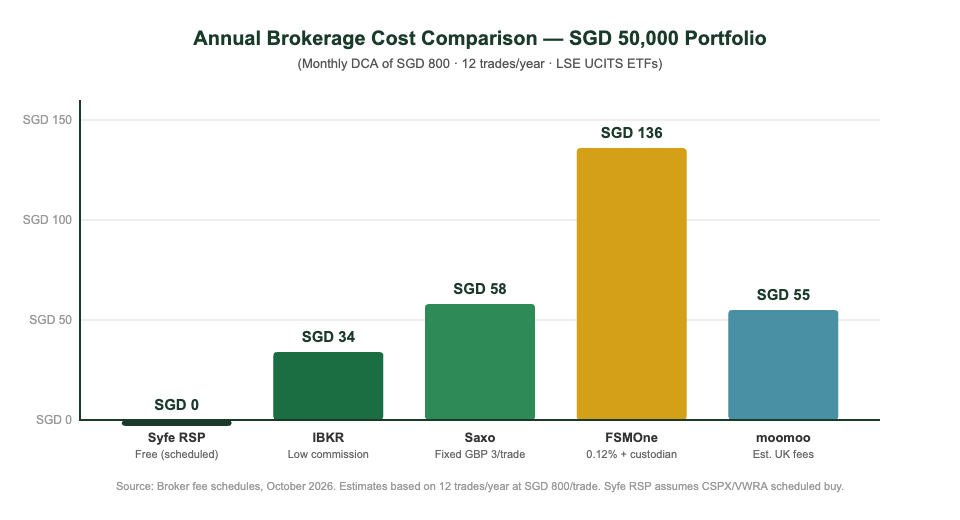
- Syfe RSP: SGD 0 (automated buys only)
- IBKR: ~SGD 34/year — still just GBP 1.70 per trade, unchanged from SGD 10k, because the minimum commission applies regardless of trade size at GBP 800 (≈ GBP 464)
- moomoo: ~SGD 55/year (estimated, LSE fees included)
- Saxo: ~SGD 58/year (GBP 3.00 × 12 × 1.72)
- FSMOne: ~SGD 136/year (0.12% on USD equivalents × trades, plus 0.03% custodian on SGD 50k = SGD 15)
See the chart below for a visual comparison at SGD 50k.
SGD 100,000 Portfolio (Established Investor)
At SGD 100k, IBKR’s per-trade commission structure makes it the undisputed lowest-cost option for commission-based ETF investing. The GBP 1.70 minimum has not changed — it is still just SGD 34/year for 12 trades — while Syfe’s manual trade fee on larger amounts starts at 0.02%, which would be SGD 16 for a single SGD 80,000 one-off purchase.
The custody fee becomes more relevant at this portfolio size. FSMOne’s 0.03% p.a. custodian fee on a SGD 100k portfolio adds SGD 30/year. IBKR charges no custody fee, which is a significant structural advantage for long-term holding.
| Broker | SGD 10k/yr cost | SGD 50k/yr cost | SGD 100k/yr cost | Notes |
|---|---|---|---|---|
| Syfe RSP | SGD 0 | SGD 0 | SGD 0 | Automated buys only; CSPX & VWRA |
| IBKR | ~SGD 35 | ~SGD 34 | ~SGD 34 | GBP 1.70 min/trade, no custody fee |
| moomoo | ~SGD 22 | ~SGD 55 | ~SGD 55 | US ETFs: $0 + $0.99/trade; LSE est. |
| Saxo | ~SGD 62 | ~SGD 58 | ~SGD 58 | GBP 3.00 min/trade; SRS eligible |
| FSMOne | ~SGD 64 | ~SGD 136 | ~SGD 181 | 0.12% min USD 3.88 + 0.03% custody |
Source: The Kopi Notes analysis, October 2026. Assumes 12 trades/year at SGD 800/trade (LSE-listed ETFs), GBP/SGD 1.72, USD/SGD 1.35. FSMOne costs reflect US-listed ETF route via SRS. Syfe RSP figures reflect automated recurring plan only. Not inclusive of FX spread.
The takeaway: for a commission-based strategy, IBKR’s cost advantage compounds dramatically over time, especially above SGD 50k. The key caveat is that Syfe’s RSP remains the cheapest overall — but only for automated, regular buys of supported ETFs. If you want to make lump-sum purchases or buy ETFs outside Syfe’s RSP catalogue, IBKR wins convincingly.
SRS Account and RSP Compatibility
Two features that significantly affect brokerage choice for Singapore investors are Supplementary Retirement Scheme (SRS) account compatibility and Regular Savings Plan (RSP) availability. Not all brokers support both, and the distinction can completely change which platform makes sense for your situation.
SRS-Compatible Brokerages
SRS is a voluntary government scheme that lets Singapore residents contribute up to SGD 15,300 per year (for Singapore citizens and PRs) and invest those funds tax-sheltered. The tax relief makes it one of the most powerful wealth-building tools available, especially for those in higher income tax brackets.
Only FSMOne and Saxo among the five platforms listed here offer SRS brokerage accounts. IBKR, Syfe, and moomoo do not currently support SRS investing. This is a major consideration if SRS optimisation is part of your retirement plan — read more about working an SRS account into your CPF investment strategy.
RSP (Regular Savings Plan) Availability
RSP or auto-DCA lets you set up an automated monthly investment on a fixed schedule. For passive investors who want to DCA into CSPX or VWRA without logging in every month, this feature is essential.
- Syfe: The most seamless RSP experience among all five. You can set up recurring buys of CSPX, VWRA, and other LSE ETFs at 0% commission. The trade-off is that you give up control over exact execution price and timing.
- FSMOne: Offers an ETF Regular Savings Plan for supported instruments. Subject to its standard fee schedule, but SRS-compatible — making it the only option if you want automated DCA from your SRS account.
- IBKR, moomoo, Saxo: Do not offer a native RSP or auto-DCA feature. You must log in manually and place each trade yourself.
The feature matrix below summarises key functionality across all five platforms.
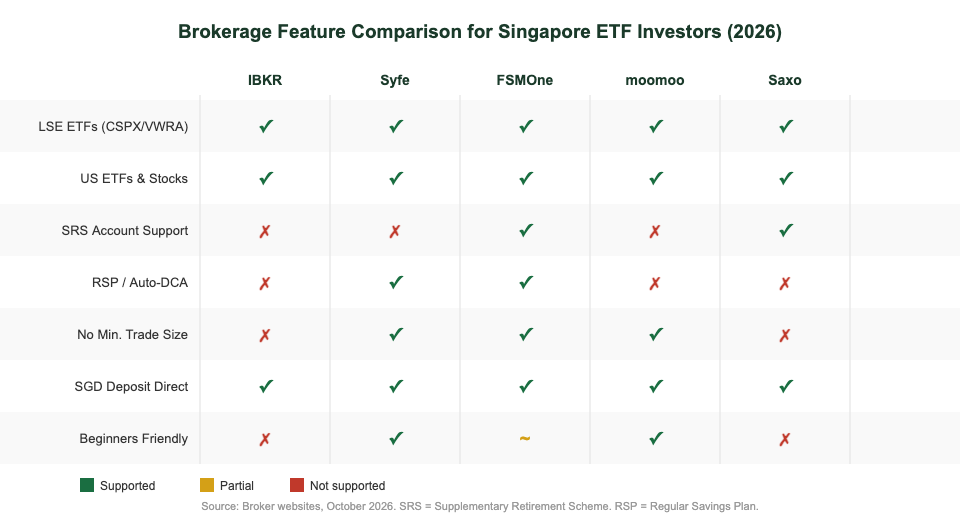
Looking at the feature matrix, FSMOne is the only broker with both SRS support and a formal RSP programme — a unique combination for Singapore retirement savers. For those specifically building a passive portfolio using SRS funds, the higher commission is a reasonable price to pay for that dual feature.
Use the Singapore retirement calculator to see how SRS contributions, compounded over your working life, could reduce your taxable income significantly while growing your investment portfolio.
Account Setup and User Experience
Fees are the primary decision factor, but user experience matters too — especially for investors who are just starting out or who do not want to spend 30 minutes on every trade.
IBKR Singapore
IBKR has the most powerful platform among the five, with access to dozens of international exchanges, professional tools, and tightly priced FX conversion. The minimum deposit to avoid inactivity fees is USD 2,000 (approximately SGD 2,700), and the platform can feel overwhelming to beginners. However, for investors who have crossed the SGD 20,000 mark and are comfortable doing their own research, IBKR’s combination of low cost and market access is hard to beat. Use referral code jianxiong368 when signing up.
Syfe Brokerage
Syfe is the most beginner-friendly option. The mobile app is clean, the RSP setup takes about five minutes, and there is no minimum deposit requirement. The trade-off is a slightly limited ETF catalogue compared to IBKR and less granular control over trade execution. Syfe’s 0% RSP commission model is genuinely exceptional value for investors who are happy to automate and forget. You can find the latest Syfe referral code and sign-up bonus on TKN for additional account credit.
FSMOne
FSMOne (formerly Fundsupermart) is one of Singapore’s most established platforms, with a reputation for strong customer service and an extensive mutual fund and ETF catalogue. Its SRS and RSP combination makes it a natural home for long-term retirement savers. The 0.03% annual custodian fee is transparent and reasonable. Grab the latest FSMOne referral code (code P0544985) for an account opening bonus. If you want to see how FSMOne compares specifically for moomoo users, check out the moomoo Singapore review 2026.
moomoo Singapore
moomoo is a relatively new entrant with aggressive promotional campaigns and a user-friendly app. Its biggest draw is the zero-commission US stock and US-listed ETF trading, making it attractive for investors who want to access US markets without paying SGD 10–15 per trade elsewhere. The platform is strong on research tools and community features. Its SRS ineligibility and no RSP support limit its use case to self-directed investors focused on US equities.
Saxo Markets
Saxo is the premium choice — slightly higher commissions than IBKR for small trades (GBP 3.00 vs GBP 1.70 minimum), but it carries SRS eligibility and a broader range of structured products for more complex portfolios. The platform interface is professional and data-rich. For SRS investors who want more control than FSMOne’s RSP and are comfortable with slightly higher commissions, Saxo is a strong alternative.
Which Brokerage Is Right for You?
There is no single “best” brokerage in Singapore — the right answer depends on your portfolio size, whether you use SRS, and how hands-on you want to be. Here is a quick decision guide:
| Your Situation | Best Broker | Why |
|---|---|---|
| Beginner, want to automate DCA into CSPX/VWRA | Syfe | 0% RSP commission, dead-simple setup |
| Active investor, SGD 20k+ portfolio, LSE ETFs | IBKR | Lowest per-trade commission, tightest FX spread, no custody fee |
| SRS investor who wants automated monthly DCA | FSMOne | Only broker with both SRS + RSP support |
| SRS investor, comfortable placing own trades | Saxo | SRS-eligible, broader product range than FSMOne for active SRS |
| Primarily US stocks & ETFs, no SRS | moomoo | Zero US commission, strong research tools, beginner-friendly UI |
Source: The Kopi Notes analysis, October 2026.
Many experienced Singapore investors run two brokers simultaneously: Syfe for automated RSP of core ETF positions (zero cost, zero effort) and IBKR for lump-sum purchases, rebalancing trades, or accessing ETFs outside Syfe’s RSP catalogue. This hybrid approach captures the best of both platforms.
If retirement planning is your focus and you want to understand how brokerage costs interact with CPF, SRS, and overall portfolio growth, the Singapore retirement planning calculator on TKN can model different scenarios for you.
Frequently Asked Questions
Which brokerage in Singapore has the lowest fees for ETF investing?
For automated Regular Savings Plan (RSP) buying of CSPX or VWRA, Syfe has the lowest fee at 0% commission. For manual or lump-sum purchases of LSE-listed ETFs, IBKR is cheapest at GBP 1.70 minimum per trade (approximately SGD 3 at current rates). The “best” answer depends on whether you prefer automated DCA or self-directed investing.
Can I use IBKR with my SRS account?
No — Interactive Brokers Singapore does not support SRS accounts as at October 2026. If you want to invest your SRS funds in ETFs, FSMOne and Saxo are the main options among the five brokerages reviewed here. FSMOne additionally offers an RSP feature for SRS funds, which no other platform currently matches.
Is Syfe a safe broker to hold ETFs with?
Syfe is a MAS-regulated capital markets services licence holder in Singapore. Client assets are held in a segregated custody account, meaning they are separate from Syfe’s own assets. As with any licensed broker, your investments are in the ETFs themselves — not in Syfe as a company. That said, no brokerage is risk-free, and diversifying across two platforms (e.g., Syfe + IBKR) is a reasonable approach for larger portfolios.
What is the difference between IBKR Fixed and Tiered pricing for Singapore investors?
IBKR offers two commission structures for Singapore-based accounts. The Fixed plan charges a flat 0.05% of trade value with a GBP 1.70 minimum per LSE trade — simple, predictable, and best for investors doing smaller regular purchases. The Tiered plan charges lower percentages at higher monthly trade volumes but adds exchange and regulatory fees on top. For most passive investors doing 1–2 trades per month on LSE ETFs, the Fixed plan is simpler and often cheaper. Active traders with monthly volumes above GBP 50,000 may benefit from switching to Tiered.
Does moomoo offer LSE-listed ETFs like CSPX and VWRA?
As at October 2026, moomoo Singapore’s primary strengths are in US-listed stocks and ETFs, where it offers zero commission. Access to LSE-listed instruments (like CSPX in GBP) is more limited and fee structures for UK stocks may differ from the US commission schedule. If your primary goal is buying CSPX or VWRA on the London Stock Exchange, verify moomoo’s current LSE offering and fee schedule directly before committing. For confirmed LSE ETF access with transparent fees, IBKR or Syfe remain the more reliable defaults.
Should I have two brokerage accounts in Singapore?
Many experienced passive investors in Singapore run two accounts: Syfe for automated RSP (zero commission, set-and-forget) and IBKR for lump-sum or rebalancing trades (lowest per-trade cost). This dual-broker approach captures the best of both worlds. There is no SRS option in this combination, so SRS investors would add a third account — FSMOne or Saxo — specifically for retirement funds. Account maintenance on two or three brokers is manageable, especially if each serves a clear role in your investment plan.
Start Investing With Lower Fees Today
Use TKN referral codes for sign-up bonuses when you open a new brokerage account.
This article was researched with the help of AI. While we strive to keep all information accurate and up to date, there may be errors. If you notice any discrepancies, please contact us.