Endowus Retirement Decumulation 2026: Turning CPF, SRS and Cash Into Monthly Income
How Stable, Higher and Future Income Portfolios pair with CPF LIFE to fund your retirement spendingEndowus lets Singapore retirees turn CPF, SRS and cash savings into a monthly income stream through its Stable, Higher and Future Income Portfolios, which currently target payouts of 3.5% to 6.0% a year. Paired with guaranteed CPF LIFE payouts, a simple three-bucket decumulation plan can cover near-term spending while letting growth assets keep compounding for the decades ahead.
Not financial advice. All figures are for educational reference only and are not guaranteed. Data as at October 2026 unless otherwise noted.
Table of Contents
What Is Decumulation and Why It Matters for SG Retirees
How Endowus Income Portfolios Work
CPF LIFE vs Endowus Income Portfolio Payouts
Building a Three-Bucket Retirement Income Plan
Worked Example: A S$300,000 Portfolio
Fees, Risks and Drawdowns to Know
How to Set Up Your Decumulation Plan
FAQ
What Is Decumulation and Why It Matters for SG Retirees
Decumulation is the process of converting the assets you built up during your working years into a steady income stream in retirement. It is the mirror image of accumulation, and most Singaporeans spend far more time planning the growing phase than the drawing-down phase.
According to Endowus’s own retirement research, Singaporean men and women have among the highest life expectancies in the world, which means a retiree’s savings may need to last 18 to 22 years or more past the official retirement age (Endowus Insights, decumulation strategy). Singapore’s official retirement and re-employment ages are also being raised in stages, so always check the Ministry of Manpower and CPF Board websites for the age that applies to your birth cohort.
A retiree with no decumulation plan risks two opposite mistakes: drawing down too fast and running out of money, or being so cautious that they under-spend and sacrifice their quality of life unnecessarily. A structured plan that blends guaranteed income (CPF LIFE), semi-guaranteed income (fixed deposits, T-bills, Singapore Savings Bonds), and market-linked income (Endowus Income Portfolios) spreads that risk.
How Endowus Income Portfolios Work
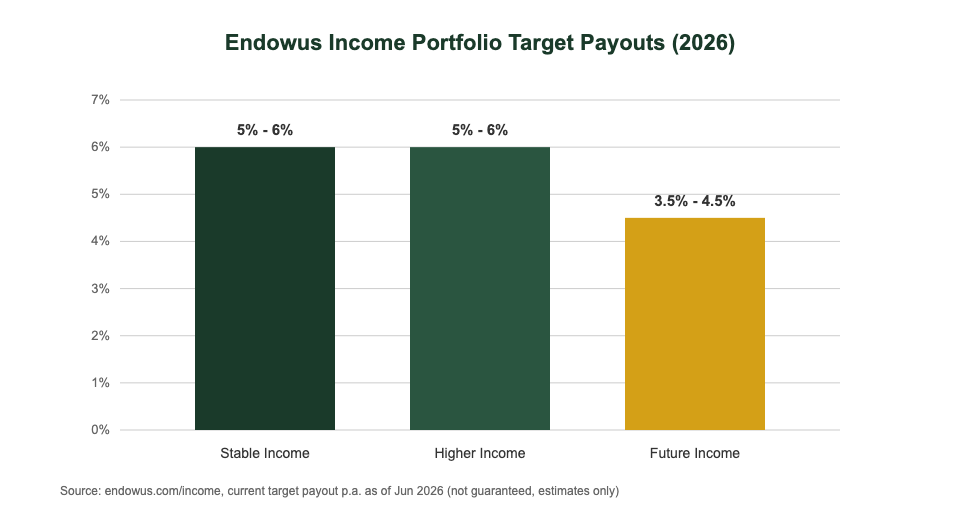
Endowus offers three Income Portfolios, each built for a different life stage and risk appetite. All three pay out monthly, and all three charge the standard Endowus Fee of 0.25% to 0.60% per annum depending on your account size and funding source, with 0% sales charge and 100% of trailer fee rebates passed back to you (Endowus pricing page).
A Singapore retiree choosing between the three should match the allocation to how much capital volatility they can tolerate. Stable Income behaves like a bond-heavy income fund; Higher Income and Future Income add equities for a higher (but less certain) payout and some capital growth potential.
| Portfolio | Allocation | Target Payout p.a. | Best For |
|---|---|---|---|
| Stable Income | 100% fixed income | 5.0% – 6.0% | Retirees wanting capital preservation |
| Higher Income | 80% fixed income / 20% equity | 5.0% – 6.0% | Working adults with bigger near-term expenses |
| Future Income | 60% fixed income / 40% equity | 3.5% – 4.5% | Younger investors building towards retirement |
Source: endowus.com/income, portfolio data as of Jun 2026. Minimum investment: S$10,000. Current payout targets are not guaranteed and are estimates only.
CPF LIFE vs Endowus Income Portfolio Payouts
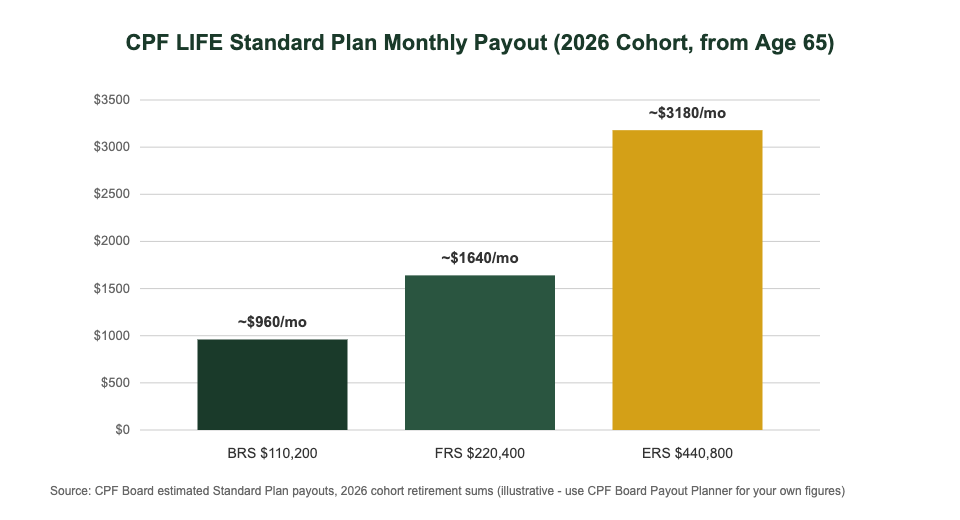
For Singaporeans turning 55 in 2026, the CPF retirement sums are S$110,200 (Basic), S$220,400 (Full) and S$440,800 (Enhanced) – about 3.5% higher than 2025 levels. Those who turned 55 in 2025 keep their own, lower Full Retirement Sum of S$213,000.
Under the CPF LIFE Standard Plan, CPF Board’s own estimates put monthly payouts from age 65 at roughly S$960 at the Basic Retirement Sum, S$1,640 at the Full Retirement Sum, and S$3,180 at the Enhanced Retirement Sum. The Escalating Plan starts about 20% lower but rises 2% a year, and deferring your start date adds roughly 7% a year to your payout. These are illustrative figures – always confirm your own numbers using the CPF Board’s Retirement Payout Planner.
The key structural difference: CPF LIFE payouts are guaranteed for life, backed by the Singapore Government, and fully tax-exempt, but the amount is fixed once you start the plan. Endowus Income Portfolio payouts are not guaranteed – they move with the underlying bond and equity distributions – but they offer more flexibility, no lock-in, and a higher theoretical ceiling.
| Retirement Sum (2026 cohort) | Amount | Est. CPF LIFE Payout (Standard, from 65) |
|---|---|---|
| Basic Retirement Sum (BRS) | S$110,200 | ~S$960/month |
| Full Retirement Sum (FRS) | S$220,400 | ~S$1,640/month |
| Enhanced Retirement Sum (ERS) | S$440,800 | ~S$3,180/month |
Source: CPF Board estimated Standard Plan payouts, 2026 cohort retirement sums. Figures are illustrative estimates, not guarantees – confirm with CPF Board’s own planner.
Building a Three-Bucket Retirement Income Plan
A simple way to structure decumulation is to split your retirement assets into three buckets by time horizon and certainty of income, rather than putting everything into one product.
Bucket 1: 0-3 Years – Cash and Near-Cash
Keep one to three years of expected expenses in Endowus Cash Smart, Singapore Savings Bonds, or short-dated Singapore T-bills so a market downturn never forces you to sell growth assets at a loss. Endowus Cash Smart has advertised net yields of up to 2.5% (not guaranteed) as of August 2026.
Bucket 2: Lifetime Floor – CPF LIFE
CPF LIFE forms your guaranteed income floor from your official payout eligibility age. Because it is government-backed and tax-exempt for life, it should cover your non-discretionary expenses – housing, utilities, food, basic healthcare – before anything market-linked is relied upon.
Bucket 3: Growth and Supplemental Income – Endowus Income Portfolio
Capital beyond your cash buffer and CPF LIFE floor can go into an Endowus Income Portfolio matched to your risk tolerance, to generate a second income stream and preserve some growth potential against inflation. This bucket is explicitly the one that can fall in value, so size it only with money you can afford to see fluctuate.
Worked Example: A S$300,000 Retirement Portfolio
Consider a retiree with S$220,400 in their CPF Retirement Account (the 2026 Full Retirement Sum) plus S$300,000 in cash and SRS savings outside CPF.
- Bucket 1 (Cash Smart, S$50,000): covers roughly 2 years of discretionary spending at S$2,000/month, at up to 2.5% p.a. (not guaranteed).
- Bucket 2 (CPF LIFE, Full Retirement Sum): pays an estimated ~S$1,640/month for life from the Standard Plan, tax-free.
- Bucket 3 (Endowus Higher Income Portfolio, S$250,000): at a 5.5% midpoint target payout, this generates roughly S$13,750 a year, or about S$1,145/month, before the 0.25%-0.60% Endowus Fee.
Combined, Bucket 2 and Bucket 3 alone would produce an estimated S$2,785 a month in income, with Bucket 1 as a buffer against any shortfall or market dip in Bucket 3’s payout. This is an illustrative calculation only – actual Endowus Income payouts move with fund distributions and are never guaranteed, and your own CPF LIFE payout depends on your actual Retirement Account balance and plan choice.
Fees, Risks and Drawdowns to Know Before You Commit
Every retirement income product trades certainty for yield somewhere. For Endowus Income Portfolios, be clear-eyed about three things before you commit retirement capital.
Fee Drag
The Endowus Fee ranges 0.25% to 0.60% per annum. On a S$250,000 Higher Income allocation, that is roughly S$625 to S$1,500 a year taken off your returns before you see a payout – small relative to the 5.0%-6.0% target, but worth confirming your exact tier on the Endowus Fee Breakdown page.
Capital Is Not Guaranteed, and Can Fall Sharply
Based on Endowus’s own representative historical data (2016-2026), the worst 1-year rolling return was -13.1% for Stable Income, -20.7% for Higher Income, and -22.1% for Future Income. A retiree drawing income during a drawdown year like that needs Bucket 1 (cash) to avoid forced selling at depressed prices.
Not SDIC-Insured
Unlike a savings account, Income Portfolio assets are market-linked unit trusts, not bank deposits, so they are not covered by the Singapore Deposit Insurance Corporation. Your capital value can go up or down.
S$10,000 Minimum and Payout Timing
Endowus requires a S$10,000 minimum to start an Income Portfolio, and payout dates vary by underlying fund, so expect payouts to land on different days of the month rather than a single fixed payday.
How to Set Up Your Decumulation Plan on Endowus
- Sign up with Endowus using Endowus referral code 2V343 for the current sign-up bonus.
- Decide how much of your retirement capital goes into each bucket – cash/T-bills, CPF LIFE, and an Income Portfolio.
- Fund your Income Portfolio (minimum S$10,000) via cash or SRS, based on your own tax and liquidity needs – always check the latest funding eligibility for each portfolio in the Endowus app before transferring.
- Pick Stable, Higher, or Future Income based on how much capital volatility you can tolerate against the payout you need.
- Review your full retirement income plan yearly using the Singapore retirement calculator, and rebalance your buckets as CPF LIFE payouts begin and your cash buffer depletes.
For a deeper look at funding your CPF OA through Endowus before you retire, see our Endowus CPFIS guide, and for how Income Portfolios stack up against direct REIT ownership, read our Endowus Income Portfolios vs S-REITs comparison.
Frequently Asked Questions
Can I fund an Endowus Income Portfolio with CPF OA or SRS?
What is the minimum investment for an Endowus Income Portfolio?
Are Endowus Income Portfolio payouts guaranteed?
How does Endowus Income compare to CPF LIFE for retirement income?
What are the risks of relying on Endowus Income Portfolios for retirement income?
How do I get the Endowus referral code bonus?
Ready to build your retirement income plan?
Sign up with Endowus using referral code 2V343 and explore Income Portfolios alongside your CPF and SRS strategy.
Disclaimer: This article is for educational purposes only and is not financial advice. The Kopi Notes may earn a referral fee if you sign up through the links above. All figures are illustrative estimates based on publicly available data as at October 2026 and are not guaranteed. Always verify current rates and terms directly with Endowus and CPF Board, and consider speaking to a licensed financial adviser before making retirement decisions.
This article was researched with the help of AI. While we strive to keep all information accurate and up to date, there may be errors. If you notice any discrepancies, please contact us.