Endowus Income Portfolios target 3.5%-6% a year in fund payouts, built from fixed income and equities, versus roughly 5.7%-6.5% for the average S-REIT today. Endowus charges a 0.15%-0.60% access fee plus a 0.05%-1% fund-level fee, both before 9% GST, while direct S-REIT investing costs only brokerage commission — the trade-off is diversification and zero DIY effort versus a lower all-in yield.
Not financial advice. All figures are for educational reference only. Data as at October 2026 unless noted.
Contents — Click to expand
Endowus Income Payouts vs S-REIT Yields: The Numbers
Fee Drag: Endowus Fees vs DIY S-REIT Investing
Tax and CPF/SRS Treatment Compared
Liquidity and Volatility: Unit Trust NAV vs REIT Share Price
Who Should Choose Which?
How to Open an Endowus Account (Referral Code Bonus)
Frequently Asked Questions
What Are Endowus Income Portfolios?
Endowus Income Portfolios are a separate product line from the standard Flagship portfolios. Instead of maximising long-term total return, they’re built to pay out cash on a target yield, funded by a mix of fixed income funds, dividend equity funds, and (for the higher-payout version) some capital drawdown. A Singapore investor putting S$50,000 into the Higher Income Portfolio is, in effect, outsourcing the “pick bonds and dividend funds, then distribute the income” job that a DIY S-REIT investor does by hand when they build their own portfolio.
There are two versions live on the platform as at October 2026:
- Future Income Portfolio — target payout of 3.5%-4.5% a year, with more equity exposure aimed at some capital appreciation alongside the payout.
- Higher Income Portfolio — target payout of 5%-6% a year, roughly 80% fixed income and 20% equities, prioritising current income over growth.
Both are unit trust portfolios on Fund Smart, meaning the “dividend” you receive is technically a fund distribution, not a direct REIT or company dividend. That distinction matters later for tax and volatility — unit trust NAVs move differently from listed REIT share prices even when the underlying assets overlap.
Endowus Income Payouts vs S-REIT Yields: The Numbers
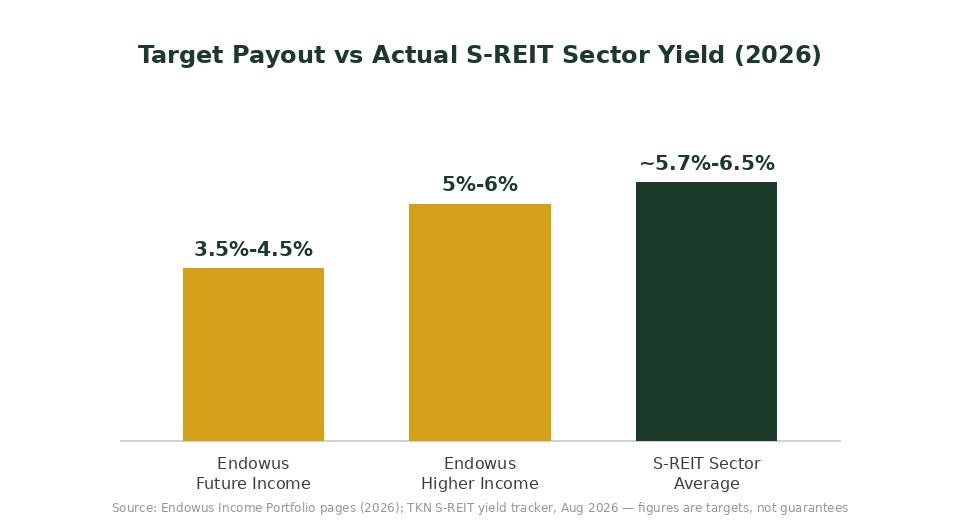
Here’s the headline comparison. The Endowus figures are target payout ranges stated by Endowus for its Income Portfolios; S-REIT figures are the sector-wide average dividend yield tracked separately on TKN’s own average S-REIT dividend yield tracker.
| Option | Target / Actual Yield | Income Source | Guaranteed? |
|---|---|---|---|
| Endowus Future Income Portfolio | 3.5% – 4.5% p.a. (target) | Bonds + dividend equities | No |
| Endowus Higher Income Portfolio | 5% – 6% p.a. (target) | ~80% fixed income + 20% equities | No |
| S-REIT sector average | ~5.7% – 6.5% (actual, Aug 2026) | Direct property rental income | No |
| A hand-picked S-REIT basket | 6% – 7%+ (varies by pick) | Direct property rental income | No |
Source: Endowus Income Portfolio product pages and TKN S-REIT dividend yield tracker, August-October 2026. Targets are not guarantees; a fund can miss its payout target in a weak quarter.
Two things stand out. First, neither Endowus Income Portfolio’s target actually beats the current S-REIT sector average on a headline-yield basis — the Higher Income Portfolio’s 5%-6% band sits at or just below the ~5.7%-6.5% S-REIT average, and the Future Income Portfolio is well below it. Second, “target” is doing real work in that sentence: Endowus’s own disclosures note that payout figures are illustrative and partly based on back-tested or hypothetical performance, not a contractual promise the way a fixed deposit rate is. A hand-picked basket from TKN’s own best S-REITs in Singapore 2026 list can often clear 6%-7%, but that comes with single-counter concentration risk an Endowus fund-of-funds structure is specifically designed to avoid.
Fee Drag: Endowus Fees vs DIY S-REIT Investing
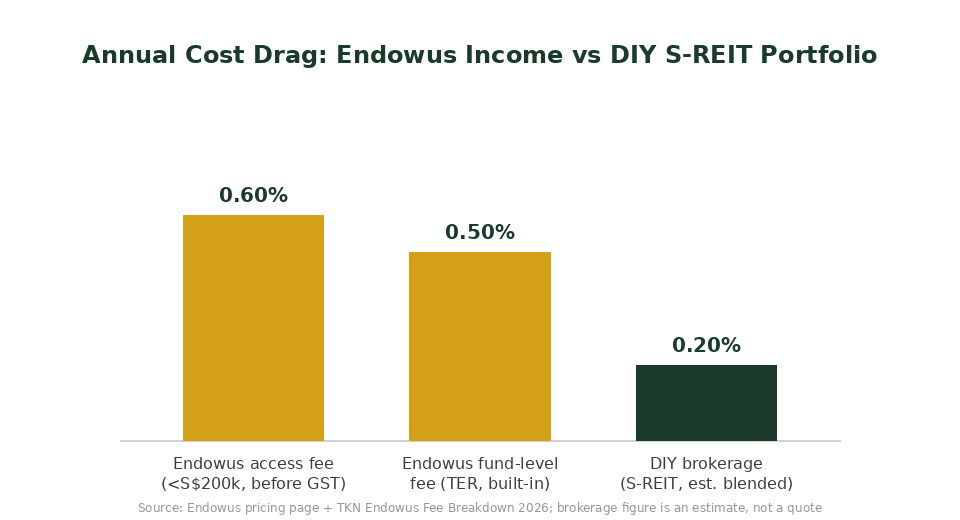
This is where the Income Portfolio case gets harder to make on yield alone. Per TKN’s own verified Endowus fee breakdown, Income portfolios under S$200,000 sit on the top access-fee tier of 0.60% a year, before 9% GST — so the real cost is closer to 0.65% once GST is added. On top of that sits a separate fund-level fee (the TER baked into each underlying fund’s price) of roughly 0.05%-1%, which isn’t billed to you directly but still eats into the return you see.
A Singapore investor buying S-REITs directly through a brokerage pays none of that. The only recurring cost is the brokerage commission on each trade (often a flat fee or ~0.08%-0.28% per trade depending on the broker) and, for some brokers, a custody or platform fee. There’s no annual advisory fee stacked on top of the yield, because there’s no advisor — you’re doing the fund selection and rebalancing yourself.
| S$50,000 portfolio | Annual cost | What it buys you |
|---|---|---|
| Endowus Higher Income Portfolio | ~S$327 access fee (0.60% + 9% GST) + fund TER | Auto-rebalancing, fund selection, monthly payout handling |
| DIY 8-10 counter S-REIT basket | Brokerage commission only (one-off per trade) | Full control, no advisory fee, but you do the picking and rebalancing |
Source: TKN Endowus Fee Breakdown 2026. Brokerage cost is indicative and varies by platform; this is not a cost quote.
On pure cost, DIY S-REIT investing wins every time — there’s no advisory layer to pay for. The question an Endowus Income Portfolio actually answers isn’t “which is cheaper,” it’s “is the diversification, auto-rebalancing, and hands-off monthly payout worth roughly 0.65%-1.6% a year in combined access and fund-level fees to someone who doesn’t want to research and rebalance 8-10 individual REIT counters themselves.”
Tax and CPF/SRS Treatment Compared
Both routes are broadly tax-friendly for Singapore resident individuals, but the mechanics differ. S-REIT distributions paid to individual investors are generally not taxed in the investor’s hands under the tax transparency treatment extended to S-REITs, so a DIY S-REIT basket’s dividends typically arrive tax-free. Endowus Income Portfolio distributions, being unit trust fund payouts rather than direct REIT dividends, follow fund-distribution tax treatment, which for most retail unit trusts held by individuals in Singapore is also not separately taxed — but the structure is one extra layer removed from the underlying asset, so it’s worth reading the specific fund’s prospectus rather than assuming it behaves identically to a direct REIT holding.
Where Endowus does add a genuine edge is CPF-OA and SRS compatibility: Income Portfolios can be funded via CPF Ordinary Account or SRS, letting an investor combine the income strategy with CPF-OA’s 2.5% floor opportunity cost or SRS tax relief. Direct S-REIT purchases through most standard brokerage accounts use cash or CPF Investment Scheme (CPFIS) — CPFIS-OA is possible for S-REITs too, but SRS-funded direct REIT purchases are less commonly supported than via a platform like Endowus or FSMOne.
Liquidity and Volatility: Unit Trust NAV vs REIT Share Price
A listed S-REIT trades intraday on the SGX — its price can swing several percent in a session on rate-decision news or a results miss, but it’s also instantly sellable at the quoted price during market hours. An Endowus Income Portfolio’s unit trust NAV is typically priced once a day (T+1 or later, depending on the underlying funds), and redemptions can take several business days to settle. For an investor who values being able to react same-day to a rate cut or a REIT-specific headline, that’s a real trade-off, not just a technicality.
In exchange, the Income Portfolio’s NAV tends to be smoother day-to-day than a concentrated REIT basket, because it’s diversified across many underlying bond and equity funds rather than 8-10 individual counters. Whether that smoothing is worth the liquidity give-up depends on how actively an investor plans to manage the position — someone parking retirement income money for the long haul cares less about intraday liquidity than someone actively trading around REIT news.
Who Should Choose Which?
A rough decision framework, based on the trade-offs above:
- Choose Endowus Income Portfolio if: you want one-click diversification across many bonds and dividend funds, you’d rather not research and rebalance individual REITs yourself, and you’re funding it via CPF-OA or SRS where that flexibility matters more than the fee.
- Choose a DIY S-REIT basket if: you’re comfortable picking 6-10 counters (TKN’s best S-REITs in Singapore 2026 comparison is a starting point), you want to avoid the 0.60%+ access fee layer, and you’re fine with doing your own rebalancing and monitoring.
- Consider a blend — many TKN readers run a core S-REIT basket for yield and control, with an Endowus Income Portfolio as a smaller, lower-effort sleeve for CPF-OA money that would otherwise sit idle at 2.5%. See our broader passive income Singapore guide for how this fits a wider income strategy.
How to Open an Endowus Account (Referral Code Bonus)
Signing up takes about 10 minutes end to end: verify your identity via Singpass or manual ID upload, link a funding source (cash, CPF-OA, or SRS), then choose a portfolio — Flagship, Income, ESG, or a Satellite single-fund option. New sign-ups using a referral code typically unlock a cash reward or fee rebate on top of the standard product terms.
Use TKN’s Endowus referral code and sign-up bonus (code 2V343) when you open your account to claim the current new-user reward. Before committing a large sum, it’s worth running your numbers through our Singapore retirement calculator to see how an income-focused allocation fits your broader retirement timeline.
Frequently Asked Questions
Is the Endowus Income Portfolio payout guaranteed?
Is Endowus Income Portfolio better than buying S-REITs directly?
Can I fund an Endowus Income Portfolio with CPF or SRS?
How much does the Endowus Income Portfolio cost in fees?
What's the difference between Future Income and Higher Income portfolios?
How quickly can I withdraw from an Endowus Income Portfolio?
Disclaimer: This article is for educational purposes only and does not constitute financial advice. TKN may earn a referral fee if you sign up via the Endowus referral code above, at no extra cost to you. All figures are approximate and sourced as noted; verify current rates directly with Endowus and SGX before making investment decisions.
Ready to Build Your Income Portfolio?
This article was researched with the help of AI. While we strive to keep all information accurate and up to date, there may be errors. If you notice any discrepancies, please contact us.