Keppel DC REIT Dividend History 2014–2026: DPU Track Record & Yield Analysis
Singapore’s largest data centre REIT — how its distributions have grown since IPO and what yields to expect in 2026.
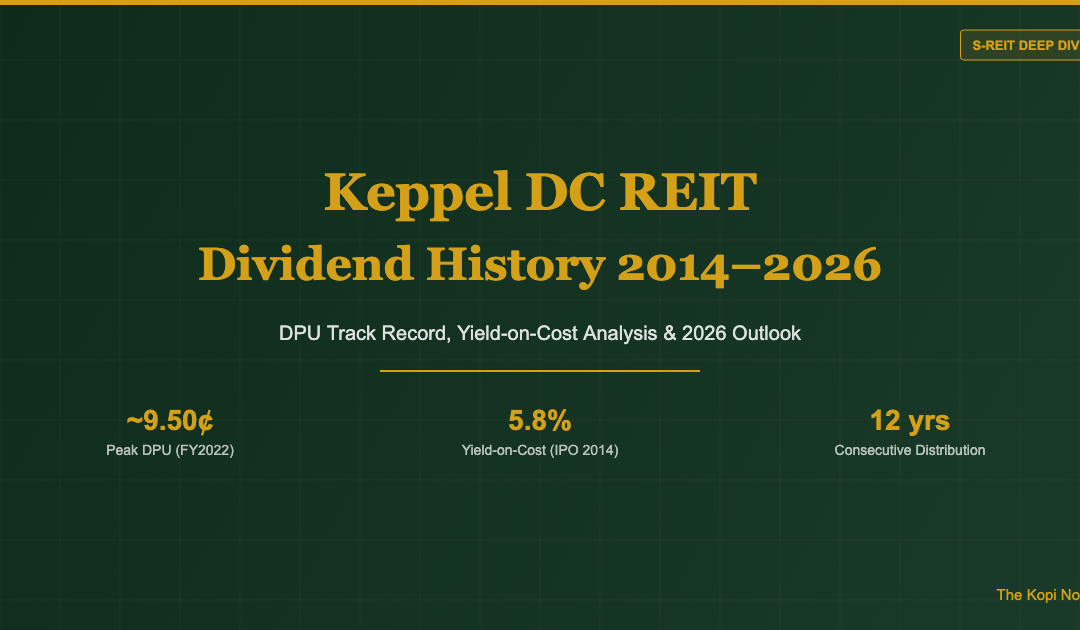
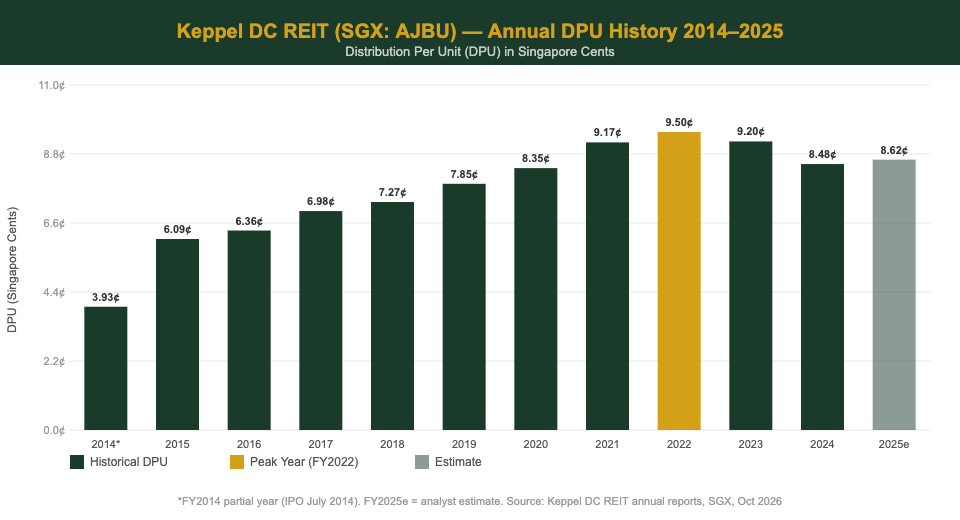
Keppel DC REIT (SGX: AJBU) has paid a distribution to unitholders every single year since its IPO in July 2014. Its annual DPU grew from a partial-year 3.93 cents in 2014 to a peak of 9.50 cents in FY2022 — representing a 141% increase over eight full fiscal years. Investors who bought at the IPO price of S$0.93 now earn a yield-on-cost exceeding 9%, making KDC one of Singapore’s most rewarding long-term REIT holdings for patient investors.
Not financial advice. All figures are for educational reference only. DPU data sourced from Keppel DC REIT annual reports and SGX filings. Data as at October 2026 unless noted.
Table of Contents
Contents — Click to expand
- What Is Keppel DC REIT?
- Full DPU History: 2014 to 2025
- Yield-on-Cost Analysis: What IPO Investors Earn Today
- What Drives Keppel DC REIT’s DPU?
- Interest Rate Impact on DPU (2022–2025)
- 2026 DPU Outlook: Recovery or Further Pressure?
- How Singapore Investors Can Buy Keppel DC REIT
- Frequently Asked Questions
What Is Keppel DC REIT?
Keppel DC REIT (SGX: AJBU) is Singapore’s first and largest data centre REIT, listed on the Singapore Exchange on 12 December 2014 (following its initial public offering in early December 2014 at S$0.93 per unit). Managed by Keppel DC REIT Management Pte. Ltd., a subsidiary of Keppel Corporation, it invests in income-producing data centre assets globally.
As at mid-2026, Keppel DC REIT owns 23 data centres across nine countries — Singapore, Australia, Germany, Ireland, Italy, Malaysia, the Netherlands, the United Kingdom, and Japan. Total assets under management exceed S$3.8 billion, making it the largest listed data centre REIT in Asia-Pacific by asset value. Its portfolio spans carrier-neutral colocation facilities, hyperscale data centres, and powered shell assets leased to major cloud and enterprise tenants.
The REIT operates under Singapore’s REIT regulations, which require distribution of at least 90% of taxable income to unitholders to enjoy tax transparency. In practice, Keppel DC REIT distributes its income on a semi-annual basis — once for the first half (H1, paid around August) and once for the second half (H2, paid around February of the following year).
| Metric | Detail |
|---|---|
| SGX Ticker | AJBU |
| IPO Date | 12 December 2014 |
| IPO Price | S$0.93 per unit |
| REIT Manager | Keppel DC REIT Management Pte. Ltd. |
| Distribution Frequency | Semi-annual (H1 + H2) |
| Number of Assets (2026) | 23 data centres across 9 countries |
| AUM (approx., mid-2026) | >S$3.8 billion |
| FY2024 DPU | 8.48 Singapore cents |
Source: Keppel DC REIT annual reports, SGX, October 2026
Full DPU History: 2014 to 2025
The table below covers every full financial year since Keppel DC REIT’s IPO. Note that FY2014 represents a partial year (listing was in December 2014, covering only the IPO quarter). The figures below are as reported in official annual reports and SGX disclosures. FY2025 is an analyst estimate based on H1 2025 actual results and H2 guidance.
For Singapore investors tracking the best S-REITs in Singapore 2026, the KDC REIT DPU trend tells an important story: consistent double-digit compound annual growth from 2015–2022, followed by a moderation as rising interest rates increased finance costs. This pattern is common among all S-REITs but has been more pronounced for KDC given its aggressive acquisition strategy during 2019–2022.
| Financial Year | DPU (S¢) | YoY Change | Notes |
|---|---|---|---|
| FY2014 | 3.93¢ | — | Partial year (IPO Dec 2014) |
| FY2015 | 6.09¢ | First full year | First complete distribution year |
| FY2016 | 6.36¢ | +4.4% | Steady organic growth |
| FY2017 | 6.98¢ | +9.7% | Acquisitions in Dublin, Sydney |
| FY2018 | 7.27¢ | +4.2% | Stable, no major acquisitions |
| FY2019 | 7.85¢ | +8.0% | Acquisition of Kelsterbach DC (Germany) |
| FY2020 | 8.35¢ | +6.4% | COVID-resilient; cloud demand surge |
| FY2021 | 9.17¢ | +9.8% | Multiple acquisitions; NPI uplift from China |
| FY2022 | 9.50¢ ▲ Peak | +3.6% | Highest-ever DPU; 8 consecutive years of growth |
| FY2023 | 9.20¢ | −3.2% | Rising interest rates; China asset write-downs |
| FY2024 | 8.48¢ | −7.8% | Higher finance costs; China impairments persist |
| FY2025 (est.) | 8.62¢ | +1.7% | Rate cuts beginning; gradual recovery |
Source: Keppel DC REIT annual reports (FY2014–FY2024), SGX filings. FY2025e = analyst consensus estimate as at October 2026. Past DPU is not a guarantee of future distributions.
Key insight: From FY2015 (first full year) to FY2022 (peak), Keppel DC REIT delivered compound annual DPU growth of approximately 6.6% per annum — well ahead of inflation and comparable to many high-growth tech stocks of the same period, while paying quarterly-equivalent distributions. This is why KDC REIT commanded a premium valuation of nearly 2× NAV at its 2021 peak.
Yield-on-Cost Analysis: What IPO Investors Earn Today
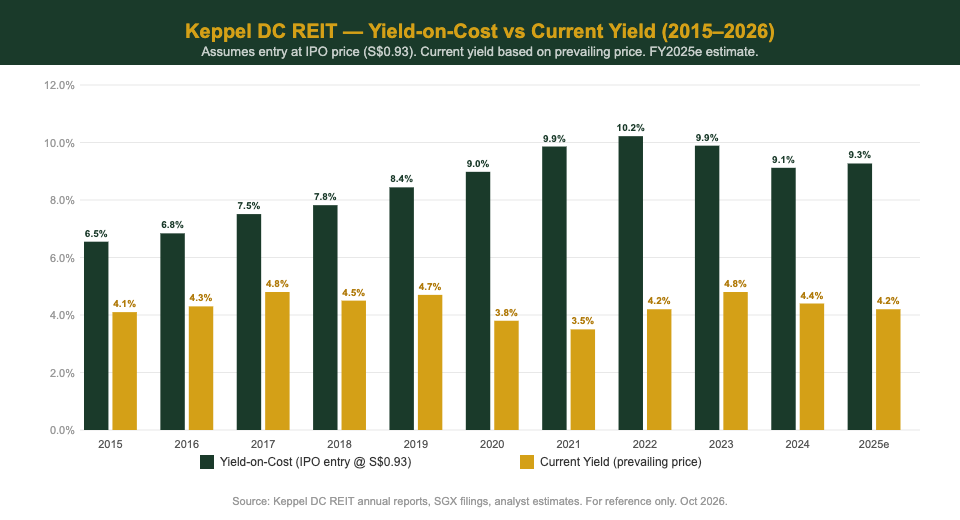
One of the most compelling stories in Keppel DC REIT’s history is how its distributions have rewarded investors who bought at the IPO price of S$0.93. As of FY2024, with an annual DPU of 8.48 cents, an investor who bought at the IPO is now earning a yield-on-cost of approximately 9.1% — nearly double the REIT’s current market yield of around 4.4%.
This concept is critical for long-term passive income Singapore investing. While new investors buying at today’s market price earn a 4–5% current yield, early investors who bought at IPO and held through the rate cycle are now earning yield-on-cost approaching double digits on their original capital.
For a Singapore investor who invested S$50,000 at the IPO price (buying approximately 53,763 units at S$0.93), the following distributions would have been received over the REIT’s life to end-FY2024:
| Period | Cumulative DPU Received (¢) | Cash Received on S$50k (approx.) | Yield-on-Cost |
|---|---|---|---|
| End FY2015 | 10.02¢ | S$5,387 | 6.6% |
| End FY2018 | 27.53¢ | S$14,806 | 7.8% |
| End FY2022 (peak) | 55.95¢ | S$30,076 | 10.2% |
| End FY2024 | 73.63¢ | S$39,583 | 9.1% |
Note: Illustrative calculation based on 53,763 units purchased at S$0.93 (S$50,000 investment). Excludes brokerage costs, withholding taxes, and any reinvestment of distributions. For reference only.
In other words, by end-FY2024, an IPO investor’s S$50,000 initial investment has received approximately S$39,583 in cumulative distributions alone — recovering about 79% of the original capital through distributions before any capital gains. This is the compounding power of REITs with growing distributions held over a full market cycle.
What Drives Keppel DC REIT’s DPU?
Understanding what underpins Keppel DC REIT’s distribution requires looking beyond the headline DPU number. Several key factors drive NPI (net property income) and ultimately the distributable income available to unitholders:
1. Long WALE leases with built-in escalations. KDC REIT’s portfolio weighted average lease expiry (WALE) stands at approximately 7–8 years as at 2026. Many leases include fixed annual rental escalations of 2–4%, providing inflation-linked income growth without requiring new acquisitions. This is a key structural advantage over office or retail REITs, where leases are often shorter and subject to market renegotiation.
2. Cloud and AI demand tailwinds. The explosive growth in cloud computing, AI model training, and enterprise data workloads has created sustained demand for colocation data centre space. KDC REIT’s hyperscale tenants — which include major cloud service providers and enterprise IT companies — have been expanding capacity commitments. This structural tailwind underpinned the DPU growth from 2017 to 2022 and is expected to support a gradual recovery from 2025 onwards.
3. Debt financing costs. Data centre REITs are capital-intensive acquirers. KDC REIT funded significant acquisition activity in 2019–2022 using a mix of equity (rights issues) and debt. When interest rates rose sharply in 2022–2023, the REIT’s finance costs surged, directly compressing distributable income. This is the single largest factor behind the DPU decline from FY2022 (9.50¢) to FY2024 (8.48¢). With central banks beginning to cut rates from late 2024, the financing headwind is gradually easing.
4. China portfolio performance. KDC REIT has significant exposure to China data centres, which have faced a combination of lower demand from domestic tech companies (regulatory crackdowns), currency headwinds from CNY depreciation, and asset impairments. Investors reviewing the DPU history should note that the FY2023 and FY2024 DPU declines were partly driven by China-specific write-downs rather than portfolio-wide operational weakness.
5. Acquisitions and rights issues. KDC REIT has grown primarily through acquisitions, funding some via equity issuance. When rights issues are dilutive — issuing new units at a discount to NAV — the per-unit DPU can be temporarily pressured even if total distributable income grows. Investors watching the Keppel DC REIT share price should distinguish between total income growth and per-unit metrics, which the DPU table above captures accurately. For a broader view of how to assess REIT acquisitions, see our best S-REITs in Singapore 2026 guide.
Interest Rate Impact on DPU (2022–2025)
The period from mid-2022 through 2024 was the most challenging in Keppel DC REIT’s short history. The US Federal Reserve hiked rates by a cumulative 525 basis points between March 2022 and July 2023 — the most aggressive tightening cycle since the 1980s. As a highly geared REIT with significant floating-rate debt exposure, KDC bore the full brunt of this rate cycle.
According to KDC REIT’s FY2024 annual report, finance costs approximately doubled between FY2021 and FY2024, consuming a meaningfully larger share of NPI. The REIT’s aggregate leverage (gearing ratio) peaked above 37% at various points in 2023, approaching Singapore’s regulatory limit of 50% and creating a need to be cautious with new acquisitions.
For Singapore investors assessing whether to buy or hold KDC REIT, the key question is: has the worst of the rate cycle passed? With the US Fed cutting rates from September 2024 and the Singapore SORA benchmark declining accordingly, the refinancing of maturing KDC debt facilities at lower margins has begun. The FY2025 DPU estimate of approximately 8.62¢ reflects this gradual easing — a modest recovery from the FY2024 trough rather than a full return to FY2022 peak levels.
For broader context on how interest rates affect fixed income alternatives, our Singapore T-bills 2026 guide and Singapore Savings Bonds guide explain how risk-free rates set the opportunity cost benchmark that REITs must outperform to attract capital.
2026 DPU Outlook: Recovery or Further Pressure?
As at October 2026, the consensus analyst view for Keppel DC REIT’s full-year FY2025 DPU stands at approximately 8.60–8.70 cents, implying a modest recovery from FY2024’s 8.48 cents. For FY2026, the range is wider: bears point to lingering China exposure and geopolitical tech supply chain risks, while bulls argue that the AI infrastructure buildout will drive occupancy and rental reversion upward across the European and Singapore portfolios.
Key catalysts to watch for a DPU recovery toward the 9–9.5 cents range by FY2027 include: (1) full refinancing of legacy high-cost debt at current market rates; (2) positive rental reversions from lease renewals at AI-driven demand premiums; (3) divestment or recovery of China assets; and (4) potential acquisition of high-yielding data centre assets funded at accretive yields.
Investors who wish to run their own return scenarios — combining expected DPU recovery with capital appreciation potential — can use our Singapore retirement calculator to model how KDC REIT fits into a broader income portfolio alongside CPF LIFE, SSB, and other income assets. Our CPF investment strategy Singapore guide also covers how KDC REIT fits into a CPF-OA and SRS investment framework.
How Singapore Investors Can Buy Keppel DC REIT
Keppel DC REIT trades on the main board of the Singapore Exchange (SGX) under ticker AJBU in Singapore dollars. It can be purchased through any SGX-connected brokerage account, including CDP-linked accounts at DBS Vickers, OCBC Securities, UOB Kay Hian, or through custodian accounts at MooMoo Singapore, Tiger Brokers, or online robo-advisors.
For investors who prefer to gain S-REIT exposure through a diversified fund structure rather than a single REIT, Syfe’s REIT+ portfolio provides exposure to a basket of S-REITs including data centre and industrial REITs. The Syfe referral code (SRPRFFFCD) provides a fee waiver for new accounts. For direct stock brokers with competitive S$0 commission, FSMOne referral code P0544985 and Endowus referral code 2V343 are worth considering for fee-efficient SGX trading.
Keppel DC REIT units are eligible for SRS (Supplementary Retirement Scheme) investment — investors can fund an SRS account and purchase AJBU units through an SRS-eligible brokerage, receiving the distributions tax-deferred until withdrawal. This makes KDC REIT a compelling high-yield option within an SRS portfolio for investors in the 22% and 24% personal tax brackets. For more on how to maximise SRS for retirement, see our passive income Singapore guide.
Note: Keppel DC REIT is NOT eligible for CPF-OA investment, as it does not meet MAS’s minimum financial inclusion criteria under the CPF Investment Scheme. Investors wishing to use CPF-OA for S-REIT exposure would need to use STI ETF or selected CPF-approved unit trusts instead.
Frequently Asked Questions
What is Keppel DC REIT's current dividend per year?
Based on FY2024 results, Keppel DC REIT paid a total annual DPU of 8.48 Singapore cents per unit, distributed in two semi-annual payments. This was down from the FY2022 peak of 9.50 cents due to higher interest costs. At a share price of around S$1.90–S$2.20 (as at mid-2026), this implies a current yield of approximately 3.9%–4.5%. For FY2025, analysts estimate a modest DPU recovery to approximately 8.60–8.70 cents.
Has Keppel DC REIT ever cut its dividend?
Keppel DC REIT did not cut its DPU during the COVID-19 pandemic in 2020 — in fact, DPU grew 6.4% that year due to strong data centre demand from remote-work and cloud adoption. The first DPU decline in the REIT’s history came in FY2023 (−3.2% vs FY2022) and continued in FY2024 (−7.8%), driven by rising interest costs and China asset impairments rather than operational weakness. The underlying operating portfolio has remained resilient, with portfolio occupancy consistently above 97%.
How does Keppel DC REIT pay its dividend?
Keppel DC REIT distributes income on a semi-annual basis. The H1 distribution (January–June) is typically announced in July/August and paid to unitholders on record approximately four to six weeks later. The H2 distribution (July–December) follows the same timeline, with payment around February of the following year. Distributions are paid in Singapore dollars directly to your brokerage account or CDP-linked bank account.
What is the yield-on-cost for Keppel DC REIT IPO investors?
Investors who bought Keppel DC REIT at its IPO price of S$0.93 per unit and held through FY2024 are now earning a yield-on-cost of approximately 9.1% on their original investment — based on the FY2024 DPU of 8.48 cents. Additionally, those IPO investors have received cumulative distributions of approximately 73.6 cents per unit since listing, recovering nearly 79% of their original S$0.93 investment through distributions alone, before any consideration of capital gains.
Is Keppel DC REIT a good buy for passive income in 2026?
At current prices and with a forward yield of approximately 4–5%, Keppel DC REIT offers a moderate yield with structural long-term growth potential from AI and cloud infrastructure demand. The main risks to consider are: (1) lingering China asset exposure; (2) higher-for-longer interest rate scenarios slowing the DPU recovery; and (3) geopolitical disruption affecting cross-border data flows. Investors seeking higher current income may find Singapore T-bills or high-yield S-REITs like Manulife US REIT offering better immediate yields, while those with a 5–10 year horizon may value KDC’s structural AI tailwind and track record of DPU growth.
Can I buy Keppel DC REIT with SRS or CPF funds?
Keppel DC REIT (SGX: AJBU) is eligible for SRS (Supplementary Retirement Scheme) investment through SRS-approved brokers. This is a tax-efficient way for high-income earners to gain exposure to KDC REIT. However, it is NOT eligible for CPF-OA investment under the CPF Investment Scheme — the REIT does not meet MAS’s minimum financial criteria for CPF-OA inclusion. CPF funds cannot be directly used to purchase AJBU units on the open market.
Start Building Your S-REIT Income Portfolio
Compare S-REITs, track dividends, and invest tax-efficiently with our guides and referral bonuses.
This article was researched with the help of AI. While we strive to keep all information accurate and up to date, there may be errors. If you notice any discrepancies, please contact us.