Singapore T-Bill vs SSB vs Fixed Deposit 2026: Which Gives Better Returns?
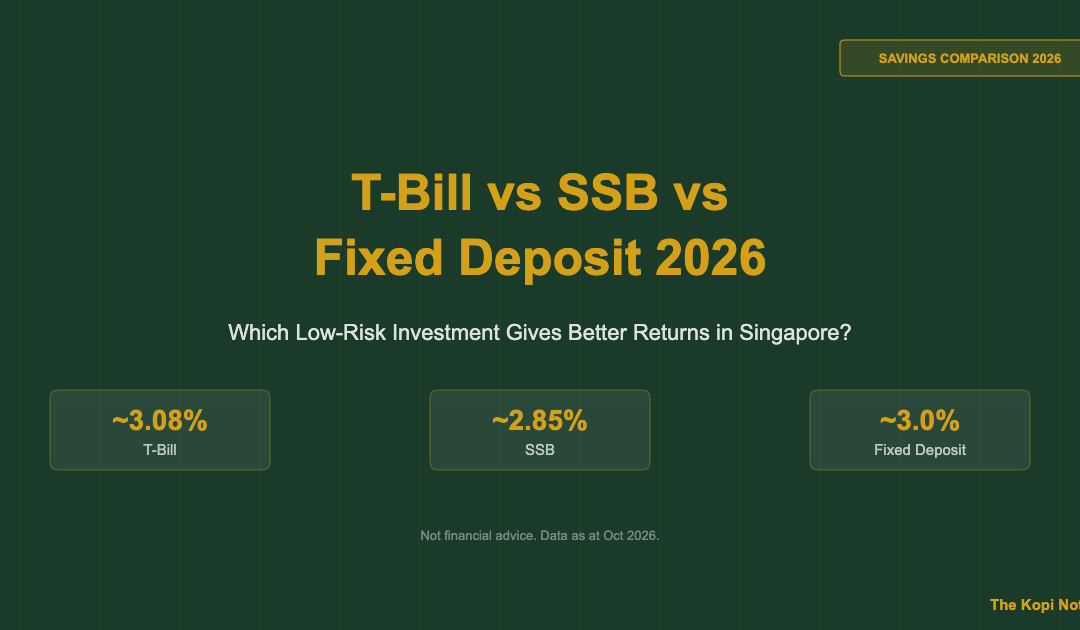
Singapore T-Bills (Treasury Bills), Singapore Savings Bonds (SSB), and fixed deposits are the three most popular low-risk savings instruments for Singapore investors in 2026. T-Bills currently yield around 3.08% for the 6-month tenor, SSB offers approximately 2.85% for year one, and the best fixed deposits come in at 3.05%. Each has different liquidity rules, minimum amounts, and lock-up periods — this guide breaks down exactly which one suits your situation.
Not financial advice. All figures are for educational reference only. Data as at October 2026 unless noted.
What Is Each Instrument?
Before diving into yields, it helps to understand what each product actually is and how it works.
Singapore T-Bills (Treasury Bills)
T-Bills are short-term Singapore government debt securities issued by the Monetary Authority of Singapore (MAS). They are sold at a discount to face value and redeemed at par — the difference is your interest. Key facts:
- Tenors: 6-month and 1-year
- Minimum investment: S$1,000 (multiples of S$1,000)
- Maximum per application: S$1,000,000
- Purchase method: ATM, internet banking (DBS, POSB, OCBC, UOB), CPF Investment Scheme (CPFIS), or SRS
- Auction frequency: 6-month T-Bills are auctioned approximately every 2 weeks; 1-year T-Bills roughly once a month
- Yield (Oct 2026): ~3.08% for 6-month, ~1.92% for 1-year
Singapore Savings Bonds (SSB)
SSB are issued monthly by MAS and offer step-up interest rates over a 10-year holding period. Unlike T-Bills, SSB can be redeemed any month with no penalty — giving you much better liquidity. Key facts:
- Tenor: Up to 10 years (but redeem any month)
- Minimum investment: S$500
- Maximum per person: S$200,000
- Purchase method: DBS/POSB, OCBC, UOB internet banking or ATM; cannot use CPF or SRS
- SSB Oct 2026 yield: ~2.85% in year one, ~2.72% average over 10 years
- Redemption: Submit redemption request by the 4th last business day of any month — funds credited on the 2nd business day of the following month
Fixed Deposits (FD)
Fixed deposits are time deposits offered by banks in Singapore. You lock in a sum for a fixed period (typically 1–24 months) and earn a guaranteed interest rate. Key facts:
- Tenors: 1 month to 24 months (3-month, 6-month, and 12-month most popular)
- Minimum investment: S$1,000 (some banks S$10,000–S$20,000 for best rates)
- Interest payment: At maturity (or some monthly-interest options)
- Early withdrawal: Typically forfeits all interest; no partial withdrawal
- Best rates (Oct 2026): CIMB 6M ~3.05%, BOC 6M ~2.90%, OCBC 6M ~2.50%
Current Yield Comparison (October 2026)
Here is how the three instruments compare on yield as at October 2026:
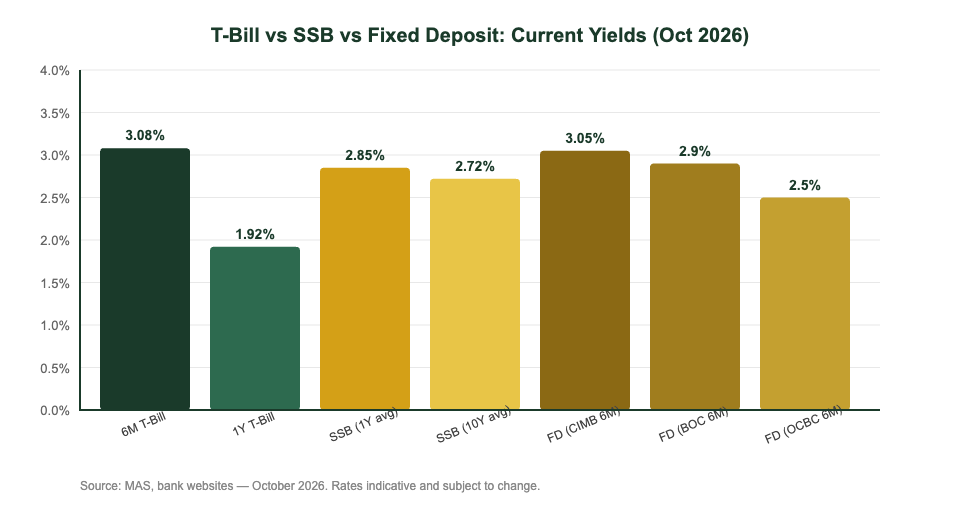
Source: MAS auction results, bank websites — October 2026. Rates are indicative and subject to change at next auction/offer.
Yield Summary Table
| Instrument | Current Rate | Tenor | Guaranteed? | CPF/SRS? |
|---|---|---|---|---|
| 6M T-Bill | 3.08% | 6 months | ✓ (at auction) | ✓ Both |
| 1Y T-Bill | 1.92% | 12 months | ✓ (at auction) | ✓ Both |
| SSB (Year 1) | 2.85% | Flexible (up to 10Y) | ✓ Fixed at issue | ✗ Cash only |
| SSB (10Y avg) | 2.72% | 10 years | ✓ Fixed at issue | ✗ Cash only |
| FD – CIMB 6M | 3.05% | 6 months | ✓ Guaranteed | ✗ Cash only |
| FD – OCBC 6M | 2.50% | 6 months | ✓ Guaranteed | ✗ Cash only |
Source: MAS, CIMB, OCBC, BOC Singapore websites — October 2026. Rates subject to change.
Key takeaway: The 6-month T-Bill currently offers the best government-guaranteed yield at 3.08%, beating SSB year-1 (2.85%) by 23 basis points. However, note that the 1-year T-Bill yields only 1.92% — significantly below the 6-month tenor — suggesting the market anticipates lower rates ahead. The best FDs are competitive with T-Bills but require cash only (no CPF/SRS).
Key Differences: Liquidity, Limits & Lock-Up
Yield is just one dimension. Before you allocate your savings, understand the structural differences between these three instruments:
| Feature | T-Bill (6M) | SSB | Fixed Deposit |
|---|---|---|---|
| Minimum | S$1,000 | S$500 | S$1,000–S$20,000 |
| Maximum | S$1,000,000 | S$200,000 | No limit (SDIC up to S$100K) |
| Early exit? | Sell on secondary market (some spread loss) | ✓ Any month, no penalty | ✗ Forfeit all interest |
| CPF/SRS eligible? | ✓ Both | ✗ Cash only | ✗ Cash only (select banks allow SRS FD) |
| Interest rate risk | Resets every auction (6 months) | Locked at issue — rising rates mean new SSB better | Locked at opening — same as T-Bill but per bank |
| Tax on interest | No withholding tax (SG) | No withholding tax (SG) | No withholding tax (SG) |
| Backed by | Singapore Government (AAA) | Singapore Government (AAA) | Bank + SDIC (up to S$100K) |
Source: MAS, SDIC Singapore — October 2026.
Liquidity winner: SSB. The SSB’s penalty-free monthly redemption makes it the only instrument among the three where you can access your capital quickly without cost. However, SSB’s S$200,000 cap limits large-scale savers. T-Bills and fixed deposits lock capital for their full tenor (though T-Bills can be sold on the secondary market at a spread).
Dollar Impact at Different Portfolio Sizes
Numbers on paper are easier to digest as actual dollars. Here’s what you actually earn per year from each instrument, assuming you roll over a 6-month T-Bill once (simulating a full year), hold SSB for year 1, or place a 6-month fixed deposit twice:
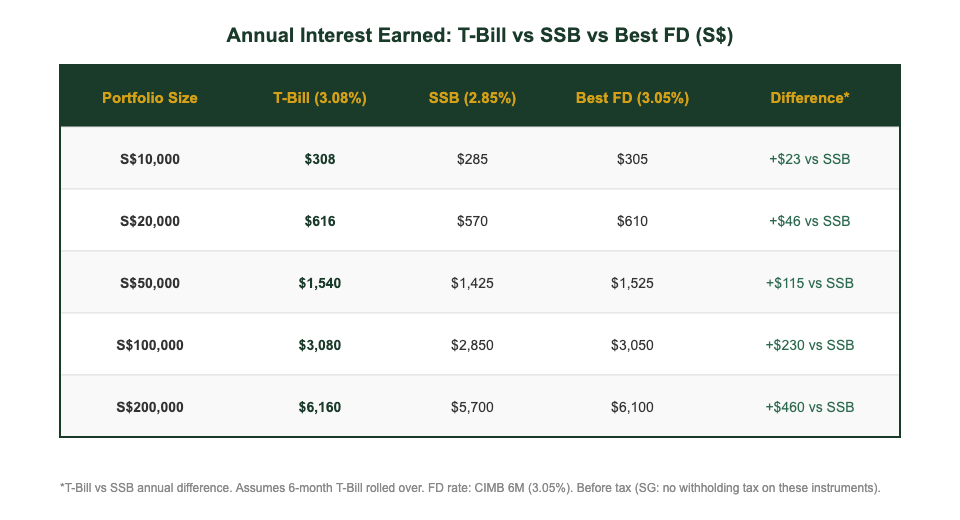
Source: Calculated from MAS and bank rates — October 2026. T-Bill rate assumes 6M roll-over twice. Before tax (no withholding tax on any instrument for SG residents).
On a S$100,000 portfolio, the T-Bill earns S$230 more per year than SSB and S$30 more than the best FD. That S$230 gap is meaningful if your savings horizon is short (6–12 months). But if you need flexibility or have an emergency fund component, SSB’s no-penalty exit is worth paying for.
For amounts above S$200,000, SSB is no longer an option — and you’d split between T-Bills and FDs.
Using CPF-OA and SRS to Buy T-Bills
One major advantage of T-Bills over SSB and fixed deposits is CPF and SRS eligibility. If you have idle CPF Ordinary Account funds earning 2.5% or SRS funds you want to deploy, T-Bills at 3.08% offer a meaningful pickup. Our detailed how to buy T-Bills using CPF-OA and SRS walkthrough covers the application steps in detail.
CPF-OA vs T-Bill: The Trade-Off
CPF-OA earns a guaranteed 2.5% with no lock-up, no application effort, and your funds remain in your account for housing needs. A 6-month T-Bill at 3.08% earns an additional 0.58% — on S$100,000, that’s S$580 extra per year. But during the T-Bill holding period, your CPF-OA funds are tied up and cannot be used for housing.
The arithmetic favours T-Bills for truly idle CPF-OA funds with no near-term housing or investment use. But the administrative cost (application every 6 months, account management) may not be worth it for smaller amounts below S$30,000.
SRS: T-Bills Make Sense for Deployed Funds
SRS funds should ideally be invested or deployed productively — they earn only 0.05% per year if left idle. A T-Bill at 3.08% is one of the simplest, risk-free ways to put SRS money to work while you decide on longer-term investments like Endowus or Syfe portfolio products. Note: SSB and most FDs do not accept SRS.
Next T-Bill Auction: October 22, 2026
The next 6-month T-Bill auction is scheduled for 22 October 2026. Applications close at 9pm the night before (21 October). See the full Singapore T-Bill guide 2026 for application steps and strategy.
Which Should You Choose? A Decision Framework
There is no single best answer — the right instrument depends on your situation. Use this framework:
| Your Situation | Best Choice | Why |
|---|---|---|
| Idle CPF-OA / SRS funds with no near-term housing plans | T-Bill (6M) | Highest yield; CPF/SRS eligible; government-backed |
| Emergency fund component needing quick access | SSB | No-penalty monthly redemption; no early withdrawal risk |
| Short-term savings (6 months), S$20,000+ in cash | T-Bill or FD | Both yield ~3.05-3.08%; FD may have simpler application if no CPF/SRS use |
| Savings for use in 12 months, uncertain timing | SSB | Can exit penalty-free when you need the money |
| Large lump sum (S$200,000+) in cash to deploy | Split: T-Bill + FD | SSB capped at S$200K; spread between T-Bill and top FD for rate competition |
| 1-year horizon, want highest guaranteed rate, no flexibility needed | FD (12M) or 6M T-Bill × 2 | Best FD 12M compares well; rolling T-Bills allows rate reset if conditions improve |
Framework based on rates and structures as at October 2026. Individual circumstances may vary. This is not financial advice.
If you’re building a passive income portfolio alongside low-risk savings, check out our guide to the best S-REITs in Singapore 2026 for the equity income component, and use our Singapore retirement calculator to see how these instruments fit your long-term plan.
The Kopi Notes Verdict
In October 2026, the 6-month T-Bill is the yield winner at 3.08% — and the only one of the three that works with CPF-OA and SRS. If you have idle government-account funds, T-Bills are the straightforward choice.
For cash savings where flexibility matters — an emergency fund, a saving-towards-a-goal bucket, or money you may need within 12 months — SSB at 2.85% with penalty-free exit is worth the 23bps trade-off. No other capital-guaranteed product gives you that kind of liquidity.
The best fixed deposits (CIMB ~3.05%) are a close third on yield — useful when CPF/SRS is not a factor and you’re confident you won’t need the money early. But the lack of any exit option is the key risk to price in.
One word of caution: the 1-year T-Bill at only 1.92% signals the market expects significantly lower rates in 12 months. That makes rolling short-term (6M T-Bills) or locking into SSB now — where rates are fixed at purchase — a reasonable hedge against future rate cuts.
Frequently Asked Questions
Which is the best low-risk investment in Singapore in 2026 — T-Bill, SSB, or Fixed Deposit?
Can I put CPF money into Singapore Savings Bonds or Fixed Deposits?
What happens if I need my money back before a T-Bill or Fixed Deposit matures?
Why is the 1-year T-Bill yield (1.92%) so much lower than the 6-month T-Bill (3.08%)?
Is S$200,000 really the maximum for SSB? What if I want to invest more?
Are there any taxes on T-Bill, SSB, or Fixed Deposit interest in Singapore?
How do I apply for a T-Bill or SSB?
This article was researched with the help of AI. While we strive to keep all information accurate and up to date, there may be errors. If you notice any discrepancies, please contact us.