Suntec REIT vs Keppel REIT 2026: Which Singapore Office REIT Pays More?
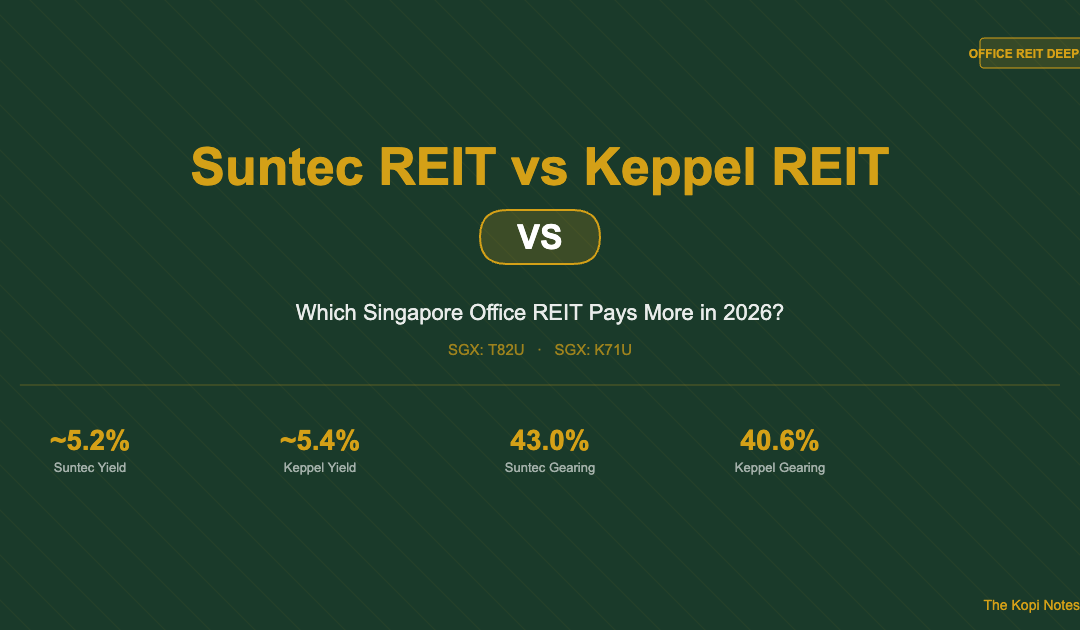
Suntec REIT (SGX: T82U) and Keppel REIT (SGX: K71U) are Singapore’s two most widely-held office-focused REITs — but they differ meaningfully in portfolio mix, gearing, and DPU trajectory. In 2026, Suntec’s mixed-use exposure is driving a strong DPU recovery (+24.8% in 1H26), while Keppel’s pure Grade A focus and lower gearing (40.6% vs 43.0%) appeal to defensive income investors. This deep-dive compares them head-to-head across yield, financials, and portfolio quality.
Not financial advice. All figures are for educational reference only. Data as at October 2026 unless noted.
Table of Contents
Jump to Section
Suntec REIT vs Keppel REIT: Quick Comparison 2026
Here’s how the two Singapore office REITs stack up on the key metrics that matter most to dividend investors:
| Metric | Suntec REIT (T82U) | Keppel REIT (K71U) |
|---|---|---|
| SGX Code | T82U | K71U |
| REIT Focus | Mixed (Office + Retail) | Pure Office (Grade A) |
| 1H 2026 DPU | 3.936¢ (+24.8% YoY) | ~2.4¢ (est.) |
| Forward Yield | ~5.2% | ~5.4% |
| Aggregate Leverage | 43.0% | 40.6% |
| Interest Coverage (ICR) | 2.2× | 3.1× |
| All-in Debt Cost | 3.55% p.a. | N/A |
| Committed Occupancy | 99.5% | ~97–98% |
| Overseas Exposure | Australia + UK (~40%) | Australia + Korea + Japan (~25%) |
| Analyst Rating | HOLD (Maybank TP: SGD 1.56) | Indicative buy range |
Source: Company 1H 2026 results, Maybank Research (Jul 2026), The Smart Investor. Data as at October 2026.
What Is Suntec REIT? (SGX: T82U)
Suntec REIT is Singapore’s first integrated commercial REIT and one of the best S-REITs in Singapore 2026 for investors seeking mixed-use commercial exposure. It owns a portfolio of office and retail assets across Singapore, Australia, and the United Kingdom.
Its flagship asset is Suntec City — a landmark mixed-use development in Marina Bay comprising five Grade A office towers and a 1.0 million sq ft retail mall. Beyond Suntec City, the REIT holds significant co-ownership interests in several premium Singapore CBD properties.
Suntec REIT’s Singapore Portfolio
- Suntec City Office Towers (5 towers, Grade A)
- Suntec City Mall (~1.0 million sq ft retail)
- One Raffles Quay — 1/3 interest (shared with Keppel REIT and MBFC Trust)
- Marina Bay Financial Centre (MBFC) Towers 1, 2 & Premium — 1/3 interests each
- 9 Penang Road (commercial office)
Overseas Assets
- Australia: 177 Pacific Highway (Sydney), 21 Harris Street (Pyrmont), Olderfleet 477 Collins Street (Melbourne), and others
- United Kingdom: Nova Properties, 21 Moorfields — premium London office assets
In 1H 2026, Suntec’s Singapore operations outperformed expectations. DPU rose 24.8% year-on-year to 3.936 Singapore cents, partly reflecting lower finance costs as the REIT refinanced at tighter spreads. Net property income came in at SGD 159.0 million (down a modest 0.3% YoY), while committed occupancy held steady at an impressive 99.5% across both office and retail. Maybank maintained a HOLD rating with a target price of SGD 1.56 as at July 2026, noting that the DPU recovery was partially driven by finance cost savings rather than NPI growth.
What Is Keppel REIT? (SGX: K71U)
Keppel REIT is a pure-play commercial Grade A office REIT. Unlike Suntec’s mixed-use model, Keppel REIT focuses exclusively on premium office buildings in core CBD locations across Singapore, Australia, South Korea, and Japan. This makes it one of the more defensive options in the Singapore office REIT segment for investors focused on building passive income in Singapore.
Keppel REIT’s Portfolio Highlights
- Singapore: Ocean Financial Centre, One Raffles Quay (1/3 interest), MBFC Tower 3 (1/3 interest)
- Australia: 8 Exhibition Street (Melbourne), 275 George Street (Brisbane), David Malcolm Justice Centre (Perth)
- South Korea: T Tower (Seoul CBD)
- Japan: Osaka office interests
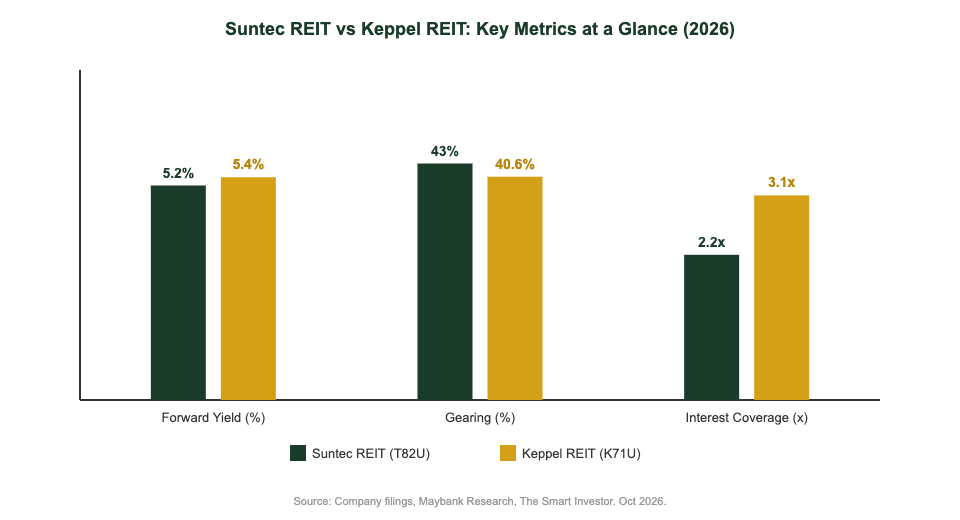
Keppel REIT’s forward yield of approximately 5.4% is marginally higher than Suntec’s, supported by a cleaner balance sheet — aggregate leverage of 40.6% and an interest coverage ratio of 3.1× (vs Suntec’s 2.2×). The stronger ICR means Keppel REIT has more headroom to service its debt even if interest rates were to increase again, and more capacity to fund acquisitions without immediate recourse to equity issuance.
Keppel REIT’s pure-office focus also means its NPI is not exposed to the retail sector’s ongoing structural headwinds — a key differentiator from Suntec REIT, which must manage Suntec City Mall’s leasing dynamics alongside its office towers.
DPU and Distribution Comparison 2026
The most important metric for REIT income investors is Distribution Per Unit (DPU). Here’s how the two REITs compare in 2026:
Suntec REIT 1H 2026 DPU: 3.936 Singapore cents — up 24.8% from the same period last year. The strong growth was driven primarily by lower all-in financing costs (now at 3.55% p.a.) as maturing high-rate debt was refinanced at more favourable spreads in the falling-rate environment. If this run-rate holds, full-year 2026 DPU could reach approximately 7.5–7.9 Singapore cents, implying a forward yield of around 5.0–5.2% at the mid-2026 price of ~SGD 1.52.
Keppel REIT trades at a forward yield of approximately 5.4%, with its DPU supported by stable long-term office leases. Across both REITs, yields fall in a relatively narrow 5.0–5.5% band — the difference in income is modest at small investment sizes but material at larger portfolio allocations.
Source: Company filings, Maybank Research (Jul 2026), The Smart Investor. Oct 2026.
A critical nuance: Suntec’s DPU growth in 2026 is partly cyclical (driven by lower finance costs) rather than purely structural (higher NPI). Investors should monitor whether NPI growth resumes as Australian and UK assets stabilise. Keppel REIT’s DPU is more stable but offers less “catch-up” upside.
Gearing, Debt and Financial Health
For S-REIT investors building a portfolio toward Singapore retirement income goals, balance sheet health is as important as yield. A REIT with excessive gearing or poor debt coverage can be forced to cut DPU or issue rights when rates rise or property values fall.
| Financial Metric | Suntec REIT (T82U) | Keppel REIT (K71U) | MAS Regulatory Limit |
|---|---|---|---|
| Aggregate Leverage | 43.0% | 40.6% | 50.0% |
| Buffer to Regulatory Limit | 7.0 ppts | 9.4 ppts | — |
| Interest Coverage Ratio (ICR) | 2.2× | 3.1× | Min 1.5× |
| All-in Debt Cost | 3.55% p.a. | N/A | — |
| Analyst Rating | HOLD (Maybank, Jul 2026) | Indicative buy range | — |
Source: Suntec REIT 1H 2026 results; Maybank Research Jul 2026; The Smart Investor. Oct 2026.
Keppel REIT’s 9.4 percentage-point buffer to the MAS gearing limit gives it meaningfully more debt headroom for acquisitions or AEI without needing equity dilution. Suntec REIT’s 7.0 ppt buffer is adequate but tighter, especially given its higher exposure to overseas market fluctuations.
Suntec’s lower ICR of 2.2× (vs Keppel’s 3.1×) is the more significant concern — it means for every SGD 1 of debt service, Suntec generates only SGD 2.20 in net income, leaving less margin for error in a volatile rate environment. Singapore REITs with ICRs below 2.5× are generally viewed as higher financial risk. However, Suntec’s improving debt cost (3.55%) and near-full occupancy (99.5%) suggest the ICR should improve as more debt cycles through at current market rates.
Portfolio Quality: Occupancy, Asset Mix and Geographic Reach
Beyond yield and gearing, the quality of a REIT’s property portfolio determines its long-term income sustainability. Singapore Grade A office properties continued to command premium rents in 2026, supported by strong demand from financial services, tech, and AI-adjacent occupiers.
| Portfolio Metric | Suntec REIT | Keppel REIT |
|---|---|---|
| Singapore Committed Occupancy | 99.5% (office + retail) | ~97–99% (office) |
| Asset Type | Mixed-use (Office + Retail) | Grade A Office only |
| Overseas Exposure | ~40% (AUS + UK) | ~25% (AUS + KOR + JPN) |
| Key Singapore Assets | Suntec City, ORQ, MBFC | Ocean Financial Centre, ORQ, MBFC |
| AEI Pipeline | Suntec City Mall AEI ongoing | Minimal (Grade A, less AEI needed) |
| Singapore CBD Focus | Marina Bay + City Hall | Marina Bay + Raffles Place |
Source: Company investor presentations, SGX filings. Oct 2026.
Both REITs share interests in some of the same Singapore assets — most notably One Raffles Quay and MBFC — creating some overlap in their Singapore portfolio exposure. Suntec’s near-100% occupancy is a major positive, but its higher overseas exposure (~40% from Australia and UK) introduces more currency risk and sensitivity to non-Singapore property market dynamics.
Keppel REIT’s pure Grade A office focus attracts premium, long-term corporate tenants with stable multi-year leases, typically yielding a WALE (Weighted Average Lease Expiry) in the 5–6 year range. For a full view of the S-REIT landscape beyond just office, see our guide to the best S-REITs in Singapore 2026.
Projected Annual Dividend Income: Suntec vs Keppel REIT
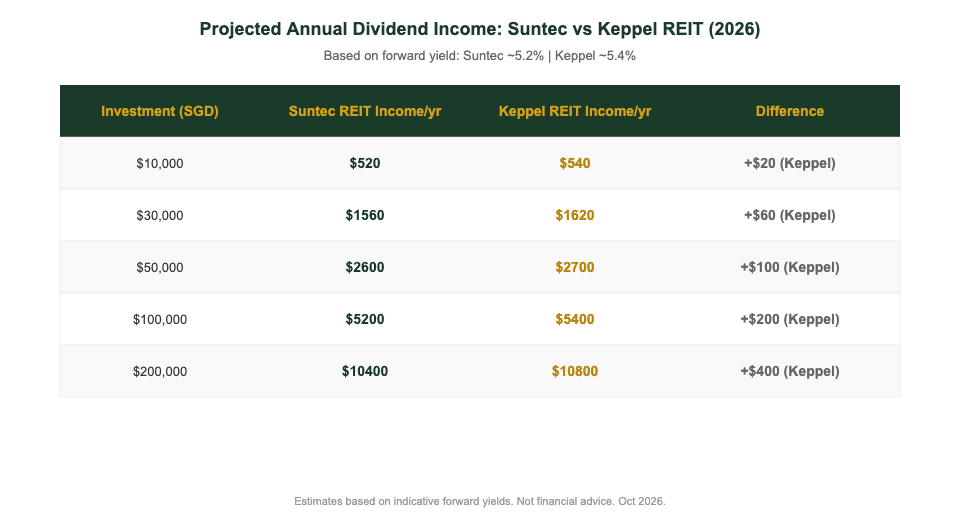
How much annual income would you actually receive from each REIT? Here’s a breakdown at common investment sizes for Singapore investors. Use our Singapore retirement calculator to model how REIT dividend income fits your overall passive income goal.
Projections based on indicative forward yields: Suntec ~5.2%, Keppel ~5.4%. Actual income will vary with price movements, DPU changes, and currency fluctuations. Not financial advice.
At most common investment sizes, the income difference between the two REITs is modest — approximately SGD 20/year on a SGD 10,000 position. At higher allocations (SGD 200,000+), Keppel REIT’s extra ~0.2 ppt yield contributes an additional ~SGD 400/year in income.
Both platforms like Syfe and FSMOne offer cost-effective access to T82U and K71U with low transaction costs. If you’re comparing against risk-free alternatives, see how their yields benchmark against the Singapore T-bills 2026 guide.
Which Singapore Office REIT Should You Buy in 2026?
There is no single correct answer — the better choice depends on your investment objectives, risk tolerance, and portfolio composition. Here’s how to think through the decision:
Choose Keppel REIT (K71U) if you want…
- A more defensive, conservative position with lower gearing and stronger interest coverage
- Pure office exposure without retail sector risk from Suntec City Mall
- A slightly higher yield (~5.4% vs ~5.2%) with a cleaner balance sheet and more acquisition headroom
- Stable, long-term DPU underpinned by premium corporate tenants with multi-year leases
Choose Suntec REIT (T82U) if you want…
- Exposure to a genuine DPU recovery story — Suntec’s 24.8% 1H26 DPU growth signals upward momentum as high-cost debt rolls off
- Mixed-use diversification across office and retail, both in Singapore’s premier Marina Bay precinct
- Comfort with slightly higher gearing (43.0%) in exchange for potential income growth in 2027
- Suntec City’s irreplaceable Marina Bay location and integrated commercial ecosystem
The Case for Holding Both
Many Singapore income investors hold both REITs as complementary positions: Keppel REIT for balance sheet stability and defensive income, Suntec REIT for DPU growth potential and mixed-use diversification. Together, they provide two distinct angles on Singapore’s Grade A office market within a single portfolio.
This article does not constitute financial advice. Please conduct your own due diligence and consult a licensed financial adviser before making investment decisions.
Frequently Asked Questions: Suntec REIT vs Keppel REIT
What is the main difference between Suntec REIT and Keppel REIT?
Suntec REIT (SGX: T82U) is a mixed-use commercial REIT owning both Grade A office towers and Suntec City Mall (retail), plus overseas assets in Australia and the UK. Keppel REIT (SGX: K71U) is a pure-play Grade A office REIT with no retail exposure, focusing exclusively on premium office buildings in Singapore, Australia, South Korea, and Japan. Suntec offers more diversification across asset types; Keppel offers a purer, more defensive office income stream with stronger balance sheet metrics.
Which REIT has a higher dividend yield in 2026 — Suntec or Keppel?
Based on indicative forward yields as at October 2026, Keppel REIT offers a marginally higher yield of approximately 5.4%, compared to Suntec REIT’s ~5.2%. However, Suntec’s 1H 2026 DPU growth of 24.8% YoY means its full-year DPU trajectory is improving, which could narrow or reverse this gap in 2027 if the recovery momentum continues.
Is Suntec REIT a buy in 2026?
As at July 2026, Maybank rated Suntec REIT as HOLD with a target price of SGD 1.56, indicating modest upside from the then-current price of ~SGD 1.52. The strong 1H26 DPU growth is a positive catalyst, but the relatively high gearing (43.0%) and lower ICR (2.2×) represent risk factors. Suntec may suit investors already holding Singapore office exposure who want DPU recovery upside, but it carries more financial risk than Keppel REIT. Always conduct your own due diligence.
What is Suntec REIT's gearing ratio in 2026?
Suntec REIT’s aggregate leverage (gearing) stood at approximately 43.0% as reported by Maybank in July 2026. This is below the MAS regulatory limit of 50% but above Keppel REIT’s 40.6%. Higher gearing amplifies both upside (higher DPU when financing costs fall) and downside (DPU cuts when rates rise or asset values decline). Suntec’s 7.0 percentage-point buffer to the MAS limit is adequate but relatively tight compared to sector peers.
How do I buy Suntec REIT or Keppel REIT in Singapore?
Both T82U (Suntec REIT) and K71U (Keppel REIT) are listed on the Singapore Exchange (SGX) and can be purchased through any Singapore brokerage with SGX access. Platforms like Syfe and FSMOne offer cost-effective access with dividend reinvestment features. Both REITs may also be held through the CPF Investment Scheme (CPFIS) subject to applicable rules — check with your broker or CPF Board for current eligibility.
Can I use SRS or CPF to invest in Suntec REIT and Keppel REIT?
Yes — both Suntec REIT and Keppel REIT are listed SGX securities generally eligible for purchase under the CPF Investment Scheme (CPFIS-OA and CPFIS-SA, subject to prevailing rules) and via Supplementary Retirement Scheme (SRS) accounts through approved brokers. Investing in S-REITs via SRS allows you to defer tax on investment gains and distributions until withdrawal, enhancing long-term after-tax income. Always confirm current eligibility directly with your broker or the CPF Board, as rules and approved investment lists may change.
This article was researched with the help of AI. While we strive to keep all information accurate and up to date, there may be errors. If you notice any discrepancies, please contact us.