S-REIT DEEP DIVE · SGX: AJBU
Keppel DC REIT Review 2026: Share Price, DPU & Yield Analysis
Asia’s first data centre REIT — complete investor guide covering portfolio, financials, valuation and how to buy in Singapore.
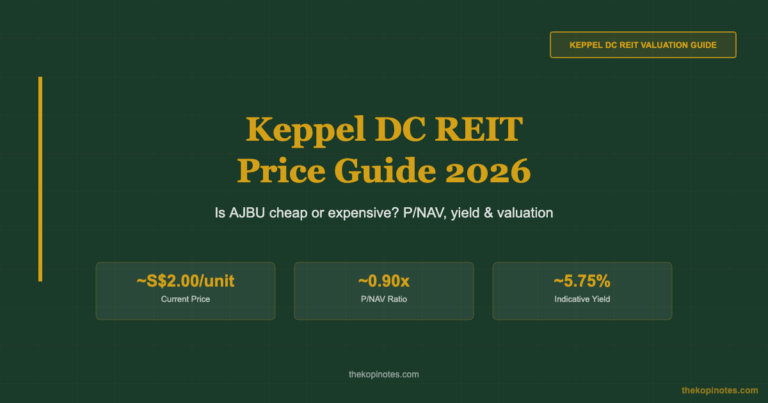
Keppel DC REIT (SGX: AJBU) is Singapore’s and Asia’s first pure-play data centre REIT, listed on the SGX in December 2014. With a portfolio of over 23 data centres spanning 10 countries, it offers Singapore investors exposure to the booming digital infrastructure sector. As at October 2026, KDC REIT trades at approximately SGD 1.90–2.10, offering a trailing yield of around 4.5–5% and a distribution per unit (DPU) of approximately 9.0 cents per year — paid semi-annually.
Not financial advice. All figures are for educational reference only. Data as at October 2026 unless noted.
What is Keppel DC REIT?
Keppel DC REIT is a Singapore-listed Real Estate Investment Trust (REIT) that owns and invests in a diversified portfolio of income-producing data centre assets. Managed by Keppel DC REIT Management Pte. Ltd. — a wholly-owned subsidiary of Keppel Ltd — it became the first data centre REIT to list in Asia when it debuted on the Singapore Exchange (SGX) on 12 December 2014.
Data centres are the physical facilities that house servers, networking equipment, and storage infrastructure that power the internet — from cloud computing (AWS, Google Cloud, Microsoft Azure) to streaming services and enterprise IT systems. As Singapore cements its position as Southeast Asia’s digital hub, demand for high-quality, carrier-neutral colocation data centres continues to outpace supply, creating a structurally favourable environment for KDC REIT’s assets.
Why KDC REIT is different from most S-REITs: Unlike commercial, retail, or industrial property REITs, KDC REIT generates income from long-term master leases and colocation agreements with hyperscale cloud providers, financial institutions, and government agencies — tenants with very high switching costs and low churn rates. This structural “stickiness” is a key reason data centre REITs command premium valuations.
Key Facts at a Glance
| Metric | Value (Oct 2026) |
|---|---|
| SGX Ticker | AJBU |
| Listed | December 2014 (Asia’s first data centre REIT) |
| Number of Assets | ~23 data centres |
| Countries | 10 (SG, AU, DE, NL, IT, IE, UK, MY, CN + others) |
| Portfolio Valuation | ~SGD 3.6 billion |
| Occupancy Rate | ~98% |
| WALE (by NLA) | ~7.5 years |
| Gearing Ratio | ~35–36% |
| Distribution Frequency | Semi-annual (H1 and H2) |
| Manager | Keppel DC REIT Management Pte. Ltd. |
Source: Keppel DC REIT Investor Relations, SGX filings, October 2026.
Portfolio Overview: Singapore and International Assets
KDC REIT’s geographically diversified portfolio spans two key regions — Asia Pacific and Europe — with Singapore remaining the largest concentration at approximately 35–40% of portfolio value.
Singapore Portfolio (Core Assets)
Singapore hosts KDC REIT’s most valuable and strategic assets. Key Singapore facilities include Keppel DC Singapore 1 (DC1) in Keppel Bay, Keppel DC Singapore 2 (DC2) in Tampines, and several purpose-built Tier 3+ colocation facilities. These assets benefit from Singapore’s political stability, world-class connectivity, Tier 1 submarine cable landings, and its role as the preferred domicile for regional cloud operations by hyperscalers.
Singapore data centres command structurally premium rents. After years under a government-imposed data centre moratorium (selectively lifted from 2022 onward), new supply remains tightly controlled even as AI-driven demand accelerates. The average power usage effectiveness (PUE) of Singapore’s newer facilities exceeds global benchmarks, making them preferred by efficiency-conscious hyperscale tenants.
International Portfolio
The international portfolio provides geographic diversification and exposure to high-demand European digital infrastructure markets driven by GDPR data sovereignty requirements:
- Australia (6 assets): Sydney and Melbourne markets serving hyperscale and enterprise clients; strong AUD-denominated income base
- Germany (3 assets): Frankfurt is Europe’s internet hub and primary data centre market; strong rental growth driven by AI and enterprise demand
- Netherlands (2 assets): Amsterdam is a critical European internet exchange point; home to AMS-IX, one of the world’s largest internet exchanges
- Malaysia (2 assets): Johor’s proximity to Singapore creates a “digital spillover” play as Singapore land constraints push tenants across the causeway
- China (2 assets): Guangdong province; serves domestic cloud providers; note regulatory/geopolitical risk as a factor
For Singapore investors building passive income in Singapore through REITs, KDC REIT’s global portfolio provides an effective geographic hedge while maintaining SGD-denominated distributions.
DPU and Financial Performance
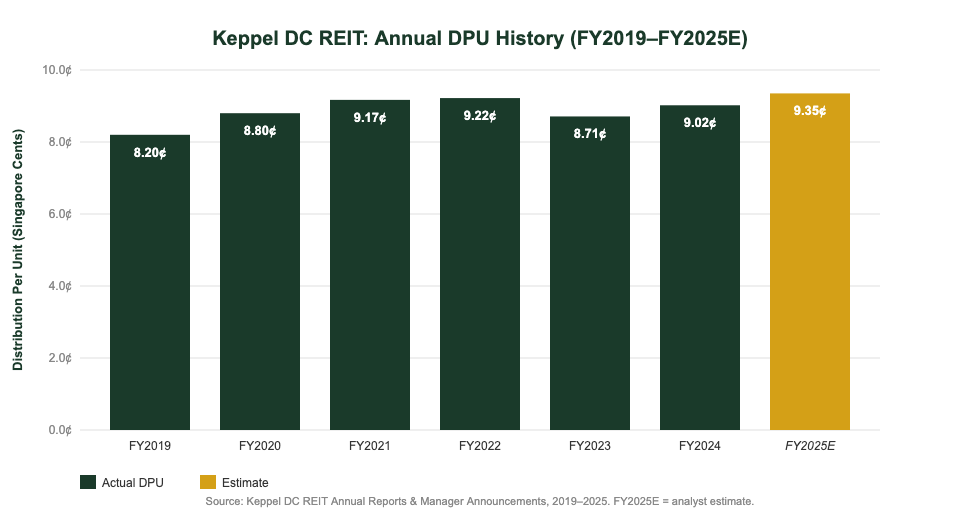
KDC REIT’s distribution per unit (DPU) history reflects the strong but occasionally volatile nature of data centre REIT income. While portfolio occupancy has remained near 100%, earnings have been affected by FX movements, interest rate changes, and one-off transaction costs.
DPU Analysis: Key Observations
- Growth phase (FY2019–FY2022): DPU grew steadily from 8.20 cents to 9.22 cents as the portfolio expanded through acquisitions in Europe and Australia. Organic growth was supported by fixed rental escalations built into master leases (typically 1–3% per annum).
- FY2023 dip to 8.71 cents: A combination of sharply higher borrowing costs, FX headwinds (EUR and AUD weakened against SGD), and increased expenses temporarily compressed DPU — mirroring the broader S-REIT sector experience during the global rate-hike cycle.
- FY2024 recovery to ~9.02 cents: As interest rates stabilised and forward hedging programmes took effect, DPU recovered. AI-driven demand also began flowing through to rental renewals at higher rates in key markets.
- FY2025E of ~9.35 cents: Analyst consensus points to continued recovery as central bank rate cuts reduce refinancing costs and AI infrastructure demand drives occupancy and rental reversion upwards.
Revenue Breakdown by Geography
| Geography | % of Revenue | Currency | Notes |
|---|---|---|---|
| Singapore | ~38% | SGD | Stable; long master leases; no FX risk |
| Australia | ~22% | AUD | Hyperscale growth; AUD/SGD exposure |
| Europe | ~28% | EUR | GDPR tailwind; Frankfurt/Amsterdam markets |
| Malaysia | ~7% | MYR | Growing market; lower yield |
| China | ~5% | CNY | Domestic cloud providers; geopolitical risk |
Source: Keppel DC REIT Annual Report estimates. Percentages are approximate.
Singapore investors should note that approximately 62% of revenue is sourced from non-SGD currencies. KDC REIT’s management employs a rolling FX hedging programme (12–24 months forward), but residual FX risk in DPU remains — particularly from EUR and AUD movements. If you’re modelling how this income fits into your retirement plan, use our Singapore retirement calculator to project how a KDC REIT position could contribute to your passive income target.
Share Price and Valuation Analysis
Keppel DC REIT has historically traded at a premium to its net asset value (NAV) — the market’s recognition of the scarcity, quality, and growth profile of data centre assets. After the rate-driven de-rating of 2022–2023, valuations have moderated, potentially offering a more attractive entry point in 2026.
Valuation Snapshot
| Metric | FY2024 / Oct 2026 | Interpretation |
|---|---|---|
| Share Price Range (2026) | SGD 1.90–2.15 | 52-week trading range |
| NAV Per Unit | ~SGD 1.75 | Book value per unit after liabilities |
| Price-to-NAV | ~1.09–1.23x | Premium to book; lower than historical peak |
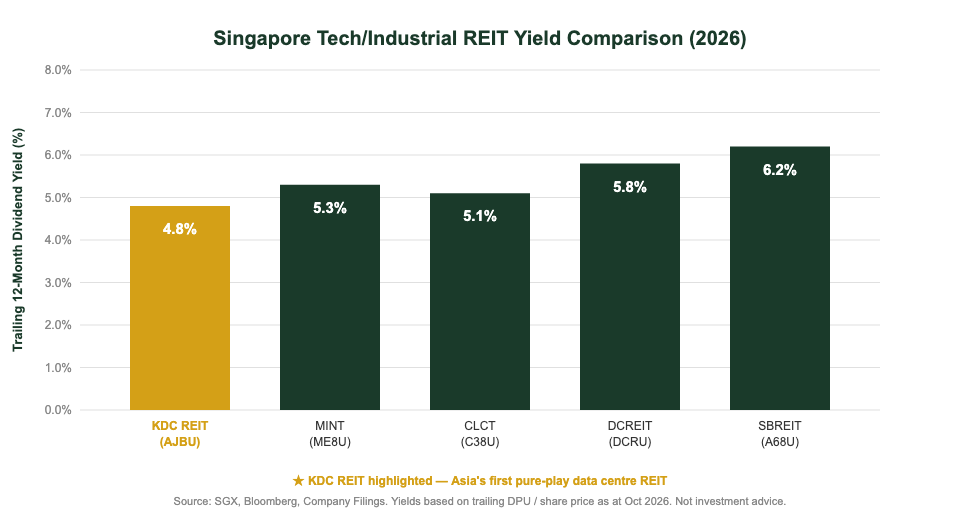
| Trailing Dividend Yield | ~4.5–4.8% | FY2024 DPU / current share price |
| Forward Yield (FY2025E) | ~4.7–5.0% | Based on estimated DPU of 9.35 cents |
| Gearing Ratio | ~35–36% | ~14pp headroom below MAS 50% limit |
Source: SGX, KDC REIT IR materials, Bloomberg estimates, October 2026. Not investment advice.
How KDC REIT Compares to Other S-REITs
Compared to traditional S-REITs in retail or office segments, KDC REIT offers a lower headline yield (4.5–5% vs 5.5–7% for commercial REITs) but compensates with:
- Structural growth tailwind: AI, cloud computing, and 5G are permanently increasing data centre demand — this is not a cyclical story
- Near-100% occupancy: Demand consistently exceeds supply in Singapore and key European markets, with no meaningful vacancy risk
- Long WALE of 7+ years: Income visibility is exceptional compared to office (3–4 years) or retail REITs (2–3 years)
- Built-in rental escalations: Most master leases include fixed annual rent increases of 1–3%, providing an inflation-linked income floor
For a broader comparison of top-yielding REITs in Singapore, including how KDC stacks up against industrial and commercial alternatives, see our comprehensive guide to the best S-REITs in Singapore 2026.
Key Risk Factors
1. Tenant Concentration Risk
A meaningful portion of KDC REIT’s Singapore revenue is derived from a small number of large master tenants. If a key tenant were to downsize or exit at lease expiry, it could materially impact DPU. The manager mitigates this through long master leases (7+ year WALE) and diversification across tenant types and geographies.
2. Interest Rate Sensitivity
Like all leveraged REITs, KDC REIT uses debt (~35% gearing) to enhance returns. When interest rates rise, refinancing costs increase, compressing net income and DPU. Approximately 80% of borrowings are on fixed rates or hedged — providing near-term protection — but this risk resurfaces at each refinancing event.
3. Foreign Exchange Volatility
With ~62% of revenue in non-SGD currencies, meaningful EUR, AUD, or GBP depreciation against SGD reduces SGD-equivalent DPU. The management hedges 12–24 months of forward income, but long-term structural FX risk remains unhedged. Singapore investors should factor in their personal view on EUR/SGD and AUD/SGD trends.
4. Technology Obsolescence Risk
While extremely unlikely in the medium term, data centres could theoretically face disruption from edge computing decentralisation or quantum computing reducing centralised processing needs. The manager’s focus on Tier 3+ facilities with high power densities suited to AI workloads mitigates this risk for the foreseeable decade.
5. China Asset Risk
KDC REIT’s Chinese assets (~5% of portfolio) are exposed to regulatory and geopolitical risks specific to China. The small weighting limits portfolio-level impact, but it warrants monitoring given the current US-China technology tensions and potential data sovereignty regulations.
6. Singapore New Supply Risk
After years of moratorium, MAS and EDB have been selectively approving new data centres. A significant relaxation of supply controls could put pressure on Singapore rents at renewal. However, combined land scarcity and power capacity constraints make a large supply surge structurally difficult.
How to Buy Keppel DC REIT in Singapore
Keppel DC REIT (SGX: AJBU) can be purchased through any SGX-connected brokerage. Here are the most popular platforms for Singapore retail investors, along with referral bonuses where available:
| Broker | Min Commission | Best For | Bonus |
|---|---|---|---|
| IBKR | SGD 2.50 or 0.08% | Active traders | Broker comparison | Code: jianxiong368 |
| Syfe Trade | SGD 0.99 | Beginners | Syfe referral code and sign-up bonus |
| FSMOne | SGD 10 or 0.08% | RSP / REIT focus | FSMOne referral code |
| Endowus | 0.3% access fee | CPF / SRS investors | Endowus referral code |
Commissions correct as at Oct 2026. Verify on each broker’s website before transacting. TKN may receive referral compensation from some platforms.
CPF and SRS Investing: KDC REIT is CPF Investment Scheme (CPFIS)-approved — Singapore citizens and PRs can use their CPF Ordinary Account (OA) funds to buy AJBU units through CPFIS-approved brokerages. KDC REIT is also eligible for SRS (Supplementary Retirement Scheme) investment via platforms such as Endowus, giving investors further tax efficiency on top of the REIT’s regular distributions.
Frequently Asked Questions
What is Keppel DC REIT's current dividend yield?
As at October 2026, Keppel DC REIT (SGX: AJBU) offers a trailing dividend yield of approximately 4.5–4.8%, based on the FY2024 DPU of ~9.02 cents and a share price in the SGD 1.90–2.10 range. The forward yield for FY2025 is estimated at 4.7–5.0% based on analyst DPU estimates of ~9.35 cents. Distributions are paid semi-annually — once for H1 and once for H2.
Is Keppel DC REIT a good investment for Singapore investors?
KDC REIT has strong structural fundamentals: near-100% occupancy, a WALE of 7+ years, AI and cloud computing-driven demand growth, and a diversified global portfolio. However, it trades at a premium to NAV (~1.1x) and offers a lower headline yield than most commercial S-REITs. It suits investors who prioritise long-term income stability and growth over maximum current yield. This article is educational only — always conduct your own due diligence and consult a licensed financial advisor before investing.
Can I use CPF OA to buy Keppel DC REIT?
Yes. Keppel DC REIT (SGX: AJBU) is on the CPF Investment Scheme (CPFIS) approved list, meaning Singapore citizens and PRs can invest their CPF Ordinary Account savings in AJBU units through CPFIS-approved brokerages (e.g. FSMOne, OCBC Securities, DBS Vickers). Standard CPFIS limits apply — you can invest up to 35% of your investible savings in stocks/REITs and up to 10% in single counter positions. You can also invest KDC REIT via SRS funds through Endowus — use our Endowus referral code for a welcome bonus.
What is Keppel DC REIT's WALE?
As at the latest reporting period, Keppel DC REIT’s Weighted Average Lease Expiry (WALE) by net lettable area (NLA) was approximately 7.5 years. This is significantly longer than retail REITs (~2–3 years) or office REITs (~3–4 years), providing exceptional income visibility. Data centre master leases typically run for 5–15 years, reflecting the significant upfront capital tenants invest in customising facilities for their specific power and cooling requirements.
How does KDC REIT manage FX risk?
With approximately 62% of revenue in non-SGD currencies (EUR, AUD, GBP, MYR, CNY), FX volatility is a genuine risk factor in KDC REIT’s DPU. The manager employs a rolling FX hedging programme — typically hedging 12–24 months of forward foreign income receipts using currency forward contracts. This smooths short-term FX volatility but does not eliminate long-term structural FX risk. Singapore investors should consider how EUR or AUD depreciation against SGD could affect their SGD-equivalent distributions.
What is KDC REIT's gearing ratio and acquisition headroom?
As at the most recent filing, KDC REIT’s aggregate leverage (gearing) was approximately 35–36%, well below the MAS regulatory maximum of 50%. This leaves approximately SGD 500–700 million of debt headroom for potential acquisitions without needing to conduct an equity fundraising. The manager has historically been disciplined on acquisitions, prioritising yield-accretive deals in Singapore, Australia, and Europe. Conservative gearing is also a positive signal for distribution sustainability during higher interest rate environments.
Conclusion: Is Keppel DC REIT Right for Your Portfolio?
Keppel DC REIT occupies a unique position in the Singapore REIT landscape — it is the only pure-play data centre REIT that is both SGX-listed and CPFIS-eligible, giving Singapore retail investors access to digital infrastructure without needing a foreign brokerage account or currency conversion.
Its structural tailwinds (AI, cloud, 5G), near-100% occupancy, long WALE, and SGD distributions make it a quality income-growth hybrid in any Singapore REIT portfolio. The trade-off is a lower headline yield than commercial S-REITs and some FX complexity in the non-SGD portfolio.
For investors comfortable with a 4.5–5% yield who want the long-term growth profile of digital infrastructure baked in — particularly as AI-driven data centre demand accelerates — KDC REIT deserves serious consideration as a core portfolio holding. Compare it alongside other options in our guide to passive income in Singapore through S-REITs.
Disclaimer: This article is for educational purposes only and does not constitute financial or investment advice. Past DPU performance does not guarantee future distributions. Please consult a licensed financial adviser before making investment decisions.
This article was researched with the help of AI. While we strive to keep all information accurate and up to date, there may be errors. If you notice any discrepancies, please contact us.