Keppel DC REIT Rights Issue & Preferential Offering Guide 2026 (SGX: AJBU)
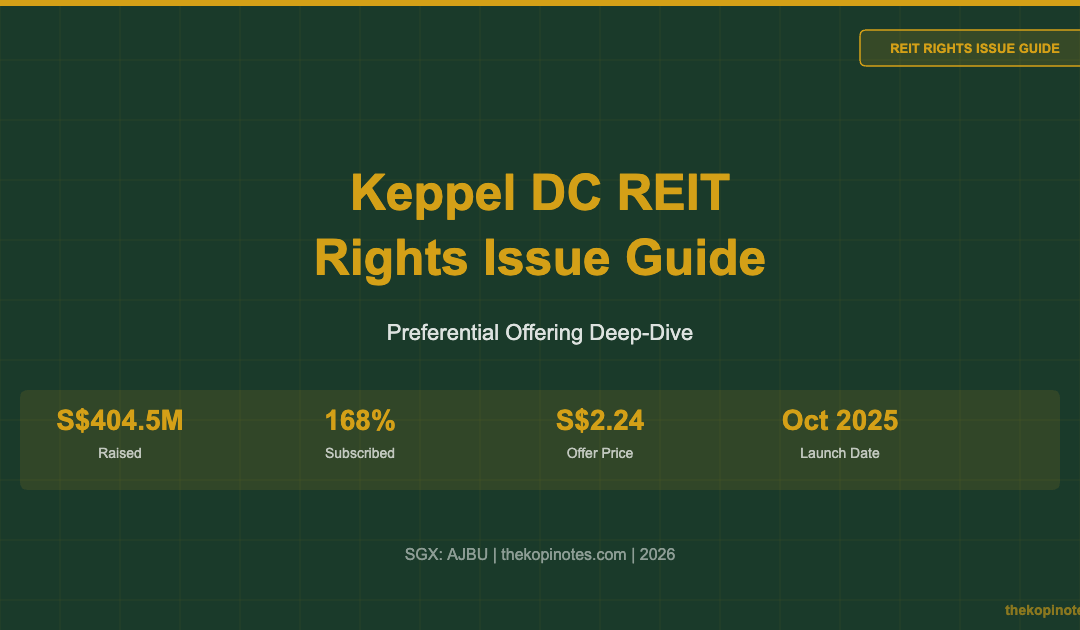
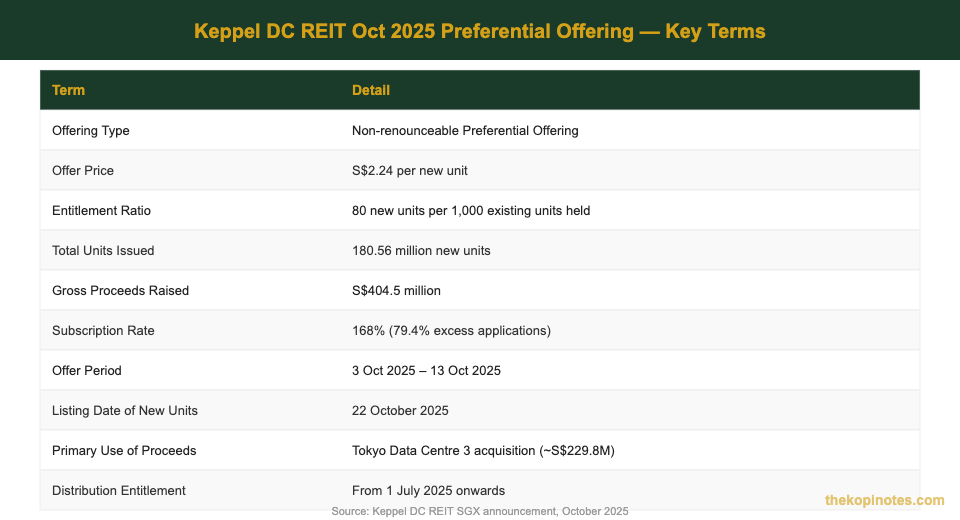
Keppel DC REIT (SGX: AJBU) raised S$404.5 million through a non-renounceable preferential offering in October 2025 — proceeds funded the acquisition of Tokyo Data Centre 3 in Japan. Entitled unitholders could buy 80 new units at S$2.24 each for every 1,000 units held. The offering was 168% subscribed, with 180.56 million new units listed on 22 October 2025. DPU rose 11.3% in 1H 2026 — accretive capital allocation working as intended.
Not financial advice. All figures are for educational reference only. Data as at September 2026 unless noted.
- KDC REIT’s Oct 2025 preferential offering raised S$404.5M at S$2.24 per unit
- Ratio: 80 new units per 1,000 held — non-renounceable (can't sell entitlement)
- 168% subscribed — one of SGX's most popular 2025 capital raises
- Proceeds funded Tokyo DC3 acquisition; DPU improved 11.3% in 1H 2026
Table of Contents
Quick Navigation
What is a Preferential Offering vs a Rights Issue?
When a Singapore REIT needs to raise capital — usually to fund an acquisition — it can issue new units to existing unitholders at a set price. This is called a preferential offering (or rights issue, depending on the structure).
You get the right to buy new units in proportion to what you already hold. KDC REIT’s October 2025 offering was specifically non-renounceable. That means you could not sell your entitlement to another investor on the open market. Either you subscribed, or your entitlement lapsed.
This differs from a standard renounceable rights issue, where your rights are tradeable. Here's how they compare:
| Feature | Non-Renounceable (KDC 2025) | Renounceable Rights Issue |
|---|---|---|
| Can sell entitlement? | No — subscribe or forfeit | Yes — trade rights on SGX |
| Excess applications? | Yes, if available | Yes, if available |
| Offer ratio (KDC) | 80 per 1,000 held | Varies (e.g. 1:5, 1:10) |
| Typical discount to market | Small (0–5%) | Larger (5–20%) |
| If you don't subscribe | Diluted, no cash received | Can sell rights for cash |
Source: Keppel DC REIT SGX circular, October 2025; MAS regulatory framework for S-REITs
The key takeaway: with a non-renounceable offering like KDC's, if you choose not to participate, you cannot sell your rights. Your stake gets diluted with no offsetting compensation. This makes it especially important to evaluate the offering carefully before deciding.
KDC REIT’s October 2025 Preferential Offering
On 26 September 2025, Keppel DC REIT announced a non-renounceable preferential offering of new units at S$2.24 per unit. The offer was structured with a ratio of 80 new units for every 1,000 existing units held on the books closure date.
The offering was timed to partially fund the acquisition of Tokyo Data Centre 3 (Tokyo DC3) — a shell-and-core data centre in Inzai City, Chiba, Japan. This is one of Asia-Pacific’s fastest-growing data centre markets, driven by hyperscaler demand from Amazon, Microsoft, Google, and domestic Japanese operators.
Why Did KDC REIT Launch This Capital Raise?
KDC REIT raised equity for three clear reasons. Understanding these helps you evaluate any future rights issue the REIT might run.
1. Fund the Tokyo DC3 acquisition: The primary use of proceeds was S$229.8 million for the Tokyo DC3 purchase. Japan data centre demand surged in 2025 on AI compute buildout, making this a strategic entry into a high-growth market.
2. Keep gearing conservative: Funding purely with debt would have pushed aggregate leverage above 40%. Instead, the mix of equity (S$404.5M) plus existing facilities kept gearing at a comfortable 34% — well within the 50% MAS regulatory ceiling.
3. Market conditions were favourable: In late 2025, data centre REIT valuations were recovering. Issuing equity close to book NAV minimised dilution. The S$2.24 offer price was at a modest discount to prevailing market levels — making it attractive enough to drive a 168% subscription rate.
Key Terms at a Glance
| Parameter | Detail |
|---|---|
| Offering type | Non-renounceable preferential offering |
| Offer price | S$2.24 per new unit |
| Offer ratio | 80 new units per 1,000 existing units held |
| New units issued | 180.56 million new units |
| Gross proceeds | S$404.5 million |
| Subscription rate | 168% (heavily oversubscribed) |
| Listing date | 22 October 2025 |
| Primary use of proceeds | S$229.8M for Tokyo DC3 acquisition; remainder for debt reduction and costs |
| Distributions eligibility | New units entitled to distributions from 1 July 2025 |
Source: Keppel DC REIT SGX announcement, September–October 2025
Results: 168% Subscribed
The offering closed on 14 October 2025. Total applications — from both entitled allocations and excess applications — amounted to 168% of the offering size. This means demand was far in excess of the 180.56 million units available.
For context, a subscription rate above 100% means the offering was oversubscribed. 168% is unusually high for a non-renounceable structure (where entitlements cannot be traded). It reflects strong unitholder confidence in KDC REIT's Japan expansion and data centre fundamentals in late 2025.
Impact on Existing Unitholders
Whether you subscribed or not, the offering affected your holding differently. Here's how to think about it:
If you subscribed at the full entitlement: Your proportional ownership in KDC REIT was maintained. You received new units at S$2.24 each — at or near market price. Those units were entitled to distributions from 1 July 2025, meaning you received the full 1H 2026 distribution despite buying in October 2025.
If you subscribed to excess units: Subject to pro-rata allocation of unsubscribed units, you may have received additional units. Given the 168% oversubscription, excess allocations were likely scaled back.
If you did not subscribe: Your proportional ownership was diluted by approximately 8% (180.56M new units issued into an enlarged float). However — and this is important — the proceeds were deployed into Tokyo DC3, an accretive acquisition. The DPU rose 11.3% in 1H 2026. Dilution in unit count was partially offset by improved distribution income.
The key insight for future KDC REIT capital raises: non-renounceable offerings at accretive prices favour subscribers. If you choose not to subscribe and cannot sell your rights (because they're non-renounceable), you bear the dilution with no offsetting cash compensation.
DPU History: Before and After the Offering
One test of whether a capital raise was worth it: did DPU recover after the new units hit the float? For KDC REIT, the answer is yes.
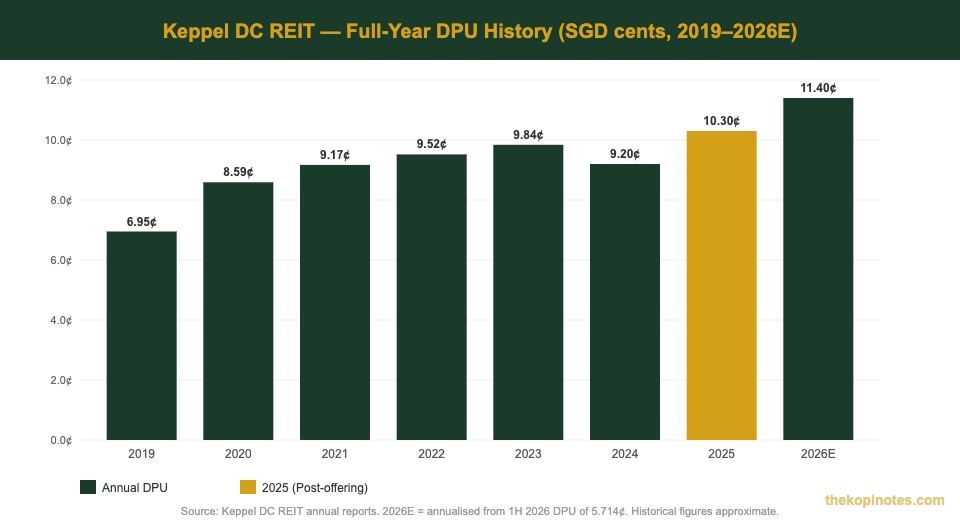
| Period | DPU (Singapore cents) | YoY Change |
|---|---|---|
| FY 2019 | 8.00¢ | — |
| FY 2020 | 9.17¢ | +14.6% |
| FY 2021 | 9.85¢ | +7.4% |
| FY 2022 | 10.21¢ | +3.7% |
| FY 2023 | 9.21¢ | −9.8% (NPI compression, higher costs) |
| FY 2024 | 10.40¢ | +12.9% (recovery) |
| 1H 2026 | 5.714¢ | +11.3% vs 1H 2025 |
Source: Keppel DC REIT annual reports and SGX announcements, 2019–2026
The 2023 dip was driven by higher interest costs and NPI margin pressure — not structural. The 2024 recovery and the continued 11.3% 1H 2026 growth reflect the benefit of Tokyo DC3 and a broader data centre demand tailwind.
This DPU trajectory is the strongest argument for why the October 2025 offering was accretive. New units increased the float, but the acquisition funded by those units grew income faster. That's the ideal outcome from a REIT rights issue.
How to Evaluate Future KDC REIT Rights Issues
KDC REIT has a history of capital raises tied to acquisitions. Here's a five-point checklist to use when the next rights issue or preferential offering is announced:
1. Is the offer price below market? A discount to the prevailing unit price means you're getting new units cheaper than the open market. The deeper the discount, the more attractive the subscription — but also the more dilutive to non-subscribers.
2. Is the acquisition accretive? Check the NPI yield of the acquired asset vs KDC REIT's weighted cost of capital. If the yield is higher, the deal grows DPU. If it's lower, DPU may fall. The Tokyo DC3 deal in October 2025 was accretive — DPU rose 11.3% in the following half.
3. Can you afford to subscribe? For non-renounceable offerings, it's subscribe or lose your proportional ownership. If you can't fund the subscription, factor in the dilution cost when evaluating your position.
4. What happens to gearing? The combined entity's leverage should stay comfortably below 40%. Above that, you're taking on meaningful balance sheet risk. KDC REIT held at 34% post-October 2025 offering — healthy.
5. What does the market say? Watch the unit price reaction on announcement day. A price drop signals the market sees the deal as dilutive or overpriced. A stable or rising price is a good signal. KDC REIT's price was resilient after the September 2025 announcement.
For more context on KDC REIT's overall investment thesis, see our Keppel DC REIT complete guide and our broader best S-REITs Singapore 2026 comparison.
How to Buy Keppel DC REIT in Singapore
KDC REIT (SGX: AJBU) trades on the Singapore Exchange. You can buy it through any SGX-linked brokerage. Here's a quick overview of the most popular options for Singapore retail investors:
FSMOne — a low-cost, full-featured brokerage popular with DIY investors in Singapore. Commission from 0.08% per trade. Use our FSMOne referral code to get started with a welcome bonus. Referral code: P0544985.
Syfe Trade — another solid option for Singapore stocks with competitive fees. Use our Syfe referral code SRPRFFFCD for a bonus when you sign up.
Interactive Brokers (IBKR) — preferred by cost-conscious investors. Very low commissions, direct SGX access. Referral code: jianxiong368.
You can also invest in KDC REIT indirectly through S-REIT ETFs. See our Singapore REIT ETF guide for more. Or use Endowus (code: 2V343) to invest via CPF or SRS — they offer curated REIT and income fund options.
For a broader view of passive income strategies in Singapore, including how S-REITs fit into a dividend portfolio, see our passive income guide.
Frequently Asked Questions
What was the Keppel DC REIT rights issue in 2025?
What was the offer price for the KDC REIT preferential offering?
Was the KDC REIT preferential offering oversubscribed?
Did the preferential offering dilute existing KDC REIT unitholders?
Will Keppel DC REIT launch another rights issue in 2026?
How do I participate in a future KDC REIT rights issue?
This article was researched with the help of AI. While we strive to keep all information accurate and up to date, there may be errors. If you notice any discrepancies, please contact us.