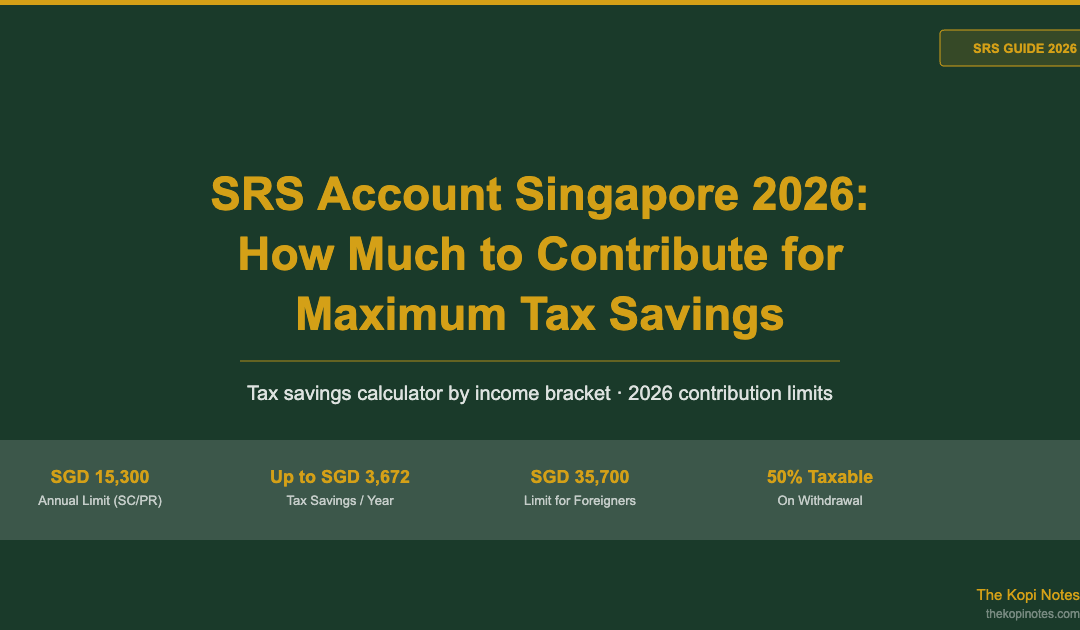
SRS Account Singapore 2026: How Much to Contribute for Maximum Tax Savings
Optimise your SRS contribution strategy and keep more of your income — with a worked tax savings calculator by income bracket.
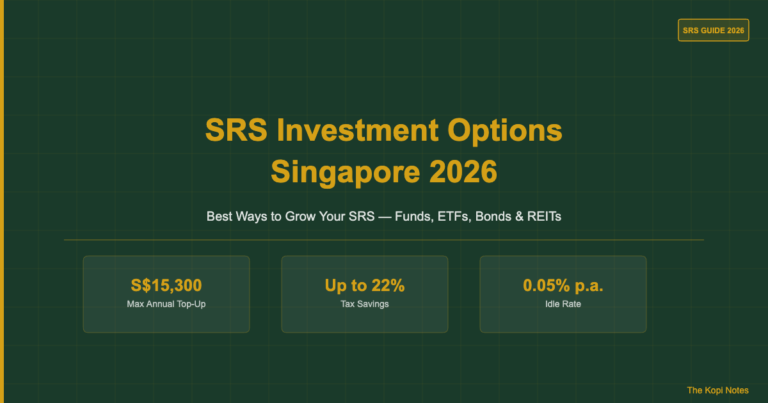
The Supplementary Retirement Scheme (SRS) lets Singapore citizens, PRs, and foreigners cut their income tax bill while building a retirement nest egg. Singapore citizens and PRs can contribute up to SGD 15,300 per year; foreigners get a higher cap of SGD 35,700. Every dollar you contribute gives a dollar of tax relief — and for a taxpayer in the 22% bracket, the full contribution saves SGD 3,366 in tax per year.
Not financial advice. All figures are for educational reference only. Data as at October 2026 unless noted.
What Is the SRS Account?
The Supplementary Retirement Scheme (SRS) is a voluntary government initiative that encourages Singaporeans, PRs, and foreigners to save for retirement beyond CPF. Launched in 2001, it is administered by three operator banks: DBS, OCBC, and UOB. You open an SRS account at any of these banks, make annual contributions up to your cap, and invest those funds in a wide range of eligible assets — or simply leave them in the bank earning interest while enjoying the immediate tax relief.
The core mechanic is simple: contributions are deducted from your chargeable income before IRAS calculates your tax bill. If you earn SGD 150,000 a year and contribute SGD 15,300 to SRS, IRAS taxes you on SGD 134,700 instead. At the 15% marginal rate, that is a SGD 2,295 tax saving — money you would otherwise have handed to the government.
Unlike CPF, your SRS money is entirely self-directed. You choose what to invest in, when to withdraw, and how to structure withdrawals for tax efficiency in retirement. This flexibility makes SRS a powerful complement to your CPF investment strategy Singapore — one where you control every decision.
SRS Contribution Limits 2026
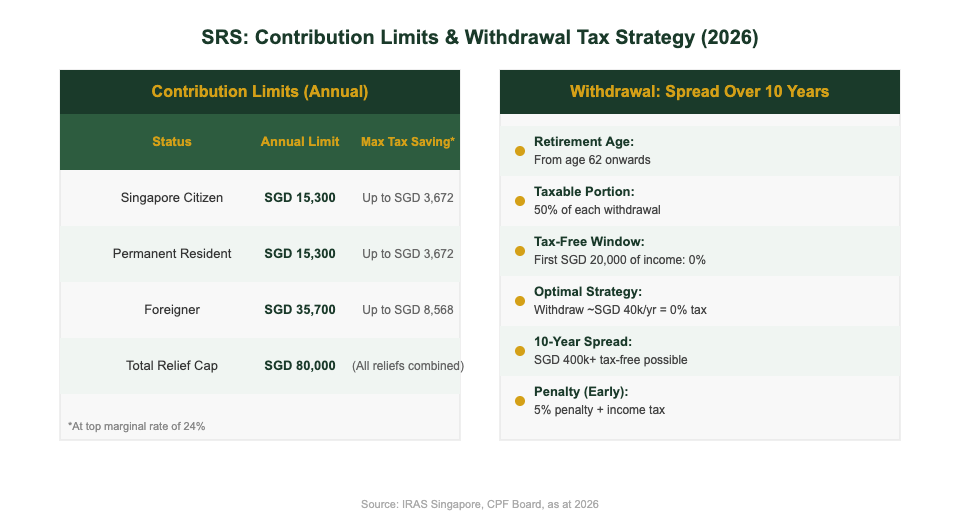
The SRS contribution cap depends on your residency status. There is also an overall annual personal income tax relief cap of SGD 80,000, which includes CPF relief, NSman relief, parent relief, and other deductions — so always calculate your remaining headroom before topping up SRS.
| Residency Status | Annual SRS Cap | Tax Relief Value (at 24%) |
|---|---|---|
| Singapore Citizen | SGD 15,300 | Up to SGD 3,672 |
| Permanent Resident (PR) | SGD 15,300 | Up to SGD 3,672 |
| Foreigner (Employment Pass) | SGD 35,700 | Up to SGD 8,568 |
Source: Ministry of Finance Singapore, IRAS, as at October 2026. Overall personal income tax relief cap: SGD 80,000 per year.
One important constraint: you cannot contribute more than your actual earned income in that year. If you earned SGD 10,000, your SRS contribution is capped at SGD 10,000 even if the statutory limit is higher. This matters for part-time workers, those taking career breaks, or retirees who have returned to part-time consulting work.
Tax Savings by Income Bracket
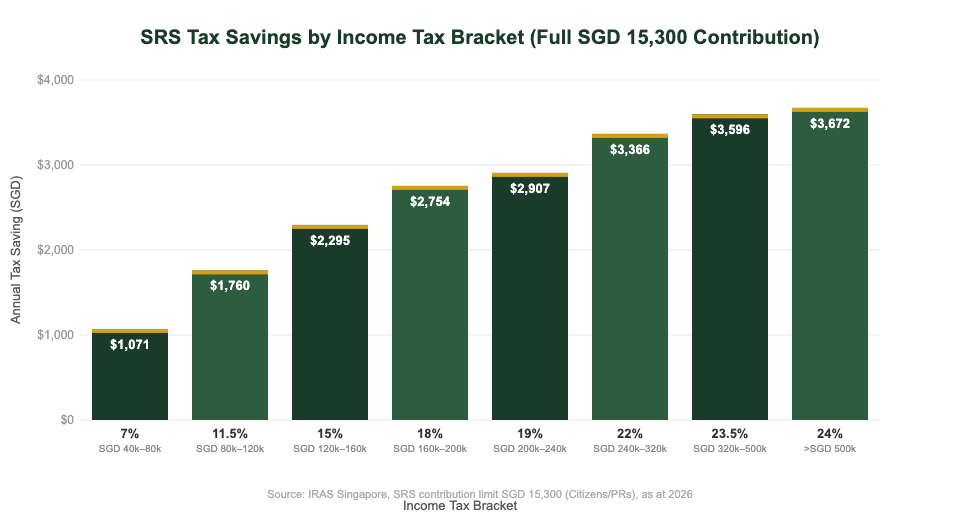
How much does SRS actually save you? The answer depends entirely on your marginal income tax rate — the rate that applies to your last dollar of income. Singapore uses a progressive tax system, so your SRS savings grow significantly as your income rises. The table below shows the exact annual tax saving for a full SGD 15,300 contribution (Singapore citizens and PRs) at each bracket:
| Chargeable Income | Marginal Rate | Annual SRS Tax Saving | Break-Even Period* |
|---|---|---|---|
| SGD 40,000 – 80,000 | 7% | SGD 1,071 | ~4.3 years |
| SGD 80,000 – 120,000 | 11.5% | SGD 1,760 | ~2.6 years |
| SGD 120,000 – 160,000 | 15% | SGD 2,295 | ~2.0 years |
| SGD 160,000 – 200,000 | 18% | SGD 2,754 | ~1.7 years |
| SGD 200,000 – 240,000 | 19% | SGD 2,907 | ~1.6 years |
| SGD 240,000 – 320,000 | 22% | SGD 3,366 | ~1.4 years |
| SGD 320,000 – 500,000 | 23.5% | SGD 3,596 | ~1.3 years |
| Above SGD 500,000 | 24% | SGD 3,672 | ~1.2 years |
Source: IRAS Singapore personal income tax rates, 2026. *Break-even period = years until cumulative tax saving recovers a 5% early-withdrawal penalty on one year’s contribution.
The break-even period shows how quickly the upfront tax saving outweighs the 5% early-withdrawal penalty (applicable if you withdraw before the statutory retirement age of 62). For taxpayers in the 15% bracket and above, SRS makes financial sense in almost every scenario — even if you were to withdraw early, you recover the penalty within two years of tax savings.
For those in the 7% bracket (chargeable income SGD 40,000–80,000), SRS is still worthwhile if you plan to keep the funds invested through retirement, but the maths are tighter. Run your numbers through our Singapore retirement calculator to see your personalised break-even scenario.
When Should You Contribute?
SRS contributions must be made by 31 December of the relevant year to qualify for that year’s tax relief. This is a hard deadline — IRAS does not grant extensions, and any contribution made on 1 January counts toward the following year’s quota. Three practical tips for timing your SRS contribution:
Contribute early in the year, not December: Many investors wait until year-end, then scramble. Contributing in January or February means your money sits in the SRS account for up to 11 extra months, earning interest or growing through investments. On a SGD 15,300 contribution invested at 6% annual returns, that is SGD 688 more in investment growth compared to a December contribution.
Automate monthly contributions: Instead of one lump-sum, consider SGD 1,275 per month. This gives you rupiah-cost averaging benefits on investments and avoids cash-flow pressure in December.
Check your remaining relief cap first: Calculate your total personal income tax reliefs for the year (CPF Medisave top-up, NSman relief, parent relief, spouse relief, etc.). If you are already near the SGD 80,000 cap, a partial SRS contribution may be more appropriate than the full SGD 15,300.
What Can You Invest Your SRS In?
Money sitting idle in your SRS account earns a nominal 0.05% bank interest — well below inflation. The key to maximising SRS returns is to invest the funds promptly. Approved SRS investments include: Singapore government securities (SGS bonds and T-bills), unit trusts, exchange-traded funds (ETFs) listed on SGX, Singapore-listed stocks and REITs, endowment plans from approved insurers, and fixed deposits with SRS-operator banks.
For a diversified approach, many investors use SRS to invest in Singapore S-REIT ETFs or global ETFs via platforms like Endowus (use referral code 2V343 for SGD 20 bonus), which offers access to institutional-class unit trusts at fund-level costs. Syfe (code SRPRFFFCD) also accepts SRS funds for their Core and Income+ portfolios, making it easy to get diversified exposure in minutes.
If you prefer to self-direct, FSMOne (code P0544985) offers a broad range of unit trusts and Singapore-listed ETFs accessible via SRS. All three platforms offer zero-sales-charge funds, which is important when the SRS benefit is to maximise compounding — high entry charges erode years of tax savings.
For conservative investors, Singapore T-bills 2026 are also SRS-eligible: you apply through your SRS operator bank, and the proceeds (principal + interest) flow back into your SRS account automatically.
SRS vs Other Tax Reliefs
SRS is not the only lever you can pull to reduce your income tax. Understanding how it compares with other reliefs helps you allocate wisely within the SGD 80,000 cap:
| Tax Relief | Max Amount | Liquidity | Best For |
|---|---|---|---|
| SRS Contribution | SGD 15,300 | Medium (5% penalty if early) | Invest-to-grow for retirement |
| CPF Cash Top-Up (SA/RA) | SGD 8,000 | Low (locked until 55+) | Guaranteed 4% interest, lower risk |
| Course Fees Relief | SGD 5,500 | N/A (spent) | If upskilling — claim what you’ve already spent |
| Parent Relief | Up to SGD 9,000 | N/A (auto-claimed) | Supporting elderly parents (must qualify) |
| NSman (Active) | Up to SGD 5,000 | N/A (auto-claimed) | NS-eligible men — auto-deducted by IRAS |
Source: IRAS Singapore, 2026. Personal income tax relief cap: SGD 80,000 per year.
The key distinction between SRS and CPF cash top-up is control. CPF locks your money at guaranteed rates with no investment choice; SRS lets you invest freely but without a guaranteed return. For most higher-income earners, the optimal strategy is to first claim all “free” reliefs (NSman, parent relief, course fees — things you have already earned), then top up CPF SA to SGD 8,000 for the 4% floor, and finally use remaining relief headroom for SRS contributions invested in higher-growth assets.
SRS Withdrawal Strategy
The SRS tax advantage does not end at contribution — it extends into retirement through a powerful withdrawal mechanic. When you withdraw from SRS after age 62 (the statutory retirement age), only 50% of each withdrawal is taxable. The other 50% is tax-free.
Here is how to structure withdrawals optimally: spread your SRS balance over the maximum 10-year withdrawal window (starting from your first withdrawal). By drawing down gradually, you keep each year’s taxable SRS income low enough to fall within the zero-tax bracket (first SGD 20,000 of chargeable income: 0% tax). For many retirees with no other earned income, this means paying zero tax on their SRS withdrawals despite having contributed at the 18–22% bracket during working years — a permanent, structural tax arbitrage.
Worked example: Suppose you have accumulated SGD 400,000 in your SRS account by age 62. Over 10 years, you withdraw SGD 40,000 per year. Only SGD 20,000 (50%) of each withdrawal is taxable. With Singapore’s first SGD 20,000 of chargeable income taxed at 0%, you pay no income tax on your SRS withdrawals — despite having received up to 22% tax relief when you contributed. That is a net tax saving of up to SGD 88,000 over a working lifetime, plus whatever investment returns your SRS funds have compounded to.
Is SRS Worth It for You?
SRS is strongly worth it if: You are in the 11.5% marginal bracket or above (chargeable income above SGD 80,000), you are at least 10–15 years from retirement age 62, and you are disciplined enough to invest the SRS funds rather than leaving them in cash. The tax saving alone often outperforms a standard savings account, and the investment upside is on top.
Think carefully if: You are in the 7% bracket or below (lower income), your total tax reliefs are already close to the SGD 80,000 cap, or you need liquidity in the near term. Also note that SRS funds are tied to your residency — if you plan to leave Singapore permanently, you may trigger the 5% early-withdrawal penalty.
One underused angle: foreigners on Employment Passes with a SGD 35,700 annual limit and high marginal rates often find SRS one of the most tax-efficient moves available to them in Singapore, alongside a broader passive income Singapore strategy combining S-REITs and diversified ETFs.
Not financial advice. Consult a licensed financial advisor for personalised recommendations. Data current as at October 2026 — tax rates and contribution limits may change annually.
Frequently Asked Questions
What is the SRS contribution limit for 2026 in Singapore?
The SRS contribution limit for 2026 is SGD 15,300 per year for Singapore citizens and permanent residents, and SGD 35,700 per year for foreigners. These limits apply to contributions made between 1 January and 31 December 2026. The overall personal income tax relief cap is SGD 80,000 per year across all reliefs.
How much tax can I save with a full SRS contribution?
Your tax savings depend on your marginal income tax rate. A Singapore citizen or PR contributing the full SGD 15,300 saves: SGD 1,071 (7% bracket), SGD 1,760 (11.5%), SGD 2,295 (15%), SGD 2,754 (18%), SGD 3,366 (22%), or SGD 3,672 (24% — top rate). The higher your income, the more SRS saves you in tax.
Can I use SRS money to invest in ETFs and REITs?
Yes. SRS funds can be invested in SGX-listed ETFs, Singapore REITs (S-REITs), unit trusts, Singapore Government Securities (SGS bonds, T-bills), endowment plans, and fixed deposits. You cannot use SRS to buy ETFs listed on foreign exchanges (such as CSPX or VWRA on the London Stock Exchange) directly — only SGX-listed products qualify. Platforms like Endowus and Syfe offer unit trusts accessible via SRS that provide diversified global and Singapore market exposure.
What happens to SRS when you withdraw after retirement?
From age 62, only 50% of each SRS withdrawal is taxable — the other 50% is tax-free. If you spread withdrawals over 10 years (the maximum window), annual taxable SRS income can fall within Singapore’s 0% tax bracket (first SGD 20,000 of chargeable income). This means many retirees pay zero income tax on their SRS withdrawals despite having claimed 15–22% tax relief during their working years.
What is the penalty for early SRS withdrawal?
If you withdraw from your SRS account before the statutory retirement age of 62, you pay a 5% penalty on the withdrawal amount, plus income tax on 100% of the amount (rather than the usual 50%). For most taxpayers, this makes early withdrawal uneconomical. However, if you are diagnosed with a terminal illness or become permanently incapacitated, the 5% penalty is waived.
Is SRS better than CPF top-up for tax savings?
SRS and CPF cash top-up serve different purposes. CPF SA/RA top-up gives you a guaranteed 4% annual return with zero risk, but locks funds until age 55+ and restricts investments to CPF-approved instruments. SRS offers full investment flexibility, potentially higher returns, but no guaranteed rate. Most financial planners recommend doing both: max your CPF top-up relief first (up to SGD 8,000) for the risk-free floor, then use SRS for higher-growth investments with the remaining relief headroom.
Which SRS account operator bank should I choose?
You can open an SRS account at DBS, OCBC, or UOB — the three designated operator banks. All offer the same contribution limits and tax relief. The main differentiator is the investment products available through each bank’s platform and whether your preferred investment platform (e.g. Endowus, Syfe, or FSMOne) is linked to that SRS operator. Most investors choose DBS or OCBC for their broader investment product range and integration with robo-advisory platforms. You can only hold one SRS account at a time.
Ready to Open Your SRS Account?
Invest your SRS contributions smarter with platforms that offer zero-sales-charge funds and intuitive SRS integration.
This article was researched with the help of AI. While we strive to keep all information accurate and up to date, there may be errors. If you notice any discrepancies, please contact us.