Retiring at 55 in Singapore 2026: CPF Withdrawal, FIRE Strategy & Passive Income
Can you really stop working at 55? Here's what the CPF rules allow — and how to build the passive income to make it work.The legal retirement age in Singapore is 63, but you can first access your CPF savings at age 55 — creating a crucial 10-year gap. Many Singaporeans dream of retiring early, but “retiring at 55” means building passive income to cover living expenses from 55 to 65 before CPF LIFE payouts begin. With the right mix of S-REITs, ETFs, T-bills, and CPF planning, it is achievable for those who start early and invest consistently.
Not financial advice. All figures are for educational reference only. Data as at October 2026 unless noted.
Table of Contents
Click to expand
- What is the Legal Retirement Age in Singapore?
- What Happens to Your CPF at Age 55?
- The 55-65 Bridge: The Biggest Challenge for Early Retirees
- How Much Do You Need to Retire at 55 in Singapore?
- Passive Income Strategies to Bridge the Gap
- FIRE Strategy for Singaporeans: Step-by-Step
- CPF Retirement Timeline Cheat Sheet
- Risks and Considerations
- Frequently Asked Questions
What is the Legal Retirement Age in Singapore?
Singapore’s retirement framework has three distinct age thresholds that are often confused:
| Age | Milestone | What It Means |
|---|---|---|
| 55 | CPF Retirement Account formed | Savings above FRS/BRS transferred to RA; first possible withdrawal |
| 63 | Statutory Retirement Age | Employer cannot compulsorily retire you before this age |
| 65 | Default CPF LIFE payout start | Monthly payouts begin (deferrable to 70 for higher amounts) |
| 67 | Re-employment ceiling | Employer must offer re-employment to eligible employees up to this age |
Source: Ministry of Manpower (MOM), CPF Board — October 2026
Under the Retirement and Re-employment Act (RRA), your employer cannot force you to retire before 63. However, nothing stops you from voluntarily retiring earlier — at 55 or younger — as long as you can fund your living expenses. This is where the challenge lies: stop working at 55, and you face a 10-year gap before CPF LIFE payouts begin at 65.
What Happens to Your CPF at Age 55?
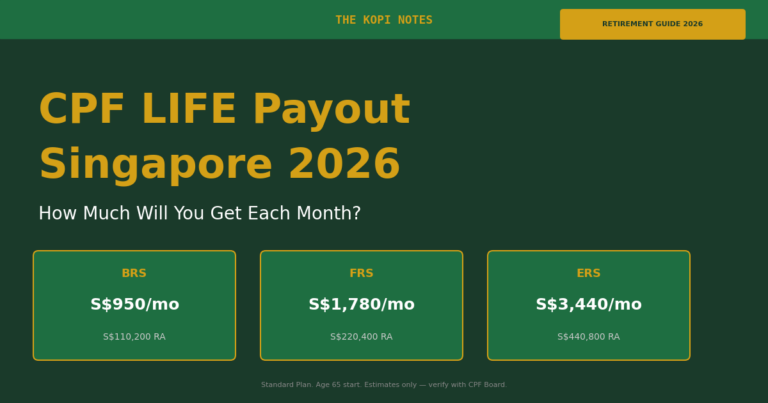
At 55, CPF creates a Retirement Account (RA) by sweeping your SA first, then OA if needed, up to the Full Retirement Sum (FRS). The FRS for 2026 is SGD $213,000. Savings above FRS can be withdrawn.
| Retirement Sum Option | Amount (2026) | Est. CPF LIFE Monthly Payout |
|---|---|---|
| Basic Retirement Sum (BRS) | ~$106,500 | ~$900–$1,100/month |
| Full Retirement Sum (FRS) | $213,000 | ~$1,600–$1,800/month |
| Enhanced Retirement Sum (ERS) | ~$319,500 | ~$2,400–$2,700/month |
Source: CPF Board — October 2026. Payout estimates vary by scheme (Standard, Basic, Escalating plan).
Even at ERS, CPF LIFE pays ~$2,400–$2,700/month from age 65. For most Singapore households spending $4,000–$6,000/month, a supplementary passive income stream is essential. For a detailed CPF planning approach, see our CPF investment strategy guide.
The 55-65 Bridge: The Biggest Challenge for Early Retirees
The hardest part of retiring at 55 in Singapore is the 10-year income gap before CPF LIFE begins. During this window, you rely entirely on savings and investment portfolio income.
Consider a couple retiring at 55 with combined monthly expenses of SGD $5,000:
- Ages 55–65: Zero CPF LIFE income. Portfolio must generate $5,000/month or they draw down capital.
- From age 65: CPF LIFE covers ~$3,400/month (both at FRS). Still a $1,600/month shortfall against $5,000 in expenses.
- The gap: They need ~$1,600/month from portfolio indefinitely — requiring ~$480,000 at 4% SWR even after CPF LIFE starts.
Use the Singapore retirement calculator to model your exact numbers based on personal spending and CPF balance projections.
How Much Do You Need to Retire at 55 in Singapore?
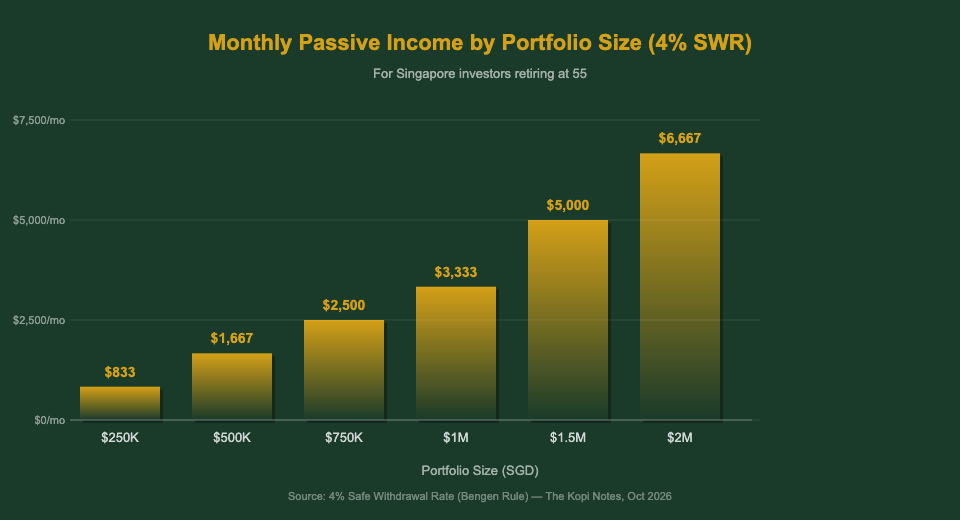
Using the 4% Safe Withdrawal Rate (SWR) — the annual amount you can withdraw from a diversified portfolio without running out of money over 30 years — here is the portfolio size needed for various monthly income levels:
Source: 4% Safe Withdrawal Rate (Bengen Rule) — The Kopi Notes, October 2026
A household spending SGD $4,000/month needs a $1.2 million portfolio at 4% SWR. Including CPF LIFE at FRS ($1,700/month from 65), the required investment portfolio reduces to roughly $660K–$900K depending on when you expect to start payouts.
Adjusted Calculation Including CPF LIFE
If CPF LIFE covers $1,800/month and you need $4,000/month total:
- Ages 55–65: Need full $4,000/month from portfolio → requires $1.2M at 4% SWR.
- Ages 65+: Need only $2,200/month from portfolio → requires ~$660K at 4% SWR.
A couple maximising both CPF accounts to ERS may need only ~$900K–$1M in external investments to retire at 55 — making consistent CPF top-ups one of the best moves for aspiring early retirees.
Passive Income Strategies to Bridge the 55-65 Gap
Source: MAS, CPF Board, SGX — October 2026. REITs and ETFs carry market risk; T-bills/SSBs/CPF are capital-protected.
S-REITs — High Yield, Market Risk
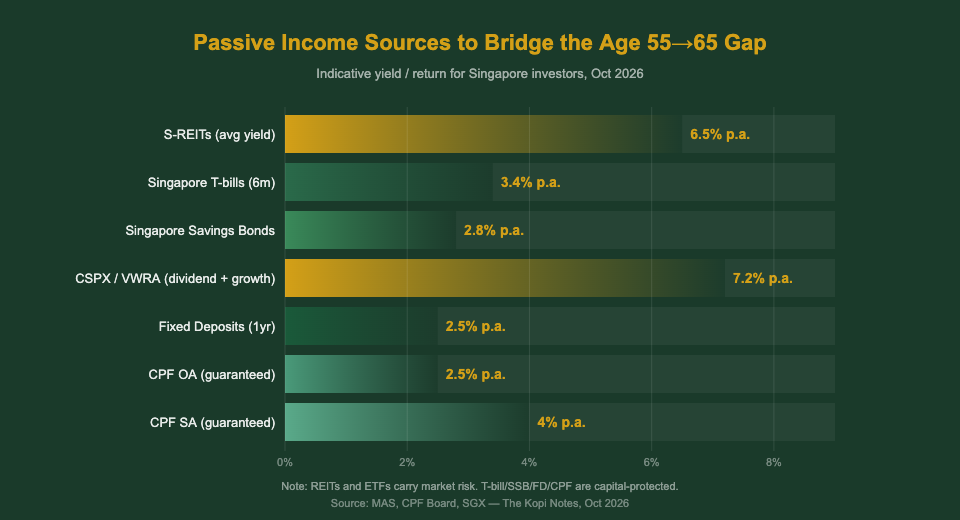
S-REITs currently yield 5.5%–7.5% on average. A $500,000 S-REIT portfolio at 6.5% generates ~$2,708/month — with no withholding tax for Singapore residents. See our guide to best S-REITs in Singapore 2026 for yield, gearing, and WALE comparisons across top picks.
Global ETFs (CSPX/VWRA) — Total Return Strategy
London-listed UCITS ETFs offer low TER and no US estate tax risk. Using a 4% SWR on a global equities portfolio, a $700K allocation generates ~$2,333/month in withdrawals, growing with the market over time. For brokerage options, the Syfe referral code (SRPRFFFCD) and Endowus referral code (2V343) both offer managed ETF portfolios with competitive fees.
Singapore T-Bills — Capital-Safe Short-Term Yield
Singapore 6-month T-bills yield ~3.4% p.a. (October 2026) and are government-guaranteed. Ideal for a 12–24 month cash buffer. See our Singapore T-bills 2026 guide for the full bidding process.
Singapore Savings Bonds (SSBs) — Flexible Income Ladder
SSBs average 2.8%–3.0% over 10 years with full redemption flexibility. Perfect as an “income ladder” across the 10-year bridge period. Our Singapore Savings Bonds guide covers the application walkthrough in detail.
FIRE Strategy for Singaporeans: Step-by-Step
Step 1 — Define your FIRE number. Annual expenses × 25. If you spend $60,000/year, FIRE number = $1.5M. Subtract CPF LIFE value (monthly payout × 12 ÷ 4%) to get your required investment portfolio.
Step 2 — Maximise CPF voluntarily. SA earns guaranteed 4% p.a. and top-ups are tax-deductible (up to $8,000 under RSTU). Highest risk-adjusted return available in Singapore — max before taxable investments.
Step 3 — Build your investment portfolio. A simple two-asset structure: 80–90% VWRA/CSPX (global equities, LSE-listed, no US estate tax) + 10–20% S-REITs for regular income distributions. Use the FSMOne referral code (P0544985) for low-cost RSP investing.
Step 4 — Build a cash buffer. Hold 12–24 months of expenses in T-bills or SSBs. This prevents forced selling of equities during bear markets — the single biggest sequence-of-returns risk for early retirees.
Step 5 — Monitor progress annually. Track your passive income growth against your FIRE number. Use our passive income Singapore guide to benchmark your portfolio against typical SG early retirement thresholds.
CPF Retirement Timeline Cheat Sheet
| Age | CPF Event | Action / Implication |
|---|---|---|
| 35–55 | Accumulation phase | Max SA top-ups; build investment portfolio; target FIRE number |
| 55 | RA formed; SA/OA swept up to FRS | Withdraw excess above FRS; RA earns 4% p.a. |
| 55–65 | Bridge period | Live on investment portfolio income; RA continues compounding at 4% |
| 65 | CPF LIFE payouts begin | Default start; defer to 70 for ~7% higher payout per year deferred |
| 70 | Latest CPF LIFE start | Maximum monthly payout; ideal if portfolio can fund ages 65–70 |
Source: CPF Board — October 2026
Risks and Considerations
Healthcare costs: Medical costs can escalate significantly after 60. Ensure Medishield Life and a private Integrated Shield Plan are in place before retirement. Budget a healthcare inflation buffer of 3%–5% above general inflation.
Sequence-of-returns risk: A major market correction in the first 5 years of retirement can permanently impair a portfolio. A 12–24 month cash buffer in T-bills and regular S-REIT income mitigates forced selling in down markets.
Longevity risk: Singaporeans are among the world’s longest-lived populations. A 55-year-old today may live to 90+ — a 35-year retirement horizon. For 35 years, consider a 3.5% SWR (portfolio × 28.5) rather than the standard 4%.
Inflation: Singapore core inflation averages 2%–3% p.a. historically. Global equities and S-REITs provide natural long-term inflation hedges, as both asset classes have historically grown faster than CPI over 10-year periods.
Frequently Asked Questions
Can I retire at 55 in Singapore legally?
How much CPF can I withdraw at 55?
What is the FIRE number for a Singapore retiree?
Can I use CPF OA to invest for retirement?
What happens to my SRS account if I retire at 55?
What is the best investment for a Singapore FIRE portfolio?
How does CPF LIFE affect early retirement planning?
This article was researched with the help of AI. While we strive to keep all information accurate and up to date, there may be errors. If you notice any discrepancies, please contact us.