Retirement Village Singapore: Costs, Options & Is It Right for You? (2026)
What “retirement village” actually means in Singapore, real monthly costs, and how to plan for it alongside CPF LIFE.
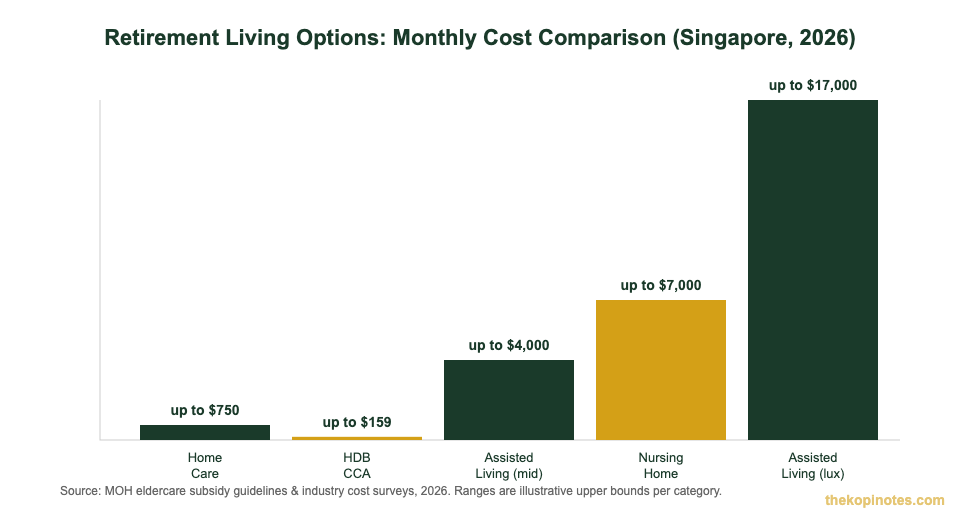
Singapore does not have Western-style “retirement villages.” Instead, you have four main paths: ageing in place with home care ($250-$750/month), HDB Community Care Apartments (care fees from $130-$159/month, plus a normal HDB lease price), private assisted living ($2,500-$17,000+/month), or nursing homes ($2,000-$7,000/month depending on care level). Your choice should be planned around your CPF LIFE payout, not the other way round.
Not financial advice. All figures are for educational reference only. Data as at August 2026 unless noted.
Free download: The Singapore Money Playbook — 7 money mindset shifts written for Singapore, with the CPF-adjusted retirement number most guides get wrong (PDF + Notion).
- There’s no single “retirement village” product in Singapore — it’s a spectrum from downsizing your HDB flat to nursing home care
- HDB Community Care Apartments (CCA) are the closest local equivalent, now open to those 55 and above from October 2026
- Whatever option you pick, check it against your CPF LIFE payout first — the numbers below help you do that math
Table of Contents
Contents — Click to expand
- What Do Singaporeans Actually Mean by “Retirement Village”?
- Your Real Options: CCA, Assisted Living, Nursing Homes & Ageing in Place
- HDB Community Care Apartments — The Closest Local Equivalent
- Cost Comparison: What Each Option Really Costs You Monthly
- Overseas Retirement Villages: Malaysia, Thailand & the Trade-Offs
- How to Fund It: CPF LIFE, Downsizing & Subsidies
- Who Should Consider Each Option?
- Frequently Asked Questions
What Do Singaporeans Actually Mean by “Retirement Village”?
If you search “retirement village singapore,” you’re probably picturing something like Australia or the UK — a gated community of bungalows with a clubhouse, built specifically for retirees. Singapore doesn’t really have that.
What we have instead is a patchwork of government and private options, each solving a different problem. Some are about housing (downsizing your flat). Some are about care (help with daily tasks). Some are about medical support (nursing homes). “Retirement village” gets used loosely to describe all of them.
That’s actually useful news. It means you don’t need to commit to one big move. You can mix and match as your needs change — starting independent, adding home care later, and only considering a nursing home if your health really requires it.
Your Real Options: CCA, Assisted Living, Nursing Homes & Ageing in Place
Here’s the honest breakdown of what’s available, roughly from least to most care-intensive:
Ageing in place. You stay in your current home. You add home care services as needed — a nurse or caregiver visiting for specific tasks. This is what most Singaporeans do by default, often because moving feels disruptive.
Downsizing. You sell or right-size your HDB flat — for example, from a 5-room to a 3-room — and use the extra cash to top up your CPF LIFE or fund daily expenses. HDB’s Lease Buyback Scheme lets you sell part of your flat’s remaining lease back to HDB while staying put.
Community Care Apartments (CCA). A purpose-built HDB flat with senior-friendly fittings and a built-in care services package. Covered in detail below.
Private assisted living. Purpose-built private developments offering meals, housekeeping, and on-site nursing support. More expensive, but more resort-like — some genuinely resemble a “retirement village.”
Nursing homes. For seniors who need daily skilled nursing care — the most medically intensive option, and typically the last resort rather than the first choice.
HDB Community Care Apartments — The Closest Local Equivalent
Community Care Apartments (CCA) are the government’s answer to “retirement village” demand. They’re regular HDB flats — but senior-friendly, and bundled with a care services package.
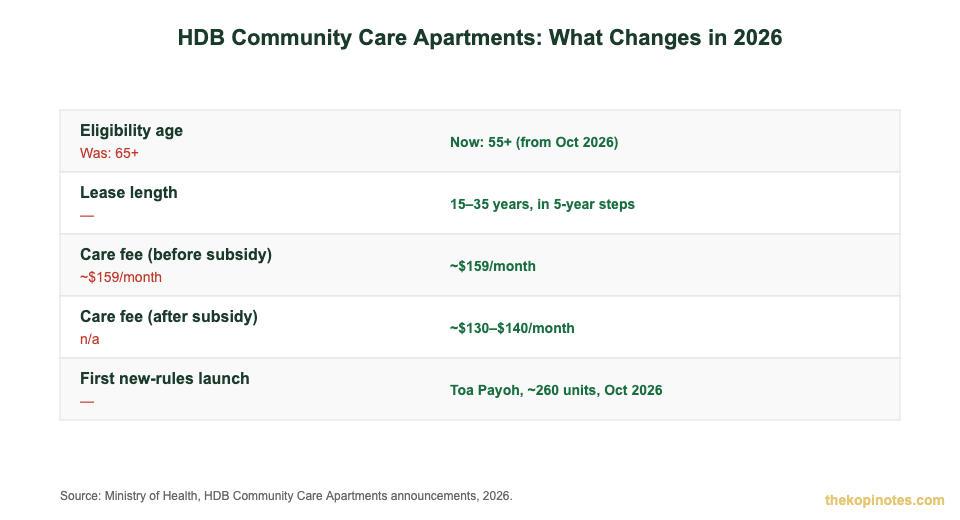
A big change lands in October 2026: the eligibility age drops from 65 to 55, opening CCA up to a much larger pool of pre-retirees. The first project under the new rules is in Toa Payoh, next to Caldecott MRT, with about 260 units on offer.
You choose your own lease length — from 15 to 35 years, in 5-year steps — as long as it covers you and your spouse until age 95. The care services package (basic wellness checks, activities, on-call assistance) costs about $159 a month before subsidies. With the new subsidies announced for 2026, this drops to roughly $130-$140 a month for many residents, as seen in the Bukit Batok Harmony Village project.
That monthly fee is separate from the flat price itself, which works like any BTO flat — you pay based on your chosen lease and the launch’s indicative pricing at the time you apply.
Cost Comparison: What Each Option Really Costs You Monthly
Here’s how the main paths stack up. Use this table with your own CPF LIFE payout estimate — the goal is to see which options your projected retirement income can actually sustain.
| Option | Typical Monthly Cost | Best For |
|---|---|---|
| Ageing in place (no care) | $0 extra (existing living costs) | Healthy, independent seniors |
| Home care add-on | $250 – $750 | Independent, but need occasional help |
| HDB CCA (care fee only) | $130 – $159 | Semi-independent, want built-in support |
| Private assisted living (mid-range) | $2,500 – $4,000 | Want hotel-style daily support, can afford it |
| Private assisted living (luxury) | $8,900 – $17,000+ | High-net-worth retirees wanting resort-style living |
| Nursing home | $2,000 – $7,000 (subsidised beds from ~$3-$13/day) | Seniors needing daily skilled nursing care |
Source: Ministry of Health eldercare subsidy guidelines and industry cost surveys, as at 2026. Actual fees vary by provider, income tier, and subsidy eligibility.
Overseas Retirement Villages: Malaysia, Thailand & the Trade-Offs
Some Singaporeans look across the Causeway or further afield — to places like Iskandar in Johor, Penang, or Chiang Mai — where dedicated retirement resorts with lower costs of living do exist. Monthly living costs can be a fraction of Singapore’s.
However, this comes with real trade-offs. Your Medisave and MediShield Life coverage don’t automatically follow you overseas for non-emergency treatment. You’ll likely need private international health insurance, and you lose the convenience of Singapore’s healthcare system for regular check-ups. For most retirees, overseas retirement villages work best as a part-year option — for example, spending several months a year there — rather than a full relocation.
How to Fund It: CPF LIFE, Downsizing & Subsidies
Whatever path you choose, the funding math is the same three levers: your CPF LIFE monthly payout, any cash from downsizing your flat, and government subsidies you qualify for.
Start by working out your expected CPF LIFE payout using a Singapore retirement calculator — this gives you a baseline monthly income to compare against the cost table above. If there’s a gap, the Lease Buyback Scheme or downsizing to a smaller flat can free up a lump sum to close it.
Subsidies matter more than most people expect. Residential long-term care subsidies can cover 10-80% of nursing home fees depending on your household income, and home and community care subsidies can reach up to 95% for eligible Singapore Citizens. Apply through the Agency for Integrated Care (AIC) well before you need the service — assessments take time.
If you’re still building your retirement savings, it’s worth reviewing your broader CPF investment strategy alongside a source of passive income in Singapore — S-REIT dividends and CPF LIFE together often give more flexibility than CPF LIFE alone. Looking at the best S-REITs in Singapore 2026 is a reasonable starting point if dividend income is new to you, and lower-risk savers can also compare this against the Singapore Savings Bonds guide for a more conservative allocation.
Who Should Consider Each Option?
Ageing in place suits you if you’re healthy, your home is already senior-friendly (or can be modified), and you have family or neighbours nearby for occasional support.
A Community Care Apartment suits you if you’re 55+ from October 2026, want the security of built-in care without leaving the HDB system, and prefer a lower ongoing monthly cost than private options.
Private assisted living suits you if budget isn’t the main constraint and you want daily housekeeping, meals, and social activities without waiting for a CCA launch in your preferred area.
A nursing home is the right call if you or your loved one needs daily skilled nursing care — this isn’t really a lifestyle choice, it’s a medical one, and subsidies exist specifically to make it accessible.
Consider alternatives — like staying in your existing flat with a paid caregiver — if you’re not yet ready for a big move, or if your family prefers keeping care arrangements flexible year to year.
Frequently Asked Questions
Does Singapore have retirement villages like Australia or the UK?
Not in the same form. Singapore’s closest equivalents are HDB Community Care Apartments, private assisted living developments, and nursing homes — each serving a different level of care need rather than one all-in-one retirement resort.
What is a Community Care Apartment (CCA) and who can apply?
A CCA is a senior-friendly HDB flat bundled with a care services package. From October 2026, Singaporeans aged 55 and above can apply, down from the previous 65 age requirement. You choose a lease of 15 to 35 years that covers you and your spouse until age 95.
How much does a Community Care Apartment cost per month?
The care services package costs about $159 a month before subsidies, dropping to roughly $130-$140 a month for many residents under 2026 subsidy rates. This is separate from the flat’s purchase price, which is set at each BTO launch based on your chosen lease length.
Can I use my CPF LIFE payout to cover retirement living costs?
Yes — CPF LIFE is designed to give you a monthly income for life, which you can put towards home care, a CCA’s care fee, or assisted living costs. Use a retirement calculator to check your projected payout against the option you’re considering before committing.
Is a nursing home the same as a retirement village?
No. A nursing home is for seniors who need daily skilled nursing care — it’s a medical care setting, not a lifestyle choice. Retirement village-style options like CCA or private assisted living are for seniors who are still largely independent but want built-in support.
Should I consider retiring overseas instead of a local retirement village?
It can lower your cost of living significantly, but your Medisave and MediShield Life coverage won’t follow you for non-emergency overseas treatment. Most retirees who go this route treat it as a part-year arrangement rather than a full move, keeping access to Singapore’s healthcare system.
Plan Your Retirement Living Costs Today
Check your projected CPF LIFE payout against the costs above, and see if your retirement income needs a boost.
This article was researched with the help of AI. While we strive to keep all information accurate and up to date, there may be errors. If you notice any discrepancies, please contact us.