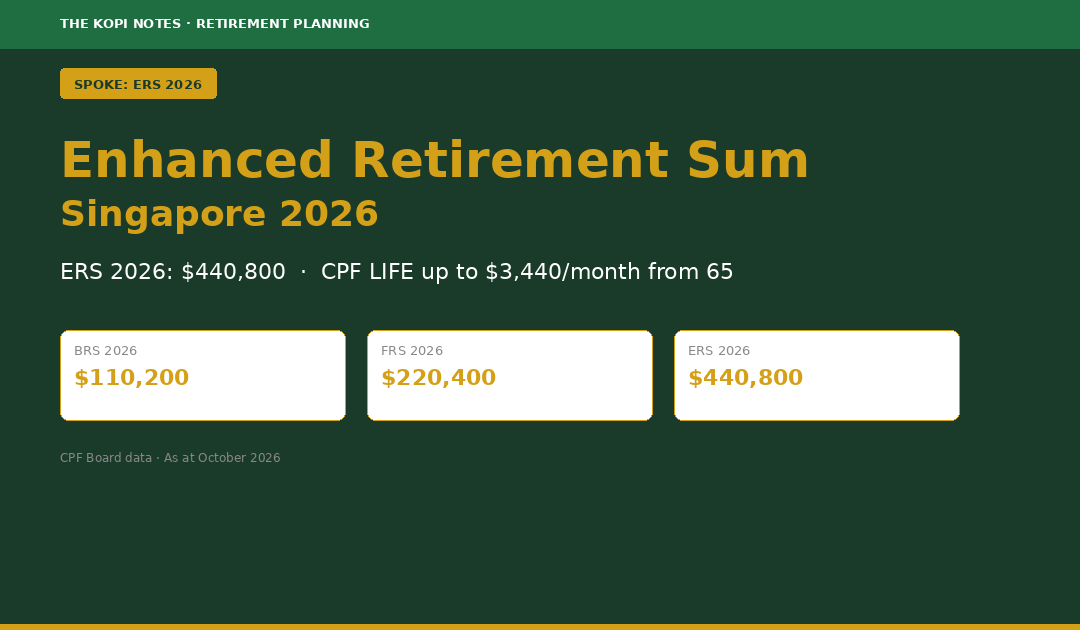
Enhanced Retirement Sum Singapore 2026: Top Up Your CPF to $440,800 for Higher Retirement Payouts
If you want the highest possible CPF LIFE monthly payout in retirement, the Enhanced Retirement Sum (ERS) is the ceiling you are topping up to. From 1 January 2026, the ERS is $440,800 — the maximum amount you can hold in your CPF Retirement Account (RA) after age 55. This spoke sits alongside our full guide to the CPF Retirement Sum, where you can read how the BRS, FRS and ERS fit together in the wider CPF picture.
TL;DR — Enhanced Retirement Sum 2026
- The ERS for 2026 is $440,800 — rising from $426,000 in 2025.
- From 2026, ERS is set at 2× the current year’s FRS ($220,400).
- Eligible: Singaporeans and PRs aged 55 and above can top up their RA to the ERS with cash or OA savings.
- At ERS, a member turning 55 in 2026 receives up to $3,440/month from age 65 on the CPF LIFE Standard Plan.
- Cash top-ups under RSTU attract up to $8,000 tax relief per year for yourself, plus another $8,000 for loved ones.
- The ERS rises every 1 January; in 2027 it will be $456,400.
Figures as at October 2026. Source: CPF Board.
What Is the Enhanced Retirement Sum?
The Enhanced Retirement Sum is the highest amount you may hold in your CPF Retirement Account once you turn 55. It is a voluntary ceiling, not a mandatory target: you are not required to reach it, but if you want the largest possible CPF LIFE monthly payout, topping up to the ERS is how you get there.
There are three retirement sum tiers in Singapore’s CPF system:
- Basic Retirement Sum (BRS): The minimum set-aside. Enough for basic living expenses, assuming you own property with a remaining lease covering you until at least 95.
- Full Retirement Sum (FRS): Double the BRS. The default amount placed in your RA when you turn 55 if you have no CPF property charge or pledge. Provides a comfortable income floor.
- Enhanced Retirement Sum (ERS): Double the FRS (= 4× BRS). The maximum you can top up to, giving the highest CPF LIFE payouts.
Before 2025, the ERS was 3× the BRS. From 1 January 2025, the government raised it to 4× the BRS, giving members the option to set aside more and receive a higher income in retirement.
BRS, FRS and ERS Amounts: 2025 to 2027
The retirement sums are indexed to inflation and rise roughly 3.5% each year. The table below shows amounts for members turning 55 in each year.
| Year Turning 55 | BRS | FRS (2× BRS) | ERS (4× BRS) |
|---|---|---|---|
| 2025 | $106,500 | $213,000 | $426,000 |
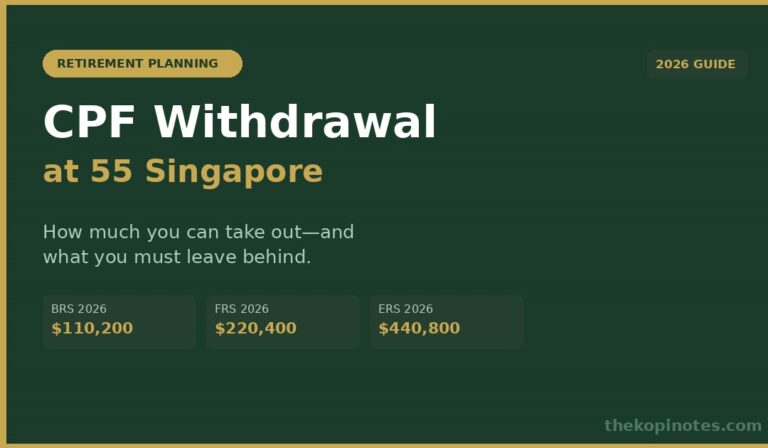
| 2026 (current) | $110,200 | $220,400 | $440,800 |
| 2027 | $114,100 | $228,200 | $456,400 |
Source: CPF Board. Figures for members turning 55 in the respective year. The ERS for top-up purposes is always the current year’s ERS, regardless of what year you turned 55.
CPF LIFE Payouts at BRS, FRS and ERS
Once you start CPF LIFE at age 65 (or defer to up to 70), your monthly payout depends on how much is in your RA. The table below uses indicative figures from CPF Board for a member turning 55 in 2026 on the Standard Plan.
| RA Balance at 55 | Monthly from Age 65 | Monthly from Age 70 (defer) |
|---|---|---|
| BRS — $110,200 | ~$950 | ~$1,280 |
| FRS — $220,400 | ~$1,780 | ~$2,380 |
| ERS — $440,800 | ~$3,440 | ~$4,580 |
CPF LIFE Standard Plan. Indicative figures for a male member; female members receive slightly lower payouts due to longer life expectancy (CPF uses unisex-adjusted tables). Payouts may be adjusted for long-term changes in interest rates or life expectancy. As at October 2026.
Deferring your CPF LIFE payout by one year beyond age 65 increases your monthly amount by roughly 6–7%. A member with ERS who defers to 70 could receive up to $4,580 per month — approaching the monthly CPF salary ceiling for a working Singaporean.
Who Can Top Up to the ERS?
You can top up your Retirement Account to the current year’s ERS if you meet these conditions:
- You are a Singapore Citizen or Permanent Resident.
- You are aged 55 or above.
- Your RA balance is below the current year’s ERS ($440,800 in 2026).
The ERS for top-up purposes is always the current calendar year’s ERS, not the ERS for the year you turned 55. If you topped up to $440,800 in 2026, you can top up a further $15,600 in 2027 (when the ERS rises to $456,400) to stay at the ceiling.
Members under 55 cannot top up their RA to the ERS — at 55 your SA is closed and the savings flow into your RA, at which point the ERS top-up option opens. See our guide to what happens to your CPF at 55 for the full picture of how your accounts change at that milestone.
How to Top Up Your RA to the ERS
You can top up using cash or CPF Ordinary Account (OA) savings. The steps are straightforward:
- Log in to my cpf online: Navigate to the Retirement Dashboard to see your current RA balance and the maximum amount you can top up to.
- Check your top-up room: Your top-up limit = ERS ($440,800) minus your current RA balance. If you already have $350,000 in your RA, you can top up $90,800 more.
- Choose your source: Cash tops up via PayNow (CPF Mobile app) or GIRO; OA transfers are initiated through my cpf online under “Top Up Retirement Savings”.
- Submit the top-up: For cash, use PayNow (reference: your NRIC) or submit a GIRO form. For OA-to-RA transfers, complete the online form under “CPF transfers”.
- Note on tax relief: Only cash top-ups (not OA transfers) qualify for the RSTU tax relief. Keep the receipt — you’ll need it when filing your income tax return.
Top-ups are generally credited within two to three business days for cash, and one to two days for OA transfers. The CPF top-up guide covers all three top-up vehicles — SA/RA, MediSave and RSTU — in more detail if you want to compare your options.
Tax Relief on ERS Top-Ups
Cash top-ups to your RA under the Retirement Sum Topping-Up Scheme (RSTU) attract personal income tax relief:
- Up to $8,000/year for cash top-ups to your own CPF accounts (SA before it closes at 55, then RA).
- Up to another $8,000/year for cash top-ups to loved ones’ CPF accounts (parents, parents-in-law, grandparents, grandparents-in-law, spouse or siblings).
Important exclusions: CPF-to-CPF transfers (OA→RA) do not qualify. Top-ups matched by the Matched Retirement Savings Scheme (MRSS) also do not qualify — if you receive MRSS matching, the $2,000 matched grant is excluded from tax relief calculations. See our MRSS guide for how that scheme works alongside ERS top-ups.
The $8,000 personal relief cap is shared with all cash top-ups to your own accounts, not just RA. Plan your top-ups early in the year to maximise the benefit — CPF pays 4% interest on RA balances, compounding monthly.
Worked Example: Mr Lim, Age 58
Scenario
- Mr Lim turned 55 in 2023. His current RA balance is $280,000.
- He has $60,000 in his OA and receives an annual cash bonus of $20,000.
- He would like to maximise his CPF LIFE payout at 65.
Step 1 — Check the 2026 ERS ceiling: $440,800. His top-up room = $440,800 − $280,000 = $160,800.
Step 2 — Transfer OA savings first (no tax relief, but frees up cash for tax-deductible top-ups): Mr Lim transfers $60,000 from his OA to his RA. RA balance rises to $340,000.
Step 3 — Cash top-up up to tax relief cap: He makes a $8,000 cash top-up (claiming the full personal RSTU relief for the year). RA balance = $348,000.
Step 4 — Repeat annually: Each year the ERS rises by ~3.5%, so more top-up room opens. Over 7 years (ages 58–65) he can close most of the gap, especially if he contributes his annual bonus to RSTU.
Estimated outcome at 65: If Mr Lim reaches $400,000 in his RA by age 65, CPF LIFE Standard Plan would pay him approximately $3,100–$3,200/month — comfortably above the FRS payout and close to the ERS ceiling.
This is a simplified illustration. Actual payouts depend on final RA balance, CPF LIFE plan chosen, and prevailing interest rates at retirement. Use the Retirement Planning Calculator to model your own numbers.
Is Topping Up to the ERS Worth It?
The ERS is not right for everyone. Here are the key trade-offs to consider:
| Reason to Top Up to ERS | Reason to Stop at FRS or Below |
|---|---|
| Guaranteed 4% p.a. interest on RA, compounding monthly | Capital is locked — you cannot withdraw RA savings above the BRS after 65 |
| CPF LIFE provides longevity insurance — payouts continue for life, however long you live | Liquidity need — if you anticipate large expenses (medical, home, education), keeping cash may be better |
| Tax relief up to $8,000/year on cash top-ups reduces your income tax bill | Leaving cash in equities or REITs may offer higher expected returns (with higher risk) |
| Reduces sequence-of-returns risk — income floor rises regardless of market conditions | Bequest motive — money left in the RA at death passes to nominees, but you cannot specify how; a will handles other assets more flexibly |
The CPF system was designed as a longevity income floor, not a total wealth solution. Most Singapore retirement planners advocate reaching the FRS as a baseline, then using additional savings for liquidity and growth. Topping up to ERS makes most sense for those who have sufficient liquid assets outside CPF, want a higher guaranteed income floor, and whose marginal tax rate makes the RSTU tax relief meaningful.
If you are calculating your retirement number, see how the CPF LIFE floor fits into the three-bucket framework in our Singapore FIRE guide.
Frequently Asked Questions
What is the Enhanced Retirement Sum in 2026?
The Enhanced Retirement Sum (ERS) for 2026 is $440,800. This is the maximum amount a CPF member aged 55 and above can hold in their Retirement Account. The ERS rises every 1 January — it will be $456,400 in 2027.
What is the difference between BRS, FRS and ERS?
All three are reference amounts for how much you set aside in your Retirement Account at 55. The BRS ($110,200 in 2026) provides the minimum income floor for those who pledge their HDB flat. The FRS ($220,400) is double the BRS and the default amount at 55. The ERS ($440,800) is double the FRS — the maximum you can voluntarily top up to for the highest CPF LIFE payouts.
Can I top up to the ERS if I turned 55 before 2026?
Yes. The ERS for top-up purposes is always the current year’s ERS, not the ERS from the year you turned 55. If you turned 55 in 2020, you can still top up your RA to $440,800 in 2026, and $456,400 in 2027, as long as your balance is below those limits.
Does topping up to the ERS qualify for tax relief?
Only cash top-ups to your RA under the Retirement Sum Topping-Up Scheme (RSTU) qualify for tax relief — up to $8,000 per year for your own account, and another $8,000 for top-ups to eligible loved ones. CPF-to-CPF transfers (e.g. OA to RA) and top-ups matched under the MRSS do not qualify.
How much CPF LIFE will I get if I top up to the ERS?
A member turning 55 in 2026 who tops up to the ERS ($440,800) can receive approximately $3,440/month from age 65 on the CPF LIFE Standard Plan, or roughly $4,580/month if they defer to 70. These are indicative figures from CPF Board and may change with long-term interest rate adjustments.
What happens to money in my RA above the FRS if I die?
RA savings above the BRS (the refundable CPF balance) are distributed to your nominees or estate after any outstanding CPF LIFE premiums are accounted for. If you have no nominees on record, the balance goes to the Public Trustee. Nominating beneficiaries through my cpf ensures the money reaches your intended recipients. CPF nominations are separate from your will.
Related Tools and Guides
- CPF Retirement Sum Singapore 2026 — Full Guide (BRS, FRS & ERS) — the pillar article this spoke links up to
- Retirement Planning Calculator — model how much you need and whether ERS top-ups close the gap
- CPF Full Retirement Sum (FRS) 2026 Glossary
- CPF LIFE Plans Explained — compare Standard, Basic and Escalating plans
- Matched Retirement Savings Scheme 2026 — free government top-up for eligible seniors
- CPF Ordinary Account Guide — understand OA-to-RA transfers and how to optimise your CPF accounts
Disclaimer: This article is for informational purposes only and does not constitute financial, tax or legal advice. CPF figures are sourced from CPF Board as at October 2026; verify current amounts at cpf.gov.sg before making any decisions. Individual CPF LIFE payouts depend on your exact RA balance, chosen plan, age at payout commencement, and any adjustments CPF Board makes over time. Please consult a licensed financial adviser for advice tailored to your personal circumstances. The Enhanced Retirement Sum is a voluntary option — whether it suits your retirement plan depends on your liquidity needs, investment goals and overall financial position.
This article was researched with the help of AI. While we strive to keep all information accurate and up to date, there may be errors. If you notice any discrepancies, please contact us.