Medisave Limit 2026: How New ISP Rider Co-Payment Rules Change Your Hospital Bill
The April 2026 ISP rider changes mean deductibles are now uncoverable by new riders — here is what that means for your Medisave balance and what you pay out of pocket.
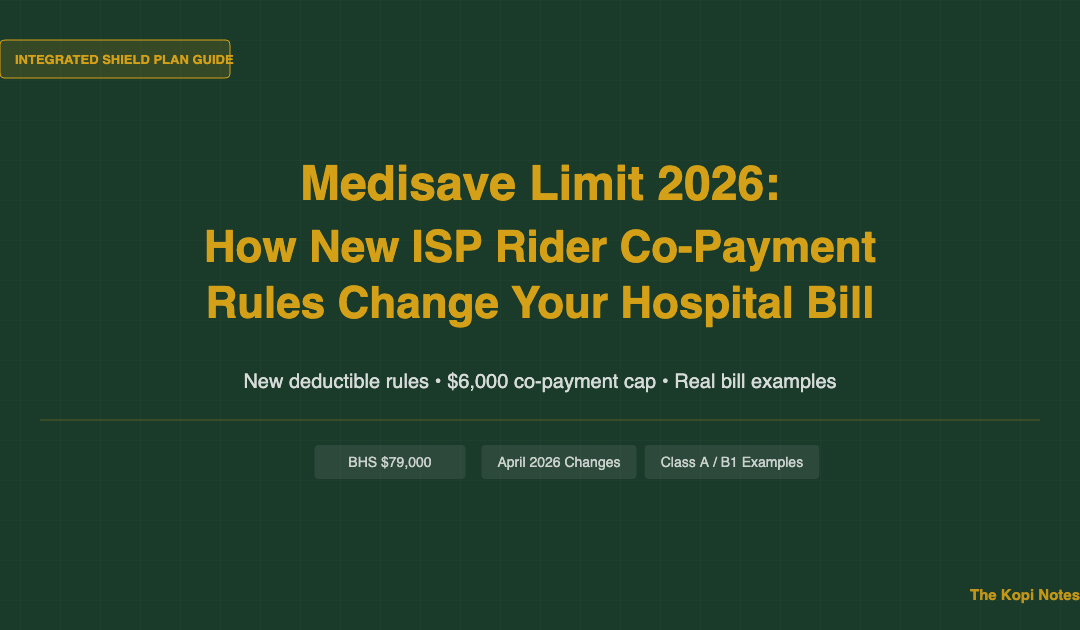
Singapore’s Medisave limit in 2026 is governed by the Basic Healthcare Sum (BHS) of $79,000. From 1 April 2026, new Integrated Shield Plan (ISP) riders can no longer cover the MOH minimum deductible — ranging from $1,500 for Class C to $3,500 for Class A/Private wards. The annual co-payment cap has also risen from $3,000 to $6,000. This guide shows exactly how these changes affect your hospital bill and how much Medisave covers.
Not financial advice. All figures are for educational reference only. Data verified as at 20 October 2026 unless noted.
Table of Contents
Contents — Click to expand
- What Changed with ISP Riders from 1 April 2026?
- Your Medisave Limit in 2026: Key Figures
- ISP Minimum Deductibles by Ward Class
- How Your Hospital Bill Flows Under the New Rules
- Real Bill Examples: Class A vs Class B1
- The New $6,000 Co-Payment Cap: What It Means for You
- Should You Keep Your Old Rider or Switch?
- Frequently Asked Questions
What Changed with ISP Riders from 1 April 2026?
For years, many Singaporeans with Integrated Shield Plan riders enjoyed near-total coverage on their hospital bills — some riders would absorb even the deductible, leaving patients with very little to pay. The Ministry of Health (MOH) changed this with new rules that took effect on 1 April 2026 for all newly sold riders.
Two changes matter most for how you use your Medisave limit in 2026:
1. New riders can no longer cover the minimum IP deductible. Before this change, some riders would pay the entire deductible on your behalf. From 1 April 2026, new IP riders sold are prohibited from covering the MOH minimum deductible. You pay the deductible first — and while you can use Medisave for this, it eats directly into your Medisave balance. According to MOH’s announcement, the deductible ranges from $1,500 to $3,500 depending on your ward class.
2. The annual co-payment cap has risen from $3,000 to $6,000 (minimum). After paying your deductible, your rider covers the remaining insured bill — but you still pay a minimum 5% co-payment on each claim. Under the old framework, total annual co-payments were capped at $3,000. The new minimum cap is $6,000. This means your potential out-of-pocket from co-payments alone can now double compared to older riders. For a deep dive into the detailed co-payment mechanics, see our guide on the new ISP rider co-payment breakdown.
Important: These rules apply to new riders sold from 1 April 2026. If you bought your ISP rider before 27 November 2025, your existing rider continues under its original terms until your insurer reprices or you switch plans. New rider premiums, however, are expected to be about 30% lower on average — a meaningful offset.
Your Medisave Limit in 2026: Key Figures
Understanding your Medisave limit in 2026 starts with knowing the two governing figures: the Basic Healthcare Sum (BHS) — the maximum amount you can hold in Medisave — and the withdrawal limits that apply when you use it for hospitalisation.
The BHS for 2026 is $79,000, confirmed by the CPF Board. This is the cap on how much your Medisave account can hold if you are below age 65. Any contributions above the BHS flow automatically into your Special Account or Retirement Account.
| Medisave Figure | Amount (2026) | Notes |
|---|---|---|
| Basic Healthcare Sum (BHS) | $79,000 | Max savings cap for members below age 65 |
| Daily hospital limit (Days 1–2) | $1,130/day | Applies to approved hospitals, any ward class |
| Daily hospital limit (Day 3+) | $400/day | Applies from the third day of admission onward |
| ISP premium AWL (Age 1–40) | $300/year | Additional Withdrawal Limit for ISP base premiums |
| ISP premium AWL (Age 41–70) | $600/year | Above this, the ISP base premium must be paid in cash |
| ISP premium AWL (Age 71+) | $900/year | Rider premiums cannot be paid with Medisave |
Source: CPF Board official tables; MOH ISP framework, as at October 2026
The daily withdrawal limits are particularly relevant now, because the deductible and co-payment that were previously absorbed by your rider must now come from your pocket — and Medisave is the first line of defence. For more on how the deductible specifically affects your Medisave balance, see our article on Medisave limit 2026 and your ISP deductible.
ISP Minimum Deductibles by Ward Class
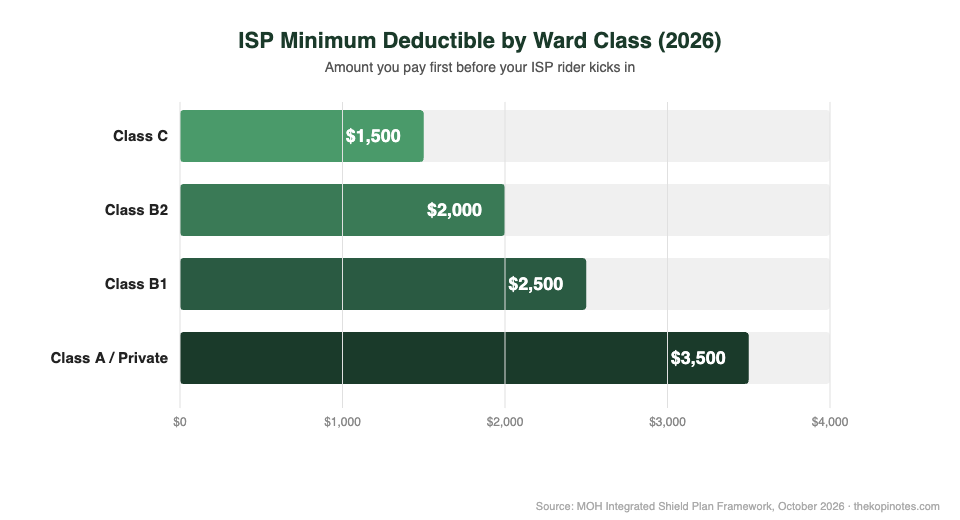
The deductible is the first amount you pay out of your own pocket (or Medisave) before your ISP begins covering the rest of the bill. Under the new April 2026 rules, no new rider can pay this amount for you. The deductible applies per policy year and is the lower of the ward class your plan covers and the ward class you actually use.
| Ward Class | Minimum ISP Deductible (2026) | Impact on Medisave |
|---|---|---|
| Class A / Private Hospital | $3,500 | Highest deductible; uses about 3 days of Medisave daily limits |
| Class B1 | $2,500 | Moderate; can largely be covered by Medisave for a short stay |
| Class B2 | $2,000 | MediShield Life covers more at B2; smaller Medisave draw |
| Class C | $1,500 | Lowest deductible; government subsidies apply most here |
Source: MOH Integrated Shield Plan framework, Annex A, as at November 2025 / October 2026
You can pay the deductible from Medisave — it is considered part of your hospitalisation expenses — subject to the daily limits in the table above. For a 3-day Class A admission, your Medisave daily limit is $1,130 + $1,130 + $400 = $2,660. This partially covers the $3,500 deductible, leaving approximately $840 to pay in cash unless a surgical procedure adds further Medisave-claimable amounts.
How Your Hospital Bill Flows Under the New Rules
Understanding your bill flow under the new ISP rider rules helps you plan your Medisave usage. Here is the step-by-step sequence for a private hospital admission with a new 2026-compliant ISP rider:
- Total bill is calculated by the hospital after discharge (or as an estimated bill).
- MediShield Life pays its share — this covers a portion based on MOH’s published claim tables for each ward class and procedure. MediShield Life claim limits are lower for private hospitals than for restructured hospitals.
- You pay the ISP deductible ($1,500–$3,500 depending on ward class). Under the new rules, your rider cannot cover this. You use Medisave first, then cash if Medisave’s daily limit is insufficient.
- Your ISP rider covers the remaining insured bill — after the deductible and MediShield Life payout, your rider pays 95% of the remaining eligible amount (the 5% is your co-payment).
- You pay the 5% co-payment on each claim, up to the annual cap of $6,000 (minimum under the new framework). This can also be paid using Medisave within daily withdrawal limits.
- Any bill excess over your ISP’s limits (e.g. non-panel doctor charges, cosmetic procedures, or charges above your plan’s ward class) is your responsibility in full.
The key shift: before April 2026, many policyholders paid only the 5% co-payment (sometimes capped at a small dollar amount), with the rider absorbing the deductible. Today, the deductible is a separate, guaranteed out-of-pocket cost — though Medisave partially cushions the impact. The ISP rider real cost in Singapore guide breaks down the total annual spend across premiums, deductibles, and co-payments.
Real Bill Examples: Class A vs Class B1
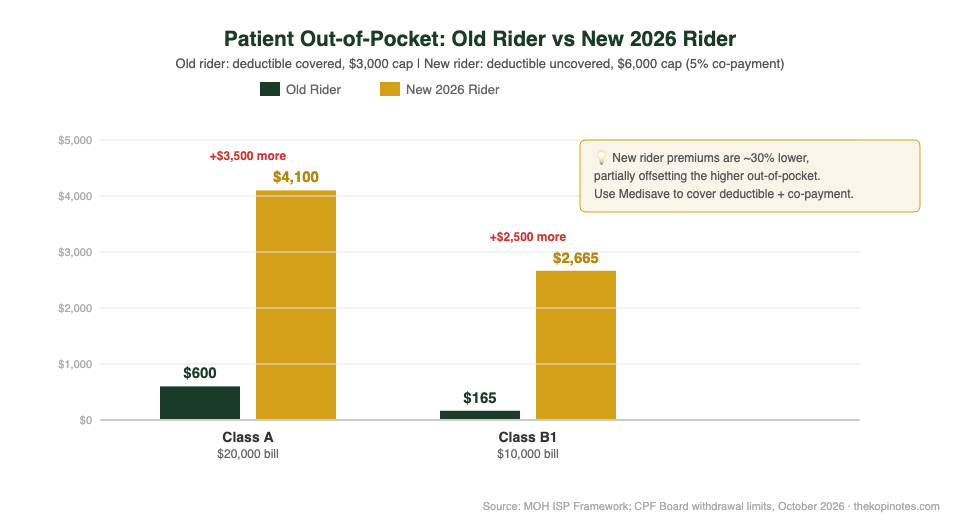
To see the concrete impact on your Medisave limit 2026, consider two common hospitalisation scenarios. Both assume a new 2026-compliant ISP rider with 5% co-payment and a $6,000 annual cap.
Example 1: Class A Ward (Private Hospital) — 5-Day Admission, No Surgery, Total Bill $20,000
| Bill Component | Amount | Paid By |
|---|---|---|
| Total hospital bill | $20,000 | — |
| MediShield Life payout | $4,500 | MediShield Life |
| ISP deductible (Class A) | $3,500 | Medisave (up to daily limits) + Cash |
| ISP rider covers (95% of $12,000) | $11,400 | ISP rider |
| 5% co-payment (on $12,000) | $600 | Medisave + Cash |
| Total patient out-of-pocket | $4,100 | Medisave: ~$3,460 | Cash: ~$640 |
Medisave daily limits for 5 days: $1,130 + $1,130 + $400 + $400 + $400 = $3,460. Figures are illustrative and based on published CPF and MOH tables as at October 2026.
Example 2: Class B1 Ward (Restructured Hospital) — 3-Day Admission, No Surgery, Total Bill $10,000
| Bill Component | Amount | Paid By |
|---|---|---|
| Total hospital bill | $10,000 | — |
| MediShield Life payout | $4,200 | MediShield Life |
| ISP deductible (Class B1) | $2,500 | Medisave (up to daily limits) + Cash |
| ISP rider covers (95% of $3,300) | $3,135 | ISP rider |
| 5% co-payment (on $3,300) | $165 | Medisave + Cash |
| Total patient out-of-pocket | $2,665 | Medisave: ~$2,660 | Cash: ~$5 |
Medisave daily limits for 3 days: $1,130 + $1,130 + $400 = $2,660. Figures are illustrative and based on published CPF and MOH tables as at October 2026.
Notice how the B1 example results in near-zero cash payment, as Medisave’s 3-day limits almost exactly cover the deductible and co-payment combined. Class A admissions require more cash top-up, especially for longer stays where the daily Medisave limit drops to $400 from day 3. For a similar analysis on how MediSave for hospitalisation in Singapore works across different scenarios, our step-by-step guide covers each claim type.
The New $6,000 Co-Payment Cap: What It Means for Your Medisave
The annual co-payment cap governs the maximum you pay in co-payments across all ISP claims in a single policy year. Under old riders, this cap was $3,000. Under the new framework, the minimum allowed cap is $6,000 — insurers may set it even higher.
For most hospitalisation episodes, the 5% co-payment on a single claim will be well below $6,000. The cap matters most for:
- Multiple hospitalisations in a year — if you are admitted two or three times, your co-payments accumulate. With the old $3,000 cap, you hit the ceiling faster; with the new $6,000 cap, you may keep paying 5% through more admissions before the cap protects you.
- High-cost single admissions — a lengthy stay or complex procedure with a large insured bill can produce a 5% co-payment that approaches the cap quickly.
- Medisave planning — since Medisave can cover co-payments within daily limits, a higher cap means a greater potential draw on your Medisave balance across the year.
For those managing multiple hospitalisations, our dedicated guide on Medisave limit 2026 and multiple hospitalisations explains how to sequence Medisave claims across admissions to minimise cash outflow.
Should You Keep Your Old Rider or Switch?
This is one of the most common questions since the April 2026 changes. Here is a structured way to think through it:
Keep your old rider if:
- Your existing rider’s premium is already budgeted and your insurer has not repriced it significantly.
- You or a family member have a pre-existing condition or are of higher age — the old rider’s deductible coverage becomes more valuable when you expect frequent hospitalisations.
- Your Medisave balance is low and you cannot afford to fund the deductible from Medisave without depleting it.
Consider switching to a new 2026-compliant rider if:
- You are young, healthy, and rarely hospitalised — the 30% lower premium outweighs the occasional deductible cost.
- Your Medisave balance is strong (close to the $79,000 BHS) and you can comfortably absorb the deductible from Medisave.
- Your existing insurer has repriced your old rider significantly — making the premium differential between old and new much smaller.
The ISP base premium increases in 2026 guide has the latest data on how much each insurer has raised premiums, which directly influences this calculation. If you are considering a plan change altogether, our article on switching your integrated shield plan walks through the process and what to check before you make the move.
This analysis is for educational purposes only. Individual circumstances vary — consult a licensed financial adviser before making changes to your health insurance coverage.
Frequently Asked Questions
What is the Medisave limit in 2026?
The Medisave limit in 2026 is set by the Basic Healthcare Sum (BHS) of $79,000. This is the maximum amount you can hold in your Medisave account if you are below age 65. It is adjusted annually by the CPF Board. For hospitalisation, the relevant limits are the daily withdrawal amounts: $1,130 per day for the first two days of each admission, and $400 per day from day three onwards.
Can I use Medisave to pay my ISP deductible under the new 2026 rules?
Yes. Even though your new ISP rider can no longer cover the deductible, you can still pay it using your Medisave balance — subject to the daily withdrawal limits ($1,130/day for days 1–2, $400/day from day 3 onward). For a 3-night Class A admission, your Medisave daily limits total $2,660, which partially covers the $3,500 Class A deductible. Any shortfall must be paid in cash.
What is the co-payment cap for new ISP riders in 2026?
The minimum annual co-payment cap for new ISP riders sold from 1 April 2026 is $6,000 per policy year. This is double the previous minimum of $3,000. The cap applies to your 5% co-payment only — it excludes the minimum IP deductible. Individual insurers may set the cap higher than $6,000. Once you reach the annual cap, further claims in that policy year are fully covered by your rider (above the deductible).
Does the new ISP rider co-payment rule affect existing policyholders?
No — if you bought your ISP rider before 27 November 2025, your existing rider continues under its original terms. The new rules apply only to riders newly sold on or after 1 April 2026. However, if your insurer reprices your existing rider significantly or if you choose to switch plans, any new rider you purchase will be subject to the 2026 framework. Check your policy documents or contact your insurer to confirm the terms of your current rider.
How much will the new ISP rider co-payment cost me compared to the old rider?
For a single typical admission, the 5% co-payment difference is modest — in Example 1 above ($20,000 Class A bill), the co-payment is just $600. The bigger change is the deductible: where your old rider might have covered the full $3,500, you now pay this yourself (from Medisave or cash). However, new rider premiums are expected to be approximately 30% lower than old riders, which may offset the additional deductible costs — especially if you are rarely hospitalised.
Is it better to stay in a lower ward class to reduce my deductible?
Choosing a lower ward class does reduce your deductible: Class C carries only a $1,500 deductible versus $3,500 for Class A. However, this must be weighed against the overall bill and the quality of care considerations. Also note that your deductible is the lower of your plan’s ward class or the ward class you actually use — so if you have a Class A plan but are admitted to a B1 ward, your deductible is $2,500. Downgrading your ISP to a lower ward class plan may lower both your premium and your deductible, but reduces your future flexibility.
Understanding Your ISP and Medisave Coverage
Stay informed about Singapore’s healthcare financing rules — the right ISP and Medisave strategy can save you thousands when you are hospitalised.
Get Free Insurance Advice
Speak with a licensed insurance advisor. No obligation, no cost.
By submitting this form, you agree to our Privacy Policy.
This article was researched with the help of AI. While we strive to keep all information accurate and up to date, there may be errors. If you notice any discrepancies, please contact us.