CPF Shield Plan Singapore 2026: MediShield Life & ISPs Explained
Your complete guide to Singapore’s two-tier healthcare insurance system — premiums by age, coverage limits, and how to decide if an Integrated Shield Plan is worth it.
The CPF shield plan refers to MediShield Life — Singapore’s mandatory basic hospitalisation insurance administered by the CPF Board. Every Singaporean and Permanent Resident is automatically enrolled. It covers Class B2 and C wards at restructured hospitals, with an annual claim limit of S$200,000 (from June 2026) and premiums ranging from S$200 to S$2,826 per year depending on your age. Most people top this up with an Integrated Shield Plan (ISP) from a private insurer.
Not financial advice. All figures are for educational reference only. Data verified as at 11 September 2026. MediShield Life premium table: MOH, effective 1 April 2025.
- MediShield Life is your CPF’s built-in shield plan — mandatory, covers B2/C wards, premiums paid from MediSave
- Integrated Shield Plans (ISPs) are private top-ups that extend coverage to B1, A, or private wards
- From April 2026, ISP riders changed — you now pay a deductible out of pocket, but rider premiums dropped ~30%
Table of Contents
What Is the CPF Shield Plan?
When Singaporeans say “CPF shield plan,” they’re almost always referring to MediShield Life — the national hospitalisation insurance scheme run by the CPF Board. It launched in November 2015, replacing the older MediShield scheme, and unlike its predecessor it covers you for life with no upper age limit.
Every Singapore Citizen and Permanent Resident is enrolled automatically at birth (or upon obtaining PR status). You can’t opt out. Your annual premiums are deducted directly from your MediSave account, so there’s no cash outlay unless your MediSave balance runs low.
MediShield Life is designed as a baseline. It covers subsidised B2 and C ward hospitalisation at restructured hospitals. For most planned, non-emergency stays, that’s adequate. But if you want access to B1 or A ward — or a private hospital — you’ll need a private Integrated Shield Plan (ISP) on top.
For a full breakdown of what the scheme covers, see our guide on what is MediShield Life Singapore.
MediShield Life Premium Table 2026
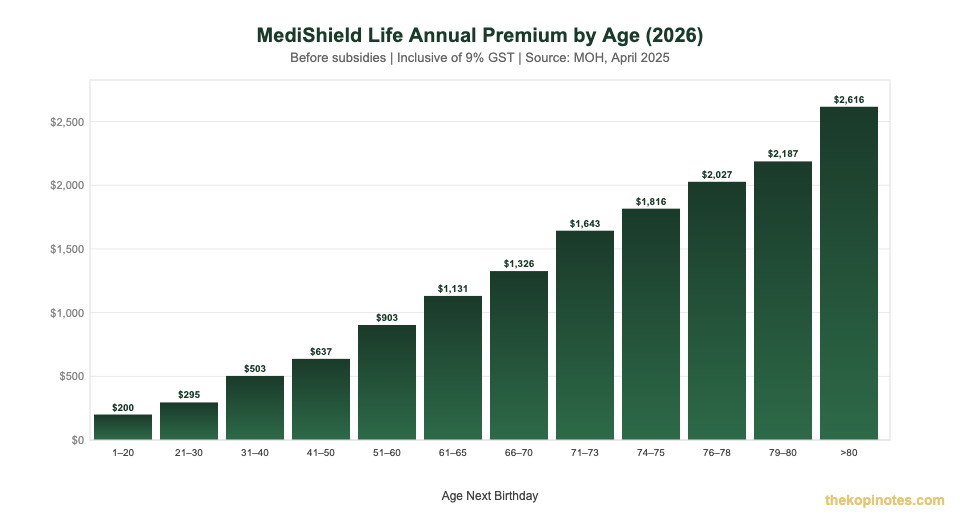
Premiums are set by MOH and updated periodically. The current schedule has been in effect since 1 April 2025, with a phased increase of up to 35% spread over three years (April 2025 to March 2028). All figures below are inclusive of 9% GST and before any subsidies.
| Age Next Birthday | Annual Premium (Before Subsidies) |
|---|---|
| 1 – 20 | S$200 |
| 21 – 30 | S$295 |
| 31 – 40 | S$503 |
| 41 – 50 | S$637 |
| 51 – 60 | S$903 |
| 61 – 65 | S$1,131 |
| 66 – 70 | S$1,326 |
| 71 – 73 | S$1,643 |
| 74 – 75 | S$1,816 |
| 76 – 78 | S$2,027 |
| 79 – 80 | S$2,187 |
| 81 – 85 | S$2,303 – S$2,616 |
| 86 – 90 | S$2,785 |
| Above 90 | S$2,826 |
Source: MOH Premium and Subsidy Tables, effective 1 April 2025. Inclusive of 9% GST.
Lower- and middle-income households (annual value of residence S$31,000 or below) can receive premium subsidies of 15–60% depending on household monthly income per person and age. Pioneer Generation and Merdeka Generation Singaporeans also receive additional subsidies.
The chart below shows how premiums scale with age — a key reason why buying a CPF shield plan (or ISP) when you’re young is so important.
What MediShield Life Covers
MediShield Life is a claimable insurance — you pay first, then claim. It doesn’t cover everything, and there are two key cost-sharing elements you need to understand.
Deductible — the amount you pay first before MediShield Life kicks in. As at 2026, the deductible is S$1,500 for Class C wards and S$2,000 for Class B2 and above, for those aged 80 and below. You pay this out of pocket (or from MediSave).
Co-insurance — after the deductible, you still share some of the cost. The co-insurance rate is tiered: roughly 10% on the first portion of the bill, dropping to 3% on larger bills. For most hospital stays, your total out-of-pocket share ends up being manageable — but can still be thousands of dollars for a serious illness.
The annual claim limit is S$200,000 per year (from 1 June 2026), with no lifetime cap. This is a significant improvement from the previous cap of S$150,000 and reflects MOH’s 2025 enhancements to the scheme.
To see the full benefits breakdown including outpatient coverage, read our article on MediShield Life benefits.
ISPs: The Private Top-Up Layer
An Integrated Shield Plan is a private health insurance plan that wraps around MediShield Life. It’s “integrated” because the MediShield Life component is embedded inside — the insurer pays MOH your MediShield Life premium, and you just pay the insurer one single combined premium.
ISPs let you choose a higher ward class. If you want to be hospitalised in a B1, A, or private ward — and have the insurer pay most of the bill — you need an ISP. Without one, you’d be covered at B2/C rates only, and the gap between that and, say, a private hospital bill can easily run into tens of thousands of dollars.
To compare all five ISPs side by side, see our best integrated shield plan Singapore guide.
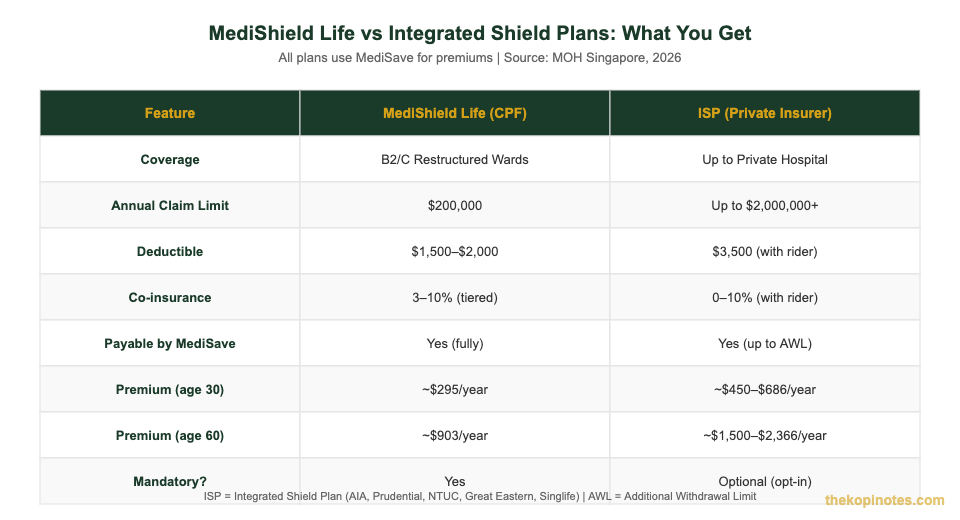
The comparison table below shows how MediShield Life and ISPs differ:
How MediSave Pays for ISP Premiums
You can use your MediSave to pay for ISP premiums — but only up to a limit set by MOH, called the Additional Withdrawal Limit (AWL). The AWL varies by age: younger policyholders have lower limits because their ISP premiums are naturally lower anyway.
| Age Next Birthday | MediSave AWL for ISP (per year) |
|---|---|
| 1 – 40 | S$300 |
| 41 – 70 | S$600 |
| 71 – 73 | S$900 |
| 74 – 75 | S$1,100 |
| 76 – 80 | S$1,190 |
| 81 and above | S$1,530 |
Source: CPF Board. The MediShield Life base premium is NOT counted towards this AWL — it’s a separate deduction from MediSave.
In practice, for most working-age Singaporeans (41–70), you can cover S$600 of your ISP premium with MediSave. If your ISP premium exceeds that, you pay the difference in cash. For young adults (under 40) with lower ISP premiums, the S$300 AWL often covers most or all of the ISP cost.
For more detail on MediSave withdrawal limits, see our guide on the MediSave withdrawal limit guide.
April 2026 Rider Changes Explained
MOH introduced major changes to ISP riders from 1 April 2026. These are the most significant reforms since the 2018 co-payment rider rules. Here’s what changed:
Before April 2026: You could buy a rider that fully covered your deductible. That meant zero out-of-pocket costs even for a major hospitalisation. The downside — it reduced your incentive to choose cost-appropriate care, pushing up healthcare costs overall.
From April 2026: New riders (the “Care Series” from each insurer) no longer cover the deductible. You must pay the deductible (S$1,500–S$3,500 depending on ward class) yourself. However, there’s a stop-loss cap of S$3,000 per policy year on your total out-of-pocket costs, and rider premiums dropped by an average of 30%.
In short: you bear more risk upfront, but your total exposure is capped and your premiums are lower. For most healthy policyholders who rarely hospitalise, this is a net positive. For those with frequent hospital stays, the maths is tighter.
The integrated shield plan premium by age guide has full premium tables for each insurer post-April 2026.
Which Insurers Offer ISPs in Singapore?
There are exactly five insurers approved by MOH to offer Integrated Shield Plans:
- AIA — AIA HealthShield Gold Max (Plans A, B, B Lite, Standard)
- Prudential — PRUShield (Standard, Plus, Premier)
- NTUC Income — Enhanced IncomeShield (Basic, Advantage, Preferred)
- Great Eastern — GREAT SupremeHealth (B Plus, A Plus, P Plus)
- Singlife — Shield Plan (1, 2, Standard)
All five plans cover Singapore Citizens and PRs. Foreigners on some visa types may qualify for ISPs, but MediShield Life itself does not cover non-residents. For a full review of AIA’s offering, see our AIA HealthShield Gold Max Singapore guide.
Do You Need an ISP on Top of MediShield Life?
MediShield Life alone is sufficient if you’re comfortable being treated in a B2 or C ward at a restructured hospital. Many Singaporeans with subsidy eligibility find this perfectly adequate — the care quality at restructured hospitals is high regardless of ward class.
You should consider an ISP if:
- You want access to a B1 or A ward (single or twin-sharing room)
- You prefer a private hospital or specialist of your choice
- You have family dependants and want comprehensive coverage as a household
- You’re younger and healthy — ISP premiums are much cheaper at younger ages
You can probably skip an ISP if you’re comfortable with B2/C wards, your MediSave is healthy, and the out-of-pocket deductible (S$2,000) plus co-insurance isn’t a financial hardship.
One practical tip: buy an ISP while you’re young and healthy. Insurers can apply exclusions for pre-existing conditions when you first apply. If you wait until you’re 50 with a chronic illness, you may find certain conditions excluded from your ISP coverage — or face higher loading premiums.
Data verified as at 11 September 2026. MediShield Life premiums from MOH effective April 2025. ISP rider changes effective April 2026.
Frequently Asked Questions
What is the CPF shield plan in Singapore?
What is the difference between MediShield Life and an Integrated Shield Plan?
Can I use MediSave to pay for my ISP premium?
What changed about ISP riders in April 2026?
What is the annual claim limit for MediShield Life in 2026?
Do I need an ISP if I already have MediShield Life?
Get Free Insurance Advice
Speak with a licensed insurance advisor. No obligation, no cost.
By submitting this form, you agree to our Privacy Policy.
This article was researched with the help of AI. While we strive to keep all information accurate and up to date, there may be errors. If you notice any discrepancies, please contact us.